



Introduction
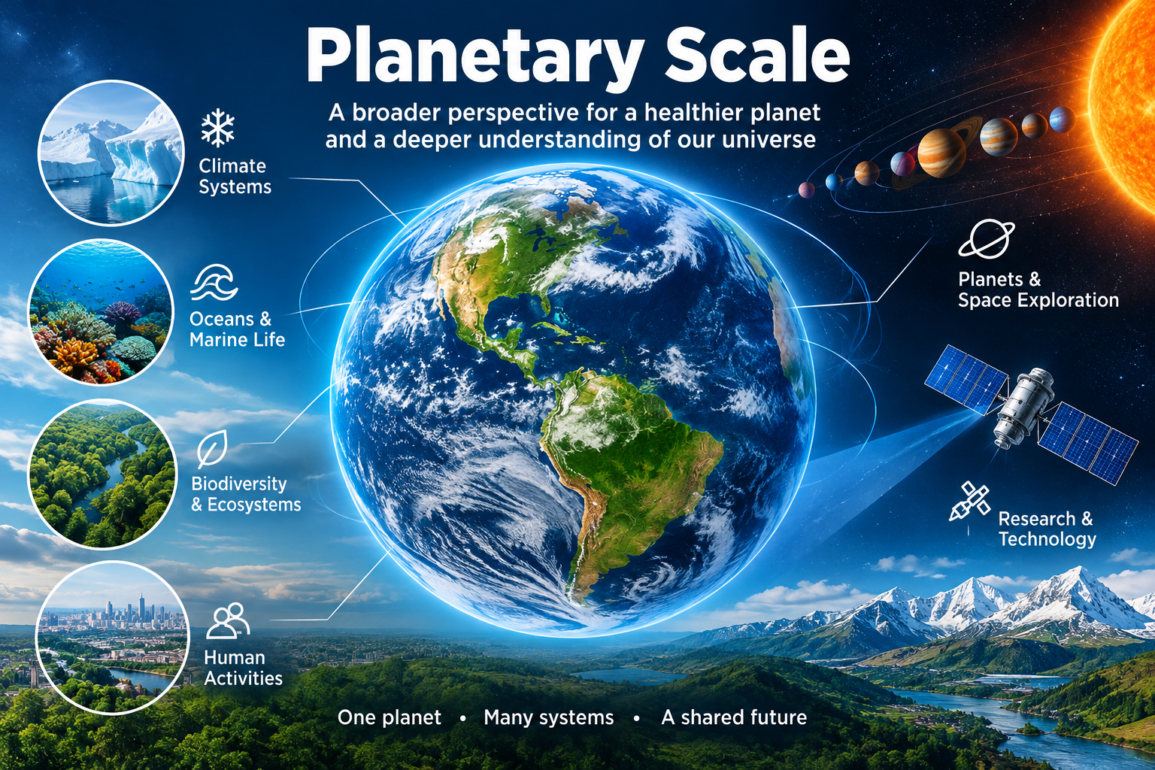
The universe operates on a scale that is difficult for the human mind to imagine. From tiny particles and individual organisms to enormous planets, stars, and galaxies, everything exists within a vast system of physical relationships. The planetary scale helps scientists, researchers, and environmental experts understand processes that affect entire planets rather than isolated locations. It provides a broader perspective on climate change, natural resources, planetary motion, ecosystems, and the development of life.
Understanding the planetary scale is increasingly important as humanity faces global environmental challenges, explores other worlds, and develops technologies capable of observing Earth from space. By studying events at this level, researchers can identify patterns that remain hidden when they examine only individual regions. This perspective also helps explain how local activities influence global systems and how changes on one planet can affect its long-term future.
What Does Planetary Scale Mean?
The planetary scale refers to processes, measurements, events, and systems considered across an entire planet or at a scale comparable to planetary dimensions. It can describe physical structures, environmental changes, scientific observations, and large-scale human activities.
For example, measuring rainfall in one town represents a local observation. Studying rainfall patterns across an entire continent involves a regional perspective.
The meaning can vary depending on the subject. In astronomy, researchers use this perspective to compare planets and investigate their physical properties. In environmental science, it helps explain interactions between the atmosphere, oceans, land, and living organisms. In technology and engineering, it can describe systems designed to operate across enormous geographical areas.
Although these applications differ, they share a common principle: examining a system as a connected whole rather than treating each part independently.
Why Is the Planetary Scale Important?
Understanding Earth’s Connected Systems
Earth contains many interconnected systems, including the atmosphere, hydrosphere, geosphere, and biosphere. These systems continuously exchange energy and materials. Changes in one component can influence several others.
For instance, increasing global temperatures can accelerate ice loss, raise sea levels, and alter ocean circulation. Changes in ocean temperatures can affect weather patterns and marine ecosystems. These relationships become easier to understand when scientists examine the planetary scale instead of focusing exclusively on one location.
This broader approach allows researchers to identify connections between environmental observations and develop explanations for complex natural events.
Improving Scientific Research
Scientific research often begins with measurements collected from specific locations. Researchers then combine these observations with satellite imagery, computer models, laboratory experiments, and historical records.
Using the planetary scale allows scientists to compare information from different parts of the world and determine whether a particular pattern is widespread or limited to a specific region. This distinction is essential when evaluating climate trends, monitoring environmental conditions, and investigating changes in planetary systems.
It also encourages collaboration between researchers working in different scientific disciplines.
Supporting Long-Term Planning
Governments, businesses, and international organisations increasingly depend on large-scale scientific information to make informed decisions. Water management, food production, disaster preparedness, and energy planning can all benefit from a broader understanding of environmental systems.
A planetary perspective helps decision-makers consider how present activities might affect future generations. It also highlights the importance of cooperation when environmental challenges extend beyond national borders.
Planetary Scale in Environmental Science
Environmental science is one of the most important fields in which the planetary scale plays a central role. Many environmental problems develop through interactions among natural systems and human activities.
Climate Change and Global Temperatures
Climate change illustrates why scientists need to examine the planet as a connected system. Greenhouse gases released through fossil fuel combustion, deforestation, agriculture, and industrial activities influence Earth’s energy balance.
Although the effects vary by location, the accumulation of greenhouse gases affects the global atmosphere. Scientists therefore combine temperature records, ocean measurements, ice observations, and atmospheric data to evaluate long-term changes.
The planetary scale helps researchers distinguish between short-term weather fluctuations and persistent climate trends. It also supports the development of climate models that estimate possible future conditions under different emissions scenarios.
Oceans and Marine Ecosystems
Earth’s oceans cover approximately 71% of its surface and play a major role in regulating the climate. They absorb substantial amounts of heat and carbon dioxide, influence weather systems, and support diverse marine organisms.
Studying ocean conditions at the planetary scale helps scientists track warming waters, changing currents, rising sea levels, and ocean acidification. These processes can affect fisheries, coastal communities, coral reefs, and marine biodiversity.
Observations from ships, buoys, underwater instruments, and satellites provide complementary information about these interconnected systems.
Biodiversity and Ecosystem Protection
Biodiversity supports food production, nutrient cycling, pollination, and the stability of natural environments. However, habitat destruction, pollution, invasive species, and climate change threaten many ecosystems.
A planetary perspective helps conservationists compare biodiversity patterns across continents and identify areas where species face significant risks. It also reveals how habitat fragmentation and changes in land use can influence ecological connections over large distances.
Planetary Scale in Astronomy and Space Exploration
Astronomy provides another important application of this concept. Scientists study planets to understand their formation, composition, atmospheres, and potential to support life.
Comparing Planets in the Solar System
The planets in our solar system differ greatly in size, temperature, composition, and atmospheric conditions. Mercury has an extremely thin atmosphere, Venus has a dense carbon dioxide atmosphere, and Mars has a much thinner atmosphere than Earth.
Jupiter and Saturn are gas giants, while Uranus and Neptune are commonly classified as ice giants. Comparing these worlds helps scientists investigate why planets develop different characteristics despite forming within the same solar system.
The planetary scale allows researchers to examine features such as planetary diameter, gravity, orbital motion, internal structure, and atmospheric circulation.
Searching for Habitable Worlds
Scientists also investigate planets orbiting stars beyond our solar system. These objects, known as exoplanets, offer opportunities to study how planetary systems form and evolve.
Researchers examine an exoplanet’s size, orbital distance, estimated temperature, and atmospheric composition to assess whether it might possess conditions suitable for life. However, being located within a star’s habitable zone does not automatically mean that a planet supports life.
The planetary scale provides a useful framework for comparing these worlds with Earth while recognising the limits of current observations.
Understanding Planetary Formation
Planets form through complex processes involving dust, gas, gravity, collisions, and the accumulation of material around young stars. Over millions of years, these processes can produce worlds with different structures and compositions.
By studying meteorites, planetary surfaces, spacecraft measurements, and astronomical observations, researchers develop models explaining how planets emerge and change over time.
This knowledge helps scientists understand Earth’s history and the broader processes that shape planetary systems throughout the universe.
How Scientists Measure Planetary-Scale Changes
Scientists cannot observe every part of a planet directly at all times. Instead, they combine several measurement techniques to develop reliable representations of large-scale systems.
Satellite Observations
Satellites provide extensive information about Earth’s surface, atmosphere, oceans, vegetation, and ice cover. Instruments can measure surface temperatures, detect changes in land use, monitor clouds, and estimate atmospheric conditions.
Repeated observations allow researchers to compare measurements over time and identify trends that may not be visible through ground-based monitoring alone.
Satellite data also support weather forecasting, agricultural planning, wildfire monitoring, and disaster response.
Computer Models and Simulations
Computer models help researchers understand processes that involve many interacting variables. Climate models, for example, simulate relationships between atmospheric circulation, ocean currents, land surfaces, and energy transfer.
Scientists test these models against observations and examine different scenarios to estimate potential future outcomes. Models cannot predict every event with perfect accuracy, but they provide valuable insights into possible changes and associated uncertainties.
At the planetary scale, simulations are especially useful because many important processes operate across enormous distances and long periods.
International Data Sharing
No single research institution can independently collect every measurement needed to understand Earth or other planets. Scientists therefore share observations, methods, and research findings across countries and organisations.
International cooperation improves the quality of scientific analysis and helps researchers compare measurements collected using different instruments. Shared information is particularly important for tracking climate change, monitoring natural hazards, and coordinating space exploration.
Planetary Scale and Human Activities
Human activities increasingly influence environmental processes that extend across the globe. Industrial production, transportation, agriculture, energy consumption, and urban development affect the movement of materials and energy through Earth’s systems.
For example, carbon dioxide released in one country contributes to the concentration of greenhouse gases throughout the atmosphere. Plastic waste can travel through rivers and ocean currents, while airborne pollutants can cross national boundaries.
Examining these issues at the planetary scale helps researchers understand why solutions sometimes require international agreements alongside local policies.
Renewable energy, efficient transportation, sustainable agriculture, responsible resource management, and forest conservation can contribute to reducing environmental pressures. However, their effectiveness depends on implementation, regional conditions, and long-term commitment.
A broader perspective also encourages individuals and organisations to recognise that environmental decisions can have consequences beyond their immediate surroundings.
Challenges of Studying the Planetary Scale
Despite its benefits, studying planetary systems presents several challenges. The enormous quantity of information involved can make analysis complicated, particularly when observations come from different instruments or periods.
Scientists must also account for uncertainty. Measurements may contain errors, computer models rely on assumptions, and some planetary processes remain poorly understood. Researchers address these limitations through repeated observations, independent testing, improved technology, and transparent reporting.
Another challenge involves communicating large-scale findings clearly. Global averages can hide important regional differences, while dramatic local events do not always indicate a long-term planetary trend.
Reliable interpretation therefore requires scientists to connect large-scale patterns with local evidence and explain the limitations of available information.
The Future of Planetary-Scale Research
Advances in artificial intelligence, satellite technology, robotics, and high-performance computing are creating new opportunities for planetary research. Improved instruments can collect more detailed observations, while advanced analytical systems can identify patterns across enormous datasets.
Future missions may provide better information about Mars, icy moons, distant exoplanets, and other objects in the solar system. On Earth, improved monitoring systems can strengthen climate research, ecosystem protection, and disaster preparedness.
These developments will not eliminate scientific uncertainty, but they can improve our ability to recognise emerging problems and evaluate possible solutions.
As research progresses, the planetary scale will remain an important perspective for understanding how natural systems function and how human decisions influence the future of our world.
Conclusion
The planetary scale offers a comprehensive way to understand processes that affect entire planets, from climate systems and biodiversity to atmospheric conditions and planetary formation. It allows scientists to connect observations, identify long-term patterns, and investigate relationships that cannot be fully explained through local measurements alone.
Its importance extends beyond scientific discovery. Understanding planetary systems helps communities prepare for environmental challenges, supports informed policymaking, and encourages international cooperation. Although researchers must address uncertainty and complex data, continued advances in observation and modelling are improving our knowledge.
By applying the planetary scale to environmental science, astronomy, and human activities, we gain a clearer understanding of Earth’s interconnected systems and our place within the wider universe.
Frequently Asked Questions
1. What is the planetary scale?
The planetary scale describes processes, measurements, or systems considered across an entire planet or at dimensions comparable to planetary size.
2. Why is the planetary scale important in science?
It helps scientists identify large-scale patterns, understand interconnected systems, compare observations, and investigate changes that extend beyond individual regions.
3. How does the planetary scale help explain climate change?
It allows researchers to examine global temperature trends, greenhouse gas concentrations, ocean warming, ice loss, and other connected climate processes.
4. How do scientists study planetary systems?
Scientists use satellites, ground-based instruments, spacecraft, laboratory research, historical records, and computer models to investigate planetary characteristics and changes.
5. Is the planetary scale relevant to everyday life?
Yes. Research at this level informs weather forecasting, environmental protection, agricultural planning, disaster preparedness, and decisions about sustainable resource use.