

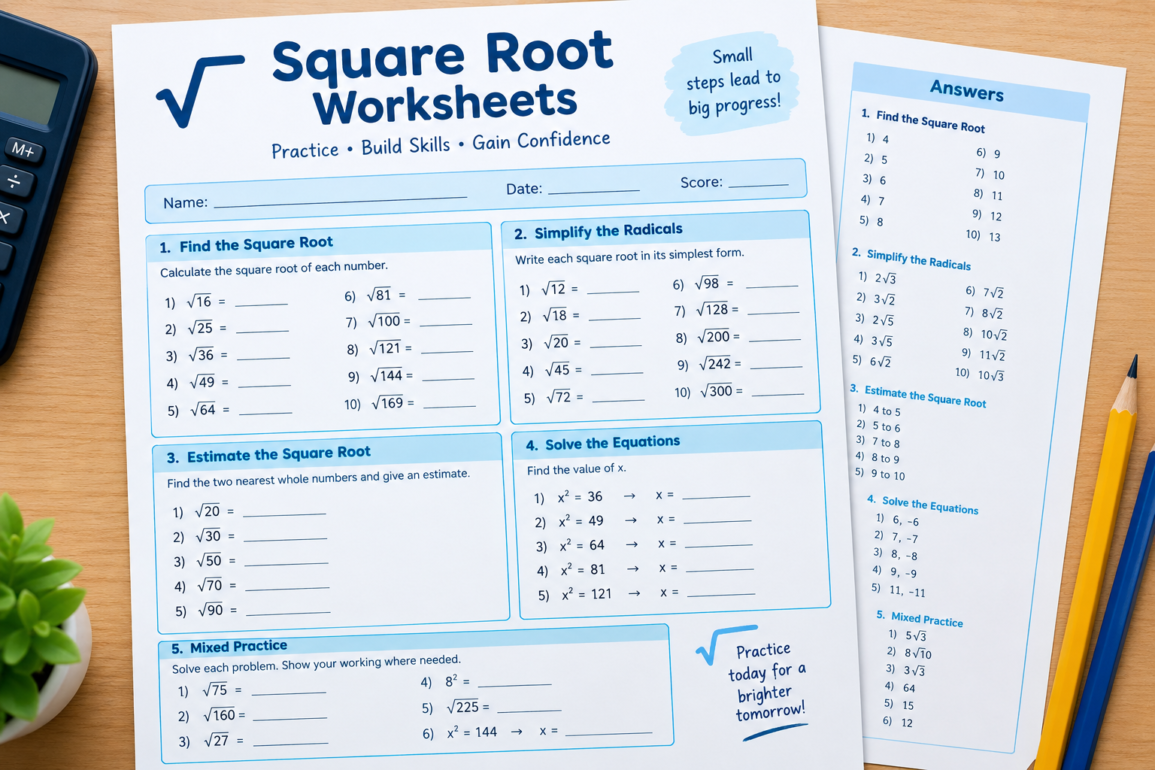
Square roots are an important part of mathematics because they help students understand numbers, solve equations, and explore the relationship between multiplication and division. However, many learners need regular practice before they can calculate square roots confidently. Square root worksheets provide a simple and effective way to strengthen these skills through structured exercises, worked examples, and progressively challenging questions.
Whether students are learning perfect squares for the first time or preparing for more advanced algebra, the right practice materials can make mathematical concepts easier to understand. Teachers can use these resources during classroom lessons, while parents can introduce them into home study routines. With consistent practice, students can improve accuracy, develop problem-solving skills, and become more comfortable working with square roots.
What Are Square Roots?
A square root is a number that produces a given value when multiplied by itself. For example, the square root of 25 is 5 because 5 × 5 = 25. Similarly, the square root of 64 is 8 because 8 × 8 = 64.
The square root symbol is called the radical sign and looks like √. Students commonly encounter expressions such as √9, √36, and √100 when studying elementary and middle school mathematics.
Square root worksheets introduce these expressions through different types of exercises. Beginners may start by identifying perfect squares, while more advanced learners can practise estimating square roots, simplifying radicals, and solving equations.
Understanding this concept also helps students recognise patterns in numbers. Once they know that 7² = 49, for instance, they can quickly determine that √49 = 7. Repeated practice makes these relationships easier to remember.
Why Square Root Worksheets Are Important
Regular practice helps students move beyond memorising answers and develop a deeper understanding of mathematical relationships. Square root worksheets provide opportunities to apply concepts independently, identify mistakes, and improve calculation speed.
One major benefit is improved number recognition. Students gradually learn common perfect squares, including 1, 4, 9, 16, 25, 36, 49, 64, 81, and 100. Remembering these values makes more complicated questions easier to solve.
Another benefit is increased confidence. Students who initially struggle with radicals can begin with simple examples and progress towards more challenging problems. This gradual approach prevents unnecessary frustration and encourages independent learning.
Teachers can also use square root worksheets to assess understanding. By reviewing completed exercises, they can identify whether learners struggle with multiplication facts, perfect squares, estimation, or simplifying radicals. Parents can use the same approach to determine which topics need additional attention.
Types of Square Root Worksheets
Different worksheets support different learning objectives. Selecting appropriate exercises helps students practise the skills they need most.
1. Perfect Square Worksheets
Perfect square worksheets are suitable for beginners who are learning the relationship between squares and square roots. These activities focus on numbers that have whole-number square roots.
For example, students may solve √16 = 4, √36 = 6, and √121 = 11. These questions help learners connect multiplication facts with radical notation.
Teachers can include matching activities, fill-in-the-blank questions, and short quizzes. Students might match 8² with 64 or identify the square root of 144 from several answer choices.
2. Basic Square Root Practice
Basic practice sheets contain a mixture of straightforward calculations. Students solve expressions involving familiar perfect squares and gradually increase their speed.
A typical exercise might include √4, √25, √49, √81, and √144. Students can complete these problems mentally or show their working on paper.
Square root worksheets at this level are useful for homework, classroom warm-ups, revision sessions, and independent study. They also help learners develop reliable methods before moving to more advanced calculations.
3. Simplifying Square Roots Worksheets
Simplifying radicals requires students to identify perfect-square factors within a number. Instead of calculating a decimal approximation, learners rewrite a radical in its simplest form.
For example, √72 can be simplified by recognising that 72 = 36 × 2. Therefore, √72 = √36 × √2 = 6√2.
This skill becomes increasingly important in algebra, geometry, and higher-level mathematics. Exercises should begin with relatively simple examples, such as √12 and √18, before progressing to larger numbers.
4. Estimating Square Roots Worksheets
Not every number has a whole-number square root. For instance, √20 falls between 4 and 5 because 4² = 16 and 5² = 25.
Estimation worksheets teach students to identify the nearest perfect squares and use them to determine a reasonable answer. Learners may estimate √30, √50, or √70 before checking their results with a calculator.
These exercises develop numerical reasoning and help students understand why some square roots produce irrational numbers.
5. Algebraic Square Root Worksheets
Advanced worksheets combine square roots with algebraic expressions and equations. Students may solve equations such as x² = 49 or simplify expressions containing variables.
For x² = 49, the solutions are x = 7 and x = −7 because both numbers produce 49 when squared.
These activities are especially useful for students preparing for algebra tests. They encourage learners to consider positive and negative solutions carefully rather than assuming that every equation has only one answer.
How to Solve Square Root Problems
A consistent method can make square root calculations easier. Students should begin by identifying the number under the radical sign and determining whether it is a perfect square.
If the number is a perfect square, they can recall the corresponding multiplication fact. For example, since 9 × 9 = 81, the value of √81 is 9.
When the number is not a perfect square, students can identify the nearest perfect squares. To estimate √40, they know that 36 is less than 40 and 49 is greater than 40. Therefore, √40 lies between 6 and 7.
For simplifying radicals, learners should look for the largest perfect-square factor. Consider √48. Since 48 = 16 × 3, the expression becomes √16 × √3, which simplifies to 4√3.
Square root worksheets allow students to apply these methods repeatedly. Teachers should encourage learners to write down their steps instead of recording answers alone. Showing the process makes errors easier to identify and correct.
Free Printable Square Root Worksheets
Printable practice sheets can make mathematics lessons more flexible. Students can complete them in classrooms, libraries, tutoring sessions, or at home without requiring an internet connection.
When choosing square root worksheets, look for clear instructions, readable numbers, sufficient working space, and questions arranged by difficulty. Worksheets that include answer keys are particularly useful because students can check their work after completing the exercises.
Teachers may prefer themed worksheets for revision or assessment, while parents may choose short activities that fit into daily study routines. Students preparing for examinations can benefit from mixed-topic sheets that combine perfect squares, estimation, and radical simplification.
It is important to select resources that match the learner’s current level. A beginner should not immediately attempt complicated algebraic radicals. Building a strong foundation first usually leads to better long-term progress.
How Teachers and Parents Can Use These Worksheets
Teachers can introduce a topic with a short explanation and demonstrate two or three sample questions. Students can then complete a worksheet independently before reviewing answers as a class.
For additional engagement, teachers can organise timed challenges, partner activities, or matching games. However, accuracy and understanding should remain more important than speed, especially when students are learning a new method.
Parents can support learning by setting aside 10 to 15 minutes for regular practice. They should encourage children to explain how they reached an answer rather than simply correcting mistakes. Asking questions such as “Which number multiplied by itself gives 64?” helps reinforce understanding.
Square root worksheets can also support differentiated instruction. Students who need extra help can practise perfect squares, while confident learners can work on estimation, simplifying radicals, and algebraic equations.
Common Mistakes to Avoid
One frequent mistake is confusing a square with a square root. Squaring 6 gives 36, while taking the square root of 36 gives 6. Students should understand that these operations reverse each other for nonnegative numbers.
Another error occurs when learners forget that negative numbers can have positive squares. For example, both 5 and −5 produce 25 when squared. Consequently, the equation x² = 25 has two real solutions, even though the principal square root √25 equals 5.
Students may also simplify radicals incorrectly. For example, √(9 + 16) is √25, which equals 5. It is not equal to √9 + √16, which equals 7. Square roots do not distribute over addition in this way.
Finally, learners sometimes rely too heavily on memorisation without checking their answers. Encouraging students to square their results provides a simple verification method.
Tips for Getting Better Results
Consistent practice is more effective than completing many questions in a single session. Students should begin with familiar examples, review mistakes, and gradually increase the difficulty of their exercises.
Memorising common perfect squares up to at least 15² can also help. Knowing these values makes it easier to recognise square roots quickly and estimate unfamiliar ones.
Learners should keep a record of recurring mistakes. If they repeatedly confuse perfect squares or struggle to simplify radicals, they can revisit those concepts before moving forward.
Square root worksheets work best when combined with clear explanations, feedback, and practical examples. Students who understand why a method works are more likely to apply it successfully to unfamiliar questions.
Frequently Asked Questions
1. What are square root worksheets used for?
Square root worksheets help students practise identifying perfect squares, calculating square roots, estimating irrational values, simplifying radicals, and solving related algebraic problems.
2. At what grade level should students learn square roots?
Students commonly encounter square roots in middle school, often around Grades 6–8, depending on the curriculum. More advanced radical operations generally appear in later grades.
3. Can students use square root worksheets at home?
Yes. Printable worksheets are useful for independent study, homework, revision, and additional practice. Parents can check answers using an answer key and discuss any mistakes.
4. What is the best way to learn perfect squares?
Practise multiplication facts regularly and connect each square with its corresponding square root. For example, remembering that 12 × 12 = 144 helps students recognise √144 = 12.
5. Should square root worksheets include answer keys?
Answer keys are helpful because they allow students to check their work and identify errors. However, learners should attempt each question independently before consulting the answers.
Conclusion
Square roots are a fundamental mathematical skill that supports learning in algebra, geometry, and many other areas. With well-structured practice, students can understand perfect squares, estimate unfamiliar values, simplify radicals, and solve equations more confidently.
Square root worksheets offer an accessible way to develop these skills through repetition and gradual progression. Teachers can use them to assess classroom understanding, while parents can incorporate them into home learning routines. Students should focus on understanding each method, showing their working, and correcting mistakes rather than memorising answers alone.
By choosing appropriate exercises and practising consistently, learners can build a stronger mathematical foundation and approach more advanced topics with greater confidence.