



Understanding shades of meaning helps readers, writers, and students choose words that communicate ideas clearly. Although many words share similar definitions, they do not always express the same feeling, intensity, or intention. For example, “happy,” “pleased,” “delighted,” and “ecstatic” all describe positive emotions, but each word conveys a different degree of happiness. Recognizing these differences makes language more precise and expressive.
Learning how words differ in meaning can improve vocabulary, reading comprehension, creative writing, and everyday communication. Students can use this skill to understand unfamiliar passages, while writers can select words that match their intended message. This guide explains what shades of meaning are, why they matter, and how to teach and practise them through simple examples and practical activities.
What Are Shades of Meaning?
Shades of meaning refer to the small differences between words that have similar definitions but communicate slightly different ideas, emotions, or levels of intensity. These differences can involve how strong a feeling is, whether a word sounds positive or negative, or what impression it creates in a particular situation.
Consider the words “look,” “stare,” “glance,” and “gaze.” All four describe directing your eyes toward something, but they suggest different actions. A glance is usually brief, a stare may be intense or prolonged, and a gaze often suggests a steady or thoughtful look. Understanding these distinctions allows readers to picture a scene more accurately.
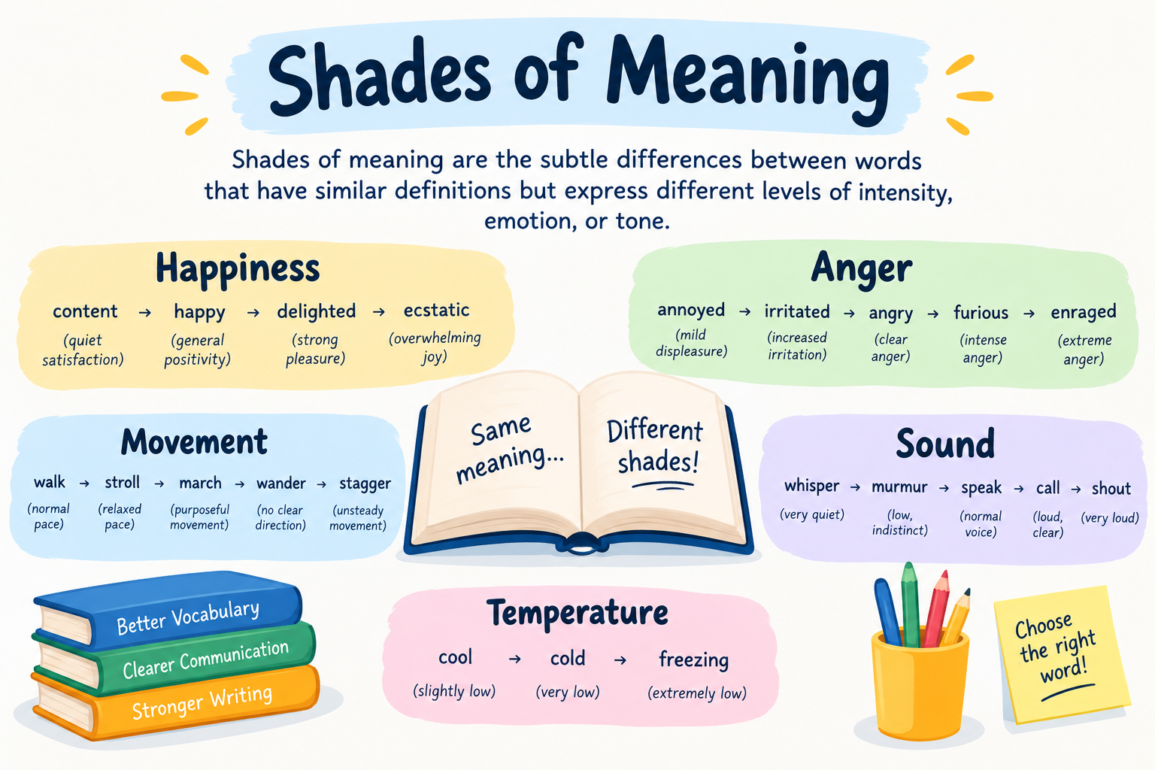
The concept also applies to emotions, actions, sounds, and descriptions. For example, “cool,” “cold,” and “freezing” describe low temperatures at different levels. Similarly, “dislike,” “hate,” and “detest” express negative feelings with varying degrees of intensity.
These examples show that shades of meaning are not simply about memorizing definitions. They involve understanding how words work together and selecting the expression that best fits the context.
Why Are Shades of Meaning Important?
They Improve Vocabulary
Learning related words helps students develop a broader vocabulary. Instead of using the same familiar word repeatedly, learners discover alternatives that express their ideas more accurately.
For instance, a student might describe a character as “angry.” After learning more vocabulary, the student could use “irritated,” “furious,” or “enraged,” depending on the situation. Each option provides a different level of emotion and helps create a clearer picture.
Studying shades of meaning also encourages learners to explore synonyms beyond their basic definitions. They begin to understand that similar words are not always interchangeable.
They Strengthen Reading Comprehension
Authors carefully select words to establish mood, develop characters, and communicate important details. Readers who recognize subtle differences can better understand what an author intends to convey.
Imagine a story describing a character who “whispered,” “murmured,” or “shouted.” Each verb gives the reader a different impression of the character’s voice and emotional state. A whisper may suggest secrecy, a murmur may indicate quiet speech, and a shout may communicate excitement, anger, or urgency.
Recognizing these distinctions helps students understand passages more deeply and identify clues that contribute to the overall meaning.
They Make Writing More Effective
Writers need words that match their ideas. Using a general word can communicate basic information, but a more precise choice may create a stronger impression.
For example, compare these sentences: “The dog walked across the yard” and “The dog crept across the yard.” The first sentence describes ordinary movement, while the second suggests cautious or secretive behavior.
By applying shades of meaning, writers can make descriptions more vivid without adding unnecessary words. This skill is especially useful in stories, essays, reports, and persuasive writing.
Common Examples of Shades of Meaning
The easiest way to understand this concept is to compare related words and identify their differences.
Words That Describe Happiness
The words “content,” “happy,” “delighted,” and “ecstatic” describe positive emotional states, but they differ in intensity. Content suggests quiet satisfaction, happy expresses a general positive feeling, delighted communicates strong pleasure, and ecstatic describes overwhelming excitement or joy.
A person might feel content after a relaxing afternoon, delighted when receiving a thoughtful gift, and ecstatic after winning an important competition.
These distinctions help speakers describe emotions more accurately instead of relying on one general term.
Words That Describe Anger
“Annoyed,” “irritated,” “angry,” “furious,” and “enraged” can form a useful sequence from milder displeasure to intense anger. The exact intensity may depend on context, but the words generally communicate different emotional levels.
Someone may feel annoyed when interrupted, irritated by repeated noise, angry after an unfair decision, or furious about a serious betrayal.
Writers can use these differences to show how a character’s feelings change throughout a story.
Words That Describe Movement
Words such as “walk,” “stroll,” “march,” “wander,” and “stagger” describe movement in different ways. A person who strolls moves at a relaxed pace, while someone who marches may move firmly and purposefully. A person who wanders may move without a clear destination, whereas someone who staggers may struggle to maintain balance.
Choosing the right verb gives readers useful information about the person’s actions and condition.
Words That Describe Sound
“Whisper,” “murmur,” “speak,” “call,” and “shout” represent different ways of using the voice. A whisper is very quiet, a murmur is low and often indistinct, and a shout is loud enough to attract attention or communicate across a distance.
Understanding these differences helps students select verbs that accurately describe conversations and events.
How Shades of Meaning Work in Sentences
Words become easier to understand when learners examine them in context. A dictionary definition provides useful information, but the surrounding sentence often reveals the most appropriate choice.
Consider the sentence, “The child was ___ when the balloon burst.”
Possible answers include “surprised,” “startled,” and “terrified.” Surprised indicates an unexpected reaction, startled suggests a sudden response, and terrified communicates intense fear. The best choice depends on what the writer wants readers to understand about the child’s reaction.
Now consider this example: “The wind moved through the trees.” Replacing “moved” with “rustled,” “whistled,” or “howled” changes the image. Rustled suggests a soft, light sound, whistled may indicate a high-pitched sound, and howled creates an impression of a loud, powerful wind.
These examples demonstrate why context matters when studying shades of meaning. A word that works well in one sentence may be unsuitable in another, even when the words have related definitions.
How to Teach Shades of Meaning to Students
Teachers can introduce the concept through familiar vocabulary before moving to more advanced examples. Visual aids, classroom discussions, sentence activities, and short writing exercises can help students recognize differences between related words.
Use Word Continuums
A word continuum arranges related words from the lowest to the highest intensity. For example, students can place “warm,” “hot,” and “scorching” along a temperature scale. They can also arrange “dislike,” “hate,” and “detest” according to the strength of the emotion.
Students should discuss why they place each word in a particular position. Some words may overlap, and their order can change depending on context. Explaining these choices encourages critical thinking rather than simple memorization.
Compare Synonyms
Give students a group of related words and ask them to explain how each differs from the others. For example, they could compare “tiny,” “small,” “little,” and “minuscule.”
Although these words describe limited size, their usage and emphasis can vary. “Minuscule” often emphasizes extreme smallness, while “little” may sound more conversational or affectionate in certain contexts.
Ask students to create a sentence for each word. This activity demonstrates how shades of meaning influence real communication.
Use Stories and Pictures
Short stories and illustrations provide useful opportunities to explore vocabulary. A picture showing a person walking slowly through a garden could inspire words such as “strolling,” “wandering,” or “exploring.”
Students can explain which word best matches the image and identify additional details that would change their answer. This approach connects vocabulary learning with observation, interpretation, and creative thinking.
Practical Activities for Learning Shades of Meaning
Regular practice helps learners apply new vocabulary confidently. These activities work well in classrooms, at home, or during independent study.
Activity 1: Choose the Best Word
Complete each sentence with the most suitable word from the choices provided.
- The exhausted runner began to ___ toward the finish line. (stagger, march, stroll)
- She felt ___ when she discovered the surprise party. (pleased, delighted, miserable)
- The angry customer became ___ after waiting for several hours. (furious, content, cheerful)
- The kitten made a ___ sound while sleeping. (deafening, faint, thunderous)
- The tiny insect was almost ___ against the dark background. (invisible, enormous, obvious)
Suggested answers are “stagger,” “delighted,” “furious,” “faint,” and “invisible.” Depending on additional context, some alternatives may also be reasonable.
Activity 2: Arrange the Words
Arrange each group from the weakest intensity to the strongest intensity.
- Warm, scorching, hot.
- Annoyed, enraged, angry.
- Content, ecstatic, happy.
- Glance, stare, look.
Possible sequences are warm, hot, scorching; annoyed, angry, enraged; content, happy, ecstatic; and glance, look, stare. The final group is less straightforward because these words describe different kinds of looking rather than a perfectly consistent intensity scale.
Activity 3: Rewrite a Sentence
Begin with a simple sentence such as, “The man walked into the room.” Rewrite it using “marched,” “stumbled,” and “crept.”
Discuss how each version changes the reader’s impression. Marching may suggest confidence or determination, stumbling suggests difficulty maintaining balance, and creeping implies cautious movement.
Common Mistakes to Avoid
One common mistake is assuming that all synonyms have exactly the same meaning. Although synonyms share related definitions, they may differ in intensity, emotional tone, formality, or typical usage.
Another mistake is choosing the strongest word simply because it sounds more impressive. A precise word is more effective than an exaggerated one. Describing mild disappointment as “devastation,” for example, may misrepresent the situation unless the context supports that level of emotion.
Students should also avoid memorizing word sequences without considering context. A word’s meaning can shift depending on how people use it, the subject being described, and the surrounding sentence.
The best way to improve is to read widely, consult reliable dictionaries, compare example sentences, and practise using new vocabulary in original writing.
Frequently Asked Questions
What is the meaning of shades of meaning?
Shades of meaning are subtle differences between words with similar definitions. These differences may involve intensity, emotion, tone, or the impression a word creates.
What is an example of shades of meaning?
“Warm,” “hot,” and “scorching” describe different levels of temperature. Similarly, “annoyed,” “angry,” and “furious” express different degrees of displeasure.
Are shades of meaning the same as synonyms?
No. Synonyms are words with similar meanings, while shades of meaning describe the distinctions between related words. Studying synonyms helps learners recognize these differences.
At what age should students learn shades of meaning?
Students can begin exploring simple word differences in the early elementary grades. Teachers can introduce more complex vocabulary and contextual analysis as reading and writing skills develop.
How can students practise shades of meaning at home?
Students can read stories, compare synonyms, create word continuums, rewrite sentences, and keep a vocabulary notebook containing definitions and original examples.
Conclusion
Shades of meaning help learners understand that words communicate more than basic definitions. Small differences in intensity, tone, and emotional association can change how a sentence sounds and how readers interpret it. By comparing related vocabulary, studying words in context, and practising through meaningful activities, students can develop stronger reading comprehension and more effective writing skills.
Whether someone is learning English, preparing classroom materials, or improving everyday communication, understanding shades of meaning provides a valuable foundation for precise language use. With regular practice and careful word selection, learners can express their ideas more clearly, interpret texts more accurately, and become confident communicators.