

A well-designed worksheet can turn early learning into an enjoyable experience for young children. A j worksheet helps students recognize the letter J, practise its sound, develop handwriting skills, and identify words that begin with this letter. Whether children are learning at home, attending preschool, or studying in kindergarten, these activities provide a simple way to build early literacy skills.
The letter J is an important part of the English alphabet. Children benefit from seeing the letter, hearing its sound, tracing its shape, and using it in familiar words. A structured j worksheet combines these learning opportunities in one place, making lessons more interactive and easier to understand. Parents and teachers can use different exercises to support children at their own pace while encouraging confidence and independence.
What Is a J Worksheet?
A j worksheet is an educational resource designed to teach children about the uppercase letter J and the lowercase letter j. It usually includes activities such as tracing, letter identification, colouring, matching, and simple vocabulary exercises. These tasks introduce children to the appearance and sound of the letter through repeated practice.
Most worksheets are suitable for preschoolers, kindergarten students, and beginners who are developing their reading and writing abilities. The activities can range from simple letter recognition exercises to more advanced tasks involving words and short sentences.
A good j worksheet should be clear, age-appropriate, and easy to follow. Large letters, familiar pictures, and short instructions help children understand what they need to do without feeling overwhelmed.
Why Children Need Letter J Practice
Learning the alphabet requires more than memorising the names of letters. Children must also recognize different letter shapes, connect letters with sounds, and learn how letters appear in written words. Regular practice helps them develop these essential skills.
Improving Letter Recognition
Letter recognition is one of the first steps toward reading. Children need to distinguish J from similar-looking letters and identify it in different positions on a page. A j worksheet provides repeated opportunities to recognize both uppercase J and lowercase j.
For example, a child might circle every J on a page containing several letters. Another activity might ask the student to match uppercase J with lowercase j. These exercises strengthen visual awareness and help children become familiar with the alphabet.
Developing Handwriting Skills
Writing the letter J involves controlled hand movements. Children must learn where to begin, how to move the pencil, and how to create the letter’s curved shape. Tracing activities introduce these movements before students attempt to write independently.
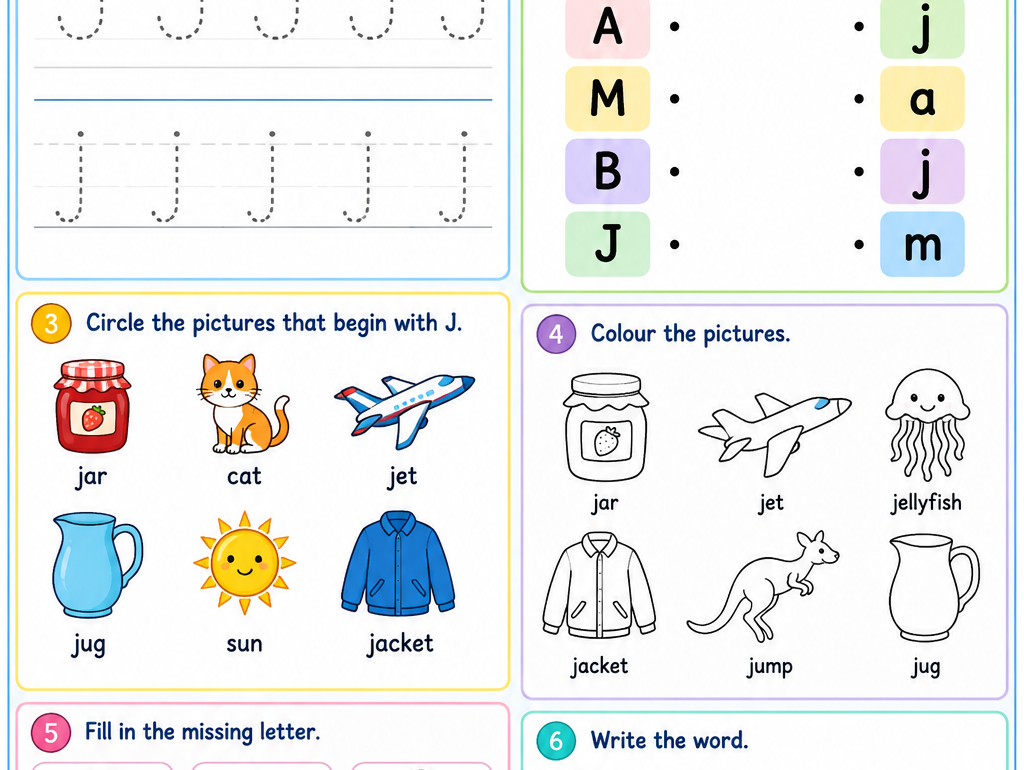
A handwriting-focused j worksheet often includes dotted letters, starting points, and blank spaces for independent practice. These features help children develop pencil control and improve the consistency of their writing.
Connecting Letters With Sounds
The letter J commonly represents the /dʒ/ sound heard at the beginning of words such as jam, jump, and jelly. Learning this connection helps children develop phonemic awareness, which supports early reading and spelling.
When children complete a j worksheet that includes pictures and vocabulary, they can connect the written letter with familiar spoken words. Repeating these connections makes it easier to recognize the sound in new words.
Different Types of J Worksheet Activities
Children learn in different ways, so using a variety of exercises can make alphabet lessons more effective. Combining handwriting, pictures, games, and vocabulary gives students several ways to practise the same skill.
Letter Tracing Activities
Tracing is a useful starting point for children who are learning to write. These exercises show the correct shape of uppercase J and lowercase j, allowing students to follow dotted outlines with a pencil or crayon.
A beginner-friendly j worksheet may include several rows of letters followed by empty spaces where children can practise independently. Teachers can demonstrate the writing movement first and then encourage students to complete the remaining letters.
As children become more confident, they can move from tracing to copying letters and eventually writing them without visual guidance.
Uppercase and Lowercase Matching
Children need to understand that J and j represent the same letter, even though their shapes differ. Matching activities help students establish this connection.
A worksheet might display uppercase letters in one column and lowercase letters in another. Students draw lines between the matching pairs or select the correct answer from several choices.
This type of j worksheet is particularly useful for kindergarten students who are beginning to recognise letters in books, signs, and everyday writing.
Picture Identification Exercises
Pictures make alphabet lessons more interesting because they connect letters with familiar objects. Teachers can include images of a jar, jet, jug, jacket, or jellyfish and ask children to identify the pictures whose names begin with J.
A j worksheet with pictures can also include a few words beginning with different letters. Children must decide which words start with the target sound rather than simply choosing every image on the page.
This activity encourages careful listening, vocabulary development, and sound recognition.
Letter J Colouring Pages
Colouring activities provide a creative way to reinforce letter recognition. Children might colour a large uppercase J, decorate a lowercase j, or colour pictures of objects beginning with the letter.
Teachers can combine colouring with short learning instructions. For example, students might colour the letter J blue and the pictures of a jar and a jet yellow.
Although colouring is enjoyable, it should support the main learning objective. A balanced j worksheet uses pictures and decorations without making the letter difficult to see.
How to Teach the Letter J Step by Step
A consistent teaching routine helps children understand new letters without introducing too much information at once. Parents and teachers can follow a simple process that combines listening, looking, speaking, and writing.
Step 1: Introduce the Letter
Begin by showing children a large uppercase J and a lowercase j. Say the letter’s name clearly and ask students to repeat it. Explain that both forms represent the same letter.
You can point out examples of J in storybooks, classroom labels, or familiar product names. These everyday examples help children understand that letters are used beyond worksheets.
Step 2: Practise the Sound
Introduce words such as jam, jungle, jacket, and jump. Say each word slowly and encourage children to listen to the beginning sound.
Ask students to suggest additional words that start with J. If they struggle, offer picture clues or familiar objects. The aim is to help them hear the sound rather than memorise a list without understanding it.
Step 3: Complete a J Worksheet
Once children recognize the letter and its sound, introduce a j worksheet with tracing, matching, or picture identification exercises. Start with the easiest activity and gradually increase the difficulty.
Give children enough time to complete each task. Offer guidance when needed, but allow them to attempt answers independently before providing corrections.
Step 4: Review and Celebrate Progress
Review the completed work together. Ask children to point to J, identify a word beginning with the letter, and write one example independently.
Praise effort and improvement rather than expecting perfect handwriting immediately. Short, positive review sessions help children remain motivated and willing to practise again.
Tips for Choosing the Best J Worksheet
Not every educational worksheet suits every child. Choosing an appropriate resource depends on the student’s age, current abilities, and learning goals.
For preschool children, choose simple pages with large letters, dotted outlines, and colourful pictures. These activities introduce the alphabet without requiring advanced writing skills.
For kindergarten students, look for a j worksheet that combines tracing with independent writing, beginning-sound recognition, and uppercase-to-lowercase matching. These activities encourage children to apply what they have learned.
For students who already recognize the letter, choose more challenging exercises involving word completion, letter searches, and simple sentence reading. Increasing the difficulty gradually keeps the learning experience useful without making it frustrating.
It is also important to consider page design. Clear fonts, adequate spacing, and short instructions make activities easier to complete. Avoid pages containing too many unrelated tasks, particularly for children with limited attention spans.
Using a J Worksheet at Home and in the Classroom
A j worksheet can support learning in several environments. At home, parents can introduce one short activity after reading an alphabet book or discussing familiar objects. A few minutes of focused practice may be more productive than a long session that leaves children tired.
Teachers can use worksheets during literacy lessons, small-group activities, or independent learning time. Students who need extra support can practise tracing, while children who have mastered the letter can work on vocabulary and beginning sounds.
Printable worksheets are also convenient because adults can prepare copies for repeated practice. However, children should not complete identical exercises endlessly. Changing the activity helps maintain interest and gives them opportunities to apply the same knowledge in new ways.
Parents and teachers can extend a j worksheet lesson with hands-on activities. Children might search for objects beginning with J, arrange letter cards, build the letter using modelling clay, or draw a picture of something that starts with the sound.
These activities connect written practice with real experiences and make alphabet learning more memorable.
Common Mistakes to Avoid
One common mistake is expecting children to write perfectly formed letters before they have developed sufficient hand control. Early learners may need several attempts before they can reproduce the shape accurately. Provide tracing opportunities and encourage gradual improvement.
Another mistake is focusing only on uppercase J. Children also need to recognize lowercase j because it appears frequently in ordinary text. A balanced j worksheet should introduce both forms and explain their relationship.
Adults should also avoid confusing letter names with letter sounds. The name of the letter is J, while its common sound at the beginning of jam is /dʒ/. Practising both helps children develop a stronger foundation for reading.
Finally, avoid correcting every small error in a way that discourages participation. Give clear, gentle feedback and demonstrate the correct response when necessary. Positive reinforcement helps children approach future activities with greater confidence.
Benefits of Regular Alphabet Practice
Consistent alphabet practice supports several early learning skills. Children gradually become more familiar with letter shapes, improve their pencil control, and develop stronger connections between written symbols and spoken language.
Using a j worksheet regularly can also help parents and teachers identify areas that require additional attention. A child who traces successfully but struggles to identify J in a group of letters may need more recognition exercises. Another child who recognizes the letter but finds writing difficult may benefit from additional fine-motor activities.
Progress should be measured through understanding rather than the number of pages completed. When children can recognize the letter, identify its common sound, and write it with increasing independence, they are developing useful foundational skills.
Conclusion
A j worksheet is a practical resource for helping young learners recognize, write, and understand the letter J. Through tracing, matching, colouring, and vocabulary exercises, children can strengthen early literacy skills while enjoying a variety of learning activities.
Parents and teachers can make these lessons more effective by choosing age-appropriate materials, providing clear demonstrations, and encouraging regular practice. Combining worksheets with reading, conversation, and hands-on games gives children more opportunities to apply what they learn.
The most effective approach focuses on steady progress rather than perfection. With suitable activities and positive guidance, children can build confidence in their alphabet knowledge and develop skills that support future reading and writing success.
Frequently Asked Questions
1. What is a j worksheet used for?
A j worksheet helps children recognize uppercase J and lowercase j, practise handwriting, identify beginning sounds, and learn words that start with the letter.
2. At what age should children start letter J worksheets?
Children can begin simple letter activities around preschool age, often between three and four years old. The difficulty should match their developmental stage and fine-motor abilities.
3. What words can children learn from a j worksheet?
Common examples include jam, jar, jet, jug, jump, jelly, jacket, jungle, and jellyfish. Pictures can help children connect these words with the letter’s sound.
4. How often should children practise writing J?
Short practice sessions several times a week can help children become familiar with the letter. Adjust the frequency according to the child’s attention span and comfort level.
5. Can parents use a j worksheet at home?
Yes. Parents can print suitable activities, practise letter sounds together, and combine writing exercises with books, toys, and everyday objects to reinforce learning.