



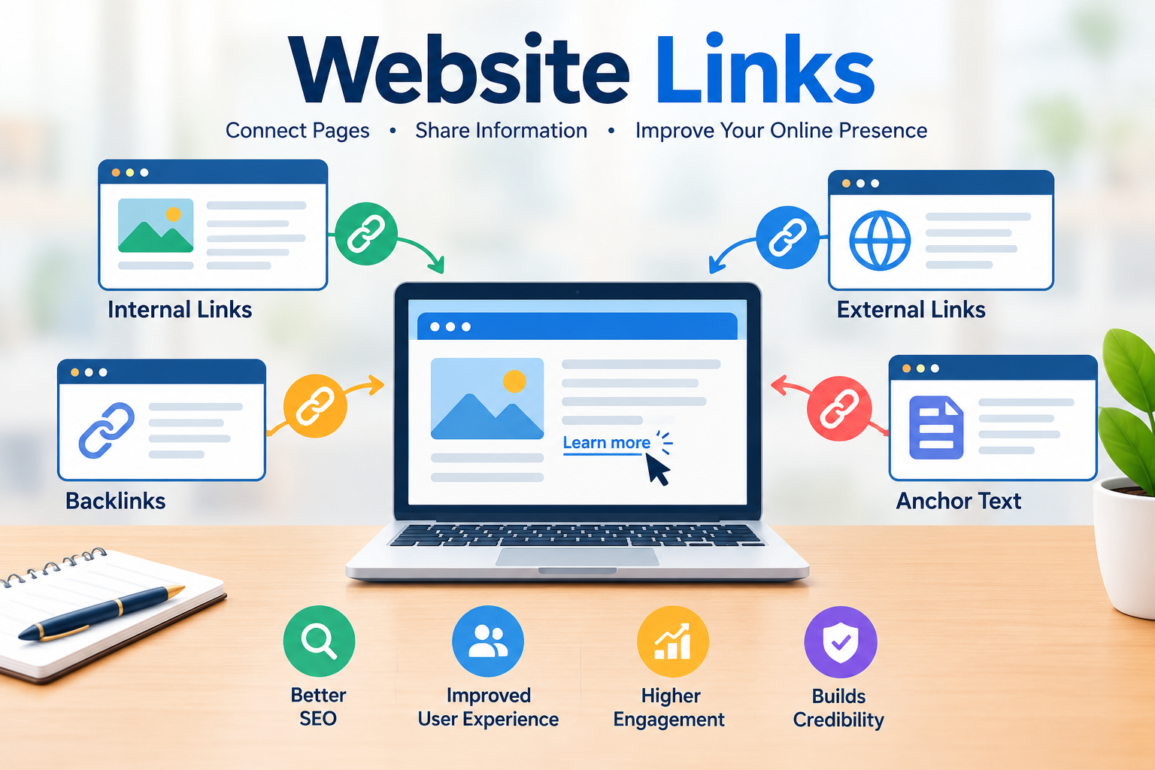
Website links play an essential role in how people navigate the internet, discover information, and connect different web pages. Whether you manage a personal blog, an educational platform, or a business website, understanding website links can help you improve user experience, search engine visibility, and online credibility. They allow visitors to move between pages, explore useful resources, and find the information they need without unnecessary effort.
For website owners, links are more than clickable text. A well-planned linking strategy can support search engine optimisation (SEO), encourage visitors to explore additional content, and make information easier to access. However, poor linking practices can confuse readers and create unnecessary navigation problems.
This guide explains what website links are, the different types available, their SEO benefits, and practical ways to use them effectively.
What Are Website Links?
Most links appear as highlighted text, although images, buttons, and other website elements can also contain clickable destinations. For example, a link within an educational article might direct readers to an official examination website for updated results or application instructions.
A useful linking structure benefits both human visitors and search engines. It makes navigation more intuitive while helping important pages become easier to discover.
Different Types of Website Links
Understanding the main types of website links allows website owners to create a more organised and effective online experience. Each type serves a different purpose, so choosing the right one depends on the destination and the needs of your audience.
Internal Links
They help visitors discover related information without returning to the homepage or searching through the entire website.
For example, an educational blog discussing examination results might link to separate articles about admit cards, application deadlines, and revaluation procedures. These connections make the website easier to navigate and encourage readers to explore relevant resources.
Internal website links also help search engines discover pages and understand their relationships. Website owners should connect important pages with relevant supporting content instead of leaving useful articles isolated.
External Links
They are useful when an article references official information, research, statistics, or additional resources that support its discussion.
For instance, a guide explaining digital marketing could link to an official search engine documentation page for technical guidance. This gives readers an opportunity to verify information or explore a subject in greater detail.
Relevant external website links can improve the usefulness of an article, but they should lead to trustworthy destinations.
Inbound Links and Backlinks
Inbound links, commonly called backlinks, are links from other websites pointing toward your website. They can help readers discover your content through different sources.
A backlink from a relevant, reputable publication may introduce your website to a new audience. Search engines can also consider links as part of their systems for evaluating pages, although a link does not automatically guarantee higher rankings.
The value of backlinks depends on several factors, including relevance, context, editorial quality, and whether the links follow search engine guidelines. Website owners should prioritise genuinely useful content and legitimate editorial relationships rather than purchasing large quantities of low-quality links.
Anchor Text Links
Anchor text is the visible, clickable text used in a hyperlink. It helps readers understand what they can expect after following the link.
For example, the phrase “complete guide to website security” provides more information than a generic phrase such as “click here.” Descriptive anchor text makes website links easier to understand and can help search engines interpret the relationship between connected pages.
Use natural wording that accurately describes the destination. Repeating the same exact-match keyword in every link can appear manipulative and may make the text less useful for readers.
Why Website Links Matter for SEO
Search engine optimisation involves improving a website so that search engines can discover, understand, and present its content to relevant audiences. Linking is an important part of this process.
Improving Website Crawling and Discovery
Search engines use automated crawlers to discover and revisit web pages. Accessible links provide pathways that help these crawlers find additional content.
When important pages receive relevant internal links, they can become easier to discover. A logical site structure also reduces the likelihood that useful content will remain disconnected from the rest of the website.
However, links alone cannot guarantee that every page will be indexed. Search engines also consider factors such as page accessibility, content quality, technical settings, and canonicalisation.
Supporting Page Relationships
Website links help communicate how different pages relate to one another. A main guide might link to several detailed articles covering individual aspects of the subject.
This structure allows readers to move from general information to more specific explanations. It also gives search engines additional context about the website’s organisation and topical coverage.
For the best results, link pages because their subjects genuinely complement one another. Avoid adding unrelated links simply to increase the total number of hyperlinks.
Helping Users Discover More Content
Effective links create a smoother browsing experience. Readers who find a helpful article may want to explore another guide, compare information, or visit an official resource.
Relevant internal website links can help them continue their journey naturally. This may increase engagement and encourage visitors to return when the website consistently provides useful information.
The goal should be to help visitors accomplish their objectives rather than directing them through unnecessary pages.
How to Create Effective Website Links
Creating useful links requires attention to relevance, clarity, accessibility, and technical accuracy. The following practices can help you develop a reliable linking strategy.
Choose Descriptive Anchor Text
Use words that explain the destination. If you are linking to a page about search engine optimisation, use an appropriate description rather than vague wording.
Descriptive anchor text helps visitors understand the link before they click it. It also supports accessibility because people using screen readers often navigate through links independently of the surrounding text.
Keep the wording natural and avoid forcing keywords into sentences where they do not belong.
Link to Relevant and Reliable Pages
Every link should serve a clear purpose. Before adding website links to an article, consider whether the destination provides useful information or helps readers complete a task.
For factual subjects, official organisations, primary documents, and reputable publications can be valuable sources. Check that the destination supports the claim being made and that the page remains accessible.
Relevant links improve the practical value of your content. Unrelated links, by contrast, can distract readers and weaken the overall quality of a page.
Check for Broken Links
A broken link leads to a destination that no longer works as intended. It may point to a deleted page, an incorrect URL, or a resource that has moved.
Broken links can frustrate visitors and interrupt navigation. Regular website audits help identify these problems before they affect too many users.
When a destination changes, update the link to the correct page if one exists. If the resource has disappeared permanently, remove the link or replace it with a genuinely useful alternative.
Use Links in a Natural Context
Links should fit smoothly into the content. Instead of adding a large collection of hyperlinks at the end of an article, connect relevant phrases to useful resources where readers are most likely to need them.
For example, an article about online learning could link to a related guide when discussing digital classrooms. This approach gives readers additional information at the moment it becomes relevant.
The number of links matters less than their usefulness. There is no universal ideal link count for every article, so focus on context, readability, and the purpose of each connection.
Website Links and User Experience
A website can contain excellent information yet still frustrate visitors if its navigation is confusing. Well-organised links help solve this problem by creating clear routes between related pages.
Navigation menus usually connect visitors to major sections, while contextual links provide additional information within articles. Breadcrumb links can show users where a page sits within a larger website structure. Footer links may provide access to contact information, policies, and other important resources.
Website links should also be easy to identify and operate on mobile devices. Use sufficient contrast, meaningful labels, and clickable areas that users can comfortably tap. Test important links with a keyboard as well as a mouse or touchscreen.
A consistent linking structure makes a website easier to understand, particularly when it contains many articles or categories.
Common Website Linking Mistakes to Avoid
One common mistake is using too many links without considering their relevance. Excessive linking can distract readers and make an article difficult to follow. Include a link when it adds genuine value, not simply because space is available.
Another problem is relying on misleading anchor text. A link should accurately represent its destination. Sending visitors to an unrelated page can damage trust and create a disappointing experience.
Website owners should also avoid manipulative link-building schemes. Buying links intended to manipulate rankings, participating in excessive link exchanges, or publishing large amounts of low-quality guest content solely for backlinks can conflict with search engine spam policies.
Ignoring link attributes is another potential issue. When links involve paid placements, advertising, or user-generated content, appropriate attributes such as ‘sponsored’ or ‘UGC’ may be relevant. These attributes help communicate the nature of a link to search engines.
Finally, do not assume that every backlink improves SEO. A smaller number of relevant, editorially earned links can be more valuable than a large collection of artificial or unrelated links.
How to Measure the Performance of Website Links
Monitoring link performance helps you identify opportunities to improve navigation and discoverability.
Google Search Console can help website owners review search performance, inspect indexing information, and examine available link reports. Analytics tools can show how visitors move between pages, which links attract engagement, and where users leave the website.
A regular audit should check important internal links, external destinations, redirected URLs, and pages that receive few internal links. You can also review whether your most valuable articles are connected to relevant category pages and supporting guides.
Use these findings to make practical improvements. For example, if an important article receives little internal traffic, adding a contextual link from a closely related popular page may help visitors discover it.
Evaluate results over time instead of expecting every change to produce immediate ranking improvements.
Conclusion
Website links are an essential part of an organised, accessible, and search-friendly online presence. They connect related information, guide visitors through useful resources, and help search engines discover and understand website content. Internal links strengthen navigation, external links provide supporting information, and relevant backlinks can expand your reach to new audiences.
The most effective strategy focuses on quality, relevance, and a positive user experience. Use descriptive anchor text, maintain working destinations, connect related pages, and follow responsible SEO practices. Avoid manipulative link-building techniques and review your linking structure regularly.
When you create website links with a clear purpose, you make your content easier to explore and build a stronger foundation for sustainable website growth.
Frequently Asked Questions
1. What are website links used for?
Website links connect pages and resources, help visitors navigate online content, and provide pathways that search engines can use to discover related pages.
2. What is the difference between internal links and external links?
Internal links connect pages on the same website, while external links direct users to pages on other websites.
3. Do backlinks improve SEO?
Relevant, naturally earned backlinks can support SEO by helping people discover content and providing search engines with additional signals. However, backlinks do not guarantee higher rankings.
4. How many links should an article contain?
There is no fixed number that works for every article. Include enough relevant links to support navigation, provide useful references, and help readers understand related topics without overwhelming them.
5. How can I check whether website links are broken?
You can use website crawling tools, link-checking software, or manual reviews to identify broken destinations. Google Search Console may also help you investigate indexing and website issues, although it is not a dedicated broken-link checker.