

The division area model is a visual math strategy that helps students understand division by breaking large numbers into smaller, manageable parts. Instead of relying only on memorized division rules, learners use rectangles, areas, and partial quotients to see how a division problem works. This approach connects multiplication and division, making calculations easier to understand and explain.
Whether students are learning basic arithmetic or working with larger numbers, the division area model provides a practical way to solve problems step by step. Teachers can use it to introduce division concepts, while parents can use it to support homework and independent practice. By understanding how the model works, students can build stronger number sense, improve their accuracy, and develop confidence in mathematics.
What Is the Division Area Model?
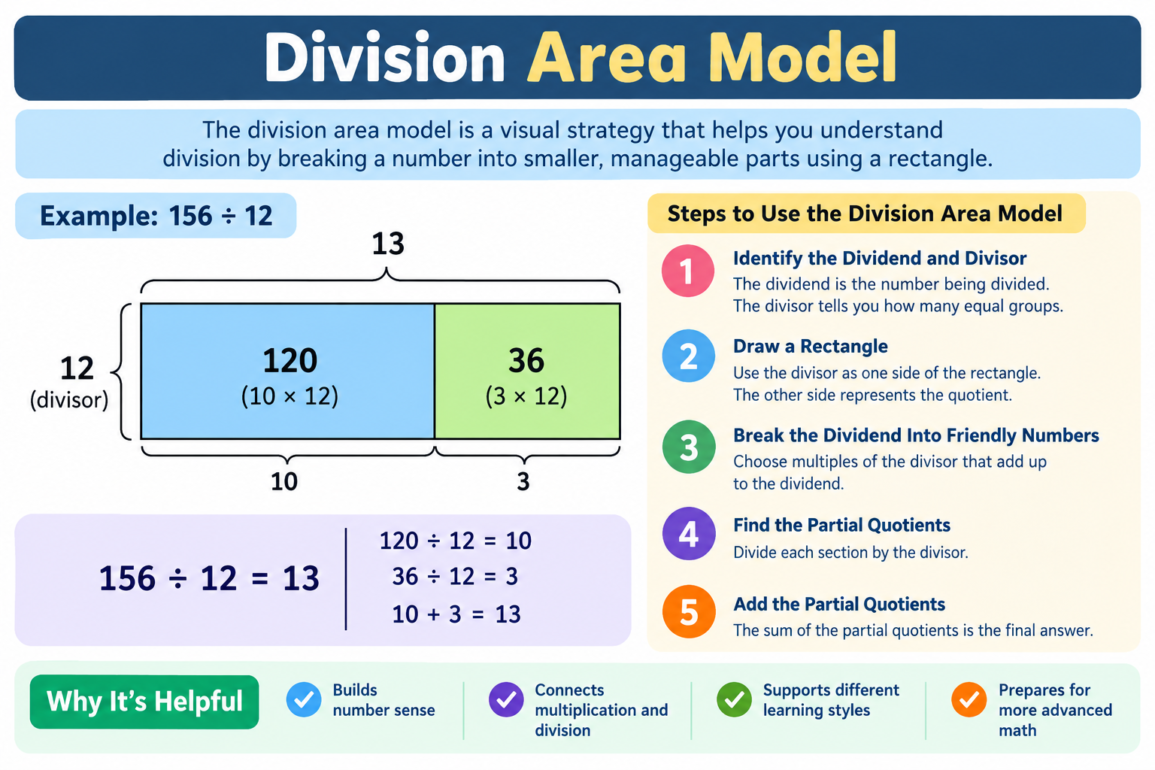
The division area model is a visual method that represents a division problem using a rectangle. The rectangle’s total area represents the dividend, while one side represents the divisor. Students divide the rectangle into smaller sections, each showing a useful multiple of the divisor.
The areas of these sections add together to equal the original dividend. Their corresponding side lengths, or partial quotients, combine to produce the final answer.
For example, when solving 156 ÷ 12, students can break 156 into 120 and 36. Since 120 is 12 multiplied by 10 and 36 is 12 multiplied by 3, the partial quotients are 10 and 3. Adding these values gives 13.
This visual approach makes division less abstract. Students can see how multiplication helps them identify manageable portions of a larger number.
How Does the Division Area Model Work?
The division area model follows a simple process. Students identify the numbers in the problem, divide the dividend into suitable parts, and use multiplication to determine the quotient for each section.
Step 1: Identify the Dividend and Divisor
Every division problem includes a dividend and a divisor. The dividend is the number being divided, while the divisor indicates how many equal groups or how many units belong in each group, depending on the problem.
In 168 ÷ 12, the dividend is 168 and the divisor is 12. The goal is to determine how many groups of 12 fit into 168.
Step 2: Draw a Rectangle
Draw a rectangle to represent the total value of the dividend. Label one side with the divisor, which is 12 in this example.
The other dimension represents the unknown quotient. Divide the rectangle into smaller sections to make the calculation easier.
Step 3: Break the Dividend Into Friendly Numbers
Choose multiples of the divisor that add up to the dividend. For 168 ÷ 12, you could use 120 and 48 because both numbers divide evenly by 12.
Calculate each partial quotient:
120 ÷ 12 = 10
48 ÷ 12 = 4
These two sections represent 10 groups and 4 groups.
Step 4: Add the Partial Quotients
Add the partial quotients to find the final answer.
10 + 4 = 14
Therefore, 168 ÷ 12 = 14.
This process demonstrates how the division area model turns one large calculation into smaller steps that students can solve more comfortably.
Division Area Model Examples
Working through examples helps students understand how to apply this method to different types of division problems. The following examples demonstrate how to use the model with two-digit and three-digit dividends.
Example 1: Divide 84 by 4
Start with the problem 84 ÷ 4. Represent 84 as the total area of a rectangle and use 4 as the known side length.
Break 84 into 80 and 4. Both numbers are divisible by 4, making them convenient choices.
80 ÷ 4 = 20
4 ÷ 4 = 1
Now add the partial quotients: 20 + 1 = 21.
The answer is 84 ÷ 4 = 21.
This example shows how students can use familiar multiplication facts to solve a division problem without performing long division.
Example 2: Divide 144 by 12
Consider 144 ÷ 12. The dividend is 144, and the divisor is 12.
Break 144 into 120 and 24. These values are easy to divide because both are multiples of 12.
120 ÷ 12 = 10
24 ÷ 12 = 2
Add the partial quotients: 10 + 2 = 12.
Therefore, 144 ÷ 12 = 12.
The rectangle would contain two sections representing areas of 120 and 24, with corresponding widths of 10 and 2. Together, the sections represent the complete rectangle.
Example 3: Divide 325 by 5
Larger numbers can also be solved using the same strategy. For 325 ÷ 5, split 325 into 300 and 25.
300 ÷ 5 = 60
25 ÷ 5 = 5
Add the results: 60 + 5 = 65.
Therefore, 325 ÷ 5 = 65.
This example demonstrates how the method supports calculations involving three-digit numbers while keeping the steps organized and easy to follow.
Understanding Partial Quotients
Partial quotients are an essential part of the division area model. A partial quotient represents one portion of the complete answer. Students find these values by dividing manageable multiples of the divisor.
For example, consider 252 ÷ 12. Students might break 252 into 240 and 12.
The first section gives 240 ÷ 12 = 20, while the second gives 12 ÷ 12 = 1. Adding the partial quotients produces 20 + 1 = 21.
The final answer is 252 ÷ 12 = 21.
Students do not always need to select the largest possible multiple first. They can choose any convenient multiples that add up to the dividend. However, larger friendly multiples often reduce the number of steps required.
Understanding partial quotients also prepares students for traditional long division because both methods organize a large calculation into smaller operations.
Benefits of Using the Division Area Model
Builds Conceptual Understanding
The division area model helps students understand why division works instead of simply memorizing a procedure. The rectangle illustrates how the dividend can be separated into sections that share the same divisor.
This visual connection makes it easier to understand the relationship between multiplication, division, and area.
Improves Mental Math Skills
Students must identify useful multiples and break numbers into manageable parts. These decisions encourage flexible thinking and help learners recognize number patterns.
With practice, students can estimate quotients more effectively and solve many division problems mentally.
Supports Different Learning Styles
Some students understand mathematical ideas more easily when they can draw or manipulate visual representations. The division area model gives these learners a concrete starting point before they move toward abstract calculations.
Teachers can combine drawings, multiplication charts, counters, and written equations to strengthen understanding.
Prepares Students for Advanced Mathematics
The strategy reinforces place value, multiplication facts, number decomposition, and the distributive property. These skills support later learning in fractions, decimals, algebra, and more advanced arithmetic.
Students who understand why a calculation works are often better prepared to apply their knowledge to unfamiliar problems.
Common Mistakes to Avoid
Although the division area model is straightforward, students sometimes make errors when selecting partial quotients or organizing their calculations.
One common mistake is choosing multiples that do not add up to the original dividend. Students should check that every section’s area combines to equal the starting number.
Another error involves multiplying incorrectly. Since each section depends on a multiplication fact, students should verify the relationship between the divisor and each partial quotient. For instance, 12 × 10 must equal 120, not 110.
Students may also forget to add all the partial quotients. Finding the correct values for individual sections is only part of the process; adding them produces the complete quotient.
Finally, learners should label their rectangles clearly. Writing each section’s area and corresponding quotient helps prevent confusion and makes the solution easier to check.
Division Area Model Practice Problems
Regular practice helps students become comfortable selecting multiples and calculating partial quotients. Try the following questions before checking the answers.
Practice problems
- 96 ÷ 6
- 132 ÷ 11
- 180 ÷ 9
- 216 ÷ 12
- 345 ÷ 5
Answers and suggested breakdowns
For 96 ÷ 6, split 96 into 60 and 36. Their quotients are 10 and 6, giving an answer of 16.
For 132 ÷ 11, split 132 into 110 and 22. Their quotients are 10 and 2, giving an answer of 12.
For 180 ÷ 9, split 180 into 90 and 90. Their quotients are 10 and 10, giving an answer of 20.
For 216 ÷ 12, split 216 into 120 and 96. Their quotients are 10 and 8, giving an answer of 18.
For 345 ÷ 5, split 345 into 300 and 45. Their quotients are 60 and 9, giving an answer of 69.
Students can draw a separate rectangle for each problem and label the sections to show how the partial quotients combine.
When Should Students Learn This Method?
Teachers commonly introduce area-based division after students develop a basic understanding of multiplication, place value, and simple division facts. The exact timing depends on the curriculum and each learner’s readiness.
Younger students may begin with smaller numbers and concrete materials. As their skills improve, they can use two-digit and three-digit dividends, larger divisors, and problems requiring several partial quotients.
The division area model can also help older students who struggle with traditional algorithms. Revisiting the visual meaning of division can clarify confusing steps and strengthen their understanding.
Teachers should encourage students to explain why they chose particular multiples rather than focusing only on obtaining the correct answer. This approach builds reasoning skills and makes mathematical thinking more visible.
Conclusion
The division area model is an effective strategy for making division easier to understand, especially when students work with larger numbers. By representing a dividend as a rectangle and dividing it into manageable sections, learners can connect multiplication facts with partial quotients and find accurate answers step by step.
This method supports number sense, encourages mental math, and builds a foundation for more advanced mathematical concepts. Students can begin with simple examples, practice selecting convenient multiples, and gradually move toward more challenging calculations. With regular practice and clear explanations, the division area model can help learners become more confident, independent, and capable problem-solvers.
Frequently Asked Questions
1. What is a division area model?
A division area model is a visual strategy that uses a rectangle divided into smaller sections to represent a division problem. Each section corresponds to a partial quotient.
2. How do you solve division using an area model?
Draw a rectangle, label one side with the divisor, and split the dividend into convenient multiples of that divisor. Divide each section’s area by the divisor, then add the partial quotients.
3. Is the division area model the same as partial quotients?
They are closely related but not identical. The area model provides a visual representation, while partial quotients describe the smaller quotient values that combine to form the final answer.
4. Can students use this method for large numbers?
Yes. Students can use the strategy for two-digit, three-digit, and larger dividends by breaking numbers into suitable multiples of the divisor.
5. Why is the division area model helpful for students?
It makes division more visual, strengthens multiplication skills, supports place-value understanding, and helps students understand the reasoning behind each step rather than memorizing rules alone.