
Figurative language helps writers communicate ideas in creative, memorable, and expressive ways. It allows readers to imagine scenes, understand emotions, and discover deeper meanings beyond the literal definitions of words. Students who learn to recognize figurative language can improve their reading comprehension, vocabulary, and writing skills. A figurative language worksheet provides a practical way to develop these abilities through examples, identification activities, and sentence-writing exercises.
Whether students are learning English in elementary school or developing advanced reading skills in middle school, practicing figurative language can make language arts lessons more interesting. Teachers can use these figurative language worksheet to introduce literary devices, reinforce classroom instruction, and assess student understanding. Parents can also use them at home to help children become confident readers and creative writers.
What Is Figurative Language?
Figurative language describes something in a way that goes beyond its ordinary, literal meaning. Writers use comparisons, exaggeration, human characteristics, and other techniques to make their messages more powerful. For example, saying that someone is as busy as a bee creates a more vivid impression than simply saying that the person is busy.
A figurative language worksheet introduces students to these techniques and helps them understand how writers use words to create meaning. Instead of memorizing definitions alone, learners examine sentences, identify patterns, and explain what different expressions communicate.
Figurative language appears in novels, poems, songs, advertisements, everyday conversations, and speeches. Recognizing it helps students understand the writer’s purpose and appreciate the creativity behind familiar expressions.
Why Use a Figurative Language Worksheet?
A well-designed figurative language worksheet offers several educational benefits. First, it strengthens reading comprehension by teaching students to look beyond the literal meaning of a sentence. When a writer says, “The classroom was a zoo,” students must recognize that the classroom was probably noisy and chaotic rather than filled with actual animals.
Second, these activities improve vocabulary and critical thinking. Students compare literal and figurative meanings, identify differences between literary devices, and use context clues to interpret unfamiliar expressions.
Worksheets also provide structured practice. Teachers can introduce a concept, demonstrate examples, and then allow students to complete exercises independently or in small groups. Parents can use similar activities to support learning outside school.
Most importantly, a figurative language worksheet encourages creativity. Once students understand how figurative expressions work, they can use them to make their own stories, descriptions, and poems more engaging.
Common Types of Figurative Language
Understanding the main literary devices makes worksheet activities easier to complete. Each type serves a different purpose, although some expressions may overlap depending on their meaning and context.
Simile
A simile compares two different things using the words “like” or “as.” It figurative language worksheet helps readers picture a person, object, or situation by connecting it to something familiar.
For example, “Her smile was as bright as the sun” compares a smile to the sun to emphasize its brightness or warmth. Similarly, “He ran like the wind” suggests that someone ran very quickly.
A figurative language worksheet may ask students to underline similes, identify the two things being compared, or write original comparisons. These exercises help learners recognize how similes create vivid descriptions.
Metaphor
A metaphor compares two unlike things without using “like” or “as.” Instead, it describes one thing as another to communicate a particular quality or idea.
For instance, “Time is money” suggests that time is valuable and should be used carefully. The sentence does not mean that time literally consists of money.
Students can practice metaphors by identifying the comparison and explaining its intended meaning. A figurative language worksheet may also ask learners to transform ordinary statements into imaginative metaphors.
Personification
Personification gives human qualities, feelings, or actions to animals, objects, or abstract ideas.
Consider the sentence, “The wind whispered through the trees.” Wind cannot literally whisper, but the description helps readers imagine a gentle breeze moving through the branches.
Another example is, “The alarm clock screamed at me.” This figurative language worksheet expression describes a loud alarm in a more dramatic way.
Activities involving personification teach students to distinguish between literal descriptions and imaginative language. Learners can also create their own examples by describing what the sun, rain, trees, or other objects might do if they behaved like people.
Hyperbole
It is not intended to be understood literally.
For example, “I have told you a million times” emphasizes repetition rather than reporting an exact number. Similarly, “This bag weighs a ton” suggests that the bag feels extremely heavy.
A figurative language worksheet can include exaggerated statements and ask students to explain what the speaker actually means. Students may also write their own hyperboles to describe hunger, excitement, tiredness, or surprise.
Idioms
Idioms are common in everyday English and often require cultural or contextual knowledge.
For example, “Break the ice” means to help people feel comfortable in a social situation. “Under the weather” means feeling unwell, while “Piece of cake” describes something easy to accomplish.
Students should learn idioms in context rather than relying only on word-by-word definitions. Practice activities can ask learners to match expressions with meanings or select the appropriate idiom for a short situation.
Onomatopoeia
Examples include buzz, splash, bang, hiss, and tick-tock.
For instance, “The bees buzzed around the flowers” helps readers imagine the sound of the bees.
A figurative language worksheet may ask students to identify sound words in sentences or write a short paragraph containing several examples. These exercises are especially useful when studying poetry, comics, and descriptive writing.
Alliteration
Writers use it to create rhythm, emphasize phrases, and make language memorable.
For example, “Peter picked purple plums” repeats the initial /p/ sound. “Wild winds whistled” repeats the /w/ sound.
Students can practice alliteration by circling repeated sounds, completing phrases, or inventing their own tongue twisters. These activities also support phonological awareness and creative writing.
Figurative Language Worksheet Practice Activities
The most effective practice combines identification, interpretation, and original writing. A figurative language worksheet should include different types of exercises so students can demonstrate both recognition and understanding.
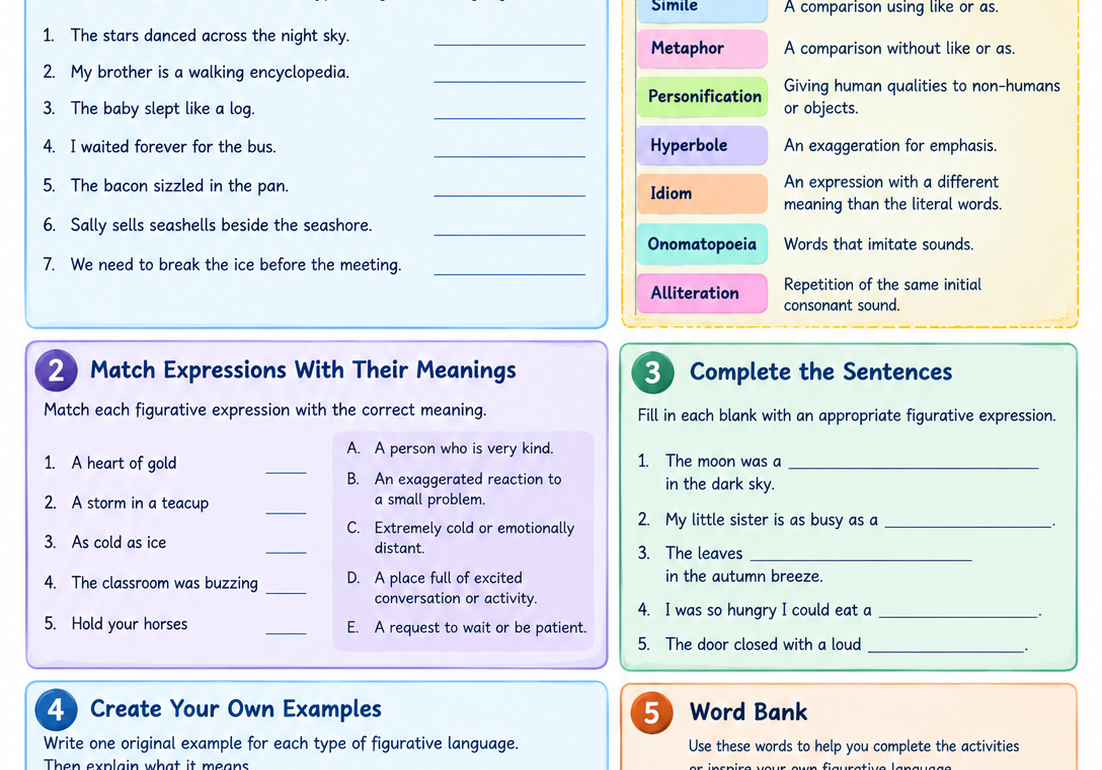
Activity 1: Identify the Literary Device
Read each sentence and identify the figurative language used.
- The stars danced across the night sky.
- My brother is a walking encyclopedia.
- The baby slept like a log.
- I waited forever for the bus.
- The bacon sizzled in the pan.
- Sally sells seashells beside the seashore.
- We need to break the ice before the meeting.
Students should label each sentence as personification, metaphor, simile, hyperbole, onomatopoeia, alliteration, or idiom.
Activity 2: Match Expressions With Their Meanings
Match each expression to its intended meaning.
- A heart of gold
- A storm in a teacup
- As cold as ice
- The classroom was buzzing
- Hold your horses
Meanings: a person who is very kind; an exaggerated reaction to a small problem; extremely cold or emotionally distant; a place full of excited conversation or activity; and a request to wait or be patient.
This type of figurative language worksheet encourages students to use context clues and understand expressions that appear in everyday communication.
Activity 3: Complete the Sentences
Complete each sentence with an appropriate figurative expression.
- The moon was a ______ in the dark sky.
- My little sister is as busy as a ______.
- The leaves ______ in the autumn breeze.
- I was so hungry I could eat a ______.
- The door closed with a loud ______.
Students can suggest different answers as long as the completed sentences make sense. Encourage them to explain why their choices fit the context.
Activity 4: Create Original Examples
Ask students to write one original example of a simile, metaphor, personification, hyperbole, idiom, and alliteration. They should then explain the meaning of each sentence.
For example, a student might write, “The city was a sleeping giant.” This metaphor suggests that a large city is quiet or inactive, perhaps late at night.
Creating original expressions helps students move beyond memorization and apply their knowledge independently.
How to Use Worksheets in the Classroom
Teachers can introduce figurative language with short, familiar examples before distributing practice sheets. Reading a sentence aloud and discussing its meaning allows students to hear the expression and understand its effect.
After the introduction, students can complete a figurative language worksheet individually, in pairs, or in small groups. Pair work encourages discussion because learners may interpret an expression differently or identify more than one possible meaning.
Teachers should also include examples from age-appropriate stories, poems, and classroom reading materials. Connecting activities to texts students already know makes literary devices easier to recognize.
For assessment, instructors can review answers, ask students to explain their reasoning, and provide feedback on misunderstandings. A short writing task at the end of the lesson can show whether learners can apply the concepts rather than simply recognize definitions.
Choosing the Right Worksheet for Each Grade
Elementary students generally benefit from simple sentences, clear illustrations, matching tasks, and familiar expressions. Beginning learners should focus on distinguishing literal language from figurative language before studying many literary devices at once.
Middle school students can work with more complex examples drawn from poems, short stories, and nonfiction passages. Their activities may require them to explain how a metaphor or simile affects tone, mood, or meaning.
High school students can analyze figurative language in literature, compare different interpretations, and explain how authors use imagery and symbolism to develop themes. They can also revise their own writing to make descriptions more precise and expressive.
When selecting a figurative language worksheet, consider students’ reading levels, prior knowledge, and learning objectives. The most useful resource challenges learners without making the instructions unnecessarily complicated.
Tips for Helping Students Succeed
Start with familiar examples from daily life. Expressions such as “I’m freezing” or “Time flies” give students an accessible introduction to nonliteral meaning.
Teach one or two devices at a time when learners are new to the topic. Comparing a simile with a metaphor, for example, helps students notice that both involve comparisons but use different structures.
Encourage students to explain their answers in their own words. Correct identification matters, but understanding the intended meaning is equally important. When students make mistakes, ask guiding questions instead of immediately giving the answer.
Finally, connect worksheet practice to real reading and writing. Invite students to find figurative expressions in books, describe everyday situations creatively, or write a short poem using several literary devices. Repeated practice builds confidence and helps students retain what they learn.
Conclusion
Figurative language gives ordinary words greater depth, emotion, and imagination. By learning to recognize similes, metaphors, personification, hyperbole, idioms, onomatopoeia, and alliteration, students develop stronger reading comprehension and more expressive writing skills. A carefully prepared figurative language worksheet provides structured opportunities to identify literary devices, interpret meanings, and create original examples. Teachers and parents can adapt these activities to different ages and abilities, making language arts lessons more engaging and effective. With regular practice, students can understand figurative expressions more confidently and use them to communicate their own ideas with clarity, creativity, and purpose.
Frequently Asked Questions
What is a figurative language worksheet?
A figurative language worksheet is an educational resource that helps students recognize, interpret, and use expressions whose meanings go beyond literal definitions.
What are the seven common types of figurative language?
Seven commonly taught types are simile, metaphor, personification, hyperbole, idiom, onomatopoeia, and alliteration. Some curricula also include symbolism, irony, and other literary devices.
Which grade levels can use these worksheets?
Elementary, middle, and high school students can all benefit. The difficulty of the examples and activities should match each learner’s reading ability and prior knowledge.
How can students improve their figurative language skills?
Students can practice identifying expressions, explaining their meanings, reading poems and stories, and writing their own examples. Regular feedback also helps them recognize mistakes and improve.
Can teachers use worksheets for assessment?
Yes. Teachers can use identification questions, matching exercises, sentence completion, and original-writing tasks to assess students’ understanding and identify concepts that need further instruction.