



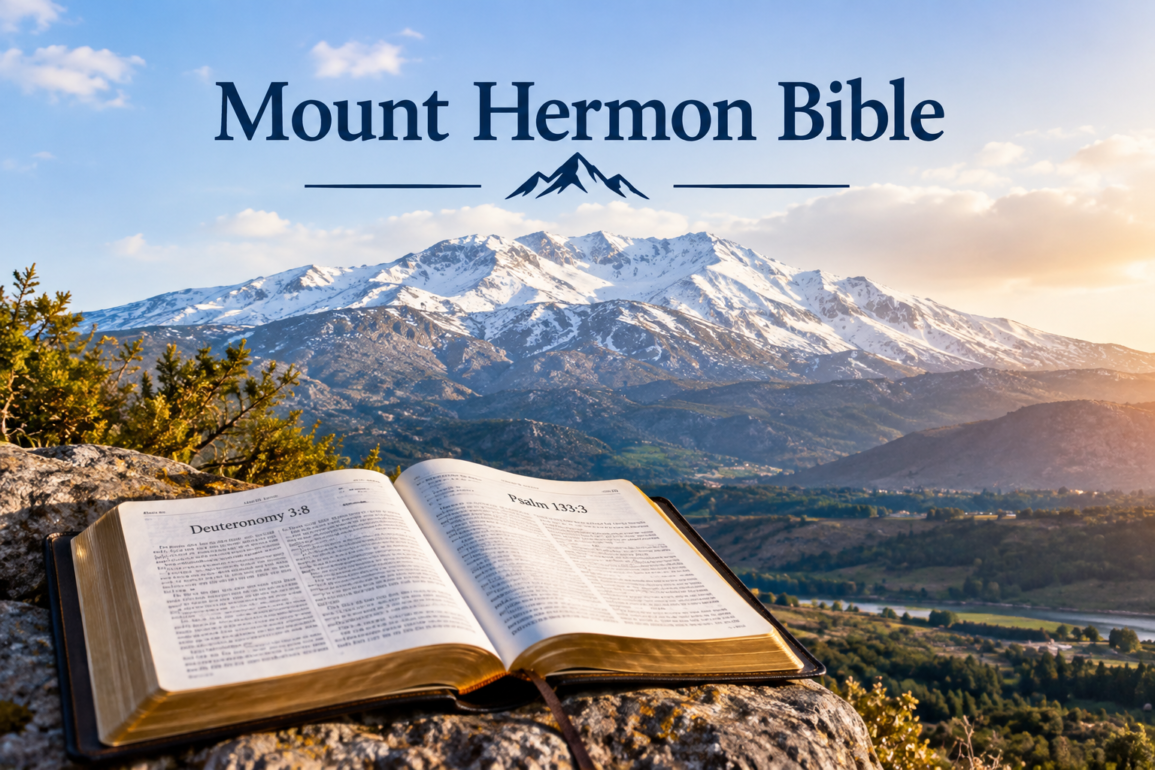
The Mount Hermon Bible references connect one of the most prominent mountains in the ancient Near East with important geographical, historical, and theological themes. Mount Hermon stands near the modern borders of Israel, Lebanon, and Syria and has long been recognized for its impressive height, snow-covered summit, and strategic location. Its importance extends beyond geography because biblical writers associated the mountain and its surrounding region with boundaries, worship, natural imagery, and significant events in Israel’s history.
Understanding the Mount Hermon Bible references can help readers appreciate how geography shaped biblical narratives. Mountains frequently appear in Scripture as places of revelation, worship, refuge, and encounters with God. While Mount Hermon does not receive as much attention as Mount Sinai or the Mount of Olives, its biblical references provide valuable insight into the landscape of the ancient world.
Where Is Mount Hermon?
Mount Hermon is a mountain range located in the Anti-Lebanon Mountains. Its highest point rises to approximately 2,814 meters above sea level, making it one of the highest mountains in the region. The range extends across territory associated today with Syria and Lebanon, while the southwestern slopes are connected with the Golan Heights.
The geographical setting is especially important when studying the Mount Hermon Bible passages. The mountain lies close to the northern limits of ancient Israel and near the source areas of several important rivers and streams. Its snow and rainfall contribute to the water resources of the region.
Because of its height, mount hermon bible is visible from considerable distances. Ancient travelers and communities could therefore use it as a major geographical landmark.
Mount Hermon in the Old Testament
The Old Testament mentions Hermon in several contexts. One important reference appears in Deuteronomy, where Moses describes the territories conquered east of the Jordan River. The mountain is associated with the Amorite territory ruled by Og of Bashan.
Deuteronomy 3:8 identifies the territory beyond the Jordan and specifically mentions Mount Hermon. The passage also records different names used for the mountain by surrounding peoples. This demonstrates that Hermon was not merely a physical landmark but also an important part of the political and cultural geography of the ancient region.
Another useful Mount Hermon Bible reference appears in Psalm 133:3. The psalm compares the refreshing unity of God’s people to the dew of Hermon descending upon the mountains of Zion. This poetic comparison highlights Hermon’s reputation for abundant moisture and refreshing conditions.
The biblical writers often used familiar features of the natural world to communicate spiritual ideas. Mount Hermon’s dew became a powerful image of blessing and renewal.
The Meaning of Hermon in Scripture
The name Hermon is commonly connected with the idea of something sacred or set apart, although scholars discuss the precise linguistic background. The mountain’s ancient importance may also have influenced how biblical writers described it.
The Mount Hermon Bible theme therefore involves more than identifying a location. Hermon represents a recognizable part of the biblical landscape and provides imagery that helped ancient readers understand concepts such as blessing, greatness, boundaries, and divine creation.
Psalm 133 is particularly significant because it transforms a geographical feature into a spiritual metaphor. The abundant dew associated with Hermon represents something life-giving and refreshing.
Mount Hermon and Psalm 133
Psalm 133 is among the best-known passages associated with Hermon. It celebrates unity among God’s people and compares that unity to precious oil and refreshing dew.
The reference to Hermon is interesting because Zion and Hermon are geographically far apart. The psalm is not necessarily suggesting that physical dew literally travels from Hermon to Zion. Instead, the poet uses Hermon as a symbol of abundance and refreshment.
This Mount Hermon Bible connection demonstrates how biblical poetry uses geography creatively. Readers familiar with the mountain would immediately understand why its dew represented something generous and refreshing.
The imagery also reminds modern readers that biblical poetry often depends on knowledge of the natural environment.
Hermon and the Land of Bashan
Mount Hermon was closely associated with Bashan, a fertile region east of the Jordan. The Old Testament describes Bashan as a territory known for strong livestock, forests, and fertile land.
The connection between Hermon and Bashan appears repeatedly in biblical geography. When studying the Mount Hermon Bible passages, it is therefore helpful to consider the wider region rather than treating the mountain as an isolated location.
Bashan played a role in Israel’s early history after the Israelites entered the territory east of the Jordan. The defeat of King Og became an important part of Israel’s memory of God’s assistance and military victory.
Mount Hermon in the Psalms
Several Psalms refer to Hermon or its surrounding mountains. These passages frequently use the mountain as part of poetic descriptions of God’s creation and power.
Psalm 42:6, for example, mentions the land of the Jordan and the heights of Hermon. The setting contributes to the psalm’s emotional atmosphere. The writer describes distance, longing, and spiritual thirst while remembering God.
This is another important Mount Hermon Bible connection because it shows how biblical geography can support emotional expression. The mountain becomes part of a landscape associated with memory, distance, and longing for God.
Was Jesus Transfigured on Mount Hermon?
One of the most frequently discussed questions involving the Mount Hermon Bible topic concerns the Transfiguration of Jesus.
The Gospel accounts state that Jesus took Peter, James, and John up a high mountain, where His appearance was transformed before them. However, the Gospel writers do not name the mountain.
Some Christian traditions and scholars have suggested that Mount Hermon could have been the location because Jesus and His disciples were in the region of Caesarea Philippi shortly before the event. Mount Hermon is located near that area and is an obvious candidate when considering the geography.
However, Scripture does not explicitly identify Mount Hermon as the mountain of the Transfiguration. Therefore, it is more accurate to describe Hermon as a proposed location rather than a confirmed one.
This distinction is important for anyone researching the Mount Hermon Bible subject. Biblical facts should be separated from later interpretations and traditions.
Mount Hermon and Caesarea Philippi
Caesarea Philippi appears in the Gospel narrative shortly before the Transfiguration. Jesus asked His disciples who people believed He was, and Peter made his well-known confession that Jesus was the Christ.
The region around Caesarea Philippi was located near the base of Mount Hermon. This geographical relationship has led many readers to consider whether the mountain could have played a role in the events described afterward.
Nevertheless, the biblical text does not provide enough information to establish the exact location with certainty. The Mount Hermon Bible discussion is therefore best approached by recognizing both the geographical possibility and the textual limitation.
Ancient Religious Associations
Mount Hermon was also significant in the religious cultures surrounding ancient Israel. Various ancient peoples associated mountains with divine beings and sacred activity. Because mountains were elevated above ordinary settlements, they often became places connected with worship.
This background makes the Mount Hermon Bible references particularly interesting. Biblical writers lived in a world where mountains carried strong religious symbolism. Yet biblical Scripture consistently directs worship toward the God of Israel rather than toward nature itself.
Understanding the religious environment surrounding Hermon can therefore provide historical context without assuming that every ancient tradition represents biblical teaching.
Why Mount Hermon Matters Today
Modern visitors can still appreciate why Mount Hermon became such a memorable feature of the biblical landscape. Snow can cover its upper slopes during winter, while its elevation gives it a striking appearance compared with surrounding areas.
Its natural environment also helps explain the biblical references to dew, water, mountains, and fertility. Geography gives greater depth to passages that can otherwise seem abstract when read from a modern setting.
The Mount Hermon Bible topic is therefore valuable for students of Scripture, historians, travelers, and anyone interested in biblical geography.
What Mount Hermon Teaches About Biblical Geography
Biblical geography is not simply about memorizing locations. Places often influence the meaning and atmosphere of biblical passages. Mountains, deserts, rivers, valleys, and cities provided the physical setting for historical events and poetic imagery.
Mount Hermon demonstrates this clearly. Its height made it a recognizable landmark. Its climate helped explain references to dew and water. Its location connected it with Bashan, Caesarea Philippi, and territories north of ancient Israel.
Studying the Mount Hermon Bible references alongside maps and historical context can therefore make Scripture easier to understand.
Frequently Asked Questions
Where is Mount Hermon mentioned in the Bible?
Mount Hermon is mentioned in several Old Testament passages, including Deuteronomy and Psalms. It appears primarily in geographical and poetic contexts.
What does Mount Hermon symbolize in the Bible?
Mount Hermon is especially associated with refreshing dew, abundance, geographical greatness, and the northern landscape of ancient Israel.
Was Jesus transfigured on Mount Hermon?
The Bible does not name the mountain where the Transfiguration occurred. Mount Hermon is one proposed location, partly because of its proximity to Caesarea Philippi, but this cannot be confirmed from Scripture.
Why is Mount Hermon important?
Mount Hermon was geographically significant because of its height, water resources, and location. It also became an important image in biblical poetry.
Does Psalm 133 mention Mount Hermon?
Yes. Psalm 133 compares the blessing of unity to the refreshing dew associated with Hermon.
Conclusion
The Mount Hermon Bible references reveal how deeply biblical writing is connected with geography, history, nature, and symbolism. From the territorial descriptions in Deuteronomy to the refreshing imagery of Psalm 133, Hermon appears as a distinctive landmark within the biblical world.
Although some traditions connect Mount Hermon with the Transfiguration, Scripture does not explicitly confirm that identification. A careful study should therefore distinguish between what the Bible directly states and what later interpretation suggests.
Ultimately, the Mount Hermon Bible topic offers more than information about an ancient mountain. It provides a window into the physical world in which biblical events occurred and helps modern readers understand why mountains, water, dew, and landscapes carried such powerful meaning in Scripture.