




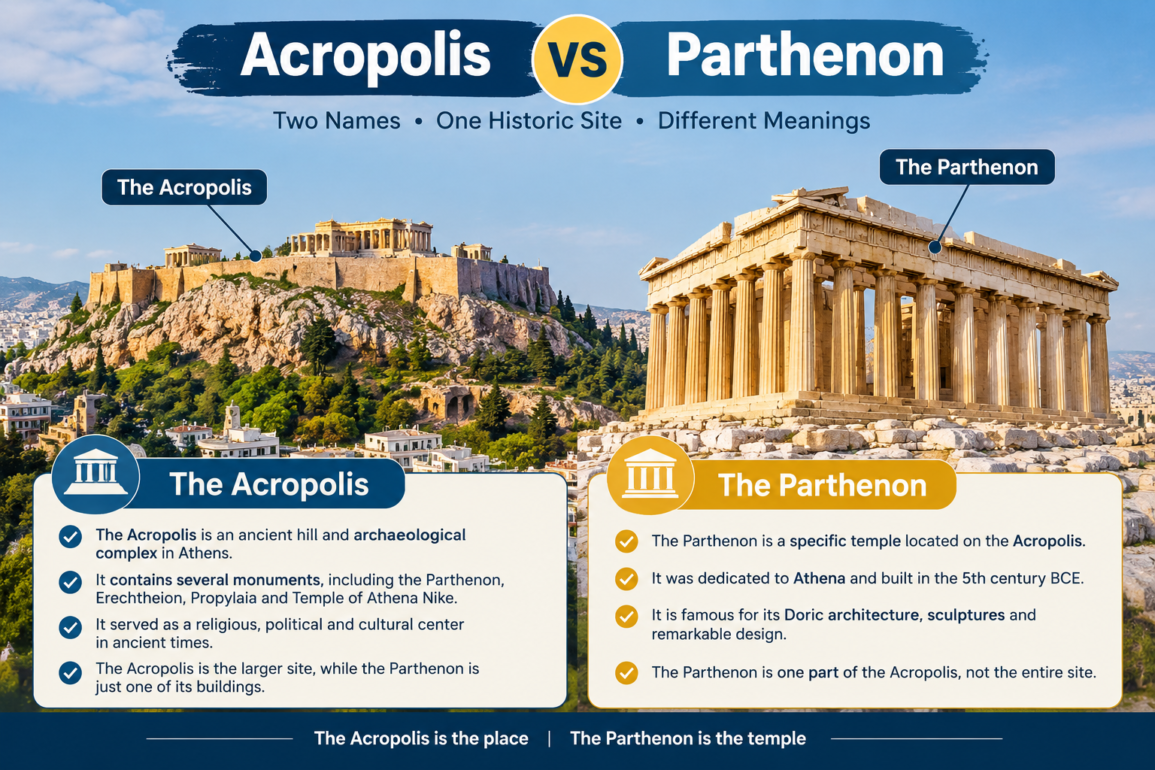
When exploring ancient Athens, two names appear again and again: the Acropolis and the Parthenon. Because both are closely connected and stand in the same historic area, visitors often use the terms as if they describe the same monument. However, they are not identical. Understanding the difference between them makes a visit to Athens more meaningful and helps explain why these landmarks remain important symbols of ancient Greek civilization.
The simplest way to understand the acropolis vs parthenon comparison is to remember that the Acropolis is the larger fortified hill and archaeological complex, while the Parthenon is one particular temple located on that hill. The Acropolis contains several important structures, sacred spaces, and monuments, whereas the Parthenon was built as a temple dedicated to Athena. Their relationship is therefore one of place and structure rather than two separate sites located far apart.
What Is the Acropolis?
The Acropolis is an ancient citadel situated on a rocky limestone hill above Athens. The word “Acropolis” broadly means “upper city,” reflecting its elevated position. Although several Greek cities had acropoleis, the Acropolis of Athens became the most famous because of its extraordinary collection of classical monuments.
This acropolis vs parthenon has a long history that extends well beyond the Classical period. People occupied and used the area during earlier stages of Greek history, and its religious importance developed over many centuries. During the fifth century BCE, Athens undertook a major building program that transformed the summit into an impressive sacred complex.
When examining acropolis vs parthenon, it is important to understand that the Acropolis includes much more than one temple. The site contains the Parthenon, the Erechtheion, the Propylaia, and the Temple of Athena Nike, along with other archaeological remains.
The Acropolis as a Sacred Center
Ancient Athenians considered the Acropolis a major religious center. Many of its monuments were associated with Athena, the city’s patron goddess. Religious ceremonies, offerings, and festivals helped establish the hill as an important part of Athenian public and spiritual life.
The elevated setting also contributed to its visual power. From different parts of Athens, the monuments could be seen rising above the city, reinforcing the importance of the sacred hill.
What Is the Parthenon?
The Parthenon is a specific temple on the Acropolis. It was constructed during the fifth century BCE, principally between approximately 447 and 432 BCE, during the period commonly associated with the leadership of Pericles.
The temple was dedicated to Athena Parthenos, an aspect of Athena associated with her identity as a maiden. The building was designed by architects Iktinos and Kallikrates, while the sculptural program is traditionally associated with the sculptor Phidias and his workshop.
The Parthenon is especially famous for its Doric architectural character, although it incorporates several Ionic features. Its columns, sculptural decoration, proportions, and carefully calculated visual refinements demonstrate the sophistication of classical Greek architecture.
In an acropolis vs parthenon comparison, the Parthenon should therefore be described as one component of the Acropolis rather than an alternative name for the entire hill.
Acropolis vs Parthenon: The Main Difference
The central distinction becomes easy when the two are placed side by side conceptually. The Acropolis is the site or complex, while the Parthenon is a temple within that complex.
Think of the Acropolis as a historic campus containing several important buildings. The Parthenon is one of those buildings. This comparison makes it easier to understand why someone can visit the Acropolis without seeing only the Parthenon.
The Acropolis includes multiple monuments with different functions and histories. The Parthenon has a much more specific purpose and architectural identity.
Architecture and Design
Architecture provides another useful way to understand the acropolis vs parthenon distinction. The Acropolis itself is not a single building with one architectural style. It is a collection of structures created or modified during different periods.
The Parthenon, on the other hand, acropolis vs parthenon is a clearly defined temple. Its design follows the principles of classical Greek architecture while introducing sophisticated refinements.
Doric Features of the Parthenon
The Parthenon is primarily Doric. Its acropolis vs parthenon exterior features a colonnade of sturdy columns with relatively simple capitals. Above the columns, the entablature contains alternating triglyphs and metopes, characteristic features of the Doric order.
However, the temple also includes Ionic elements, showing that ancient Greek architects did not always follow architectural orders in completely rigid ways.
Visual Refinements
One of the remarkable characteristics of the Parthenon is its use of subtle optical adjustments. The architects incorporated slight curves and variations into different parts of the structure. These acropolis vs parthenon refinements helped create a visually balanced appearance when viewed from the ground.
Such details demonstrate that the Parthenon was not simply a large rectangular building surrounded by columns. Its design involved careful planning, mathematical relationships, and an advanced understanding of visual perception.
Other Important Structures on the Acropolis
A complete acropolis vs parthenon explanation should also consider the other monuments found on the Acropolis.
The Erechtheion is particularly notable for its unusual plan and its famous Caryatid Porch, where sculpted female figures serve as architectural supports. The building had connections to several important religious traditions associated with Athens.
The Temple of Athena Nike is a smaller Ionic temple positioned near the entrance area. It was dedicated to Athena in her role as a goddess associated with victory.
The Propylaia served as the monumental gateway to the Acropolis. Its impressive architecture created a formal entrance to the sacred complex.
Together, these structures show why the Acropolis cannot be reduced to the Parthenon alone.
Historical Changes to the Parthenon
The Parthenon has experienced significant changes throughout its long history. Although originally constructed as a temple, it was later converted into a Christian church. During the Ottoman period, it became a mosque.
The building also suffered severe damage in the seventeenth century. In 1687, during a Venetian attack on Athens, ammunition stored inside the Parthenon exploded after the building was struck. The explosion caused major destruction to the structure and its sculptural decoration.
Later removal of sculptures also affected the monument. Some Parthenon sculptures are now held in museums outside Greece, while others remain in Athens. The ownership and potential reunification of these sculptures continue to be subjects of international cultural discussion.
Why the Acropolis Is More Than the Parthenon
The acropolis vs parthenon distinction becomes especially important when considering archaeology. The Acropolis represents centuries of religious, political, architectural, and cultural development. The Parthenon represents one extraordinary phase within that larger story.
The hill contains evidence from different historical periods, including earlier settlements and later modifications. Its monuments reveal how Athens changed over time.
For this reason, describing the Acropolis simply as “the Parthenon” leaves out important historical information. Likewise, describing the Parthenon as the entire Acropolis overlooks the other buildings and archaeological features that make the site significant.
Religious Significance
Religion played a central role in ancient Greek society, and both the Acropolis and Parthenon were closely connected with religious traditions.
The Acropolis functioned as a broader sacred landscape containing multiple religious monuments. The Parthenon was one of its most prominent temples and was associated particularly with Athena.
The temple originally housed a monumental image of Athena Parthenos. Ancient sources describe the statue as an exceptionally valuable work featuring gold and ivory. Although the original statue no longer survives, historical accounts help researchers understand its importance.
Cultural Importance Today
The acropolis vs parthenon discussion is not only about ancient architecture. Both names have become symbols of Greek cultural heritage and the classical world.
The Acropolis attracts visitors because it offers a broader experience of ancient Athens. Visitors can walk through the monumental gateway, see several temples, and observe the relationship between architecture and the surrounding city.
The Parthenon attracts particular attention because of its recognizable design and historical importance. Images of its columns and surviving structure have appeared in books, museums, educational materials, and cultural discussions around the world.
Acropolis vs Parthenon for Visitors
For someone planning a visit to Athens, understanding acropolis vs parthenon can make the experience much easier. A ticket or visit associated with the Acropolis generally refers to access to the archaeological site and its monuments, not simply entry into the Parthenon.
Visitors should allow enough time to explore the wider area rather than focusing exclusively on one building. The surrounding monuments provide important context for understanding why the Acropolis became one of the most significant architectural landscapes of the ancient Mediterranean.
The elevated location also provides broad views across Athens. Seeing the city from the Acropolis helps visitors appreciate its geographic relationship with the surrounding landscape.
Common Misunderstandings About the Two
One common misunderstanding is that the Acropolis and Parthenon are two completely separate attractions. They are not. The Parthenon stands on the Acropolis.
Another misunderstanding is that the Acropolis is itself a single temple. It is not. The Acropolis is a fortified hill and archaeological complex containing several important monuments.
A third misconception is that everything visible today dates from exactly the same period. In reality, the site reflects many centuries of construction, destruction, rebuilding, religious transformation, and conservation.
Understanding these differences makes the acropolis vs parthenon comparison much clearer.
Why the Difference Matters
Learning the distinction between these two names helps visitors and students discuss ancient Athens more accurately. When someone says “Acropolis,” they are referring to the broader historic site. When they say “Parthenon,” they are identifying a particular temple within that site.
The relationship is similar to a large historic district containing a famous individual building. The building can be the most recognizable part of the district without representing the entire area.
That is the key to understanding the acropolis vs parthenon relationship.
Conclusion
The acropolis vs parthenon comparison becomes straightforward once their roles are understood. The Acropolis is the ancient hill and archaeological complex that contains several important monuments. The Parthenon is one of the most famous temples located on that hill and was dedicated to Athena.
Both have played important roles in the history of Athens, but they represent different levels of the same historic landscape. The Acropolis provides the wider setting, while the Parthenon stands as its most recognizable architectural monument. Exploring both perspectives gives visitors a deeper appreciation of ancient Greek architecture, religion, history, and cultural heritage.
Understanding acropolis vs parthenon is therefore more than learning two definitions. It is a way to see how individual monuments fit into a much larger historical story.