




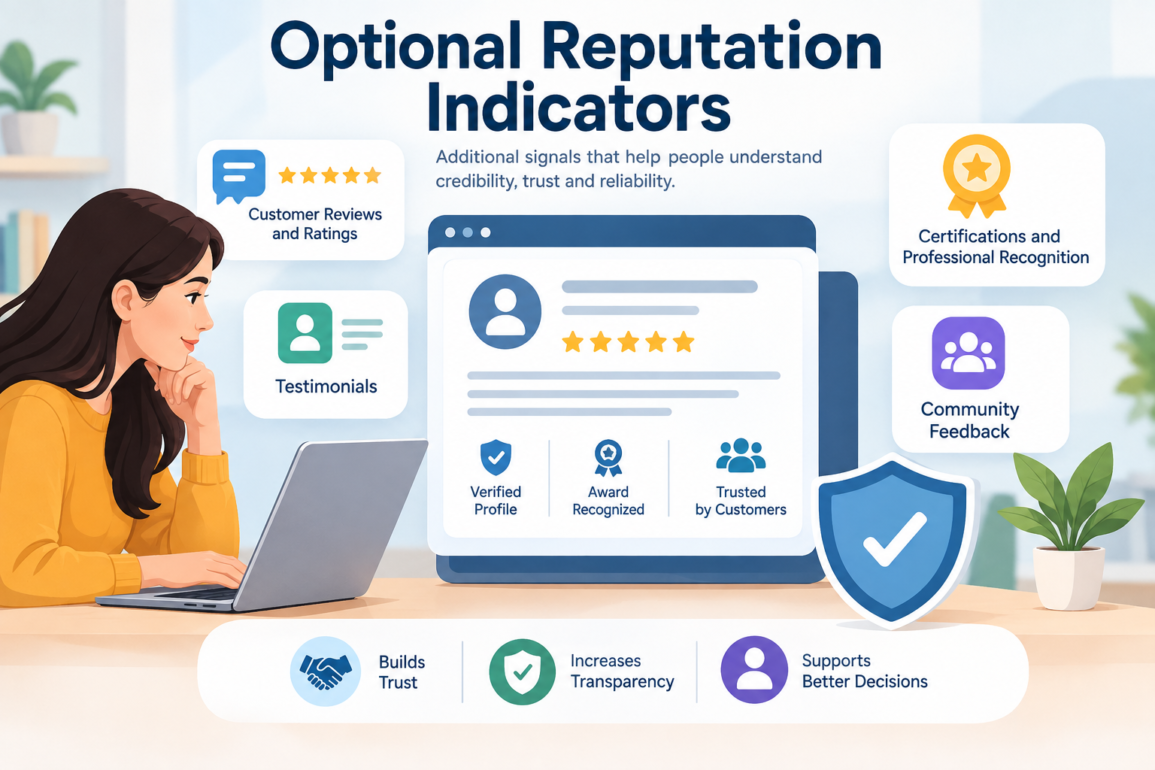
In today’s digital environment, reputation plays an important role in how people evaluate websites, businesses, professionals, products, and online communities. A strong reputation can create confidence, while unclear or inconsistent information can make visitors hesitate before taking action. This is where optional reputation indicators can provide useful context. These indicators offer additional signals that may help users understand credibility, reliability, experience, or community perception without making them mandatory requirements.
Understanding optional reputation indicators is particularly useful for website owners, digital marketers, business professionals, and online platform managers. When presented responsibly, these signals can improve transparency and help visitors make informed decisions. However, reputation indicators should support genuine information rather than replace evidence, customer experiences, or established trust signals.
What Are Optional Reputation Indicators?
Optional reputation indicators are additional pieces of information that can communicate how a person, organization, website, or product is perceived. They are described as optional because they are not always required for participation, verification, or access to a service.
These indicators can take many forms. Examples may include ratings, testimonials, community feedback, experience badges, professional achievements, customer satisfaction information, review summaries, or participation records. Their purpose is generally to provide context rather than serve as an absolute measure of credibility.
For example, a website may display customer reviews alongside information about its services. A professional profile might mention industry awards or certifications. An online community could show contribution history or feedback from other members. Each of these can function as a reputation-related signal.
Why Reputation Indicators Matter
Trust has become increasingly important in online interactions. Visitors often have limited information about an unfamiliar website or business, so they look for signals that help them assess whether the source deserves attention.
Well-designed optional reputation indicators can make this process easier by presenting relevant information in a visible and understandable way. Instead of forcing visitors to search through multiple pages, a platform can provide useful context close to the information being evaluated.
Reputation signals can also improve transparency. When businesses clearly explain where ratings, reviews, or recognition come from, users can better understand what those signals actually represent.
However, reputation indicators should not be treated as automatic proof of quality. A rating or badge provides one piece of information. Users may still need to consider pricing, policies, experience, qualifications, independent reviews, and other evidence.
Common Types of Optional Reputation Indicators
Customer Reviews and Ratings
Customer feedback is one of the most familiar forms of reputation information. Reviews can describe real experiences and may highlight strengths or weaknesses that are not immediately obvious from a company’s own marketing materials.
Optional reputation indicators based on customer feedback should ideally provide enough context for users to understand what the rating represents. Showing the number of reviews, date ranges, or review criteria can make the information more meaningful.
Testimonials
Testimonials allow customers or users to describe their experiences in their own words. They can provide a more detailed perspective than a simple numerical rating.
Authentic testimonials can be useful because they explain why someone found a service, product, or organization valuable. Businesses should avoid presenting testimonials in ways that create misleading impressions.
Certifications and Professional Recognition
Certifications, awards, memberships, and professional achievements can also act as reputation signals. Their value depends on the organization providing the recognition and the requirements associated with receiving it.
For this reason, optional reputation indicators involving certifications should include accurate descriptions whenever possible. A badge without context may not tell visitors much about what was actually assessed.
Community Feedback
Online platforms often develop reputation systems through user participation. Members may receive feedback based on helpful contributions, completed transactions, or interactions with other users.
Community-based indicators can be particularly valuable on marketplaces, forums, collaborative platforms, and social networks. They can help participants identify experienced or consistently active members.
How Optional Reputation Indicators Support Trust
Trust develops when people can understand information and evaluate it independently. Optional reputation indicators can contribute to that process by giving visitors additional evidence.
For example, a new customer may hesitate to interact with an unfamiliar business. Seeing transparent reviews, relevant credentials, or verified customer feedback may provide additional context.
The important point is that these indicators should complement other information. A company with positive reviews should still provide clear contact details, policies, pricing information, and accurate service descriptions.
Similarly, an individual with a professional recognition badge should not be assumed to have expertise in every area. The relevance of the indicator matters.
Using Reputation Signals Responsibly
Organizations should use optional reputation indicators carefully. The goal should be to inform users rather than manipulate their decisions.
One important principle is accuracy. Reputation information should reflect genuine experiences, qualifications, or achievements. Organizations should not create artificial reviews or misleading badges to make their reputation appear stronger.
Another principle is clarity. Visitors should understand what an indicator means. If a badge represents participation rather than expertise, that distinction should be clear.
Transparency also matters when displaying ratings. A score based on three reviews can have a very different context from a score based on thousands of reviews. Providing supporting information helps users interpret the signal more effectively.
The Difference Between Required and Optional Indicators
The distinction between required and optional information is important. Required indicators may be necessary to meet a particular standard, regulation, platform rule, or verification process. Optional indicators, on the other hand, provide additional context.
For example, a platform may require identity verification before allowing a user to sell products. A seller’s customer rating might then function as an additional reputation signal.
In this situation, optional reputation indicators do not replace mandatory requirements. Instead, they supplement them with information that may help other users understand the seller’s history.
This distinction prevents reputation systems from becoming confusing. Users should know which information represents an official requirement and which information is supplementary.
Designing Effective Reputation Indicators
Good reputation indicators should be easy to understand and relevant to the user’s decision. Businesses should avoid displaying excessive badges, icons, or scores simply to make a page appear more trustworthy.
A useful indicator answers a practical question. Does it show experience? Does it demonstrate customer satisfaction? Does it identify professional recognition? Does it indicate community participation?
When designing optional reputation indicators, organizations should also consider accessibility. Important information should not be communicated through color or icons alone. Text descriptions can make reputation information easier for a wider range of visitors to understand.
The placement of indicators matters as well. A relevant reputation signal should appear near the information it supports rather than being hidden in an unrelated section.
Potential Limitations
Although optional reputation indicators can be useful, they also have limitations. Reputation can change over time, and a historical achievement may not accurately describe a current situation.
Ratings can also be affected by review volume, customer expectations, sampling differences, or unusual experiences. A small number of reviews may not provide enough information to establish a reliable overall impression.
Some indicators may also be difficult to compare. One organization might use a five-star system, while another uses percentages or recommendation rates.
Therefore, users should consider reputation signals as part of a broader evaluation process rather than treating them as definitive proof.
Reputation Indicators and Digital Marketing
Digital marketing increasingly depends on credibility. Visitors want useful information, authentic experiences, and clear evidence before engaging with unfamiliar brands.
Optional reputation indicators can support digital marketing by highlighting genuine customer experiences, professional recognition, or community participation. When used ethically, they can make important credibility information easier to discover.
However, reputation signals should never replace valuable content. Search engines and users both benefit from websites that provide original, accurate, useful information.
Businesses should therefore combine reputation signals with strong content, transparent policies, good customer service, and a clear online presence.
Best Practices for Businesses
Businesses using optional reputation indicators should focus on authenticity and relevance. Every displayed indicator should have a clear purpose and should be supported by accurate information.
Companies should regularly review their reputation data to ensure that outdated information does not remain prominent. If an award has expired or a certification is no longer valid, the associated indicator should be updated or removed.
It is also useful to explain the source of a reputation signal. A visitor should not have to guess whether a rating comes from verified customers, community members, employees, or another group.
Most importantly, businesses should avoid manipulating reputation systems. Artificial reviews, misleading claims, and unclear badges can damage trust instead of strengthening it.
The Future of Reputation Signals
As online interactions continue to grow, reputation systems are likely to remain important. Users need ways to evaluate unfamiliar sources, particularly when they cannot interact with a business or professional in person.
Future optional reputation indicators may become more transparent and detailed. Platforms may provide better explanations of how ratings are calculated, how feedback is verified, and how old information is.
Technology may also make it easier for users to distinguish between verified information and general opinions. Even so, the basic principle will remain the same: reputation information is most useful when it is accurate, relevant, understandable, and presented in context.
Conclusion
Optional reputation indicators can provide valuable context in digital environments where trust and credibility matter. Reviews, testimonials, professional recognition, community feedback, and other signals can help users understand a source without replacing more important evidence.
The effectiveness of these indicators depends largely on how they are created and presented. Transparent information can support informed decisions, while exaggerated or misleading signals can have the opposite effect. Businesses and online platforms should therefore focus on authenticity, clarity, accessibility, and relevance.
When used responsibly, optional reputation indicators can become a useful part of a broader trust-building strategy. They work best when combined with accurate information, genuine experiences, strong service, and transparent communication. Ultimately, reputation should be supported by real value rather than appearances alone.