


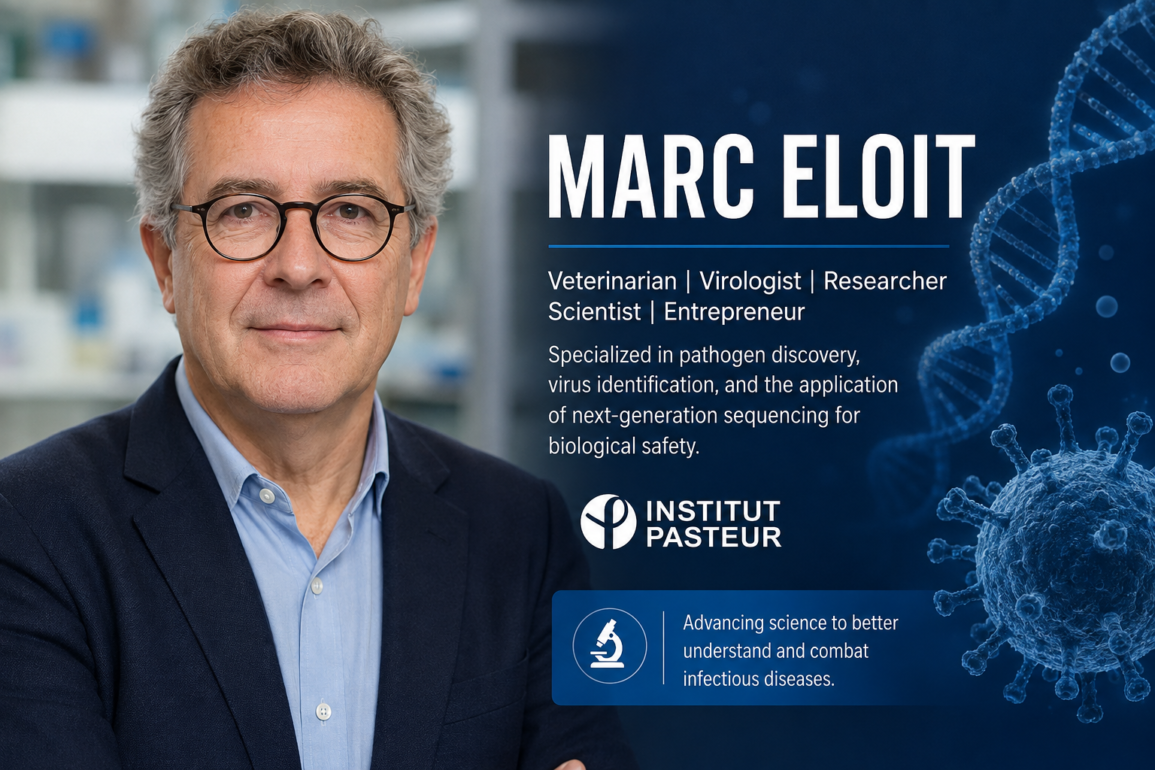
Marc Eloit is a French veterinarian, virologist, researcher, and scientific advisor known for his work in pathogen discovery and biological safety. His career connects veterinary medicine, infectious disease research, genomics, and biotechnology. He has worked with major scientific institutions, including the Institut Pasteur, and has contributed to research focused on identifying viruses that may otherwise remain difficult to detect.
His professional journey also includes academic teaching, laboratory leadership, regulatory expertise, and entrepreneurship. In 2010, he founded PathoQuest, a company created as an Institut Pasteur spin-off to apply untargeted next-generation sequencing to pathogen identification and biological safety. This combination of research and practical innovation has made his work relevant to modern infectious disease investigation.
Who Is Marc Eloit?
Marc Eloit is a scientist specializing in virology and infectious diseases. He trained as a veterinarian at the École Nationale Vétérinaire d’Alfort and later earned a PhD from Pierre and Marie Curie University. His scientific career developed around the study of viruses, pathogen discovery, and methods for identifying infectious agents.
His work has involved both human and animal health. This broad perspective is important because many infectious diseases can cross boundaries between humans, animals, and the environment. By investigating pathogens across these areas, researchers can better understand emerging disease risks and improve diagnostic approaches.
Academic and Scientific Background
Veterinary Medicine and Virology
Eloit’s veterinary education provided an important foundation for his later research. Rather than focusing exclusively on clinical veterinary practice, he developed expertise in virology and infectious disease research. He subsequently became a Professor of Virology at the Veterinary School of Maisons-Alfort.
His academic work demonstrates how veterinary science can contribute to wider medical research. Viruses affecting animals can sometimes provide valuable information about viral evolution, transmission, and potential threats to humans. This makes collaboration between veterinary and human medicine particularly valuable.
Work at Institut Pasteur
A significant stage of his career took place at Institut Pasteur in Paris. He became associated with pathogen discovery research and led the Pathogen Discovery Laboratory. According to professional profiles, he held this leadership position until October 2023.
The laboratory’s research has focused on discovering new or unexpected infectious agents, including pathogens involved in clinical conditions whose causes may initially be unknown. Institut Pasteur also identifies clinical metagenomics as an important research area connected with his work.
Marc Eloit and Pathogen Discovery
Pathogen discovery is one of the most important themes associated with Marc Eloit’s scientific career. Traditional diagnostic methods often begin with a specific hypothesis about the organism causing an illness. Researchers may test for known viruses, bacteria, or other infectious agents.
Modern sequencing can approach the problem differently. Instead of looking only for one suspected organism, researchers can analyze genetic material in a sample and search for unexpected biological signals. This approach can help investigators identify pathogens that conventional tests may overlook.
Eloit’s research has contributed to this broader approach through the use of high-throughput and next-generation sequencing techniques. His work has addressed pathogen identification in humans and investigations involving animal reservoirs.
Clinical Metagenomics
Clinical metagenomics allows researchers to examine genetic material from biological samples to investigate possible infectious causes. The approach can be particularly useful when a patient presents with a serious illness but routine diagnostic testing does not provide a clear explanation.
Institut Pasteur describes a project associated with Marc Eloit that aims to improve knowledge of the human virome during health and disease. The research particularly considers immunocompromised patients, where unusual infections and associations between pathogens and disease may occur more frequently.
This area of research demonstrates why sequencing technology has become increasingly important in modern infectious disease science.
Contribution to Virus Discovery
Marc Eloit’s research record includes numerous publications involving viruses and infectious diseases. His work has contributed to the identification and investigation of viral agents, including research involving unexpected or previously poorly characterized pathogens.
One example is a patent concerning the identification of a novel human polyomavirus known as IPPyV. The patent lists Marc Eloit among the inventors and describes methods related to identifying the virus and detecting exposure or infection.
Such research illustrates the practical value of pathogen discovery. Identifying an unfamiliar virus is only the beginning. Scientists must also determine its characteristics, possible hosts, biological significance, and potential methods for detection.
Role in Biological Safety
Another major part of Eloit’s career involves the safety of biological products. Biological medicines and related products require careful evaluation because unwanted viral contamination can create significant safety concerns.
Eloit served as a member of the Virus Safety of Medicinal Products Committee associated with the French medicines agency for many years. Professional biographies describe his experience in virus discovery and biological safety as central parts of his expertise.
This work connects laboratory research with regulatory decision-making. Scientific evidence can help organizations establish appropriate testing strategies and improve confidence in the safety of biological products.
Founding PathoQuest
From Academic Research to Biotechnology
In 2010, Marc Eloit founded PathoQuest, a spin-out from Institut Pasteur. The company was established to apply untargeted next-generation sequencing to the testing and characterization of biological products.
The creation of PathoQuest represents an important transition from academic research toward commercial biotechnology. Instead of keeping sequencing expertise within a research laboratory, the company developed services designed for organizations working with biological products.
PathoQuest continues to identify Marc Eloit as its founder and scientific advisor. The company’s profile states that he served as Chief Scientific Officer until 2016 and later continued as a scientific advisor.
Why PathoQuest Matters
The biotechnology sector increasingly depends on sensitive analytical methods. Next-generation sequencing can examine large quantities of genetic information and support comprehensive approaches to biological safety.
For this reason, the type of technology associated with PathoQuest can be valuable in areas where organizations need to investigate potential viral contamination or characterize biological materials. Eloit’s involvement demonstrates how scientific discoveries can move from university and institutional laboratories into applied technology.
Research Publications and Scientific Influence
Marc Eloit’s research has produced a substantial publication record. Research databases list him among scientists working primarily in biology, medicine, and infectious diseases, with research spanning virology, molecular biology, public health, and related fields.
His published work covers different aspects of pathogen discovery rather than one narrowly defined virus or disease. This breadth reflects the changing nature of infectious disease research, where scientists increasingly combine laboratory methods, sequencing, epidemiology, and computational analysis.
Recent publications associated with his name include research involving next-generation sequencing and severe encephalitis, demonstrating that pathogen discovery remains relevant to challenging clinical cases.
The Importance of Next-Generation Sequencing
Next-generation sequencing has changed how scientists investigate infectious diseases. Earlier diagnostic approaches often required researchers to know what organism they were searching for. Sequencing can provide a much broader view of genetic material present in a sample.
This does not mean sequencing replaces traditional diagnostics. Instead, it can complement established laboratory methods. Researchers can use sequencing to discover unexpected organisms, generate new hypotheses, and support further testing.
Marc Eloit’s career illustrates this transition. His work at the intersection of virology and sequencing demonstrates how technological advances can strengthen pathogen discovery and biological safety.
A One Health Perspective
A notable feature of Marc Eloit’s background is the connection between human and animal infectious disease research. His veterinary training and virology career provide a strong foundation for studying pathogens across species.
The One Health approach recognizes that human health, animal health, and environmental conditions are interconnected. Viruses can circulate among wildlife, domestic animals, and humans, creating opportunities for emerging infections.
Research into pathogens at the human-wildlife interface can therefore contribute to early understanding of potential disease threats. Professional biographies of Eloit describe his research as including viruses circulating at this interface.
Marc Eloit’s Current Professional Role
Marc Eloit’s professional profile has evolved from academic laboratory leadership toward scientific advising and biotechnology. PathoQuest currently identifies him as its Founder and Scientific Advisor.
His continued involvement in scientific discussions reflects the value of long-term expertise. Researchers and biotechnology organizations often benefit from specialists who understand both fundamental virology and the practical requirements of biological safety.
His career also demonstrates that scientific leadership can extend beyond laboratory research. Teaching, regulatory consultation, entrepreneurship, and scientific advising can all contribute to the development of a field.
Why Marc Eloit’s Work Is Significant
The significance of Marc Eloit’s work comes from the combination of several disciplines. His career includes veterinary science, virology, pathogen discovery, genomic technology, regulatory expertise, and biotechnology.
These fields are increasingly interconnected. Emerging infectious diseases require researchers to identify unfamiliar organisms quickly. Biological products require reliable safety testing. Clinical medicine sometimes encounters infections that conventional diagnostics cannot immediately explain.
By contributing to methods based on pathogen discovery and next-generation sequencing, Eloit has participated in an important transformation in infectious disease research. His work shows how scientific innovation can support both diagnosis and biological safety.
Conclusion
Marc Eloit has built a scientific career around one of modern medicine’s most important challenges: understanding and detecting infectious agents. His background in veterinary medicine and virology led to research at Institut Pasteur, where he became closely associated with pathogen discovery and sequencing-based investigation.
His founding of PathoQuest further demonstrates his ability to translate scientific knowledge into practical biotechnology. Through research, academic work, regulatory experience, and scientific advising, he has contributed to the development of modern approaches to virus discovery and biological safety. His career remains a useful example of how interdisciplinary science can address complex problems in infectious disease research.
Frequently Asked Questions
Who is Marc Eloit?
Marc Eloit is a French veterinarian and virologist known for research in pathogen discovery, virus identification, and biological safety. He has worked with Institut Pasteur and founded PathoQuest.
What is Marc Eloit known for?
He is particularly known for his work in virus discovery, next-generation sequencing, infectious disease research, and the safety testing of biological products.
Did Marc Eloit found PathoQuest?
Yes. Marc Eloit founded PathoQuest in 2010 as a spin-off from Institut Pasteur. The company focuses on applications of next-generation sequencing for biological testing and safety.
Where did Marc Eloit work?
He worked as a Professor of Virology at the Veterinary School of Maisons-Alfort and later held a leadership role at Institut Pasteur’s pathogen discovery laboratory.
Why is pathogen discovery important?
Pathogen discovery helps researchers identify infectious agents that may be unknown, unexpected, or difficult to detect through conventional diagnostic methods. It can improve understanding of unexplained diseases and emerging infection risks.