



Introduction
Learning words with IE is an important step for children, students, and English learners. The letter combination “ie” appears in many common English words and can represent different sounds depending on the word. Understanding how it works helps improve reading, spelling, pronunciation, and vocabulary.
Whether you are searching for 3-letter words with IE, 4-letter words with IE, 5-letter words with IE, 100 words with IE, or examples for kids, this guide covers everything in simple language.
You can also explore more educational learning resources at https://educationviews.uk/.
What Are Words with IE?
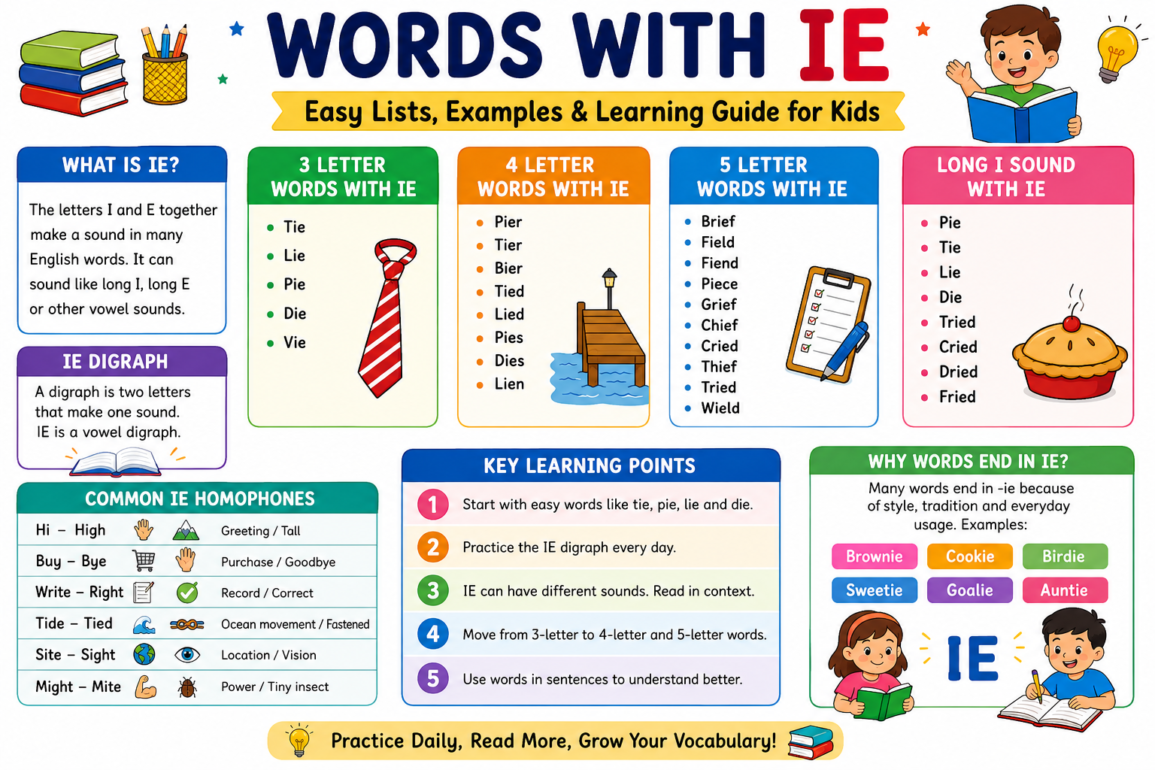
Words with IE contain the letters I and E together. Sometimes they produce a long “I” sound, while in other words they create a long “E” sound or another vowel sound depending on pronunciation.
Examples include:
- Tie
- Lie
- Pie
- Die
- Field
- Friend
- Piece
- Believe
Learning these patterns makes reading much easier.
What Is the IE Digraph?
An IE digraph is a pair of letters that usually works together to create one vowel sound. Instead of sounding each letter separately, readers pronounce them as a single sound.
For example:
- Tie
- Pie
- Lie
- Field
- Brief
Teachers often introduce IE digraphs during phonics lessons because they appear in many everyday words.
3 Letter Words with IE
These are excellent for beginners.
| Word | Meaning |
| Tie | A knot or necktie |
| Lie | To tell something untrue or rest down |
| Pie | A baked dessert |
| Die | To stop living |
| Vie | To compete |
4 Letter Words with IE
Here are common four-letter examples.
- Pier
- Tier
- Bier
- Lien
- Tied
- Lied
- Dies
- Pies
These are useful for spelling practice and classroom activities.
5 Letter Words with IE
Many learners search specifically for 5-letter words with IE.
Examples include:
- Brief
- Field
- Fiend
- Piece
- Grief
- Chief
- Fried
- Cried
- Tried
- Pried
- Wield
- Thief
These frequently appear in books, puzzles, and vocabulary tests.
Words with IE for Kids
Children learn faster with familiar words.
Some easy examples are:
- Pie
- Tie
- Lie
- Die
- Cried
- Tried
- Friend
- Field
- Piece
- Chief
- Brief
- Belief
Parents can encourage children to read these aloud every day.
📦 Main Learning Points
1. Learn Small Words First
Start with easy words like tie, pie, lie, and die before moving to longer vocabulary.
2. Practice the IE Digraph Daily
Reading the same words repeatedly helps improve pronunciation and spelling.
3. Notice Different Sounds
The letters IE do not always sound the same. Reading in context helps you recognize the correct pronunciation.
4. Build Vocabulary Gradually
Move from 3-letter words to 4-letter and 5-letter words for steady improvement.
5. Read Real Sentences
Using words inside sentences improves understanding much faster than memorizing lists alone.
Words with Long I Sound
Sometimes IE produces the long I sound.
Examples include:
- Pie
- Tie
- Lie
- Die
- Tried
- Cried
- Dried
- Fried
Reading these aloud helps students hear the pronunciation clearly.
100 Words with IE
Here is a collection of common words.
tie, lie, pie, die, vie, pier, tier, bier, tied, lied, pies, dies, field, brief, chief, grief, thief, piece, friend, belief, achieve, believe, relief, fierce, shield, yield, wield, cried, tried, dried, fried, flies, cried, replied, copied, viewed, species, cookie, movie, quiet, science, patient, variety, prairie, niece, cookie, brownie, goalie, priest, siege, friend, retrieve, relieve, shriek, pierce, fielding, briefcase, beliefs, yielded, shielding, frontier, mischief, obedient, audience, species, brownie, sweetie, cutie, auntie, movie, cookie, genie, zombie, selfie, newbie, birdie, goalie, techie, foodie, rookie, auntie, bestie, piecing, cried, denied, untied, retried, viewed, replied, believed, relieved, achieved, wielded, yielding, friendlier, beliefs, piece, fierce, field, shield, chief.
Common IE Homophones
Homophones sound alike but have different meanings.
| Word Pair | Meaning |
| Hi – High | Greeting / Tall |
| Buy – Bye | Purchase / Goodbye |
| Write – Right | Record / Correct |
| Site – Sight | Location / Vision |
| Tide – Tied | Ocean movement / Fastened |
| Might – Mite | Power / Tiny insect |
Learning homophones improves both writing and reading skills.
Why Do Some Words End in IE?
Many English words ending in IE developed through language history or spelling traditions. In modern English, some words end in -ie because they create a friendlier or informal appearance.
Examples include:
- Brownie
- Cookie
- Birdie
- Sweetie
- Goalie
- Auntie
These spellings have become standard through everyday usage.
Tips to Remember IE Words
- Practice reading every day.
- Use flashcards.
- Read children’s books.
- Group words by length.
- Learn meanings with examples.
- Write sentences using new vocabulary.
Helpful Learning Resources
Explore more educational content at https://educationviews.uk/.
Useful references:
- Cambridge Dictionary – https://dictionary.cambridge.org/
- Oxford Learner’s Dictionaries – https://www.oxfordlearnersdictionaries.com/
- Merriam-Webster – https://www.merriam-webster.com/
Conclusion
Learning words with IE becomes much easier when you practice them regularly and understand how the IE digraph works. Beginning with simple three-letter words before progressing to longer vocabulary builds confidence and improves reading skills. Whether you are a student, parent, or teacher, using word lists, phonics activities, and real-life examples is one of the best ways to strengthen English spelling, pronunciation, and vocabulary over time.
FAQs
1. What are words with IE?
They are English words containing the letter combination IE, such as tie, pie, field, chief, and piece.
2. What is an IE digraph?
An IE digraph is two letters working together to represent one vowel sound in many English words.
3. What are some 5-letter words with IE?
Examples include brief, field, chief, grief, piece, thief, and fiend.
4. Why is the IE pattern important?
It helps improve spelling, pronunciation, reading fluency, and phonics skills.
5. How can kids learn words with IE easily?
Children can practice with flashcards, phonics games, reading books, and daily writing exercises using simple IE words.