
Geometry becomes much more exciting when students can explore shapes, solve visual puzzles, and imagine mathematical ideas in unusual ways. Alien Angles is an engaging concept that can turn an ordinary geometry lesson into an imaginative learning experience. By using fictional aliens, colorful shapes, and mysterious patterns, teachers and parents can help children understand angles while encouraging curiosity and logical thinking.
Whether students are learning about basic shapes for the first time or practising more advanced geometric concepts, this creative approach can make mathematics feel less intimidating. It combines visual learning with problem-solving activities, helping learners connect mathematical rules to situations they can see and understand. With the right activities, Alien Angles can introduce important geometry skills through exploration, observation, and enjoyable challenges.
What Are Alien Angles?
Alien Angles is a creative way to explore geometry through imaginary characters, space-themed puzzles, and unusual shapes. The phrase can describe educational games, worksheets, classroom activities, or independent exercises that teach students how angles work. It is not a standard mathematical term, but it provides an imaginative theme for learning established geometric principles.
For example, students might imagine that an alien spaceship can land only when its navigation system identifies the correct angle. To solve the problem, learners must examine the shape, estimate the angle, and determine its measurement. This fictional situation gives them a reason to practise mathematical skills.
The central idea behind Alien Angles is simple: students learn geometry by investigating problems rather than memorising definitions alone. They can draw shapes, compare measurements, identify patterns, and explain their answers. These activities support both mathematical understanding and creative thinking.
Understanding the Basics of Angles
Before attempting more challenging puzzles, students should understand what an angle represents. An angle forms when two rays or line segments meet at a common endpoint. That endpoint is called the vertex, while the two sides form the angle.
Angles are usually measured in degrees. A full turn measures 360 degrees, and smaller angles represent different amounts of rotation. Learning to recognise these measurements helps students understand geometric diagrams, directions, and spatial relationships.
Acute Angles
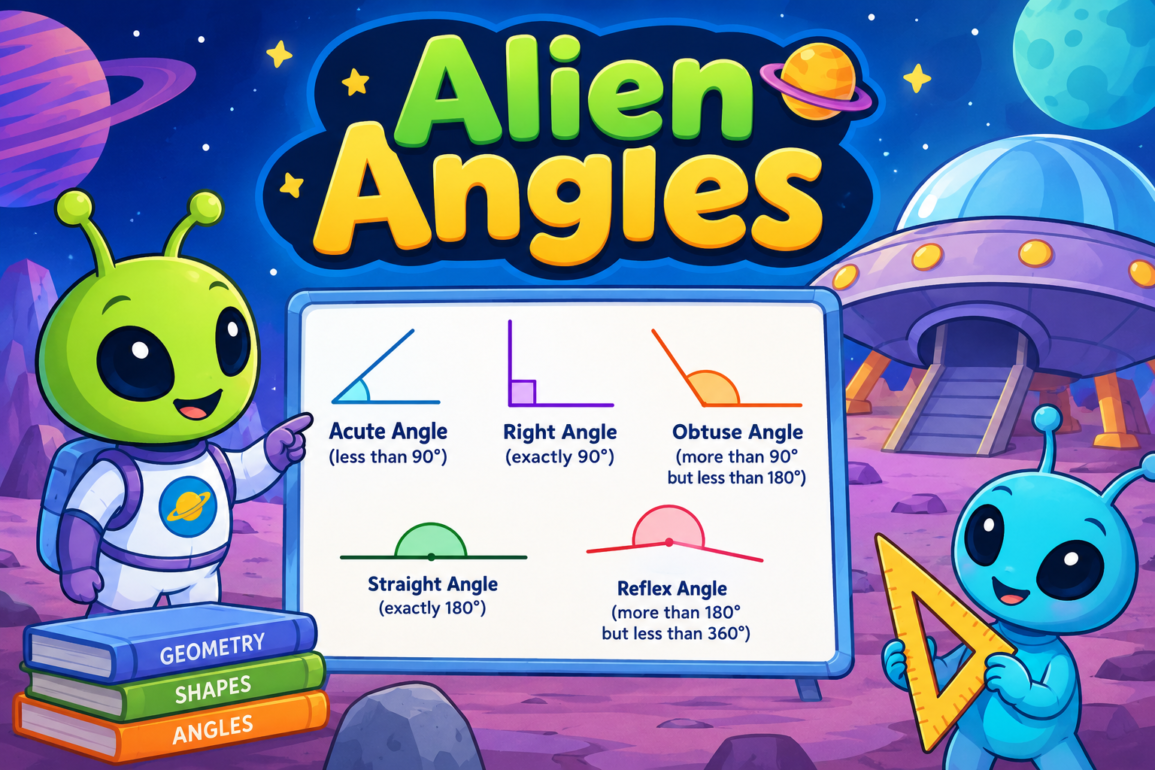
An acute angle measures less than 90 degrees but more than zero degrees. It looks relatively narrow and often appears in triangles, stars, and pointed shapes.
In an Alien Angles activity, students might identify the angle formed by an alien’s antennae or the pointed tip of a spacecraft. They can estimate the measurement before checking it with a protractor. This encourages visual judgement and helps learners recognise acute angles in different positions.
Right Angles
A right angle measures exactly 90 degrees. It resembles the corner of a square or rectangle and appears frequently in everyday objects, including books, tables, windows, and floor tiles.
Teachers can create a space-themed challenge in which students must identify right angles in the walls of an imaginary alien laboratory. Recognising these corners helps children connect classroom geometry with the physical world.
Obtuse Angles
An obtuse angle measures more than 90 degrees but less than 180 degrees. It appears wider than a right angle but does not form a straight line.
Students can use Alien Angles puzzles to compare obtuse angles with acute and right angles. For instance, they might examine the opening between two spaceship wings and decide which category best describes it. Comparing examples builds a clearer understanding of angle size.
Straight and Reflex Angles
A straight angle measures exactly 180 degrees and forms a straight line. A reflex angle measures more than 180 degrees but less than 360 degrees.
These angle types help students understand rotation and direction. In a fictional space mission, a robot might turn through a straight angle to face the opposite direction or make a reflex turn to reach a destination. Such examples demonstrate how geometric measurements describe movement.
Why Alien Angles Can Make Learning More Engaging
Mathematics can feel difficult when students encounter unfamiliar symbols and abstract explanations. A creative theme gives them a familiar story through which they can explore new concepts.
Alien Angles activities encourage learners to investigate a problem, test an idea, and check whether their answer makes sense. Instead of simply repeating a definition, students apply what they know to complete a challenge.
Visual storytelling can also make lessons more memorable. A student may forget a measurement explained once on a board but remember the angle needed to guide a fictional spaceship through a narrow opening. The story provides context without changing the underlying mathematical rule.
Another advantage is flexibility. Teachers can adapt these activities for different ages and ability levels. Younger learners can identify basic shapes and compare narrow and wide angles, while older students can calculate missing measurements and solve problems involving triangles.
Popular Alien Angles Activities for Students
A space-themed geometry lesson does not require expensive equipment or complicated software. Simple classroom materials can provide plenty of opportunities for meaningful practice.
1. Alien Shape Identification
Create drawings of imaginary creatures using triangles, squares, rectangles, circles, and other geometric shapes. Ask students to identify the shapes and count their sides or corners.
Next, encourage learners to locate angles within the drawings. They might discover acute angles in a creature’s horns, right angles in a rectangular body, or obtuse angles in its wings. This activity combines shape recognition with introductory geometry.
2. The Spaceship Angle Challenge
Draw several spaceships with wings pointing in different directions. Students must identify the angles formed by the wings or estimate how far each spaceship has turned.
For an additional challenge, provide measurements such as 45 degrees, 90 degrees, and 120 degrees. Learners can match each measurement to the correct drawing. This exercise strengthens estimation skills and helps students distinguish between angle categories.
3. Design an Alien Planet
Ask students to draw a fictional planet containing buildings, bridges, mountains, and spacecraft. Each object should include several geometric shapes and different types of angles.
Students can label the angles and explain why they selected particular measurements. This project combines mathematics with artistic expression and gives learners an opportunity to demonstrate their understanding independently.
4. Missing-Angle Mystery
Provide diagrams with one unknown angle. Students must use the information in the diagram to calculate the missing measurement.
For example, the interior angles of a triangle always add up to 180 degrees. If two angles measure 50 degrees and 60 degrees, the third angle must measure 70 degrees.
Alien Angles mysteries can present this calculation as a mission to unlock a spaceship’s navigation system. The story adds interest, while the calculation reinforces a fundamental geometric rule.
How to Use Alien Angles Worksheets Effectively
Worksheets can help students practise independently and allow teachers to identify areas that require additional explanation. However, learners benefit most when each worksheet has a clear purpose and matches their current level of understanding.
Begin with simple exercises that ask students to recognise and classify angles. Once they feel confident, introduce activities involving measurement, comparison, and missing-angle calculations.
An effective Alien Angles worksheet should include clear diagrams, readable instructions, and enough space for students to write their answers. Visuals should support the mathematics rather than distract learners from the task.
Parents can also use worksheets at home. A short practice session allows children to review classroom concepts without feeling overwhelmed. After completing each exercise, ask them to explain how they reached their answers. Their explanations can reveal whether they understand the concept or have simply guessed correctly.
Skills Students Develop Through Geometry Puzzles
Geometry activities support several important academic skills. Although the primary objective is to understand angles, students can develop additional abilities while working through puzzles and creative challenges.
Logical reasoning helps learners identify relevant information and choose a suitable method for solving a problem. When a puzzle contains an unknown angle, students must decide which geometric rule applies.
Spatial awareness enables children to understand how shapes fit together and how objects change position. This skill is useful in geometry, drawing, construction, design, and many practical situations.
Problem-solving develops when students test different approaches, recognise mistakes, and revise their answers. A challenging puzzle encourages persistence instead of immediate reliance on memorised solutions.
Communication also plays an important role. Explaining why an angle is acute or how a missing measurement was calculated helps students express mathematical ideas clearly.
By incorporating Alien Angles into lessons, educators can provide opportunities to practise these skills together rather than treating each one as a separate learning objective.
Common Mistakes to Avoid
Students sometimes assume that an angle’s category depends on the direction in which its lines point. However, rotating an angle does not change its measurement. A right angle remains 90 degrees whether it faces upward, sideways, or downward.
Another common mistake involves confusing the length of an angle’s sides with its size. Longer lines do not automatically create larger angles. The amount of opening between the sides determines the angle’s measurement.
Learners may also struggle when using a protractor. They should place its centre on the vertex, align the baseline with one side, and read the correct scale where the other side crosses the markings.
Teachers can address these difficulties by demonstrating each step and giving students opportunities to practise. In Alien Angles exercises, varied diagrams are particularly helpful because they prevent learners from relying only on visual orientation.
Tips for Teachers and Parents
Start with concepts that students already understand, such as corners, straight lines, and familiar shapes. Introduce new terminology gradually, then reinforce it through practical demonstrations.
Use paper shapes, rulers, protractors, and simple drawings to make abstract ideas easier to understand. Encourage students to estimate an angle before measuring it, as this builds number sense and visual awareness.
Provide feedback that explains the reasoning behind a correct answer. When a student makes a mistake, ask which step caused the confusion instead of simply giving the correct measurement.
Finally, adjust the difficulty according to the learner’s progress. Beginners may need to classify angles, while more advanced students can investigate complementary angles, supplementary angles, and the relationships between angles in polygons.
Conclusion
Geometry becomes more approachable when students have opportunities to explore, create, and solve meaningful problems. Alien Angles offers a playful framework for introducing angle measurements, recognising geometric shapes, and practising essential mathematical rules. Its imaginative theme can help learners stay interested while developing logical reasoning, spatial awareness, and confidence.
Teachers and parents can adapt these activities to suit different ages, learning environments, and skill levels. Whether students complete a worksheet, design an imaginary planet, or solve a missing-angle mystery, the goal remains the same: to understand geometry through active practice. With consistent guidance and engaging challenges, Alien Angles can help turn mathematics into an enjoyable learning experience.
Frequently Asked Questions
1. What does Alien Angles mean?
Alien Angles is a creative educational theme for learning about angles through space-inspired puzzles, fictional characters, drawings, and geometry activities. It is not a formal mathematical term.
2. What age group can benefit from Alien Angles activities?
The activities can suit primary-school students and older learners when educators adjust the difficulty. Younger children can identify shapes, while advanced students can calculate unknown angles.
3. What materials are needed for Alien Angles worksheets?
Most activities require only paper, pencils, printed diagrams, a ruler, and a protractor. Digital worksheets or classroom presentation tools can also be useful.
4. How do these activities help students learn geometry?
They encourage students to recognise angles, compare measurements, apply geometric rules, and explain their reasoning. Visual challenges can also make abstract concepts easier to understand.
5. Can students practise Alien Angles at home?
Yes. Parents can create simple angle puzzles, print geometry worksheets, or ask children to identify angles in everyday objects. Regular, short practice sessions can reinforce classroom learning.
FF