


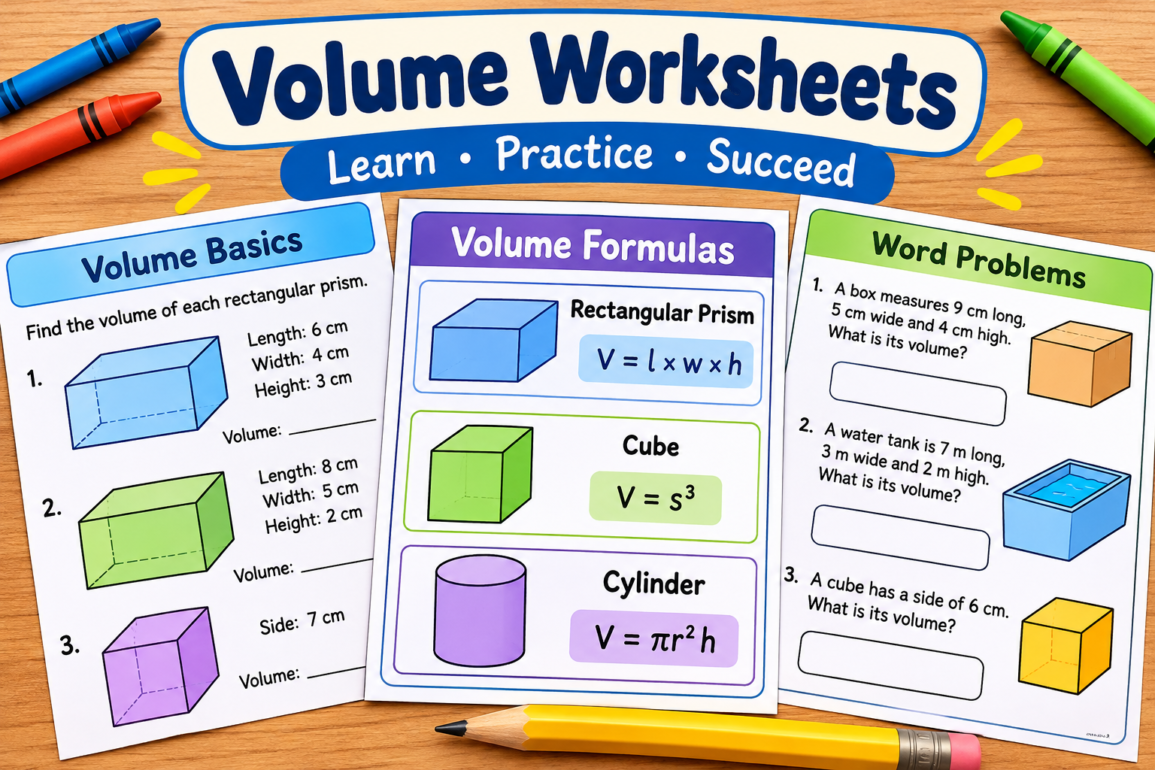
Understanding measurement is an important part of developing strong mathematical skills. Students encounter volume in everyday situations, from filling water bottles and measuring containers to calculating the space inside boxes. However, learning this concept can sometimes feel challenging, especially when children need to understand three-dimensional shapes and apply mathematical formulas. This is where volume worksheets become valuable learning resources.
These educational worksheets help students understand how much space an object occupies, recognise different units of measurement, and solve practical mathematical problems. They provide structured exercises that allow learners to practise at their own pace while building confidence in mathematics. Whether students are learning basic volume concepts or working with more advanced geometric calculations, regular practice can make the subject easier to understand.
What Is Volume in Mathematics?
Volume refers to the amount of three-dimensional space occupied by an object. Unlike length and width, which describe two-dimensional measurements, volume also considers height or depth. It helps students understand how much space a container can hold or how much space a solid object occupies.
For example, a rectangular storage box has length, width, and height. Multiplying these three measurements gives its volume. Similarly, the capacity of a water tank can be estimated by calculating its internal dimensions.
Students generally learn volume after developing an understanding of basic shapes, multiplication, and measurement units. Volume worksheets introduce these ideas through examples, diagrams, calculations, and word problems that gradually increase in difficulty.
Why Are Volume Worksheets Important for Students?
Mathematics becomes easier when students have enough opportunities to practise different types of problems. Reading formulas alone does not always help learners understand how volume works. They need to apply mathematical concepts to different situations.
Developing Measurement Skills
One of the main benefits of volume worksheets is that they improve measurement skills. Students learn to identify length, width, and height and understand how these dimensions affect the space inside an object.
Repeated exercises also help children recognise the relationship between measurements and mathematical operations. As they complete more questions, they become comfortable using the correct formulas.
Improving Mathematical Accuracy
Volume calculations require students to follow specific steps. They must identify the correct dimensions, select the appropriate formula, and perform multiplication accurately.
Regular practice helps learners avoid common mistakes, such as forgetting one dimension or using the wrong unit. It also encourages them to check their answers before completing an exercise.
Building Problem-Solving Abilities
Many measurement questions involve everyday situations. Students may need to calculate how much water a swimming pool holds or determine the capacity of a storage container.
These activities encourage learners to think logically and apply classroom knowledge to practical situations. Volume worksheets can introduce such problems in a simple and organised format.
Different Types of Volume Worksheets
Students benefit from practising different question formats because each activity develops a particular mathematical skill. Teachers and parents can select exercises according to the learner’s current understanding.
Basic Volume Calculation Worksheets
These worksheets introduce the fundamental concept of volume using simple geometric shapes. Students usually work with rectangular prisms and cubes before moving towards more complicated solids.
The exercises provide measurements for different objects and ask learners to calculate their volume. They are particularly useful for beginners who are learning how to apply multiplication to three-dimensional shapes.
Volume of Cubes and Rectangular Prisms
Cubes and rectangular prisms are among the first solid shapes students encounter when studying volume. A cube has equal sides, while a rectangular prism has three dimensions that may have different measurements.
For a rectangular prism, students multiply its length, width, and height. For a cube, they multiply the side length by itself three times.
Volume worksheets covering these shapes help students understand the relationship between dimensions and the amount of space an object occupies.
Missing Dimension Worksheets
Some exercises provide the volume and two known dimensions while asking students to calculate the missing measurement.
These questions require learners to understand the relationship between multiplication and division. They also develop the ability to rearrange mathematical formulas.
For example, if students know the volume, length, and width of a rectangular container, they can divide the volume by the product of its length and width to find its height.
Volume Word Problem Worksheets
Word problems connect mathematical calculations with real-world situations. They may describe water tanks, boxes, swimming pools, packaging materials, or classroom storage containers.
Students must read each question carefully, identify the relevant measurements, and decide which calculation to perform.
This activity improves reading comprehension alongside mathematical reasoning. It also demonstrates why measurement skills are useful outside the classroom.
Understanding Volume Formulas
Learning the correct formulas is essential for solving volume questions. Students should understand what each measurement represents instead of memorising mathematical rules without explanation.
Rectangular Prism Formula
The volume of a rectangular prism is calculated by multiplying its length, width, and height.
For example, consider a box measuring 8 centimetres in length, 4 centimetres in width, and 3 centimetres in height.
The calculation is:
Volume = Length × Width × Height
Volume = 8 × 4 × 3 = 96 cubic centimetres.
Therefore, the box has a volume of 96 cm³.
Cube Formula
A cube has six equal square faces and all its edges have the same length.
Its volume is calculated by multiplying the side length three times.
For example, if each side measures 5 centimetres, the volume is 5 × 5 × 5, which equals 125 cubic centimetres.
Cylinder Formula
Older students may also study the volume of cylinders. These shapes have circular bases and a curved surface connecting the two bases.
The formula is:
Volume = π × Radius² × Height.
Students use the radius of the circular base and the cylinder’s height to calculate its volume. Volume worksheets covering cylinders help learners develop confidence with more advanced geometry.
How to Use Volume Worksheets Effectively
Simply completing mathematical exercises does not guarantee understanding. Students should follow a structured approach that helps them learn from their mistakes and recognise mathematical patterns.
First, review the lesson before beginning an exercise. Make sure students understand the meaning of volume, the dimensions of three-dimensional shapes, and the measurement units used in calculations.
Next, begin with simple questions. Basic exercises allow learners to understand the formulas without feeling overwhelmed. Once they become comfortable, introduce more challenging calculations and practical word problems.
Teachers can also encourage students to draw diagrams before solving questions. Visual representations make it easier to identify the length, width, and height of an object.
Finally, review incorrect answers together. Instead of simply providing the correct result, explain which step caused the mistake. This approach helps students understand the process and avoid repeating similar errors.
Common Measurement Units Used in Volume
Understanding measurement units is another important part of learning volume. Students must know which units are appropriate for different objects and calculations.
Cubic Centimetres
Cubic centimetres are commonly used to measure the volume of smaller objects. They are suitable for describing boxes, small containers, and other compact solids.
Cubic Metres
Cubic metres are generally used for larger spaces and objects. For example, the volume of a room, large storage container, or swimming pool may be expressed in cubic metres.
Millilitres and Litres
Millilitres and litres are units of capacity commonly used for liquids. Students often compare these units with cubic measurements to understand how volume relates to the amount a container can hold.
A useful relationship is that one litre is equal to 1,000 cubic centimetres. Understanding these connections makes measurement activities more meaningful.
Benefits of Printable Volume Worksheets
Printable learning materials remain useful because they offer a simple way to practise mathematics without requiring complicated technology. Students can complete exercises in notebooks, classrooms, or at home.
Teachers can distribute different activities according to learning levels. Beginners can practise identifying dimensions, while advanced students can work on complex solids and multi-step calculations.
Parents can also use volume worksheets to support children’s homework and provide additional practice during holidays. Printed exercises make it easier to monitor progress and identify areas that need improvement.
Another advantage is flexibility. Students can solve questions independently, work with classmates, or complete activities under teacher supervision.
Common Mistakes Students Should Avoid
Although volume calculations follow clear mathematical rules, students sometimes make mistakes that affect their results.
One common error is multiplying only two dimensions instead of three when calculating the volume of a rectangular prism. Students should always check that they have included length, width, and height.
Another mistake involves confusing square units with cubic units. Area measures two-dimensional surfaces, whereas volume measures three-dimensional space. Therefore, volume answers should use cubic units, such as cm³ or m³.
Some learners also forget to convert measurements into consistent units before calculating. For example, multiplying centimetres by metres without converting them can produce an incorrect result.
Careful reading, organised calculations, and regular practice can help students overcome these difficulties.
How Teachers and Parents Can Make Volume Learning Interesting
Students often understand mathematical concepts more effectively when they can connect them with familiar objects. Teachers and parents can use household items to demonstrate how volume works.
For example, filling different containers with water can help children compare their capacities. Building small boxes using cardboard can demonstrate how changing length, width, or height affects volume.
Teachers can also organise classroom activities in which students estimate the volume of objects before calculating their actual measurements. Comparing estimates with calculated answers encourages curiosity and critical thinking.
Using volume worksheets alongside practical demonstrations creates a balanced learning experience. Students first explore the concept visually and then reinforce their understanding through written exercises.
Frequently Asked Questions
1. What are volume worksheets?
Volume worksheets are educational practice materials that help students learn how to calculate the space occupied by three-dimensional objects. They include formulas, diagrams, measurement exercises, and word problems.
2. Which grade levels can use volume worksheets?
Students generally begin learning basic volume concepts in elementary school. More advanced exercises involving cylinders, composite solids, and missing dimensions are suitable for middle school and higher grade levels.
3. What is the formula for calculating volume?
The volume of a rectangular prism is calculated by multiplying length, width, and height. Other geometric shapes have different formulas depending on their structure.
4. Why should students practise volume calculations?
Regular practice improves measurement skills, mathematical accuracy, problem-solving abilities, and understanding of geometric concepts. It also prepares students for more advanced mathematics.
5. Can students use volume worksheets at home?
Yes. Parents can provide printable exercises and help children practise calculations outside school. Working with household objects can make these activities even more engaging.
Conclusion
Learning volume is an important step in developing mathematical understanding and practical measurement skills. Students need to recognise three-dimensional shapes, understand measurement units, and apply the correct formulas to solve different problems. Consistent practice makes these skills easier to develop and strengthens confidence in mathematics.
Volume worksheets offer a convenient way to reinforce classroom lessons through structured exercises, diagrams, and real-world questions. Teachers can use them to support different learning levels, while parents can introduce additional activities at home. By combining written practice with practical demonstrations, students can develop a clearer understanding of volume and its everyday applications. With regular guidance and meaningful exercises, learners can build a strong foundation for more advanced mathematical topics.