


Introduction
Every writer makes decisions while creating a piece of writing. From selecting particular words to developing characters, arranging sentences, and establishing a specific tone, these decisions influence how readers understand a text. Although some choices may appear small, they can significantly change the meaning and emotional impact of a story, poem, article, or other written work. This concept is commonly known as author’s choice.
Understanding this concept helps readers look beyond the basic meaning of words and recognise the techniques writers use to communicate their ideas. It also helps students become more thoughtful readers and stronger writers. When readers examine an author’s choice, they can identify why certain words, expressions, structures, and literary devices appear in a text.
Whether someone is studying literature, analysing a short story, or improving their writing skills, understanding these decisions provides valuable insight into the writing process. This guide explains the meaning, importance, examples, and different elements involved in making effective writing decisions.
What Is Author’s Choice?
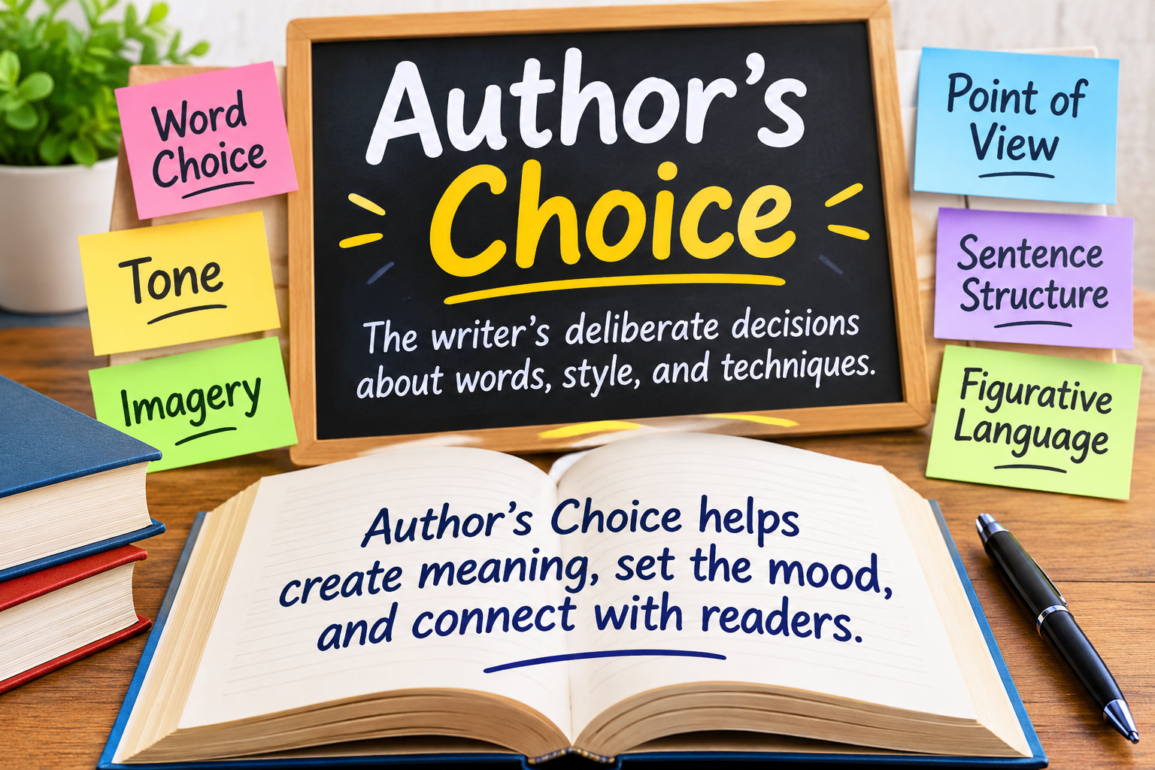
Author’s choice refers to the deliberate decisions a writer makes when creating a written work. These decisions influence how information is presented, how characters develop, and how readers respond to the content. A writer does not select every word or sentence randomly. Instead, many decisions serve a particular purpose.
For example, a writer describing a peaceful garden might use words such as gentle, colourful, refreshing, and beautiful. Another writer describing the same location might choose words such as silent, empty, gloomy, and forgotten. Both descriptions discuss a garden, but their language creates completely different impressions.
This difference demonstrates how author’s choice shapes the reader’s experience. Writers use language, organisation, tone, and literary techniques to express their intended messages.
The concept applies to different types of writing, including fiction, nonfiction, poetry, academic essays, news articles, and persuasive texts. Recognising these decisions allows readers to understand not only what a writer communicates but also why the writer communicates it in a particular way.
Why Is Author’s Choice Important?
Understanding writing decisions is an essential part of reading comprehension and literary analysis. It encourages readers to examine the deeper meaning of a text instead of accepting every sentence at face value.
1. It Develops Critical Thinking
When students examine author’s choice, they learn to ask meaningful questions about written material. They consider why a writer selected a particular expression, introduced a character, or organised information in a specific order.
This process develops critical thinking because readers must evaluate evidence and explain how different writing techniques influence meaning.
2. It Improves Reading Comprehension
Readers who understand writing techniques can identify important details more effectively. They recognise emotional language, repeated expressions, descriptive passages, and changes in tone.
For instance, repeated references to darkness might suggest fear, uncertainty, or sadness. Recognising this pattern helps readers understand the writer’s intended atmosphere.
3. It Strengthens Writing Skills
Studying different writing decisions helps students improve their own communication. They learn how to choose appropriate vocabulary, organise paragraphs, establish a consistent tone, and communicate ideas clearly.
By studying effective examples, writers can discover new ways to make their work more interesting and meaningful.
4. It Reveals Deeper Meanings
Sometimes writers communicate ideas indirectly through symbolism, imagery, irony, or character behaviour. Examining these techniques helps readers discover messages that may not appear directly in the text.
Major Elements of Author’s Choice
Writers make several important decisions during the writing process. Each element contributes to the overall meaning and presentation of a text.
Word Choice and Vocabulary
Word choice is one of the most noticeable elements of writing. Writers select vocabulary according to their audience, subject, purpose, and desired emotional effect.
For example, describing a person as confident creates a different impression from describing that person as arrogant. Although both words relate to someone’s attitude, they communicate different meanings.
An effective author’s choice uses precise vocabulary to make ideas understandable and meaningful.
Tone and Mood
Tone refers to the writer’s attitude towards the subject or audience. It may be humorous, serious, critical, optimistic, persuasive, or sympathetic.
Mood describes the emotional atmosphere experienced by readers. A mysterious setting, for example, may create suspense, while a cheerful conversation may establish a relaxed atmosphere.
Writers carefully select expressions and descriptions to create the intended emotional response.
Sentence Structure
Sentence structure affects the pace, clarity, and emphasis of writing. Short sentences can create urgency or tension, while longer sentences can provide detailed explanations or develop complex ideas.
Consider these examples:
“She stopped. Something moved.”
The short sentences create suspense and encourage readers to continue.
“She slowly walked towards the old wooden door, wondering what might be waiting behind it.”
The longer sentence provides additional information and establishes a thoughtful atmosphere.
This is another example of how author’s choice influences storytelling.
Point of View
Point of view determines whose perspective readers experience. Writers may use first-person, second-person, or third-person narration.
First-person narration allows readers to experience events through a character’s perspective. Third-person narration can provide information about one character or several characters, depending on the narrative approach.
Choosing the appropriate perspective helps writers control how much information readers receive.
Imagery and Figurative Language
Imagery uses descriptive language to help readers imagine scenes, sounds, smells, tastes, and physical sensations.
Figurative language includes techniques such as metaphors, similes, and personification. These techniques make writing more expressive and help communicate complex ideas.
For example, the sentence “The wind whispered through the trees” uses personification to give the wind a human action.
Such techniques demonstrate how creative language decisions make writing more engaging.
Examples of Author’s Choice in Different Types of Writing
Understanding the concept becomes easier when readers examine practical examples from different writing situations.
Example in a Short Story
Imagine a writer describing a character entering an unfamiliar house.
One description might say:
“She entered the bright, welcoming house and smiled at the colourful decorations.”
Another might say:
“She stepped into the dark, abandoned house and noticed the broken windows.”
Both passages describe someone entering a house, but their vocabulary creates different atmospheres.
In the first passage, the writer creates comfort and happiness. In the second, the writer introduces fear and uncertainty.
The selected descriptions demonstrate how author’s choice changes the reader’s interpretation of a scene.
Example in Poetry
Poets frequently use symbolism, repetition, rhythm, and imagery to communicate emotions.
A poet might describe a sunrise as a symbol of hope and new beginnings. Another might use a sunset to represent endings, change, or the passage of time.
These decisions help poets communicate complicated emotions through relatively few words.
Example in Persuasive Writing
Persuasive writers select language that encourages readers to agree with a particular argument.
For example, a writer discussing environmental protection might use words such as responsibility, future generations, conservation, and sustainability.
These expressions encourage readers to consider the importance of protecting natural resources.
The writer may also include statistics, examples, and emotional appeals to make the argument more convincing.
How to Identify Author’s Choice in a Text
Identifying writing decisions requires careful reading and attention to detail. Students can follow a straightforward process to examine how a writer develops meaning.
Step 1: Read the Text Carefully
Begin by reading the entire passage to understand its subject, main message, and general purpose. Avoid focusing on individual words before understanding the overall context.
Step 2: Identify Interesting Language
Look for unusual vocabulary, repeated expressions, descriptive phrases, comparisons, and emotional language. These details may reveal important writing decisions.
Step 3: Consider the Writer’s Purpose
Ask why the writer included a particular detail. Consider whether the purpose is to inform, entertain, persuade, describe, or create an emotional response.
Step 4: Examine the Effect on Readers
Think about how the selected language influences your understanding of the text. Does it create suspense, establish sympathy, communicate excitement, or encourage a particular opinion?
Step 5: Support Your Explanation With Evidence
Use specific words, phrases, or sentences from the passage to support your interpretation. Explain how the selected technique contributes to the overall meaning.
This approach makes literary analysis more accurate and helps students develop stronger written answers.
Common Mistakes to Avoid When Analysing Writing
Although examining literary techniques is useful, students sometimes make mistakes when explaining their importance.
Identifying Without Explaining: Simply naming a metaphor or descriptive word does not provide a complete analysis. Students should explain its purpose and effect.
Making Unsupported Assumptions: Interpretations should connect directly to the text. Avoid suggesting meanings that the writer’s language does not support.
Ignoring the Context: A word may have different meanings depending on the surrounding sentences. Always consider the complete passage.
Repeating the Same Explanation: Strong analysis examines different aspects of writing instead of repeatedly describing one technique.
Confusing Tone and Mood: Tone represents the writer’s attitude, while mood describes the atmosphere created for readers. Understanding this difference improves accuracy.
Practical Ways to Improve Your Understanding
Students can develop their analytical skills through regular reading and writing activities. Reading different genres exposes them to various styles, vocabulary choices, and storytelling methods.
Comparing two descriptions of the same subject is another useful exercise. Students can identify differences in language and explain how those differences affect meaning.
Teachers can also provide short passages and ask learners to identify important expressions, describe their effects, and support their answers with textual evidence.
Keeping a vocabulary notebook can further improve understanding. Students can record interesting words, their meanings, and the emotions or impressions they communicate.
Another helpful activity involves rewriting a paragraph using different vocabulary or sentence structures. Comparing the original and revised versions shows how small changes can influence the reader’s experience.
Conclusion
Understanding author’s choice provides readers with a deeper appreciation of how written communication works. Every important decision, from vocabulary and sentence structure to tone, imagery, and point of view, contributes to the overall meaning of a text. These elements help writers express their ideas, establish emotional connections, and guide readers towards particular interpretations.
For students, learning to recognise these techniques improves reading comprehension, critical thinking, and creative writing abilities. Instead of simply identifying literary devices, readers should examine why writers use them and how they influence the audience. With regular practice, analysing author’s choice becomes easier and more meaningful. Ultimately, understanding the decisions behind written communication allows readers to appreciate literature more fully and become more confident writers themselves.
Frequently Asked Questions (FAQs)
1. What does author’s choice mean?
Author’s choice refers to the decisions writers make about vocabulary, sentence structure, tone, perspective, and literary techniques to communicate ideas effectively.
2. Why is author’s choice important in literature?
It helps readers understand the writer’s purpose, recognise deeper meanings, examine characters, and explore how language influences emotions and interpretations.
3. What are some examples of author’s choice?
Examples include selecting descriptive vocabulary, using metaphors, creating suspense through short sentences, choosing first-person narration, and repeating important phrases.
4. How can students analyse author’s choice?
Students should identify specific language techniques, consider the writer’s purpose, explain their effects, and support their interpretations with evidence from the text.
5. Is author’s choice the same as author’s purpose?
No. Author’s choice describes the decisions a writer makes when creating a text, while author’s purpose refers to the main reason for writing it, such as informing, entertaining, or persuading readers.