




Introduction
Every person encounters situations where progress suddenly slows down or stops. A project may seem impossible to complete, a conversation may become difficult, or a simple decision may turn into a complicated problem. In these situations, people often describe the difficulty as a sticking point. The expression appears frequently in everyday conversations, professional environments, business discussions, education, and personal relationships.
Understanding this phrase can help you communicate more clearly and recognize the obstacles that prevent progress. It also provides a useful way to explain why something is not moving forward and what needs to change. Whether you are working toward a personal goal or managing a professional responsibility, identifying a sticking point is often the first step toward finding a practical solution.
What Does Sticking Point Mean?
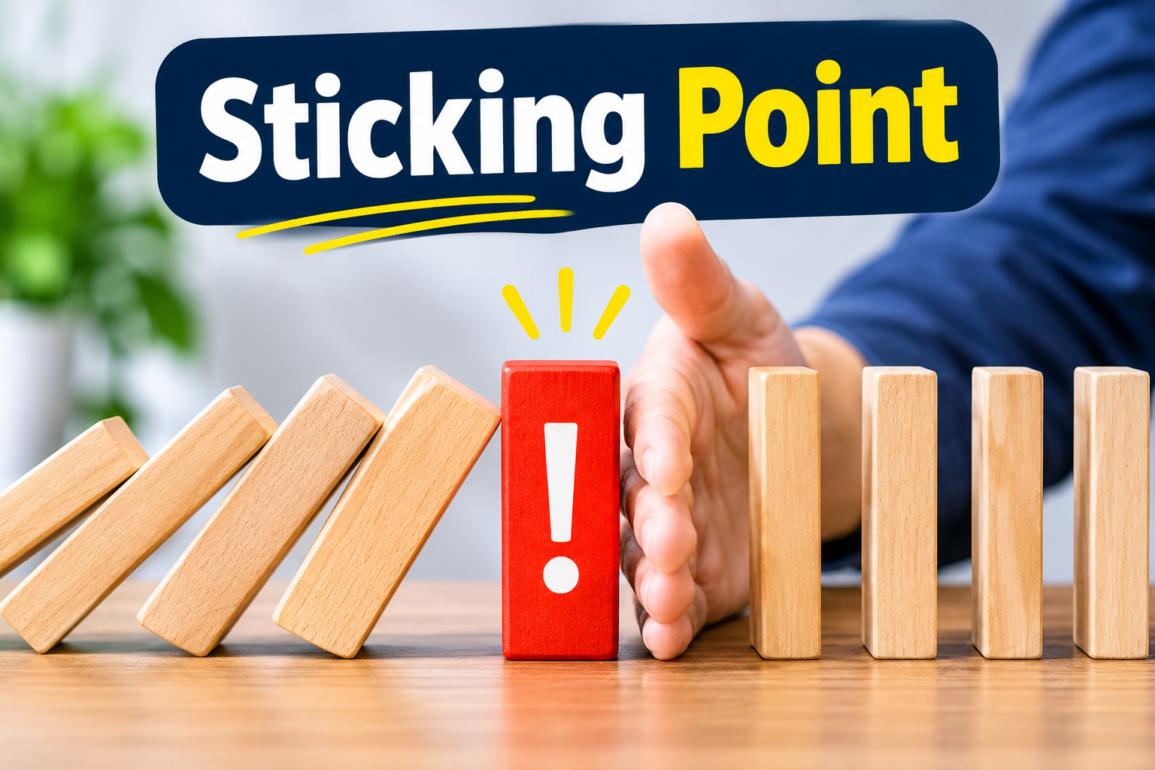
A sticking point refers to a particular issue, disagreement, obstacle, or difficulty that prevents progress. It describes the part of a situation where people become unable to move forward without addressing an existing problem.
For example, two business partners might agree on almost everything while discussing a new project. However, they may disagree about the budget. That disagreement becomes their sticking point because they cannot finalize their plans until they resolve it.
The expression can describe both practical and emotional difficulties. A missing document might create a problem during an application process, while a disagreement about trust could prevent two people from rebuilding their relationship.
In simple terms, a sticking point is the main obstacle that keeps something from progressing smoothly.
Origin and Background of the Expression
The phrase comes from the ordinary meaning of the verb “stick,” which describes something becoming attached, caught, or unable to move freely. When an object gets stuck, it cannot continue moving until someone removes the obstruction.
Over time, this physical meaning developed into a figurative expression. People began using it to describe situations in which progress stopped because of a particular difficulty.
Today, the phrase appears in different forms of communication. Journalists use it when discussing political negotiations, managers use it during business meetings, and individuals use it when explaining personal challenges.
Its popularity comes from its simplicity. Instead of describing an entire complicated situation, someone can identify the specific issue that prevents progress.
Common Situations Where Sticking Point Is Used
The expression works in several contexts. Its meaning remains similar, but the type of obstacle changes depending on the situation.
Business and Workplace Discussions
Professional environments frequently involve decisions that require agreement between different people. Employees, managers, clients, and business partners may have different expectations.
A sticking point can develop when people disagree about deadlines, financial arrangements, responsibilities, or project requirements.
For instance, a company might negotiate a partnership with another organization. Both sides may accept the proposed conditions except for the payment schedule. Until they reach an agreement, that issue remains the sticking point.
Identifying the problem allows everyone involved to concentrate on the decision that needs attention.
Personal Relationships
Relationships sometimes experience difficulties because of misunderstandings, different expectations, or unresolved disagreements.
One person may want more communication, while another may prefer greater independence. These differences can become a sticking point when neither person understands the other’s perspective.
Recognizing the central issue can make conversations more productive. Instead of repeatedly discussing unrelated frustrations, people can focus on the specific concern that needs resolution.
Education and Learning
Students sometimes struggle with one particular concept even when they understand most of their lessons.
For example, a learner studying mathematics might understand addition, subtraction, and multiplication but struggle with fractions. That difficult topic becomes a sticking point in the learning process.
Teachers can use this information to identify knowledge gaps and provide additional explanations or practice.
Technology and Problem-Solving
Technical projects often involve complicated processes in which one unresolved issue can affect everything else.
A software development team might complete most of an application but encounter a security problem during testing. That issue becomes the sticking point because the team cannot release the product until it is addressed.
Finding the exact source of the problem helps developers avoid wasting time on unrelated tasks.
Examples of Sticking Point in Sentences
Understanding an expression becomes easier when you see how people use it in natural conversations.
Here are several examples:
- The budget disagreement became the main sticking point during the negotiations.
- Communication remains a sticking point between the two departments.
- Finding reliable information was the biggest sticking point in completing the research.
- The students understood the lesson, but one difficult question became their sticking point.
- Transportation costs could become a sticking point for the new business.
- Both teams agreed on the project, although the delivery schedule remained a sticking point.
- Trust was the main sticking point in repairing their friendship.
- The application process moved forward after the company resolved its final sticking point.
These examples demonstrate that the phrase can describe different obstacles without changing its central meaning.
Why Do Sticking Points Develop?
Several factors can prevent people or organizations from making progress. Understanding these causes helps individuals recognize problems before they become more complicated.
Lack of Clear Communication
Miscommunication is one of the most common reasons disagreements develop. People may have different interpretations of instructions, expectations, or responsibilities.
When individuals fail to explain their concerns, a small misunderstanding can become a major sticking point.
Clear communication reduces confusion and helps everyone understand what needs to happen next.
Conflicting Priorities
People often approach the same situation with different objectives. A manager may prioritize reducing expenses, while employees may focus on improving working conditions.
Both perspectives can be reasonable, but their differences may create a sticking point during decision-making.
Limited Resources
Insufficient money, time, equipment, or personnel can prevent a project from moving forward.
For example, a small business might have a strong marketing strategy but lack the financial resources to implement it. The shortage becomes an important obstacle that requires attention.
Fear of Making Decisions
Sometimes people understand the problem but hesitate to choose a solution. They may worry about making mistakes, accepting responsibility, or facing unexpected consequences.
This hesitation can create another sticking point, particularly when other people depend on their decision.
How to Overcome a Sticking Point
Recognizing an obstacle is important, but finding a solution requires a thoughtful approach. The following strategies can help individuals and teams move forward.
1. Identify the Actual Problem
Begin by determining exactly what is preventing progress. Avoid making assumptions or focusing on minor issues that do not affect the final outcome.
Ask yourself which specific decision, disagreement, or missing resource is creating the difficulty.
A clear understanding of the sticking point makes it easier to develop an appropriate response.
2. Listen to Different Perspectives
When several people are involved, everyone should have an opportunity to explain their concerns.
Listening carefully can reveal information that was previously overlooked. It may also help people understand why others disagree.
A productive discussion focuses on understanding the problem rather than blaming individuals.
3. Consider Alternative Solutions
Sometimes the original plan is not practical. Instead of insisting on one approach, consider different possibilities.
For example, business partners who disagree about payment arrangements might consider installments, revised deadlines, or performance-based payments.
Exploring alternatives can help resolve a sticking point without damaging professional relationships.
4. Break Complicated Problems Into Smaller Tasks
Large challenges often seem difficult because they involve several connected issues.
Dividing the situation into smaller tasks makes it easier to understand what needs attention first.
This method also allows people to measure progress and identify which actions produce useful results.
5. Set a Clear Deadline
Some problems continue because nobody takes responsibility for resolving them.
Establishing a reasonable deadline encourages people to discuss the issue and make a decision. Assigning responsibilities also prevents unnecessary delays.
A deadline should provide enough time for careful consideration without allowing the sticking point to remain unresolved indefinitely.
Sticking Point vs. Similar Expressions
Several English expressions describe obstacles and difficulties. However, their meanings are not always identical.
| Expression | Meaning |
| Sticking point | A specific issue preventing progress or agreement |
| Roadblock | Something that stops or seriously delays progress |
| Obstacle | A difficulty that makes an activity harder |
| Hurdle | A challenge that must be overcome |
| Bottleneck | A restricted stage that slows an entire process |
| Barrier | Something that prevents access or progress |
These expressions are related, but each emphasizes a slightly different aspect of a problem.
For example, an obstacle can make a task difficult without completely stopping it. A sticking point usually refers to the particular issue that needs resolution before meaningful progress can continue.
Is Sticking Point Positive or Negative?
The expression generally describes a negative or challenging situation because it highlights something that prevents progress.
However, identifying a sticking point can have a positive effect. Once people understand what is causing the difficulty, they can concentrate their efforts on solving it.
For example, a manager who identifies poor communication as the main problem can introduce better reporting procedures. Similarly, a student who recognizes a difficult subject can seek additional support.
Therefore, although the expression describes a challenge, recognizing the problem can create an opportunity for improvement.
Frequently Asked Questions
1. What is the simple meaning of sticking point?
It means a particular problem, disagreement, or difficulty that prevents someone from making progress or reaching an agreement.
2. Is sticking point an idiom?
Yes. It is a commonly used English expression with a figurative meaning. It describes a situation in which progress becomes difficult because of one specific issue.
3. What is an example of a sticking point?
If two companies agree to work together but cannot agree on the contract price, the price becomes their sticking point.
4. What are the synonyms of sticking point?
Depending on the context, similar expressions include obstacle, roadblock, barrier, difficulty, hurdle, and bottleneck.
5. How can someone overcome a sticking point?
The best approach is to identify the actual problem, communicate with the people involved, consider alternative solutions, and take practical steps toward resolving the issue.
Conclusion
Understanding the expression sticking point helps explain why progress sometimes stops despite everyone’s efforts. It describes a specific obstacle, disagreement, or unresolved issue that prevents a person, team, or organization from moving forward. These difficulties can appear in workplaces, educational environments, personal relationships, and everyday situations.
The most effective way to address such challenges is to identify their underlying causes and approach them with patience, clear communication, and practical thinking. Rather than allowing one difficult issue to affect an entire project or relationship, people should concentrate on finding realistic solutions.
Ultimately, recognizing a sticking point is not simply about identifying what has gone wrong. It is about understanding what needs to change so that progress can continue with greater confidence and direction.