



Language becomes more interesting when a single word can express a large number of things without requiring a lengthy explanation. English contains many such words, and myriad is an excellent example. It is commonly used in everyday conversations, academic writing, literature, and professional communication to describe an enormous number or a wide variety of things. Understanding the definition of myriad can help you expand your vocabulary and communicate ideas more clearly.
Whether you have encountered this word in a book, article, classroom discussion, or workplace document, knowing its meaning and correct usage can make your writing more effective. Although the word may initially seem complicated, its meaning is relatively simple. It refers to something that exists in a very large number or an almost countless variety.
This guide explores the definition, origins, grammatical uses, synonyms, examples, and common mistakes associated with the word. It also explains how you can use it naturally in different situations.
What Is the Definition of Myriad?
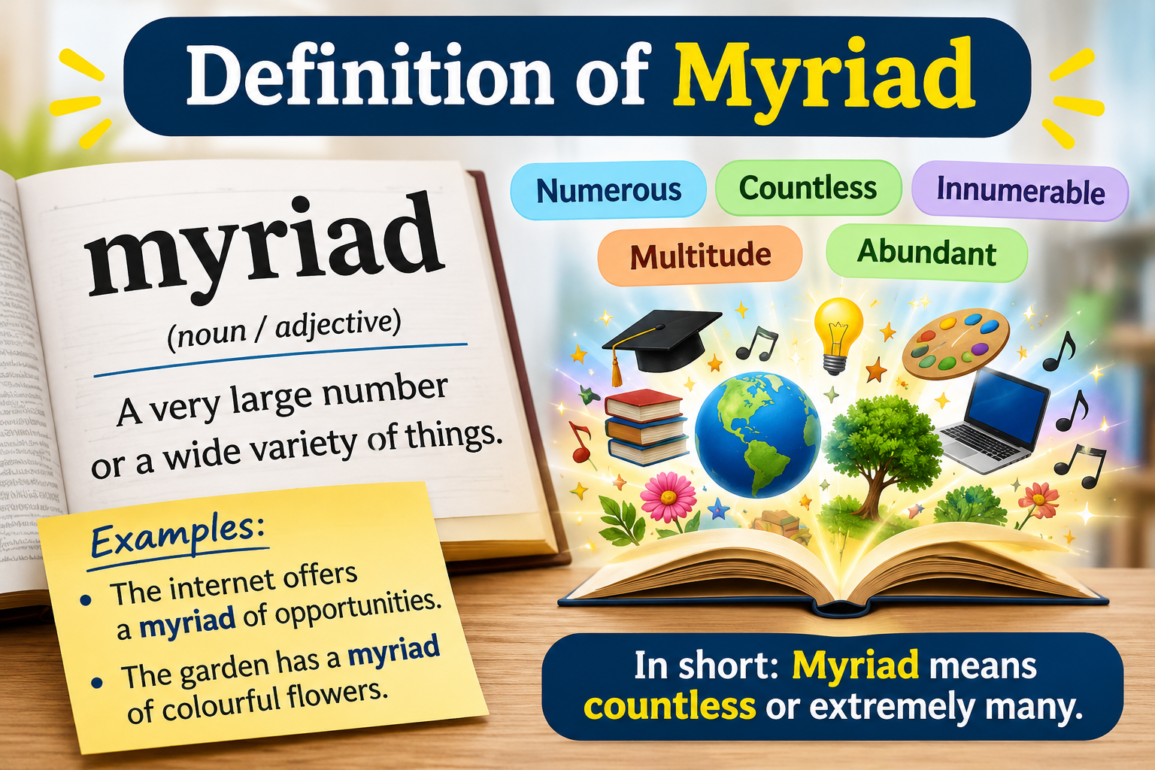
The definition of myriad refers to an extremely large number of people, objects, possibilities, or things. It can also describe a wide variety of something. In simple terms, myriad means countless, numerous, or too many to count easily.
For example, when someone says, “The internet offers a myriad of learning opportunities,” they mean that the internet provides an enormous number of ways to learn new information and develop skills.
The word can function as both a noun and an adjective. As a noun, it describes a large number or collection. As an adjective, it directly describes something that contains many different elements.
Unlike words that suggest a specific numerical quantity, myriad generally communicates abundance without identifying an exact number.
Understanding the Meaning of Myriad in Simple English
The easiest way to understand this vocabulary term is to associate it with the idea of abundance. Whenever something exists in a very large quantity or comes in many different forms, the word may be appropriate.
For example, imagine looking at the night sky and seeing countless stars. You could describe the scene as containing a myriad of stars. Similarly, a large shopping centre might offer a myriad of products, including clothing, electronics, furniture, and household supplies.
The definition of myriad is particularly useful when an exact number is unnecessary. Instead of listing every item or calculating a total, you can use this word to communicate that something is available in great abundance.
It also makes descriptions more expressive. Rather than repeatedly using ordinary words such as many or numerous, writers can introduce myriad to make their vocabulary more varied.
Origin and History of the Word Myriad
The word myriad has an interesting history that goes back to ancient Greek. It originates from the Greek word myrias, which referred to the number ten thousand.
Ancient Greek speakers used this term to describe a very large quantity. Over time, the word entered Latin and eventually became part of the English language.
Its original numerical association gradually developed into a broader meaning. Modern English speakers generally use myriad to describe an enormous or practically unlimited number rather than a precise quantity of ten thousand.
Understanding this historical development makes the definition of myriad easier to appreciate. A word that once represented a particular large number eventually became a general expression for abundance and variety.
How Is Myriad Used in English Grammar?
One important aspect of learning a new vocabulary word is understanding how it functions in a sentence. Myriad can serve as both a noun and an adjective, giving writers flexibility.
Myriad as a Noun
When used as a noun, myriad refers to a large number or collection of things. It often appears in the expression “a myriad of.”
For example, consider the sentence, “A myriad of challenges appeared during the project.” Here, the word describes the large number of difficulties encountered by the team.
Other examples include a myriad of opportunities, a myriad of possibilities, and a myriad of questions.
Myriad as an Adjective
Myriad can also function as an adjective. In this form, it directly describes a noun and communicates that something exists in numerous forms or quantities.
For example, “The museum displays myriad historical objects.”
In this sentence, myriad describes the large collection of historical objects.
Another example is, “Students explore myriad subjects during their education.” The word emphasizes the variety of academic subjects available to learners.
Both grammatical forms are acceptable in modern English. The choice depends on sentence structure and the meaning you want to communicate.
Examples of Myriad in Everyday Sentences
Practical examples make it easier to understand how vocabulary works in real communication. The following sentences demonstrate different ways to use the word naturally.
- The city provides a myriad of entertainment options for visitors.
- Scientists investigate myriad questions about the natural world.
- The garden contains a myriad of colourful flowers.
- Technology has created myriad opportunities for modern businesses.
- The teacher introduced a myriad of activities to help students learn.
- There are myriad reasons why people enjoy travelling.
- The internet contains a myriad of educational resources.
- The company offers a myriad of services to its customers.
- Artists use myriad techniques to express their creativity.
- The ocean supports a myriad of marine species.
These examples demonstrate that the definition of myriad applies to different subjects, including education, science, technology, nature, business, and entertainment.
Common Synonyms of Myriad
Learning synonyms is an effective way to improve vocabulary and avoid repeating the same words in written communication. Several English words express meanings similar to myriad.
Numerous
Numerous means existing in large numbers. It definition of myriad is suitable for formal writing, academic discussions, and everyday communication.
Example: The university offers numerous courses for international students.
Countless
Countless describes something that is so abundant that counting every individual item would be difficult or impossible.
Example: Countless stars appeared across the night sky.
Innumerable
Innumerable refers to an extremely large number of things that cannot easily be counted.
Example: The historical building has innumerable architectural details.
Multitude
Multitude refers to a large number or collection of people or objects.
Example: A multitude of visitors attended the cultural festival.
Abundant
Abundant describes something that exists in large quantities or is readily available.
Example: The region has abundant natural resources.
Although these words share similar meanings, they are not always interchangeable. Choosing the correct synonym depends on sentence structure, tone, and context.
Difference Between Myriad and Similar Words
Although myriad, numerous, countless, and innumerable communicate abundance, their usage can differ.
Numerous is a straightforward adjective that describes a large number of things. Countless emphasizes that something is difficult or impossible to count. Innumerable has a similar meaning but often sounds more formal.
Myriad is especially flexible because it definition of myriad can describe both quantity and variety. For instance, a myriad of career opportunities suggests not only that many opportunities exist but also that they may represent different choices.
Understanding these distinctions helps writers select vocabulary that communicates their intended meaning accurately.
Common Mistakes When Using Myriad
Although the word is relatively simple, some writers make grammatical mistakes when including it in sentences.
One common mistake involves using unnecessary words. For example, the expression “a myriad of different varieties” may sound repetitive because myriad already communicates abundance and variety.
Another issue concerns the choice between noun and adjective forms. Both “a myriad of choices” and “myriad choices” are acceptable in modern English. However, writers should maintain consistent grammatical structure throughout their sentences.
Some people also assume that myriad always represents exactly ten thousand things. Although this reflects its historical origin, modern English generally uses the word to indicate a very large or unspecified number.
The definition of myriad should therefore be understood through its contemporary meaning rather than its original numerical association.
Why Is Understanding Myriad Important?
Expanding your vocabulary helps you communicate more effectively in academic, professional, and personal situations. Myriad is particularly useful because it allows speakers and writers to describe abundance without providing unnecessary numerical details.
Students can use the word in essays, assignments, and classroom discussions. For example, they might write that technology provides a myriad of educational opportunities.
Professional writers can also use it in reports, articles, presentations, and business documents. It definition of myriad helps communicate the availability of multiple services, solutions, or possibilities.
In everyday conversations, the word can make descriptions more expressive. Instead of saying that a place offers many activities, you can explain that it provides a myriad of activities.
However, it is important to use sophisticated vocabulary naturally. A simple word may sometimes communicate an idea more clearly than a complicated alternative.
Frequently Asked Questions
1. What is the definition of myriad in simple words?
Myriad means a very large number or a wide variety of things. It is commonly used to describe something that exists in abundance or has numerous possibilities.
2. Is myriad a noun or an adjective?
Myriad can function as both. As a noun, it refers to a large number or collection. As an adjective, it describes something that exists in numerous quantities or forms.
3. What is an example of myriad in a sentence?
An example is, “The internet provides a myriad of opportunities for learning.” This sentence means that the internet offers a very large number of educational possibilities.
4. What are the best synonyms for myriad?
Common synonyms include numerous, countless, innumerable, abundant, and multitude. The most suitable alternative depends on the grammatical structure and context of the sentence.
5. Does myriad mean exactly ten thousand?
Historically, the Greek origin of the word referred to ten thousand. However, modern English generally uses myriad to describe an extremely large or unspecified number rather than an exact quantity.
Conclusion
Understanding the definition of myriad helps you recognise and use an important English vocabulary word in different situations. It describes an extremely large number or a wide variety of things and can function as both a noun and an adjective. Its flexibility makes it useful in academic writing, professional communication, literature, and everyday conversations.
Although the word originally referred to ten thousand in ancient Greek, its definition of myriad modern meaning focuses on abundance rather than a specific numerical value. By studying its grammatical forms, synonyms, examples, and common mistakes, you can use it with greater confidence.
Ultimately, adding myriad to your vocabulary gives you another effective way to describe countless opportunities, numerous possibilities, and the remarkable variety found throughout the world.