




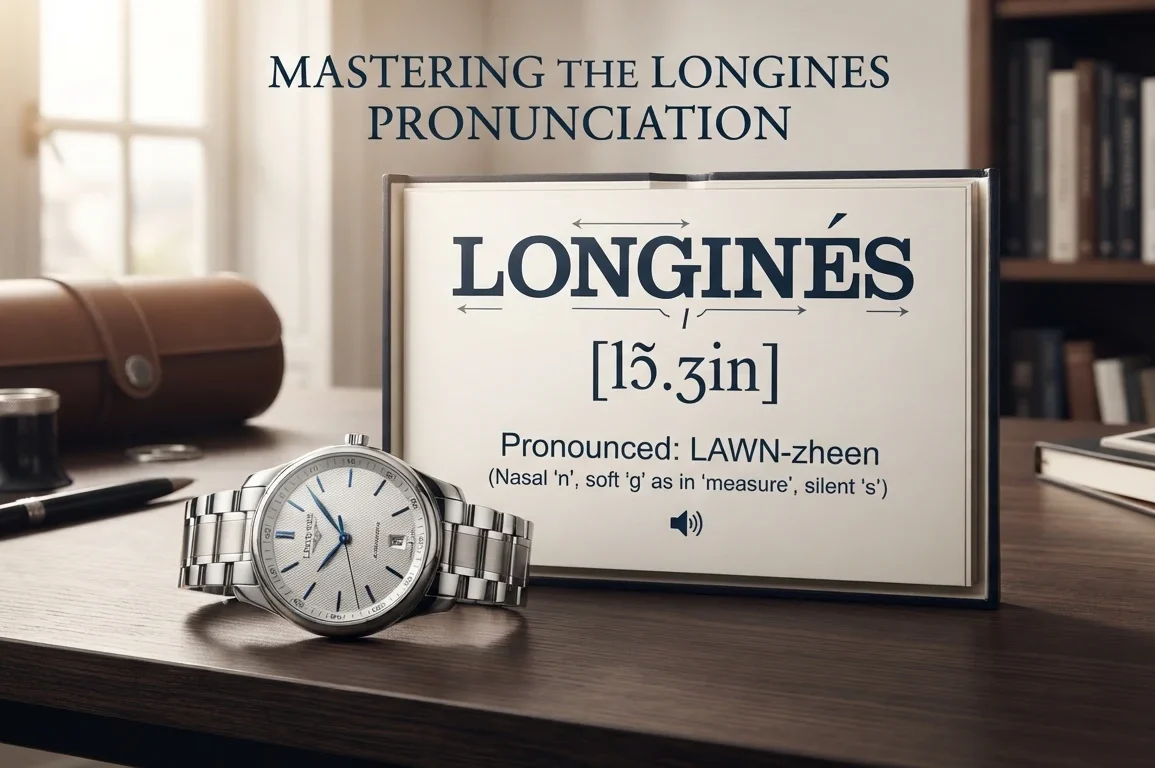
Swiss luxury horology carries centuries of heritage, prestige, and intricate craftsmanship, yet one of the simplest aspects of appreciating a fine timepiece often trips up even seasoned collectors. Knowing the proper longines pronunciation allows enthusiasts, buyers, and watch lovers to speak confidently in boutiques, auctions, and horological circles. Founded in Saint-Imier, Switzerland, in 1832, this historic watchmaker sits squarely within the French-speaking region of the Jura Mountains. Because of its geographic roots, native French phonetics govern how the brand name sounds, creating a persistent divide between the authentic Swiss delivery and common English phonetic assumptions. Understanding the exact mechanics behind the longines pronunciation transforms a moment of hesitation into effortless conversational fluency.
Why the Longines Pronunciation Confuses English Speakers
English speakers naturally apply Anglo-Saxon spelling rules when encountering unfamiliar foreign brand names on dial faces and boutique storefronts. Looking at the written word, many newcomers instinctively read it as “Lon-jeens” or “Lon-jines,” rhyming the second syllable with denim trousers or pine trees. This phonetic misstep occurs because English treats a trailing “e” after a consonant as silent while lengthening the preceding vowel, and it typically vocalizes a final “s” to indicate plurality or complete a word. However, applying English orthography to a French proper noun guarantees an inaccurate longines pronunciation.
French phonetics operate on an entirely different set of rules regarding silent letters, nasal vowels, and soft consonants. In standard French, final consonants especially the letter “s” almost always remain silent unless linked to a following vowel through liaison. Furthermore, the combination of “o” and “n” before a consonant creates a distinct nasal resonance rather than a crisp, closed English “on” sound. Recognizing these structural differences in the French language clarifies why the authentic longines pronunciation diverges so sharply from what English eyes expect to read on paper.
Breaking Down the Exact Longines Pronunciation
Mastering the authentic longines pronunciation requires isolating its two distinct syllables and practicing the subtle French vocal transitions between them. Phonetic linguists transcribe the standard French pronunciation in the International Phonetic Alphabet as /lɔ̃.ʒin/. To approximate this accurately using familiar English sounds, speakers should say “Lohn-zheen,” placing gentle, even emphasis across both syllables without harsh stress on either end.
The First Syllable: Nasal Vowel Mechanics
The opening syllable, spelled “Lon,” demands a soft nasalization rather than a hard consonant stop. Instead of touching the tip of the tongue to the roof of the mouth to finish the “n,” speakers allow air to pass simultaneously through the nose and mouth while rounding the lips slightly for an “oh” sound. This technique produces a smooth “Lohn” sound where the “n” colors the vowel without fully articulating as a separate consonant. Getting this initial nasal vowel right establishes the authentic foundation for an accurate longines pronunciation.
The Second Syllable: Soft Consonants and Silent Endings
The second syllable, spelled “gines,” contains two critical phonetic traps for non-French speakers. First, the letter “g” before “i” takes on a soft, voiced postalveolar fricative sound, identical to the “s” in the English word “measure” or “vision,” rather than a hard “j” sound as in “jeans.” Second, the vowel “i” produces a clean, bright “ee” sound, while both the “e” and the final “s” remain completely silent after the crisp “n” closure. Combining these elements yields “zheen,” completing a textbook longines pronunciation that sounds natural in both Geneva and New York.
Historical Roots Behind the Brand Name
The linguistic origin of the name provides fascinating context for anyone studying the proper longines pronunciation. When Ernest Francillon consolidated his family’s watchmaking operations into a single factory in 1867, he purchased a stretch of meadowland situated along the Suze River on the southern edge of Saint-Imier. Local residents referred to this narrow, elongated meadow in the local French dialect as “Les Longines,” which translates directly to “the long meadows.” Francillon adopted this geographic designation for his new manufactory and registered the iconic winged hourglass trademark alongside it.
Because the brand name originated as a local French topographic term describing long fields, its phonetic identity remained anchored in regional Swiss-French speech patterns. Early watchmakers at the Saint-Imier factory referred to their workplace using the local dialect, and that exact vocal pattern traveled globally alongside their pocket watches and chronographs. Appreciating that the name simply means “long meadows” reinforces why the French phonetic rules dictate the true longines pronunciation across every international market.
Regional Variations in Longines Pronunciation
While Swiss-French sets the global standard, minor regional adaptations appear when speakers integrate the brand name into different native languages. In Francophone regions of Switzerland, France, and Belgium, speakers maintain the strict nasalized “Lohn-zheen” with effortless precision. When British and American watch collectors discuss the brand in English sentences, they frequently soften the nasal vowel into a standard English “Lon” while preserving the soft “zheen” ending, resulting in “Lon-zheen.” Horological experts widely accept this slight Anglo-French hybrid as a polite and accurate longines pronunciation in English conversation.
Conversely, pronounced variations emerge in non-Francophone European markets such as Germany, Italy, and Spain, where local speakers often vocalize the final vowels or harden the consonants to match domestic spelling conventions. Even within the broader watch industry, sales associates in diverse global boutiques adapt slightly to mirror their clientele without correcting customers awkwardly. Nevertheless, striving for the classic “Lohn-zheen” remains the gold standard for anyone seeking a respectful and well-informed longines pronunciation.
Common Mistakes to Avoid in Watch Circles
Even passionate watch enthusiasts occasionally slip into bad habits when mentioning Swiss brands rapidly during collector meetups or online reviews. Avoiding the most frequent errors ensures your longines pronunciation reflects genuine familiarity with horological culture.
Pronouncing the Final S
Adding an audible “s” or “z” sound at the end of the word stands as the single most common error among English speakers. Saying “Lon-zheens” or “Lon-jeens” immediately signals an unfamiliarity with French phonetics, much like pronouncing the final “s” in Paris when speaking French. Keeping the ending crisp and silent on the “n” sound instantly elevates your longines pronunciation.
Using a Hard J Sound
Substituting a hard English “j” sound (as in “jump” or “jet”) for the soft French “zh” sound alters the acoustic character of the brand name significantly. While the difference between “Lon-jeen” and “Lon-zheen” seems subtle on paper, the softer, breathier “zh” sound captures the elegance of the Swiss-French original. Practicing words like “treasure,” “mirage,” and “genre” helps English speakers isolate this exact consonant before applying it to their longines pronunciation.
Practical Tips to Practice Your Delivery
Developing muscle memory for foreign phonetics takes only a few minutes of deliberate vocal repetition. Start by saying the English word “genre” slowly, paying close attention to the vibrating “zh” sound at the beginning of the word and the soft nasal vowel that follows it. Next, transfer that exact “zh” consonant onto the word “sheen,” replacing the voiceless “sh” with the voiced “zh” to produce “zheen.” Once that second syllable feels comfortable, precede it with a relaxed, slightly nasal “Lohn” to execute a seamless longines pronunciation.
Listening to official brand communications, heritage documentaries, and Swiss horological podcasts also reinforces correct auditory recognition. Watchmakers and brand ambassadors speaking in interviews naturally model the cadence and pacing of the name within full sentences. Repeating the phrase “Longines Spirit” or “Longines Master Collection” aloud while mimicking those official broadcasts locks the rhythm into your everyday vocabulary. Consistent practice guarantees that the correct longines pronunciation rolls off your tongue without conscious effort.
How Other Swiss Watch Brands Compare
Longines is far from the only Swiss watchmaker whose French or German spelling challenges international collectors. Understanding the longines pronunciation often serves as a gateway to mastering other prestigious names across the Swiss watchmaking landscape. Brands like Jaeger-LeCoultre (“Zhay-zhair Luh-Kooltr”), Audemars Piguet (“Oh-duh-mar Pee-gay”), and Vacheron Constantin (“Vash-er-on Con-stan-tan”) rely on similar French phonetic conventions, including silent final consonants and soft “g” or “j” sounds.
Meanwhile, brands rooted in the German-speaking cantons of Switzerland, such as IWC Schaffhausen or Breitling (“Bright-ling”), follow Germanic phonetic rules where every consonant and diphthong receives clear articulation. Recognizing whether a Swiss manufacture hails from the French-speaking Romandy region or the German-speaking plateau immediately clues you in to its phonetic rules. Mastering the longines pronunciation builds the foundational awareness needed to navigate the entire lexicon of luxury watchmaking with poise.
Speaking the Language of Horology with Confidence
Language serves as an important bridge between appreciating mechanical artistry and participating actively in the global watch community. Taking the time to learn the authentic longines pronunciation demonstrates respect for nearly two centuries of Saint-Imier watchmaking tradition and helps you communicate clearly with fellow enthusiasts, boutique specialists, and auctioneers. By remembering the simple two-syllable cadence of “Lohn-zheen” complete with its soft nasal opening, gentle “zh” consonant, and silent ending you eliminate guesswork forever. Whether you are admiring a vintage chronograph or inquiring about a modern diver at an authorized dealer, your polished longines pronunciation will reflect true horological discernment.