




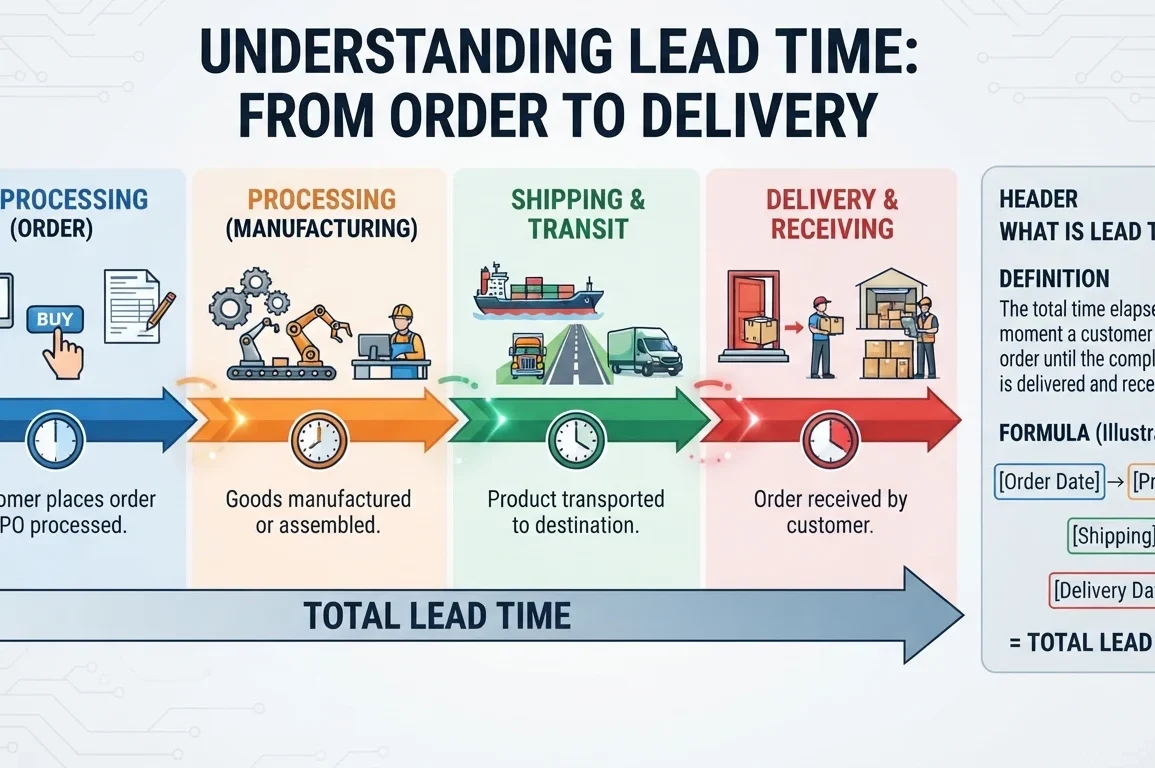
When organizations strive to deliver products or services on schedule, understanding every second of the production and delivery pipeline becomes vital. Supply chains across the globe rely on precise timing to satisfy customer demands without inflating storage expenses. To master operational efficiency, managers must first define lead time accurately within their specific industry context. By measuring the exact duration between an initial request and final delivery, companies gain the visibility required to eliminate bottlenecks, forecast inventory needs, and build resilient supplier relationships.
What Does It Mean to Define Lead Time?
In supply chain management, manufacturing, and project execution, to define lead time means to establish the total elapsed time from the initiation of a process until its final completion. Whether a customer places an online order or a factory manager submits a purchase request for raw materials, the clock starts ticking the moment the commitment occurs. The clock only stops when the finished goods arrive at the designated destination and pass final inspection.
Businesses use this metric as a foundational benchmark for operational performance. When teams accurately define lead time, they create realistic expectations for both internal stakeholders and external buyers. Rather than guessing when a shipment might arrive or when a software feature will launch, leaders rely on historical timing data to make informed scheduling decisions. Consequently, a clear definition prevents overpromising to clients and reduces friction across departments.
The Core Components of Lead Time
To manage schedules effectively, operations teams break the overarching timeline down into distinct, measurable phases. Understanding these individual segments makes it much easier to define lead time and pinpoint where delays originate.
Preprocessing Time
Preprocessing time covers all administrative and planning activities required before actual production or procurement begins. When define lead time a buyer submits an order, staff members must verify inventory availability, approve budgets, generate purchase orders, and transmit documentation to the appropriate vendor. Even though no physical goods move during this window, inefficient paperwork or slow approval chains can add days to the overall schedule.
Processing and Manufacturing Time
Processing time represents the active phase where suppliers or internal teams create, assemble, or prepare the requested item. In a manufacturing environment, this define lead time stage includes sourcing raw materials, running machinery, assembling components, and conducting quality assurance tests. In a retail distribution center, processing time consists of picking items from warehouse shelves, packing them securely, and printing shipping labels.
Transit and Delivery Time
Transit time begins the moment a completed package leaves the supplier’s loading dock and ends when it reaches the buyer’s facility. Logistics providers move goods via truck, rail, ocean freight, or air cargo, and each mode carries different speed and cost implications. Customs clearance, port congestion, and local weather conditions frequently influence this segment, making reliable carrier selection crucial for maintaining predictable schedules.
Post-Processing and Inspection Time
Post-processing occurs after the shipment physically arrives at the receiving dock. Warehouse personnel must unload the freight, verify quantities against the packing slip, inspect items for transit damage, and log the inventory into the enterprise resource planning system. Until teams complete these final verification steps, the goods remain unavailable for customer fulfilment or downstream assembly.
Different Contexts Where Professionals Define Lead Time
Because every industry operates with unique workflows, professionals adapt the concept to fit their specific operational models. Examining how various sectors define lead time reveals its versatility as a management tool.
Manufacturing and Production
Factory managers focus heavily on manufacturing lead time, which tracks the journey from raw material acquisition to finished product packaging. This define lead time metric encompasses machine setup durations, production line run times, and mandatory cooling or curing periods. By shortening manufacturing cycles, factories increase their overall output capacity without investing in expensive facility expansions.
Supply Chain and Procurement
Procurement specialists evaluate supplier lead time to determine how quickly external vendors can replenish stock. When purchasing teams define lead time for international suppliers, they must account for overseas shipping lanes and international trade regulations. Accurate supplier metrics allow inventory planners to calculate optimal reorder points, ensuring warehouses never run dry during peak selling seasons.
Customer Order Fulfillment
In e-commerce and retail, customer lead time measures the interval between a shopper clicking the purchase button and opening the package on their doorstep. Modern consumers expect rapid fulfillment, often demanding same-day or two-day delivery windows. Retailers optimize this metric by positioning inventory across regional fulfillment centers closer to major population hubs.
Project Management and Software Development
Service-based industries and technology firms also rely on timing metrics to track intellectual work. Agile software teams define lead time as the period starting when a client submits a feature request and ending when developers deploy the working code into production. Tracking this duration helps engineering managers spot code review bottlenecks and improve sprint predictability.
Why Measuring Lead Time Matters for Profitability
Monitoring timelines directly impacts a company’s financial health, cash flow, and market reputation. Organizations that consistently track and refine their schedules enjoy substantial competitive advantages.
First, shorter timelines drastically reduce inventory holding costs. When a business knows its suppliers can replenish stock within three days rather than three weeks, it no longer needs to hoard massive quantities of safety stock in expensive warehouses. Lower inventory levels free up working capital that executives can reinvest into product innovation, marketing, or talent acquisition.
Second, predictable schedules elevate customer satisfaction and brand loyalty. Buyers rarely penalize a company for a transparent five-day delivery window if the package arrives right on schedule, whereas unexpected delays quickly erode trust. When companies define lead time honestly and meet those commitments consistently, they secure repeat business and positive reviews.
Third, clear timing metrics expose hidden operational inefficiencies. A sudden spike in total duration alerts managers that a specific machine requires maintenance, a vendor is struggling with capacity, or an internal approval workflow has become overly bureaucratic. Addressing these root causes keeps the entire operation lean and agile.
How to Calculate Lead Time Accurately
Calculating this metric requires gathering accurate timestamps from enterprise software systems and applying straightforward formulas. Depending on the specific operational focus, analysts use slight variations to capture the exact data they need.
For basic supply chain procurement, analysts subtract the order request date from the final delivery date. For example, if a purchasing manager submits an order on the first day of the month and receives the inspected goods on the twelfth day, the total duration equals eleven days. When teams define lead time for manufacturing environments, they sum the preprocessing time, production run time, and post-processing inspection time together to capture the complete internal cycle.
To gain deeper insights, analysts track both the average duration and the standard deviation over several months. Relying solely on a single best-case scenario leads to dangerous scheduling errors. By evaluating historical averages alongside worst-case delays, planners establish realistic buffers that protect operations against unexpected disruptions.
Proven Strategies to Reduce Lead Time
Once an organization establishes reliable baseline measurements, managers can implement targeted strategies to compress timelines without sacrificing product quality.
Strengthen Supplier Partnerships
Collaborating closely with key vendors eliminates communication delays and fosters mutual accountability. Businesses should share long-term demand forecasts with their primary suppliers so those partners can reserve raw materials and production capacity well in advance. Additionally, partnering with local or regional vendors often slashes transit times compared to relying exclusively on distant overseas manufacturers.
Automate Administrative Workflows
Manual data entry and paper-based approvals slow down preprocessing stages unnecessarily. Implementing modern enterprise resource planning software automates purchase order generation whenever inventory drops below a predetermined threshold. Instant digital transmission ensures suppliers receive orders within seconds rather than days.
Adopt Lean Manufacturing Principles
Lean methodologies focus on eliminating waste across every step of the production floor. Techniques such as value stream mapping help teams visualize where materials sit idle between workstations. Reorganizing factory layouts into efficient cellular workflows minimizes unnecessary material handling and accelerates throughput.
Increase Order Frequency with Smaller Batches
Placing massive, infrequent orders forces suppliers to schedule lengthy production runs that tie up machinery for weeks. Transitioning toward smaller, more frequent orders allows factories to process requests rapidly and maintain continuous flow. This agile approach keeps inventory fresh and enables rapid adjustments when consumer preferences shift.
Conclusion
Mastering operational timing remains one of the most effective ways for modern enterprises to boost efficiency and outpace competitors. When leaders clearly define lead time across procurement, manufacturing, and customer fulfillment, they transform vague scheduling guesses into actionable data. Breaking down total durations into preprocessing, production, transit, and inspection phases gives managers the precision needed to eliminate bottlenecks and reduce costly safety stock. By automating administrative workflows, collaborating closely with reliable suppliers, and embracing lean production principles, any organization can compress its delivery timelines while consistently delighting its customers.