




Medical terminology can sometimes be difficult to pronounce, especially when a word contains several syllables and unfamiliar letter combinations. One example is the word eosinophils, which frequently appears in blood test reports, medical discussions, and healthcare textbooks. Although doctors and laboratory professionals use this term regularly, many people find it challenging to say correctly.
Understanding eosinophils pronunciation can make medical conversations easier and help you feel more confident when discussing laboratory results with healthcare professionals. This guide explains how to pronounce the word, where to place the emphasis, what it means, and how to remember it. Whether you are a student, healthcare worker, or someone reading a blood test report, you will find practical information to improve your understanding.
What Is the Correct Eosinophils Pronunciation?
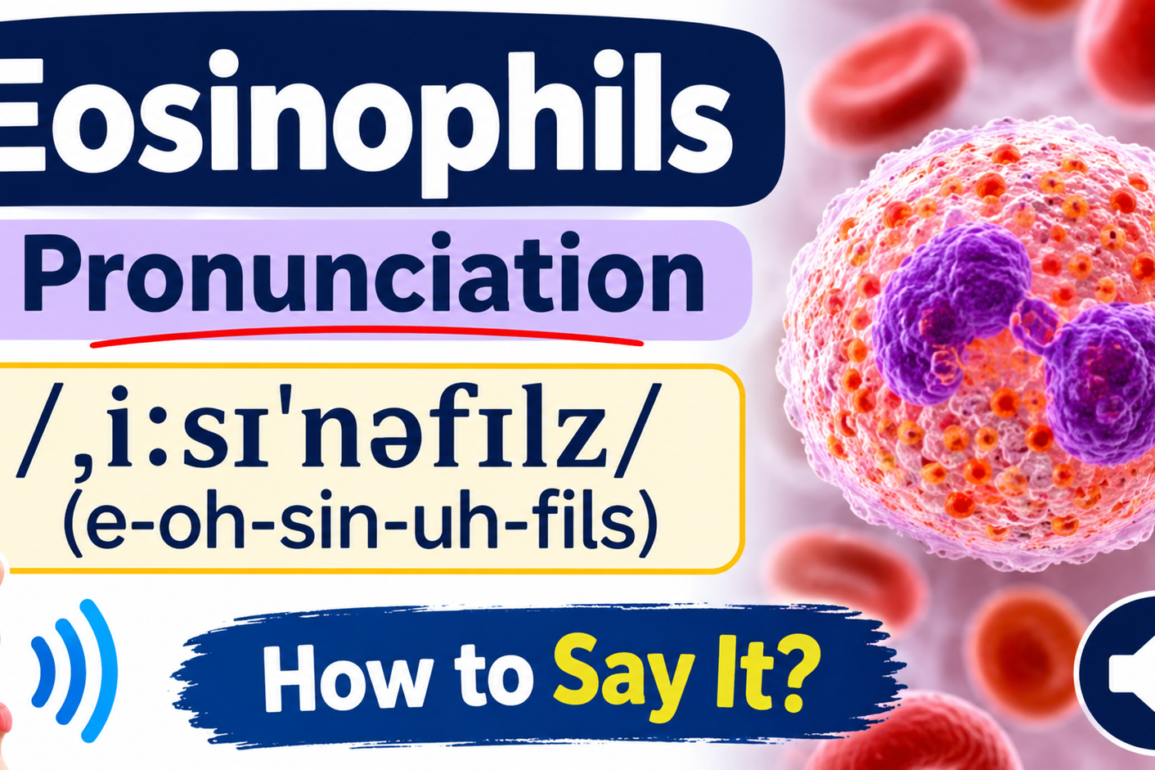
The correct eosinophils pronunciation is generally represented as:
EE-oh-SIN-oh-filz
The word contains five syllables, and the strongest emphasis falls on the third syllable, SIN. Saying each part slowly before combining them can make the pronunciation much easier.
In the International Phonetic Alphabet (IPA), a common American English pronunciation is:
/ˌiː.oʊˈsɪn.ə.fɪlz/
British English may have slight differences in vowel sounds and rhythm, but the overall pronunciation remains similar.
When learning eosinophils pronunciation, remember that the word should flow naturally rather than sound like five completely separate words. Start slowly, identify the stressed syllable, and gradually increase your speaking speed.
Breaking the Word Into Syllables
One of the easiest ways to understand eosinophils pronunciation is to divide the word into smaller sound units. Instead of trying to pronounce all the letters together, focus on each syllable individually.
The word can be divided into five parts:
- Ee: Begin with a long E sound, similar to the beginning of the word easy.
- Oh: Follow with an open O sound.
- Sin: Pronounce this syllable like the English word sin. Give it the strongest emphasis.
- Oh: Move into a softer O sound.
- Filz: Finish with a sound similar to fills, with a voiced Z sound at the end.
When you combine these sounds, you get a smooth pronunciation that is easier to remember.
Practicing the individual syllables helps improve accuracy. Once you become comfortable with each part, repeat the complete word several times without unnecessary pauses.
Which Syllable Should You Stress?
Word stress plays an important role in clear communication. Even when someone knows the correct sounds, placing emphasis on the wrong syllable can make a medical term difficult to recognize.
In eosinophils pronunciation, the main stress belongs to the third syllable, SIN. The first syllable may also receive lighter secondary emphasis, depending on the speaker and accent.
Try saying the word slowly while making the third syllable slightly stronger than the others. Avoid giving every syllable equal emphasis because this can make the word sound unnatural.
A useful practice technique is to say the word three times. First, pronounce it very slowly. Second, maintain the correct stress while speaking at a normal speed. Finally, use it in a complete sentence.
For example, you could say, “My blood test shows an increased eosinophil count.”
This exercise helps you connect the pronunciation with its actual use.
What Are Eosinophils?
Understanding the meaning of a word can make it easier to remember how to pronounce it. Eosinophils are a type of white blood cell that forms part of the body’s immune system.
These cells belong to a group called granulocytes, which contain small granules in their cytoplasm. They help the body respond to certain infections, particularly parasitic infections, and participate in allergic and inflammatory reactions.
Eosinophils are produced in the bone marrow and circulate through the bloodstream before moving into different body tissues.
Healthcare professionals commonly examine eosinophil levels through a complete blood count with a differential. This test measures different types of white blood cells and helps doctors understand certain aspects of immune activity.
Learning the meaning alongside eosinophils pronunciation gives you a better understanding of why the term appears so frequently in medical reports.
Why Do Eosinophils Matter in Medical Testing?
Eosinophils provide useful information about immune system activity. Their numbers may increase or decrease under different medical circumstances.
An increased eosinophil count is known as eosinophilia. It can occur in people with allergic conditions, asthma, certain parasitic infections, medication reactions, and some inflammatory or blood-related disorders.
However, an increased count does not automatically indicate a serious health problem. Doctors consider symptoms, medical history, other laboratory findings, and the degree of elevation before reaching a conclusion.
A low eosinophil count can occur for several reasons, including stress responses and corticosteroid treatment. In many cases, a low count is not independently significant.
Understanding these medical details makes eosinophils pronunciation more meaningful because you can recognize the term in conversations about health, diagnosis, and laboratory investigations.
Common Mistakes When Pronouncing Eosinophils
Many people struggle with this word because its spelling does not immediately reveal how its sounds fit together. Certain pronunciation mistakes are especially common among beginners.
Pronouncing Every Letter Separately
Some learners attempt to pronounce the word by following every letter individually. This approach often creates unnatural pauses and makes the word harder to understand.
Instead, divide the word into syllables and combine them smoothly.
Putting Stress on the Wrong Syllable
Another frequent mistake involves emphasizing the beginning or ending of the word instead of the central syllable.
Remember that the strongest stress falls on SIN. Practicing this pattern can make your speech clearer.
Confusing Eosinophils With Eosinophil
The singular and plural forms are closely related but have different endings.
Eosinophil refers to one cell, while eosinophils refers to more than one. The plural form ends with a Z sound rather than a separate extra syllable.
Speaking Too Quickly
Trying to pronounce unfamiliar medical vocabulary quickly can lead to unclear sounds.
Take your time when practicing eosinophils pronunciation. Accuracy should come before speed, particularly when communicating with patients, doctors, or medical students.
Eosinophils Pronunciation in Everyday Medical Conversations
Medical vocabulary becomes easier when you practice using it in realistic situations. Rather than repeating an unfamiliar word without context, include it in simple sentences.
Here are some examples:
Example 1: The doctor explained that eosinophils are involved in allergic reactions.
Example 2: The laboratory report showed an increased eosinophil count.
Example 3: The medical student studied eosinophils during an immunology lesson.
Example 4: The physician reviewed the patient’s eosinophil levels before recommending further investigations.
Reading these sentences aloud helps you become more comfortable with eosinophils pronunciation. It also teaches you how the word connects naturally with other medical terms.
Effective Ways to Practice Eosinophils Pronunciation
Learning a complicated medical word does not require hours of practice. A few simple techniques can help you develop confidence and improve your speaking ability.
Listen to Reliable Audio Examples
Listening to qualified medical educators or reputable dictionary recordings can help you understand the correct sounds. Pay attention to syllable stress, vowel quality, and the ending of the word.
Repeat the Word Slowly
Begin with individual syllables and gradually combine them. Repeat the complete word several times while maintaining the correct emphasis.
Practice With Similar Medical Vocabulary
Learning related terms can improve your familiarity with medical language. Words such as neutrophils, basophils, lymphocytes, and leukocytes frequently appear in discussions about blood cells.
Read Medical Sentences Aloud
Choose a short paragraph about blood tests or the immune system and read it aloud. This technique improves pronunciation while strengthening your understanding of medical terminology.
Record and Review Your Speech
Record yourself saying the word and compare your pronunciation with a reliable audio example. Listen for differences in syllable stress, vowel sounds, and rhythm.
Consistent practice is one of the most effective ways to improve eosinophils pronunciation and remember it for future conversations.
Eosinophils and Other Types of White Blood Cells
Eosinophils are only one category of white blood cell. The immune system contains several different types, each performing particular functions.
Neutrophils are important for responding to bacterial and fungal infections. Lymphocytes include B cells and T cells, which support different parts of the immune response. Monocytes help remove damaged cells and contribute to immune regulation.
Basophils participate in allergic and inflammatory reactions by releasing substances such as histamine.
Eosinophils have particular importance in allergic inflammation and responses to certain parasites. Their activity helps researchers and healthcare professionals understand different immune processes.
Recognizing these cell types can make medical reports easier to interpret. It also provides useful context when learning eosinophils pronunciation and related scientific vocabulary.
Frequently Asked Questions
1. How do you pronounce eosinophils correctly?
The word is commonly pronounced EE-oh-SIN-oh-filz. It contains five syllables, with the strongest emphasis on the third syllable.
2. How many syllables are in eosinophils?
Eosinophils generally contains five syllables: EE, OH, SIN, OH, and FILZ. Breaking the word into these smaller parts makes it easier to pronounce.
3. What does eosinophils mean?
Eosinophils are a type of white blood cell involved in immune responses, particularly those associated with parasitic infections, allergies, and inflammation.
4. Why do doctors check eosinophil levels?
Doctors examine eosinophil levels to investigate possible allergic conditions, parasitic infections, inflammatory disorders, and other medical concerns. They interpret the results alongside symptoms and other tests.
5. What is the difference between eosinophil and eosinophils?
Eosinophil is the singular form, referring to one white blood cell. Eosinophils is the plural form, referring to multiple cells.
Conclusion
Learning unfamiliar medical terminology becomes much easier when you understand its sounds, meaning, and practical use. Eosinophils pronunciation may initially seem complicated, but dividing the word into five syllables and emphasizing the third syllable makes it manageable. Regular listening, repetition, and sentence-based practice can help you pronounce it naturally and confidently.
Beyond pronunciation, understanding what eosinophils do provides valuable insight into the immune system and the information found in blood test reports. Whether you are studying biology, working in healthcare, or simply trying to understand medical terminology, developing confidence with this word is a useful step toward better medical communication.
Eosinophils Pronunciation: How to Say It Correctly
Medical terminology can sometimes be difficult to pronounce, especially when a word contains several syllables and unfamiliar letter combinations. One example is the word eosinophils, which frequently appears in blood test reports, medical discussions, and healthcare textbooks. Although doctors and laboratory professionals use this term regularly, many people find it challenging to say correctly.
Understanding eosinophils pronunciation can make medical conversations easier and help you feel more confident when discussing laboratory results with healthcare professionals. This guide explains how to pronounce the word, where to place the emphasis, what it means, and how to remember it. Whether you are a student, healthcare worker, or someone reading a blood test report, you will find practical information to improve your understanding.
What Is the Correct Eosinophils Pronunciation?
The correct eosinophils pronunciation is generally represented as:
EE-oh-SIN-oh-filz
The word contains five syllables, and the strongest emphasis falls on the third syllable, SIN. Saying each part slowly before combining them can make the pronunciation much easier.
In the International Phonetic Alphabet (IPA), a common American English pronunciation is:
/ˌiː.oʊˈsɪn.ə.fɪlz/
British English may have slight differences in vowel sounds and rhythm, but the overall pronunciation remains similar.
When learning eosinophils pronunciation, remember that the word should flow naturally rather than sound like five completely separate words. Start slowly, identify the stressed syllable, and gradually increase your speaking speed.
Breaking the Word Into Syllables
One of the easiest ways to understand eosinophils pronunciation is to divide the word into smaller sound units. Instead of trying to pronounce all the letters together, focus on each syllable individually.
The word can be divided into five parts:
- Ee: Begin with a long E sound, similar to the beginning of the word easy.
- Oh: Follow with an open O sound.
- Sin: Pronounce this syllable like the English word sin. Give it the strongest emphasis.
- Oh: Move into a softer O sound.
- Filz: Finish with a sound similar to fills, with a voiced Z sound at the end.
When you combine these sounds, you get a smooth pronunciation that is easier to remember.
Practicing the individual syllables helps improve accuracy. Once you become comfortable with each part, repeat the complete word several times without unnecessary pauses.
Which Syllable Should You Stress?
Word stress plays an important role in clear communication. Even when someone knows the correct sounds, placing emphasis on the wrong syllable can make a medical term difficult to recognize.
In eosinophils pronunciation, the main stress belongs to the third syllable, SIN. The first syllable may also receive lighter secondary emphasis, depending on the speaker and accent.
Try saying the word slowly while making the third syllable slightly stronger than the others. Avoid giving every syllable equal emphasis because this can make the word sound unnatural.
A useful practice technique is to say the word three times. First, pronounce it very slowly. Second, maintain the correct stress while speaking at a normal speed. Finally, use it in a complete sentence.
For example, you could say, “My blood test shows an increased eosinophil count.”
This exercise helps you connect the pronunciation with its actual use.
What Are Eosinophils?
Understanding the meaning of a word can make it easier to remember how to pronounce it. Eosinophils are a type of white blood cell that forms part of the body’s immune system.
These cells belong to a group called granulocytes, which contain small granules in their cytoplasm. They help the body respond to certain infections, particularly parasitic infections, and participate in allergic and inflammatory reactions.
Eosinophils are produced in the bone marrow and circulate through the bloodstream before moving into different body tissues.
Healthcare professionals commonly examine eosinophil levels through a complete blood count with a differential. This test measures different types of white blood cells and helps doctors understand certain aspects of immune activity.
Learning the meaning alongside eosinophils pronunciation gives you a better understanding of why the term appears so frequently in medical reports.
Why Do Eosinophils Matter in Medical Testing?
Eosinophils provide useful information about immune system activity. Their numbers may increase or decrease under different medical circumstances.
An increased eosinophil count is known as eosinophilia. It can occur in people with allergic conditions, asthma, certain parasitic infections, medication reactions, and some inflammatory or blood-related disorders.
However, an increased count does not automatically indicate a serious health problem. Doctors consider symptoms, medical history, other laboratory findings, and the degree of elevation before reaching a conclusion.
A low eosinophil count can occur for several reasons, including stress responses and corticosteroid treatment. In many cases, a low count is not independently significant.
Understanding these medical details makes eosinophils pronunciation more meaningful because you can recognize the term in conversations about health, diagnosis, and laboratory investigations.
Common Mistakes When Pronouncing Eosinophils
Many people struggle with this word because its spelling does not immediately reveal how its sounds fit together. Certain pronunciation mistakes are especially common among beginners.
Pronouncing Every Letter Separately
Some learners attempt to pronounce the word by following every letter individually. This approach often creates unnatural pauses and makes the word harder to understand.
Instead, divide the word into syllables and combine them smoothly.
Putting Stress on the Wrong Syllable
Another frequent mistake involves emphasizing the beginning or ending of the word instead of the central syllable.
Remember that the strongest stress falls on SIN. Practicing this pattern can make your speech clearer.
Confusing Eosinophils With Eosinophil
The singular and plural forms are closely related but have different endings.
Eosinophil refers to one cell, while eosinophils refers to more than one. The plural form ends with a Z sound rather than a separate extra syllable.
Speaking Too Quickly
Trying to pronounce unfamiliar medical vocabulary quickly can lead to unclear sounds.
Take your time when practicing eosinophils pronunciation. Accuracy should come before speed, particularly when communicating with patients, doctors, or medical students.
Eosinophils Pronunciation in Everyday Medical Conversations
Medical vocabulary becomes easier when you practice using it in realistic situations. Rather than repeating an unfamiliar word without context, include it in simple sentences.
Here are some examples:
Example 1: The doctor explained that eosinophils are involved in allergic reactions.
Example 2: The laboratory report showed an increased eosinophil count.
Example 3: The medical student studied eosinophils during an immunology lesson.
Example 4: The physician reviewed the patient’s eosinophil levels before recommending further investigations.
Reading these sentences aloud helps you become more comfortable with eosinophils pronunciation. It also teaches you how the word connects naturally with other medical terms.
Effective Ways to Practice Eosinophils Pronunciation
Learning a complicated medical word does not require hours of practice. A few simple techniques can help you develop confidence and improve your speaking ability.
Listen to Reliable Audio Examples
Listening to qualified medical educators or reputable dictionary recordings can help you understand the correct sounds. Pay attention to syllable stress, vowel quality, and the ending of the word.
Repeat the Word Slowly
Begin with individual syllables and gradually combine them. Repeat the complete word several times while maintaining the correct emphasis.
Practice With Similar Medical Vocabulary
Learning related terms can improve your familiarity with medical language. Words such as neutrophils, basophils, lymphocytes, and leukocytes frequently appear in discussions about blood cells.
Read Medical Sentences Aloud
Choose a short paragraph about blood tests or the immune system and read it aloud. This technique improves pronunciation while strengthening your understanding of medical terminology.
Record and Review Your Speech
Record yourself saying the word and compare your pronunciation with a reliable audio example. Listen for differences in syllable stress, vowel sounds, and rhythm.
Consistent practice is one of the most effective ways to improve eosinophils pronunciation and remember it for future conversations.
Eosinophils and Other Types of White Blood Cells
Eosinophils are only one category of white blood cell. The immune system contains several different types, each performing particular functions.
Neutrophils are important for responding to bacterial and fungal infections. Lymphocytes include B cells and T cells, which support different parts of the immune response. Monocytes help remove damaged cells and contribute to immune regulation.
Basophils participate in allergic and inflammatory reactions by releasing substances such as histamine.
Eosinophils have particular importance in allergic inflammation and responses to certain parasites. Their activity helps researchers and healthcare professionals understand different immune processes.
Recognizing these cell types can make medical reports easier to interpret. It also provides useful context when learning eosinophils pronunciation and related scientific vocabulary.
Frequently Asked Questions
1. How do you pronounce eosinophils correctly?
The word is commonly pronounced EE-oh-SIN-oh-filz. It contains five syllables, with the strongest emphasis on the third syllable.
2. How many syllables are in eosinophils?
Eosinophils generally contains five syllables: EE, OH, SIN, OH, and FILZ. Breaking the word into these smaller parts makes it easier to pronounce.
3. What does eosinophils mean?
Eosinophils are a type of white blood cell involved in immune responses, particularly those associated with parasitic infections, allergies, and inflammation.
4. Why do doctors check eosinophil levels?
Doctors examine eosinophil levels to investigate possible allergic conditions, parasitic infections, inflammatory disorders, and other medical concerns. They interpret the results alongside symptoms and other tests.
5. What is the difference between eosinophil and eosinophils?
Eosinophil is the singular form, referring to one white blood cell. Eosinophils is the plural form, referring to multiple cells.
Conclusion
Learning unfamiliar medical terminology becomes much easier when you understand its sounds, meaning, and practical use. Eosinophils pronunciation may initially seem complicated, but dividing the word into five syllables and emphasizing the third syllable makes it manageable. Regular listening, repetition, and sentence-based practice can help you pronounce it naturally and confidently.
Beyond pronunciation, understanding what eosinophils do provides valuable insight into the immune system and the information found in blood test reports. Whether you are studying biology, working in healthcare, or simply trying to understand medical terminology, developing confidence with this word is a useful step toward better medical communication.