



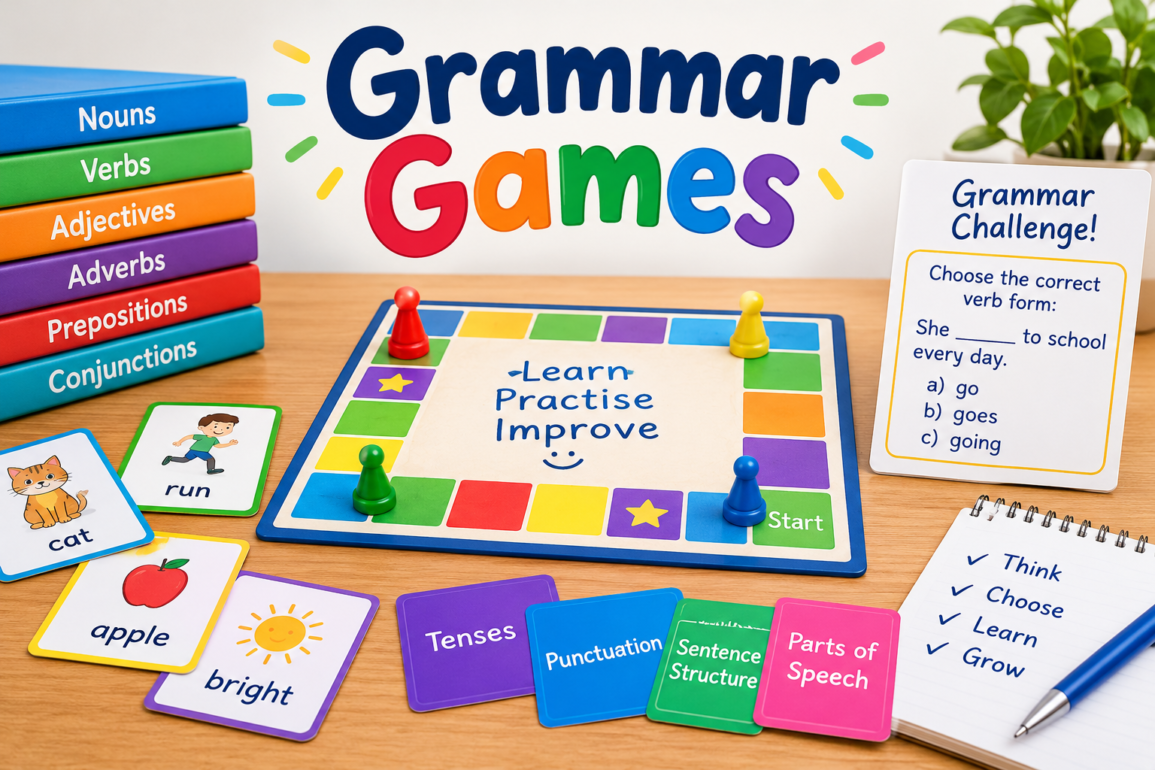
Learning grammar does not have to involve memorising long rules, completing endless exercises, or correcting the same mistakes repeatedly. Students can develop stronger language skills through activities that encourage them to think, experiment, and use English in everyday situations. Grammar games make this process more enjoyable by turning important language concepts into practical challenges that support learning and build confidence.
Whether you are a teacher looking for classroom activities, a parent helping a child with homework, or an adult improving your English, interactive practice can make a meaningful difference. From sentence-building challenges to punctuation races, these activities help learners understand how words work together and how small grammatical changes can affect meaning.
The best approach combines entertainment with a clear learning objective. When learners practise regularly, receive helpful feedback, and understand why an answer is correct, they can gradually improve their writing, reading, speaking, and communication skills.
What Are Grammar Games?
Grammar games are interactive activities designed to teach and reinforce the rules of a language. They help learners practise subjects such as nouns, verbs, adjectives, pronouns, tenses, prepositions, sentence structure, and punctuation without relying entirely on traditional worksheets.
These activities can take many forms, including online quizzes, card games, team competitions, board games, and classroom challenges. Some focus on identifying mistakes, while others encourage learners to create original sentences or complete short stories using specific grammatical rules.
Unlike repetitive exercises, well-designed grammar games encourage active participation. Learners must make decisions, apply their knowledge, and sometimes explain their answers. This makes grammar practice more engaging and gives teachers and parents opportunities to identify areas that need additional attention.
Why Grammar Games Are Effective for Learning
Interactive activities can support language development because they give learners opportunities to apply rules instead of simply reading about them. When students use grammar in meaningful situations, they can better understand how it works.
They Make Learning More Enjoyable
Some students find grammar difficult because lessons can feel repetitive or overly technical. Games introduce variety and give learners a reason to participate. A short competition or word challenge can transform an ordinary lesson into an engaging learning experience.
They Encourage Active Participation
In a traditional lesson, students may listen to explanations without using the concepts themselves. Interactive activities require them to select answers, arrange words, correct sentences, or communicate with teammates. This active involvement can help learners recognise patterns and practise important skills.
They Build Confidence Through Practice
Mistakes are a natural part of learning a language. A supportive game allows students to experiment, receive feedback, and try again without treating every error as a failure. Over time, this approach can make learners more comfortable using English in conversations and written assignments.
They Provide Immediate Feedback
Many digital activities show whether an answer is correct as soon as a learner submits it. Teachers can also explain errors during classroom competitions. This feedback helps students understand their mistakes while the relevant rule remains fresh in their minds.
7 Best Grammar Games for Students and English Learners
Choosing the right activity depends on a learner’s age, language level, and learning goals. The following ideas work well at home, in classrooms, or during independent study.
1. Sentence-Building Challenge
Sentence-building is one of the most useful grammar games for beginners because it teaches learners how to arrange words into meaningful sentences.
Write individual words on cards, such as the, dog, chased, a, ball, and ask students to arrange them correctly. As learners improve, introduce longer sentences containing adjectives, adverbs, conjunctions, and prepositional phrases.
For an additional challenge, ask students to turn a statement into a question or change a present-tense sentence into the past tense. This activity develops sentence structure, word order, and grammatical awareness.
2. Grammar Correction Race
Prepare a list of sentences containing common grammatical mistakes. Divide learners into teams and ask them to correct each sentence within a time limit.
For example, students might correct “She go to school every day” to “She goes to school every day.” Another sentence could read, “They was playing outside,” which should become “They were playing outside.”
These grammar games encourage students to recognise errors quickly while understanding the rules behind each correction. Award points for accurate answers and clear explanations rather than speed alone.
3. Parts of Speech Hunt
A parts-of-speech hunt helps students distinguish nouns, verbs, adjectives, adverbs, and other word categories.
Give learners a paragraph and ask them to identify particular types of words. Younger students can search for nouns and action verbs, while advanced learners can locate conjunctions, prepositions, and adverbs.
For example, in “The cheerful child quickly opened the door,” students can identify child as a noun, cheerful as an adjective, quickly as an adverb, and opened as a verb.
This activity improves vocabulary recognition and helps learners understand the different functions words perform within sentences.
4. Punctuation Challenge
Punctuation can change the meaning and clarity of a sentence. This activity teaches students to use full stops, commas, apostrophes, quotation marks, and question marks correctly.
Display a paragraph without punctuation and ask students to rewrite it using appropriate marks. Alternatively, provide sentences with missing punctuation and award points for each accurate correction.
For example, “Let’s eat Grandma” becomes “Let’s eat, Grandma.” The comma changes the meaning by showing that the speaker is addressing Grandma rather than suggesting something very different.
Such grammar games make punctuation rules easier to notice and remember.
5. Tense Transformation Game
Verb tenses help readers and listeners understand when an action happens. However, students sometimes confuse the present, past, and future forms.
In this game, provide a sentence and ask learners to transform it into a different tense. For example, “I walk to school” can become “I walked to school” or “I will walk to school.”
More advanced learners can practise present perfect, past continuous, and future perfect forms. Encourage them to explain how each change affects the meaning of the sentence.
These grammar games are particularly helpful for students preparing for English examinations or improving their everyday communication.
6. Grammar Bingo
Create bingo cards containing grammatical terms, sentence examples, or different word forms. Call out a definition or read a sentence, and ask students to identify the matching answer on their cards.
For instance, you might say, “Find the word that describes a noun,” and students mark an adjective. Alternatively, read “The birds are singing,” and ask them to locate the present continuous tense.
Grammar Bingo works especially well with younger learners because it combines listening, recognition, and friendly competition. Teachers can adjust the difficulty by changing the vocabulary and grammatical concepts.
7. Storytelling With Grammar Rules
Storytelling encourages learners to use grammar creatively rather than simply selecting answers from a list.
Give students a starting sentence, a setting, or a collection of vocabulary words. Ask them to create a short story using a particular tense, a minimum number of adjectives, or several conjunctions.
For example, students might write a story about a mysterious forest using past-tense verbs and descriptive language. After completing their stories, they can exchange work with classmates and identify the grammatical features they used.
Among creative grammar games, storytelling is especially valuable because it connects grammar with writing, imagination, and communication.
Online Grammar Games for Independent Practice
Digital learning platforms offer another way to practise English outside the classroom. Many websites provide interactive quizzes, timed challenges, sentence exercises, and instant scoring.
Online grammar games can help learners study at their own pace. Students can repeat difficult activities, review incorrect answers, and select exercises that match their current ability.
When choosing a platform, look for clear explanations, age-appropriate content, accurate answers, and exercises that progress from basic to advanced concepts. Teachers and parents should also check whether a website requires an account, collects personal information, or includes advertisements.
Free online activities can be useful, but students should not assume that every quiz provides reliable explanations. If an answer seems confusing, consult a trusted grammar reference or ask a teacher to clarify the rule.
How to Choose the Right Activities for Different Ages
The most effective activity matches the learner’s developmental stage and current knowledge. A game that works well for a teenager may feel too complicated for a young child, while a simple matching exercise may not challenge an advanced student.
Preschool and Early Primary Students
Young learners benefit from pictures, colourful cards, rhyming words, and simple instructions. Focus on recognising nouns, action words, plurals, and basic sentence patterns. Keep activities short and provide encouragement throughout the process.
Upper Primary and Middle School Students
Older children can explore verb tenses, subject-verb agreement, conjunctions, pronouns, and punctuation. Team challenges and short writing tasks provide useful opportunities to apply these concepts in context.
Teenagers and Adult Learners
Older learners often benefit from activities involving complex sentences, reported speech, conditionals, active and passive voice, and commonly confused grammatical structures. Real-world examples, editing exercises, and timed quizzes can make practice more relevant.
Regardless of age, grammar games should offer an appropriate level of challenge without making learners feel overwhelmed.
Tips for Getting Better Results From Grammar Practice
Playing an activity is only part of the learning process. Learners also need opportunities to review their answers and apply what they discover.
First, choose one clear objective for each session. Instead of covering every grammatical concept at once, focus on a single skill, such as irregular verbs or sentence punctuation.
Second, explain incorrect answers. When a student makes a mistake, discuss the relevant rule and provide another example. This turns a wrong answer into a useful learning opportunity.
Third, combine spoken and written activities. Oral challenges can improve fluency, while written exercises help learners notice spelling, punctuation, and sentence structure.
Fourth, increase difficulty gradually. Begin with familiar examples before introducing exceptions or more complicated sentences. A steady progression helps students build confidence while developing stronger skills.
Finally, review previous topics regularly. Repeating a useful activity after several days can help learners remember what they studied. Consistent practice with grammar games is generally more productive than trying to master every rule in one long session.
Common Mistakes to Avoid
Although games can support learning, poor planning may reduce their educational value. A competitive activity that rewards speed alone can encourage students to guess instead of thinking carefully.
Similarly, an exercise that focuses only on winning may distract learners from the grammar concept. Teachers should reward accuracy, participation, and thoughtful explanations alongside correct answers.
Another mistake is choosing activities that are too difficult or too easy. Learners need enough challenge to remain interested, but they also need opportunities to experience success.
The best grammar games balance enjoyment with meaningful practice. They should reinforce classroom lessons, address common mistakes, and help students use grammatical rules in real communication.
Frequently Asked Questions
1. What are grammar games used for?
They help learners practise grammar concepts such as verb tenses, sentence structure, punctuation, parts of speech, and subject-verb agreement through interactive activities.
2. Are grammar games suitable for beginners?
Yes. Beginners can start with picture matching, simple sentence-building activities, basic vocabulary exercises, and identifying nouns or verbs. Activities can become more challenging as their skills develop.
3. Can I play grammar games online for free?
Yes. Many educational websites offer free quizzes, interactive exercises, and language activities. Check the website’s accuracy, privacy practices, and any restrictions before using it.
4. How often should students practise grammar?
Short, regular sessions are a practical starting point. Students can practise for 10–15 minutes several times a week and adjust the schedule according to their learning goals.
5. Do grammar games improve writing skills?
They can support better writing by helping students recognise sentence patterns, correct grammatical errors, and use punctuation more accurately. Learners should also practise writing complete paragraphs to apply these skills.
Conclusion
Grammar becomes easier to understand when learners have opportunities to practise it in enjoyable and meaningful ways. From sentence-building challenges and punctuation races to online quizzes and creative storytelling, grammar games provide flexible options for students, teachers, parents, and independent English learners.
The key is to choose activities that match the learner’s ability, focus on specific language skills, and provide useful feedback. Games work best when they complement reading, writing, speaking, and traditional instruction rather than replace them entirely.
With regular practice and a willingness to learn from mistakes, students can develop stronger grammatical awareness, communicate more confidently, and produce clearer English. Start with one simple activity, build a consistent routine, and gradually introduce new challenges as your skills improve.