

Learning chemistry becomes much easier when students understand how elements are organised and how to find important information about them. The periodic table is one of the most useful tools in science because it presents essential details about every chemical element in a clear and structured format. However, memorising element symbols, atomic numbers, and chemical properties can feel challenging without regular practice. A periodic table worksheet helps students develop these skills through practical exercises, questions, and activities that reinforce classroom learning.
Whether you are a middle school student, a high school learner, or a teacher preparing classroom materials, worksheets can make chemistry more engaging and manageable. They encourage students to identify elements, recognise patterns, understand groups and periods, and apply scientific concepts independently. With consistent practice, learners can move beyond memorisation and begin to understand why the periodic table is organised the way it is.
What Is a Periodic Table Worksheet?
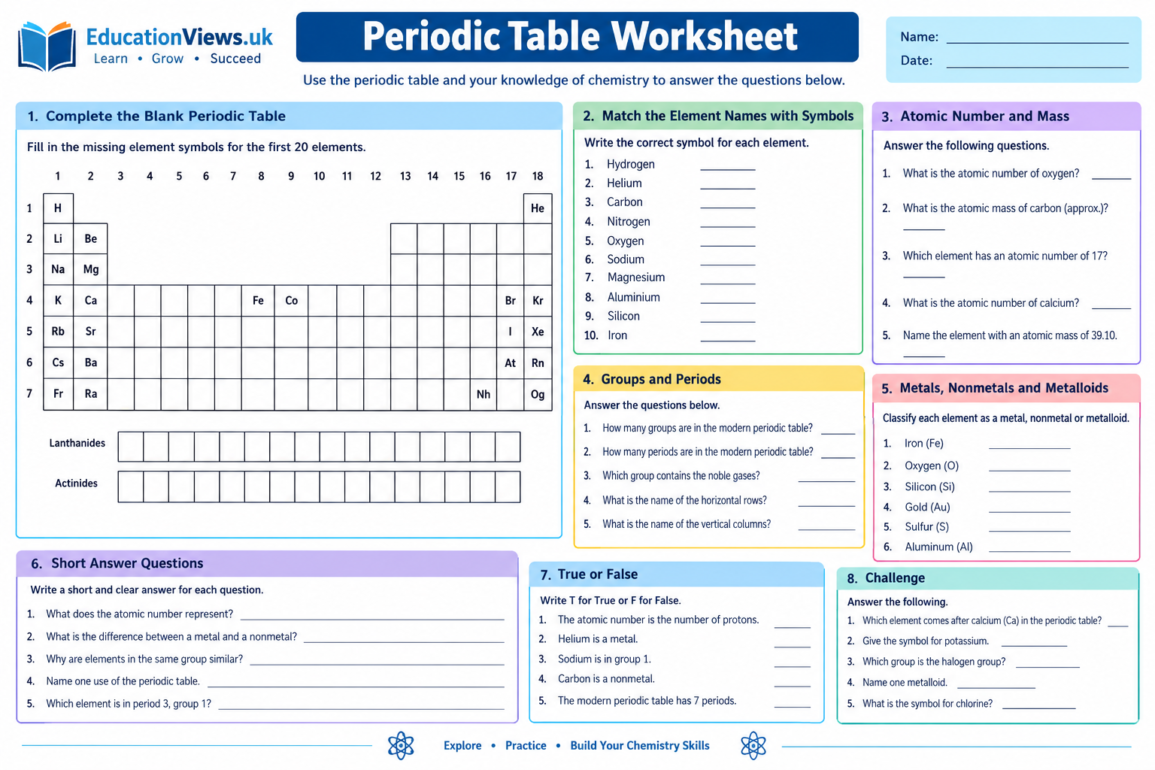
A periodic table worksheet is an educational resource designed to help students study chemical elements and their arrangement. It may include a blank periodic table, element identification questions, symbol-matching exercises, atomic number activities, and questions about chemical properties.
Teachers use these resources to introduce new concepts, review previous lessons, and assess student understanding. Students can also use them at home to prepare for quizzes, examinations, and science assignments.
A well-designed periodic table worksheet usually focuses on one or more important chemistry topics. Beginners may practise locating common elements, while advanced students may investigate electron configurations, valence electrons, and periodic trends.
Why Is the Periodic Table Important?
The periodic table organises chemical elements according to increasing atomic number and recurring chemical properties. This arrangement allows scientists and students to identify relationships between elements and predict how they may behave in chemical reactions.
Each element occupies a specific position based on the number of protons in its nucleus. Its location also provides clues about its electron arrangement and chemical characteristics.
Using a periodic table worksheet helps learners become familiar with these relationships. Instead of treating every element as an isolated fact, students can recognise patterns that make chemistry easier to understand.
For example, lithium, sodium, and potassium belong to the same group. These elements share several chemical characteristics because they have similar outer-electron arrangements. Worksheet activities help students discover such connections through observation and practice.
Types of Periodic Table Worksheets
Different activities support different learning goals. Selecting the appropriate resource helps students practise the skills they need most.
1. Blank Periodic Table Worksheet
A blank periodic table worksheet provides an outline of the table without element names or symbols. Students fill in the missing information using their textbooks, classroom notes, or a reference chart.
This activity strengthens memory and helps learners understand the positions of elements. Beginners can start by filling in the first 20 elements, while more experienced students can complete the entire table.
Teachers may also remove selected element names and ask students to identify the missing entries. This approach offers a useful balance between memorisation and problem-solving.
2. Element Symbols Worksheet
Every chemical element has a unique symbol. Some symbols are easy to recognise, such as O for oxygen and C for carbon. Others may seem less obvious because they come from Latin names. For example, Na represents sodium, and Fe represents iron.
An element-symbol activity asks students to match element names with their correct symbols. A periodic table worksheet containing these exercises can improve recall and reduce common mistakes.
Students should pay attention to capitalisation because chemical symbols follow specific rules. The first letter is always capitalised, while a second letter, when present, is lowercase.
3. Atomic Number and Atomic Mass Worksheet
Atomic number and atomic mass are important concepts in introductory chemistry. The atomic number identifies an element by showing how many protons its atoms contain.
Atomic mass is commonly displayed as a decimal value on many periodic tables because it reflects the weighted average of the masses of naturally occurring isotopes.
A worksheet may ask students to locate these values, compare elements, or calculate the approximate number of neutrons in a particular isotope.
For example, a carbon-12 atom contains six protons and six neutrons. Students can use the relationship between atomic number, mass number, and subatomic particles to solve similar questions.
4. Groups and Periods Worksheet
The periodic table contains horizontal rows called periods and vertical columns called groups. Elements in the same group often share chemical properties, while their positions across a period reveal important patterns.
A periodic table worksheet focused on groups and periods may ask learners to identify an element’s row and column or classify elements according to their locations.
Students should understand that the modern periodic table contains seven periods and 18 groups. Learning these arrangements makes it easier to locate elements and interpret their properties.
5. Metals, Nonmetals, and Metalloids Worksheet
Elements can be classified into broad categories according to their physical and chemical characteristics. Metals generally conduct heat and electricity well, while nonmetals often have different physical properties. Metalloids display characteristics associated with both categories.
These worksheets may use colours, diagrams, or classification questions to help students distinguish between the three groups.
For example, iron is a metal, oxygen is a nonmetal, and silicon is commonly classified as a metalloid. A periodic table worksheet using classification exercises encourages learners to recognise these categories quickly.
How to Use a Periodic Table Worksheet Effectively
Simply completing questions does not guarantee understanding. Students benefit most when they combine practice with careful review and explanation.
Start With the Basics
Begin by learning the names, symbols, and atomic numbers of common elements. Hydrogen, helium, carbon, nitrogen, oxygen, sodium, and calcium are useful starting points.
Once you recognise these elements, complete a simple periodic table worksheet without looking at your notes. Check your answers afterward and review any mistakes.
Study the Table’s Structure
Learn how groups and periods work before moving on to more advanced concepts. Identify where metals, nonmetals, noble gases, and other major element families appear.
Understanding the structure allows you to answer questions using patterns rather than memorising every fact separately.
Practise a Little Every Day
Short study sessions can be more manageable than trying to learn the entire table at once. Spend ten to fifteen minutes identifying elements, matching symbols, or answering review questions.
Repeated practice with a periodic table worksheet can improve recall over time. Change the activity occasionally to keep your study sessions interesting.
Review Incorrect Answers
Mistakes reveal which concepts need additional attention. When you answer incorrectly, write down the correct information and explain why it is right.
For example, if you confuse atomic number with atomic mass, revisit the definitions and practise identifying each value on several elements. This approach develops genuine understanding instead of temporary memorisation.
Sample Periodic Table Worksheet Questions
The following questions provide a simple way to practise essential chemistry concepts.
Question 1: What is the chemical symbol for oxygen?
Answer: O.
Question 2: Which element has atomic number 6?
Answer: Carbon.
Question 3: How many groups are in the modern periodic table?
Answer: 18.
Question 4: What are the horizontal rows called?
Answer: Periods.
Question 5: Which group contains the noble gases?
Answer: Group 18.
Question 6: What does an element’s atomic number represent?
Answer: The number of protons in its nucleus.
Question 7: Is silicon a metal, nonmetal, or metalloid?
Answer: Silicon is commonly classified as a metalloid.
Question 8: What is the chemical symbol for sodium?
Answer: Na.
Students can cover the answers and complete these questions independently before checking their work. Teachers can also use them as a short classroom assessment or homework activity.
Benefits of Using Printable Worksheets
Printable resources provide a simple and convenient way to practise chemistry without requiring a digital device. Students can write directly on the page, highlight important information, and keep completed activities for revision.
A printable periodic table worksheet can also support different learning styles. Visual learners may benefit from colour-coded element categories, while students who prefer written practice may enjoy matching exercises and short-answer questions.
Teachers can adapt worksheets to different ability levels. Younger learners might identify familiar elements, while older students can investigate electron configurations, oxidation states, and periodic trends.
Another benefit is flexibility. Worksheets can be completed individually, used in group activities, or incorporated into revision sessions before examinations.
Common Mistakes Students Should Avoid
Students sometimes confuse an element’s atomic number with its atomic mass. Remember that the atomic number equals the number of protons, while atomic mass values on standard periodic tables generally reflect isotopic averages.
Another frequent mistake involves chemical symbols. Students may write NA instead of Na or FE instead of Fe. Correct capitalisation matters because chemical notation follows an established scientific convention.
Learners may also assume that every element in a group behaves exactly the same way. Although elements within a group often share important characteristics, their properties can vary. Understanding both similarities and differences provides a more accurate picture of chemical behaviour.
Finally, avoid completing a periodic table worksheet by copying answers without understanding them. Take time to explain each answer, review unfamiliar concepts, and practise similar questions independently.
Tips for Teachers and Parents
Teachers and parents can make chemistry practice more effective by selecting activities that match a student’s current knowledge. A beginner may need a worksheet with element names and symbols, while an advanced learner may benefit from questions about periodic trends and electron arrangements.
Use visual aids to explain difficult concepts. A large periodic table displayed in a classroom or study area can help students connect worksheet questions with the table’s structure.
Encourage students to explain their reasoning instead of focusing only on correct answers. Asking why an element belongs to a particular group can reveal whether the learner understands the underlying concept.
Parents can support learning by scheduling regular revision sessions and celebrating improvements. Even a few correctly answered questions each day can help build confidence and consistency.
Frequently Asked Questions
1. What is a periodic table worksheet used for?
A periodic table worksheet helps students practise element names, symbols, atomic numbers, atomic masses, groups, periods, and chemical classifications. It supports classroom learning, homework, and examination preparation.
2. Can beginners use a blank periodic table?
Yes. Beginners can start with a partially completed table or focus on the first 20 elements. As their knowledge improves, they can practise completing the full table from memory.
3. What grade level is suitable for periodic table worksheets?
These resources are useful for middle school and high school students, although the difficulty depends on the activity. Basic worksheets introduce element identification, while advanced versions cover electron configurations and periodic trends.
4. How can students memorise element symbols?
Students can use flashcards, matching games, regular quizzes, and repeated worksheet practice. Learning symbols in small groups and reviewing mistakes can make memorisation easier.
5. Are printable periodic table worksheets useful for exams?
Yes. Printable worksheets provide structured revision and allow students to practise without digital distractions. They are particularly helpful when combined with textbook study, teacher explanations, and regular self-testing.
Conclusion
Understanding the periodic table is an essential step towards developing strong chemistry skills. Once students learn how elements are arranged, they can identify important information, recognise chemical patterns, and understand relationships between different substances.
A well-prepared periodic table worksheet makes this process more organised by turning complex information into manageable exercises. Whether you practise element symbols, atomic numbers, groups, periods, or chemical classifications, regular revision can improve accuracy and confidence.
Choose activities that match your learning level, review mistakes carefully, and gradually move towards more challenging questions. With consistent effort, the periodic table becomes easier to understand and far more useful in your chemistry studies.