

A name pattern can help children recognise letters, understand spelling, organise information, and develop early literacy skills. Whether a student is learning to read, practising handwriting, sorting names, or exploring repeated sequences, working with names can turn an ordinary classroom activity into a meaningful learning experience. Parents and teachers can use these activities to make learning more personal, engaging, and easier to understand.
Understanding how a name pattern works is useful in several educational settings. Children can identify similarities between names, notice repeated letters, compare beginning and ending sounds, and recognise sequences. These skills support reading, writing, memory, and logical thinking. With simple examples and regular practice, learners can gradually become more confident in recognising patterns in everyday language.
This guide explains the meaning of the term, explores common examples, and shares practical activities that parents and teachers can use at home or in the classroom.
What Is a Name Pattern?
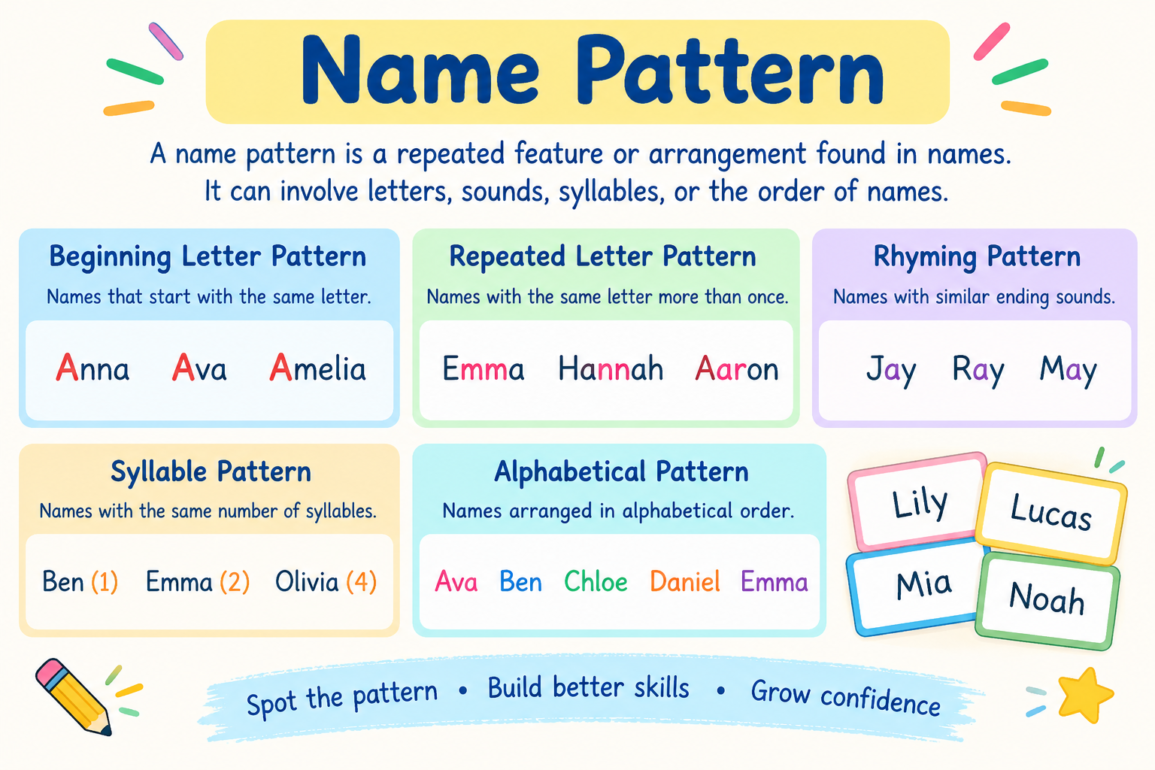
A name pattern is a recognisable arrangement or repeated feature found in names. It may involve letters, sounds, syllables, spelling structures, or the order in which names appear. For example, students might notice that several names begin with the same letter or contain a similar ending.
Consider the names Anna, Amelia, and Ava. Each begins with the letter A, creating a simple pattern that children can identify visually. Similarly, names such as Ben, Beth, and Bella share the same initial letter, even though their remaining letters differ.
The concept can also extend beyond spelling. A teacher might arrange name cards alphabetically, group names according to their number of syllables, or create a sequence based on alternating initials. Each activity encourages students to observe details and discover relationships between pieces of information.
A name pattern does not have to follow one universal rule. Its structure depends on the learning objective, the characteristics being compared, and the age of the learners involved.
Why Name Patterns Matter in Early Education
Recognising patterns is an important part of early childhood development. Children naturally begin noticing similarities in colours, shapes, sounds, and everyday objects. Applying the same skill to names provides a familiar starting point for more advanced learning.
Improving Letter Recognition
When children compare names, they become more familiar with the alphabet. They learn to recognise individual letters, distinguish between similar shapes, and identify the position of letters within words.
For instance, a student comparing Mia, Mila, and Milo may notice that all three names begin with M. Repeated exposure helps the child connect the written symbol with its place in a word. A name pattern activity can therefore reinforce alphabet knowledge without relying entirely on traditional worksheets.
Developing Phonological Awareness
Names also provide opportunities to explore sounds. Children can listen for matching first sounds, compare rhyming endings, and count syllables. These activities build phonological awareness, which supports the development of reading and spelling skills.
For example, Sam and Sarah begin with the same letter and share a similar initial sound. However, a teacher can also explain that identical letters do not always produce identical sounds in every word. This encourages careful listening rather than relying only on visual similarities.
Strengthening Memory and Attention
Finding similarities between names requires children to pay attention to details. They must examine letters, remember previously observed examples, and decide whether a new name belongs to an existing group.
These small decisions encourage concentration and classification skills. When students participate regularly, they may become more comfortable identifying similarities and differences in other learning activities as well.
Common Types of Name Patterns
There are several ways to introduce this concept, depending on whether the goal is to practise spelling, develop reading skills, or teach classification. Using different approaches helps learners understand that patterns can appear in more than one form.
1. Beginning-Letter Patterns
A beginning-letter pattern groups names according to their first letter. This is one of the easiest activities for young children because it requires only basic alphabet knowledge.
For example, a teacher can place the names Oliver, Olivia, Oscar, and Owen together. Students can examine the list and identify the shared initial. They can then find other names beginning with O.
A name pattern based on initial letters also works well with classroom attendance charts, personalised name cards, and alphabet displays. Teachers can introduce one letter at a time before asking children to sort a larger collection independently.
2. Repeated-Letter Patterns
Some names contain repeated letters, making them useful for spelling practice. Examples include Emma, Hannah, Aaron, and Ella. Children can identify the repeated letters and explain where they appear.
Teachers should clarify that repeated letters do not always sound the same across different names. The objective is to notice spelling structures, not to assume that every repeated letter follows an identical pronunciation rule.
3. Rhyming and Sound Patterns
Names can also be grouped according to their ending sounds. For instance, Jay and Ray share a rhyming sound, while names such as Ben and Ken have similar endings.
This type of activity helps children listen carefully and compare spoken language. A name pattern focused on sounds can be especially useful during phonics lessons, poetry activities, and early reading exercises.
However, teachers should distinguish between rhyming and matching spelling. Two names may rhyme without having identical final letters, so learners should listen to the sounds as well as inspect the written forms.
4. Syllable Patterns
Syllables provide another way to compare names. Children can clap as they pronounce each name and count the number of spoken parts.
For example, Ben generally has one syllable, Emma has two, and Olivia has four. Students can sort the names into groups according to syllable count.
A name pattern activity like this combines listening, speaking, counting, and classification. It also gives teachers an opportunity to introduce longer words without making the task unnecessarily difficult.
5. Alphabetical Patterns
Alphabetical ordering teaches children how to arrange names using the conventional sequence of letters. Students can begin with names starting with different letters before progressing to names sharing the same initial.
For example, Ava, Ben, Chloe, Daniel, and Emma can be arranged alphabetically with relative ease. If two names begin with the same letter, students can compare their second letters to determine which comes first.
This skill is useful when organising classroom registers, library records, attendance sheets, and lists of students.
How to Teach Name Patterns Step by Step
An effective lesson begins with a simple example and gradually introduces more challenging tasks. Teachers do not need expensive resources or specialised equipment to get started.
Step 1: Choose Familiar Names
Start with names children already know, such as their own names, those of classmates, or fictional characters. Familiar examples make it easier to focus on the learning objective instead of memorising unfamiliar words.
Write each name clearly on a separate card. Use a large, readable font or handwritten letters that children can recognise easily.
Step 2: Identify One Shared Feature
Ask students to look at the cards and identify one common characteristic. You might ask which names begin with the same letter or which names have two syllables.
Introduce only one rule initially. Too many conditions can confuse beginners and make it harder for them to explain their observations.
Step 3: Sort the Names into Groups
Invite students to place matching names together. They should explain why each name belongs in a particular group.
For example, if the lesson focuses on beginning letters, students might create separate groups for names starting with A, B, and C. A visual name pattern makes the relationship between the examples easier to understand.
Step 4: Ask Students to Predict
Once students understand the rule, introduce another name and ask where it belongs. Encourage them to explain their answer instead of simply guessing.
Prediction helps learners apply what they have discovered. It also allows teachers to identify misunderstandings and provide support when necessary.
Step 5: Let Students Create Their Own Examples
After practising with prepared cards, ask children to develop their own groups. They might collect names with repeated letters, organise names by syllables, or build an alphabetical sequence.
Creating a name pattern independently encourages learners to think critically and apply the rule without constant guidance.
Fun Name Pattern Activities for the Classroom
Early Childhood | Laredo Independent School District
13
Practical activities make lessons more interactive and help children connect abstract ideas with familiar experiences.
Name Card Sorting
Give each child a card containing a first name. Ask the class to form groups according to the first letter, repeated letters, or syllable count. Students can then explain the rule behind their group.
This activity encourages cooperation and gives every learner an opportunity to participate. It also works well in small groups where children can discuss their choices.
Complete the Sequence
Write a short sequence on the board, such as Ava, Alex, Adam, and ____. Ask students to suggest another name beginning with A.
For a more challenging task, provide a sequence based on alternating initials, such as Anna, Ben, Anna, Ben, and ____. Children must recognise the repeating order before supplying the next item.
The goal is to help students understand that a name pattern follows a specific rule rather than simply presenting a random collection of names.
Name Pattern Worksheets
Printable worksheets can reinforce classroom learning. Students might circle repeated letters, draw lines between rhyming names, count syllables, or arrange names alphabetically.
Keep the instructions short and provide an example before asking students to work independently. Younger learners may benefit from pictures or coloured cards, while older students can complete more complex sorting exercises.
Personalised Name Art
Children can decorate their names using repeating colours, shapes, or letters. For example, they might alternate two colours across the letters of their names or repeat a particular decorative symbol.
This creative activity combines literacy with art. It also gives students an opportunity to express their individuality while practising repetition and sequencing.
Using Name Patterns Beyond the Classroom
The value of this concept extends beyond early literacy lessons. Families can use everyday situations to encourage children to observe, compare, and organise information.
At home, parents can arrange family names alphabetically, compare the initials of relatives, or count syllables during a simple word game. These short activities require little preparation and can fit naturally into daily routines.
A name pattern can also help students understand basic data organisation. Older children might create a table showing initials, syllable counts, or the number of letters in fictional names. They can then compare the results and explain which categories contain the most examples.
In digital learning environments, similar activities can introduce simple classification and data-handling concepts. Students may sort a list alphabetically, search for repeated characters, or identify names that meet a particular condition. These exercises offer an accessible introduction to the structured thinking used in computing.
Teachers should always respect students’ privacy when using real names in public displays or online activities. Fictional names or teacher-approved examples can provide the same educational benefits without unnecessarily sharing personal information.
Common Mistakes to Avoid When Teaching Name Patterns
Although these activities are simple, a few teaching mistakes can make them less effective. The first is assuming that children will immediately understand the rule. Demonstrate the task clearly and allow students to practise with examples before introducing independent work.
Another common mistake is treating similar spelling as proof of similar pronunciation. English contains many irregular spelling patterns, and names may come from different languages or traditions. Explain that letters, sounds, and syllables are related but distinct features.
Teachers should also avoid making every activity competitive. Some children need more time to recognise relationships, and a supportive learning environment allows them to practise without unnecessary pressure.
Finally, keep the objective clear. A name pattern lesson designed to teach initial letters should not suddenly require advanced alphabetical sorting. Build skills gradually and increase the difficulty when students demonstrate confidence.
Frequently Asked Questions
What is a name pattern in simple words?
A name pattern is a repeated feature or arrangement found in names. It might involve matching first letters, repeated characters, similar sounds, syllable counts, or alphabetical order. Children use these similarities to recognise relationships and organise information.
How does a name pattern help children learn?
It helps children practise letter recognition, spelling awareness, listening, memory, and classification. These skills can support early reading and writing development while making classroom activities more interactive.
What are some examples of name patterns?
Examples include names beginning with the same letter, names containing repeated letters, rhyming names, and names arranged alphabetically. A teacher might group Anna, Adam, and Ava because they all begin with A.
At what age can children start learning name patterns?
Children can begin exploring simple patterns during preschool when they start recognising letters and familiar names. Teachers can introduce more complex activities involving syllables, alphabetical ordering, and sequences as their literacy skills develop.
Can parents teach name patterns at home?
Yes. Parents can use family names, name cards, alphabet games, and simple sorting activities. Even a few minutes of practice can encourage children to notice similarities and explain their observations.
Conclusion
Learning to recognise patterns through names offers a practical way to strengthen early literacy and thinking skills. From identifying initial letters to exploring repeated spelling, rhyming sounds, syllables, and alphabetical order, these activities help children understand how information can be compared and organised.
A well-designed name pattern lesson should be clear, age-appropriate, and enjoyable. Teachers can introduce the concept with familiar examples, provide opportunities for hands-on practice, and gradually encourage independent thinking. Parents can reinforce the same skills through everyday games and conversations.
The most important goal is not simply to memorise groups of names. It is to help learners observe details, identify meaningful relationships, and explain the rules they discover. With regular practice and supportive guidance, children can develop useful skills that extend beyond names into reading, writing, mathematics, and everyday problem-solving.