




Introduction
In software development, testing helps developers verify that code behaves as expected. Among the many terms used in programming, It is commonly associated with Python testing, particularly when developers create functions designed to check whether another piece of code produces the expected result. Understanding this concept is useful for beginners because it introduces the foundations of automated testing, assertions, test organization, and reliable software development.
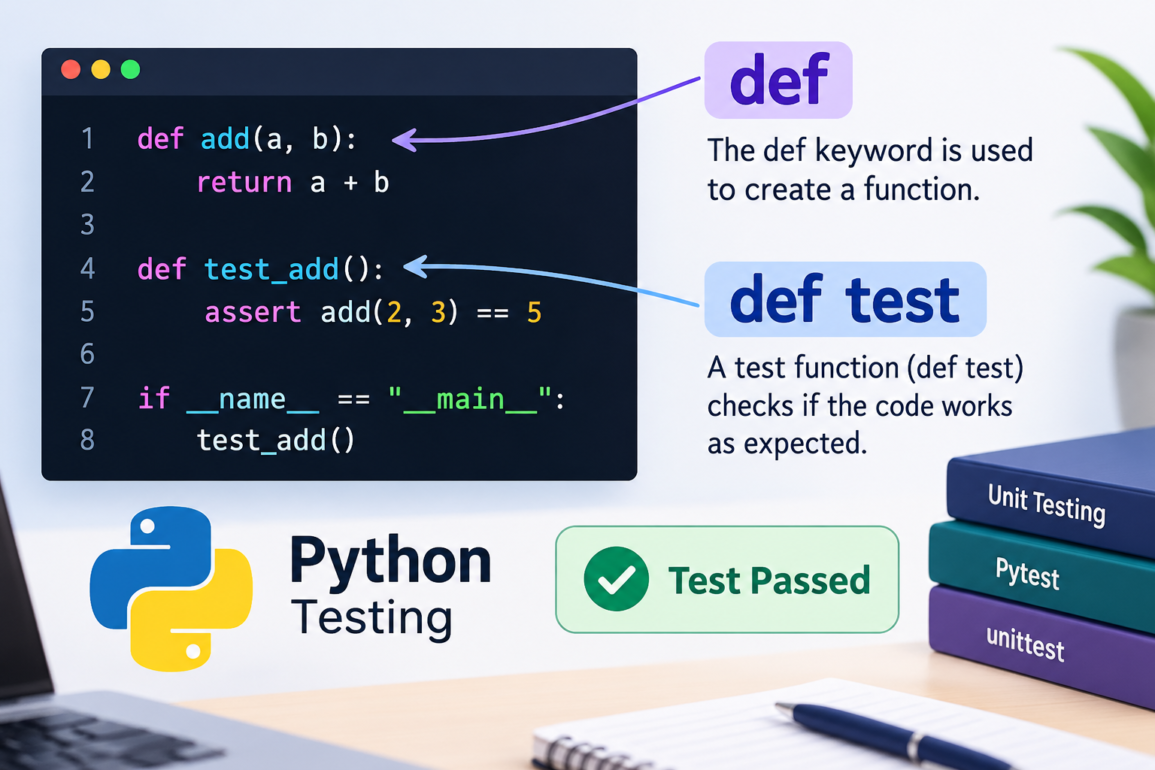
A def test generally refers to a test function defined with Python’s def keyword. Developers use these functions to test individual behaviors of their programs. Instead of manually checking every result, automated tests can perform repeatable checks and quickly identify problems after code changes.
Whether you are learning Python, working on a small script, or developing a larger application, learning how a def test works can make your development process more organized and dependable.
What Does Def Test Mean?
The phrase it is not a special Python keyword. Rather, it combines two familiar programming concepts. The def keyword creates a function, while test is commonly used as the name of a function that checks software behavior.
For example, a simple this might look like this:
def test_addition():
assert 2 + 3 == 5
Here, def tells Python that a function is being created. The function is called test_addition, and the assert statement checks whether the expected condition is true.
If the condition is correct, the test passes. If it is false, the testing framework reports a failure.
This simple structure makes a def test an important building block for automated testing.
How a Def Test Works
A typical it follows a straightforward process. First, the developer creates a function that represents a specific behavior that needs to be checked. Next, the function executes the relevant code. Finally, an assertion verifies whether the result matches the expected outcome.
Consider this example:
def multiply(a, b):
return a * b
def test_multiply():
assert multiply(4, 5) == 20
The multiply() function performs the actual operation. Then it calls that function and checks whether the returned value equals 20.
This separation is useful because it keeps production code and testing logic organized.
Why Developers Use Def Test Functions
It provides several practical advantages. One of the biggest benefits is repeatability. Once a test has been written, developers can run it repeatedly without manually performing the same checks.
Testing also helps detect regressions. A regression occurs when a change that was intended to improve one part of an application accidentally breaks another part. Existing tests can expose such problems quickly.
Another benefit is clarity. A well-written def test describes what a particular piece of code is expected to do. This can make a project easier for other developers to understand.
Automated testing can also save time as applications become larger. Instead of manually checking dozens or hundreds of behaviors, developers can allow a testing framework to execute the checks automatically.
Def Test With Python’s unittest
Python includes a built-in testing framework called unittest. Developers can create test methods inside a test class and use assertions provided by the framework.
For example:
import unittest
def subtract(a, b):
return a – b
class TestSubtract(unittest.TestCase):
def test_subtract(self):
self.assertEqual(subtract(10, 4), 6)
In this example, this is the test_subtract method. The framework recognizes it as a test because its name begins with test.
unittest provides several useful assertion methods, including assertEqual, assertTrue, and assertFalse.
These tools allow developers to test different types of expected behavior.
Def Test With Pytest
Another popular approach is pytest. It is widely used because its syntax can be concise and easy to read.
A simple def test using pytest might look like this:
def test_subtract():
assert 10 – 4 == 6
The test is short, but it clearly communicates the expected result.
Pytest can also test functions from separate application modules. For example, a project might contain application code in one file and testing code in another. This organization makes larger projects easier to maintain.
Naming a Def Test Correctly
Naming is important when creating a def test. Testing frameworks often identify test functions based on naming conventions.
With pytest, developers commonly use names beginning with test_. For example:
def test_login():
pass
or:
def test_calculate_total():
pass
Descriptive names are preferable because they explain what the test checks. A name such as test_calculate_total_with_discount provides more useful information than a vague name such as test_one.
Good naming also makes test reports easier to understand when something fails.
What Should a Def Test Check?
A def test should generally focus on one clear behavior. For instance, if you have a function that calculates shipping costs, you might create separate tests for normal orders, free shipping thresholds, and invalid inputs.
Testing one behavior at a time makes failures easier to investigate.
For example:
def calculate_total(price, tax):
return price + tax
def test_calculate_total():
assert calculate_total(100, 10) == 110
A test like this checks one straightforward expectation.
Developers can then add additional tests for different conditions rather than placing every possible scenario into one large test function.
Testing Expected Errors
Not every test checks a successful result. Sometimes a program should reject invalid input, and a def test can verify that the appropriate error occurs.
With pytest, for example:
import pytest
def divide(a, b):
if b == 0:
raise ValueError(“Cannot divide by zero”)
return a / b
def test_divide_by_zero():
with pytest.raises(ValueError):
divide(10, 0)
This test confirms that the function raises the expected exception.
Testing error handling is important because reliable software should respond predictably to invalid conditions rather than simply handling successful inputs.
Common Mistakes When Writing Def Test Functions
One common mistake is creating tests that are too broad. A test that checks many unrelated behaviors can become difficult to understand and troubleshoot.
Another problem occurs when developers make tests dependent on one another. Ideally, each def test should be independent whenever possible. If one test fails, it should not automatically cause unrelated tests to fail.
Poor test names can also create confusion. A descriptive name gives developers immediate context about the expected behavior.
Developers should also avoid writing tests that merely repeat implementation details. Effective tests should focus primarily on observable behavior and expected results.
Best Practices for Writing Def Test Code
A good def test should be simple, focused, and easy to understand. Start by identifying the exact behavior that needs verification. Then provide the necessary input and define the expected result.
Keep individual tests relatively small. If a test becomes complicated, consider whether the behavior can be divided into several independent checks.
It is also useful to test both typical and unusual inputs. Normal cases confirm that the basic functionality works, while edge cases can reveal problems that may otherwise remain hidden.
Finally, run tests regularly. Testing only at the end of development makes it harder to determine when a problem was introduced.
Def Test and Test-Driven Development
The idea of def test is also relevant to test-driven development, commonly called TDD. In TDD, developers generally write a test describing desired behavior before implementing the functionality that makes the test pass.
The process is often summarized as writing a failing test, implementing the required functionality, and then improving the code while keeping the tests passing.
This approach can encourage developers to think carefully about expected behavior before writing implementation code.
However, developers do not have to follow TDD to benefit from a def test. Automated tests are valuable in many development workflows.
Conclusion
A def test is essentially a Python function used to verify that software behaves as expected. Although the phrase itself is not a special Python command, it describes a common and important testing pattern based on Python functions and testing frameworks.
Learning how to create a def test helps beginners understand assertions, test organization, error checking, and automated quality control. As projects grow, these tests can provide an efficient way to detect regressions and confirm that existing functionality continues to work.
Whether you use Python’s built-in unittest, pytest, or another testing approach, the central principle remains the same: write clear tests that check meaningful behavior. With consistent practice, def test functions can become an essential part of building reliable and maintainable Python applications.