


5 Letter Word Ending With ID
If you are searching for a 5 letter word ending with id, you are probably solving a Wordle puzzle, completing a crossword, preparing for a spelling test, or improving your English vocabulary. Learning word patterns is one of the easiest ways to become better at reading, writing, and spelling.
In this guide, you’ll find a useful list of words, their meanings, example sentences, and practical learning activities. Whether you’re a student, teacher, or English learner, this article will help you expand your vocabulary in a simple and enjoyable way.
Why Learn 5-Letter Words?
Five-letter words appear frequently in English textbooks, spelling competitions, and vocabulary exercises. They also help students:
- Improve spelling accuracy.
- Build reading confidence.
- Write better sentences.
- Prepare for word games like Wordle and Scrabble.
- Increase overall vocabulary.
Studying words by their endings makes it easier to recognise spelling patterns and remember new vocabulary.
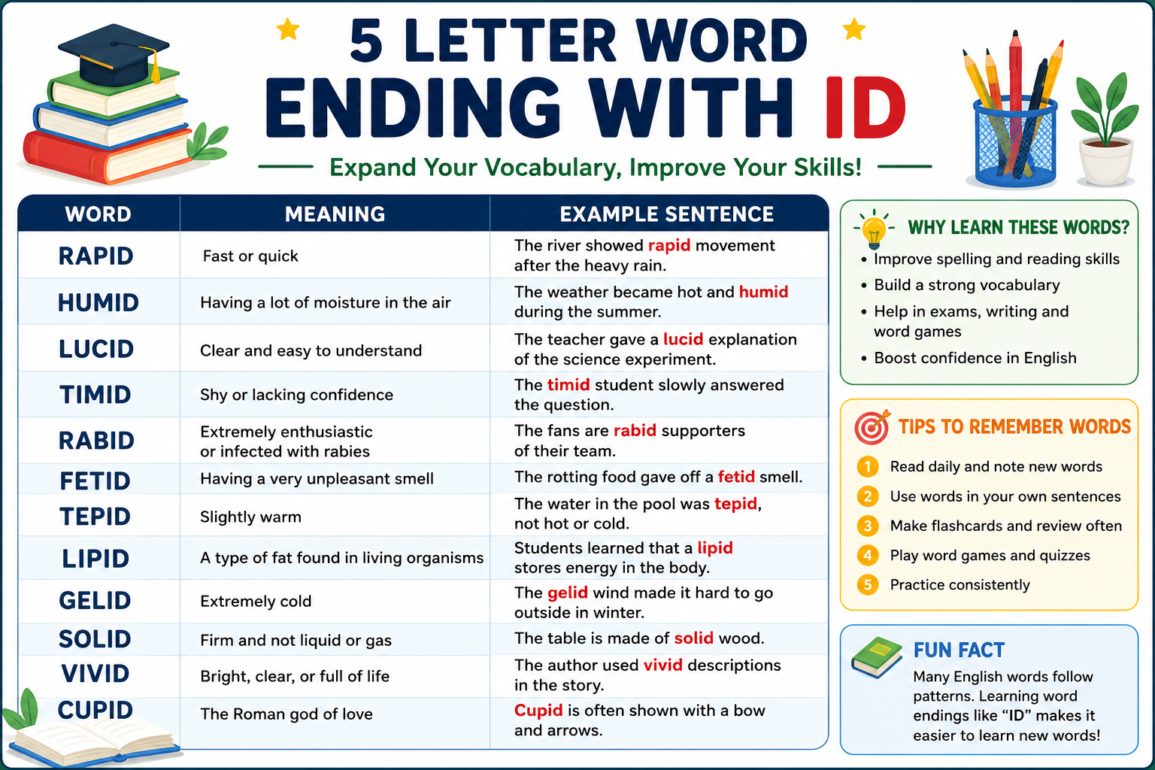
Common 5 Letter Word Ending With ID
Here are some common examples of a 5 letter word ending with id:
| Word | Meaning |
| Rapid | Fast or quick |
| Humid | Having a lot of moisture in the air |
| Lucid | Clear and easy to understand |
| Timid | Shy or lacking confidence |
| Rabid | Extremely enthusiastic or infected with rabies |
| Fetid | Having a very unpleasant smell |
| Tepid | Slightly warm |
| Lipid | A type of fat found in living organisms |
| Gelid | Extremely cold |
| Solid | Firm and not liquid or gas |
| Vivid | Bright, clear, or full of life |
| Cupid | The Roman god of love |
These are among the most useful words students are likely to encounter in school and everyday English.
Meanings and Example Sentences
Understanding vocabulary becomes much easier when you see words used in context.
Rapid
The river showed rapid movement after the heavy rain.
Humid
The weather became hot and humid during the summer.
Lucid
The teacher gave a lucid explanation of the science experiment.
Timid
The timid student slowly answered the question.
Solid
Ice is the solid form of water.
Vivid
The author used vivid descriptions in the story.
Lipid
Students learned that a lipid stores energy in the human body.
How These Words Help Students
Learning a 5 letter word ending with id strengthens several language skills.
Better Reading
Students recognise words faster while reading books and articles.
Improved Writing
Using descriptive words like vivid, rapid, and lucid makes writing more interesting.
Stronger Vocabulary
Knowing similar word endings helps students remember new words more easily.
Higher Test Scores
Many school exams include vocabulary, spelling, and reading comprehension questions.
Spelling Pattern of Words Ending in “ID”
The ending “id” appears in many English adjectives and nouns.
For example:
- Hum + id = Humid
- Luc + id = Lucid
- Viv + id = Vivid
- Sol + id = Solid
Recognising these patterns helps students guess unfamiliar words while reading.
Classroom Activities
Teachers can use these ideas to make vocabulary lessons more engaging.
Matching Activity
Match each word with its correct meaning.
Sentence Writing
Ask students to write one sentence using each new word.
Spelling Challenge
Write the words from memory after practising them several times.
Dictionary Hunt
Students can find additional words ending with ID and explain their meanings.
These activities improve both vocabulary and critical thinking.
Tips for Remembering New Words
Here are some effective learning strategies:
- Read for at least 20 minutes every day.
- Keep a vocabulary notebook.
- Review new words every week.
- Use flashcards.
- Play educational word games.
- Practise writing complete sentences.
Regular practice is the best way to remember vocabulary for a long time.
Why Word Patterns Matter
Instead of memorising hundreds of random words, students can learn groups of words with similar endings.
When you understand a spelling pattern like 5 letter word ending with id, you can quickly recognise unfamiliar vocabulary and improve your reading speed. This method is widely used in schools because it builds vocabulary naturally.
It also helps students become more confident during spelling tests and competitive word games.
Common Mistakes to Avoid
While learning new vocabulary, students often make these mistakes:
- Memorising words without learning their meanings.
- Forgetting to use new words in sentences.
- Ignoring pronunciation.
- Learning too many words at once.
Focus on a few words each day and practise them regularly.
Conclusion
Learning a 5 letter word ending with id is an excellent way to improve English vocabulary, spelling, reading, and writing skills. Words such as rapid, humid, lucid, solid, vivid, and timid appear frequently in books, classrooms, and everyday conversations. By understanding their meanings and using them in sentences, students can become more confident English learners. Regular practice, reading, and vocabulary exercises will make these words easier to remember and use correctly in both schoolwork and daily life.
FAQs
What is a common 5 letter word ending with ID?
Some common examples are rapid, humid, lucid, solid, vivid, timid, and tepid.
Why should students learn five-letter words?
They improve spelling, reading comprehension, vocabulary, and writing skills.
Are these words useful for Wordle?
Yes. Many 5 letter word ending with id examples can appear in Wordle and other word games.
How can I remember new vocabulary?
Read daily, write sentences, use flashcards, and review words regularly.
Are words ending with “ID” common in English?
Yes. Many adjectives and nouns ending in ID are commonly used in education, science, and everyday communication.