

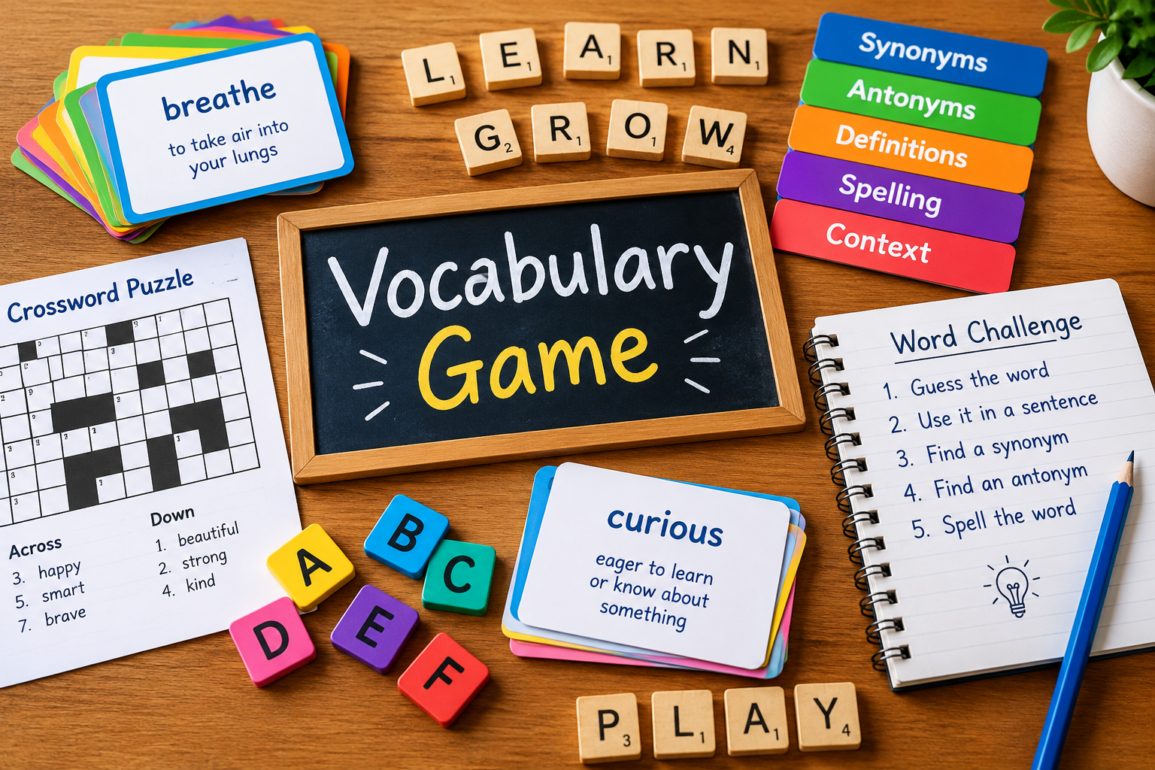
Learning new words does not have to feel like a difficult school assignment. A vocabulary game can turn language practice into an enjoyable activity that encourages curiosity, improves memory, and helps learners communicate more confidently. Whether you are a student preparing for an examination, a teacher planning classroom activities, or an adult who wants to improve everyday English, word games offer a practical way to develop language skills.
Traditional vocabulary learning often involves reading definitions, memorising spelling, and completing written exercises. Although these methods remain useful, interactive activities give learners additional opportunities to understand and use words in meaningful situations. A well-designed vocabulary game combines entertainment with learning, making it easier to stay motivated and practise regularly.
From guessing hidden words to solving puzzles and matching definitions, there are many activities suitable for different ages and skill levels. Understanding how these games work can help you choose the right approach for your learning goals.
What Is a Vocabulary Game?
A vocabulary game is an activity that helps people learn, review, recognise, and use words through rules, challenges, puzzles, or friendly competition. Players might identify a word from its definition, arrange letters into meaningful combinations, match synonyms, or explain unfamiliar terms to teammates.
The main purpose is to make word learning active rather than passive. Instead of simply reading a definition, players recall information, consider possible answers, and apply their understanding. This process encourages them to think about spelling, pronunciation, meaning, and context.
These games can take place in classrooms, at home, during study sessions, or through digital platforms. Some require nothing more than paper and pencils, while others use mobile applications, online quizzes, or interactive websites. The best choice depends on the learner’s age, language ability, interests, and available resources.
Why Vocabulary Games Are Important
They Improve Word Recognition
Regular exposure to words helps learners recognise them more quickly when reading or listening. A vocabulary game provides repeated opportunities to encounter familiar and unfamiliar terms without making practice feel repetitive. For example, matching a word with its definition helps learners connect the written form with its meaning.
As players encounter the same words in different activities, they can gradually become more comfortable using them. This familiarity can support reading comprehension and make it easier to understand conversations, instructions, and educational materials.
They Strengthen Memory
Remembering a new word requires more than seeing it once. Learners benefit from revisiting words, recalling their meanings, and using them in different contexts. A vocabulary game encourages this active recall by asking players to produce answers instead of merely recognising information on a page.
Activities such as flashcard challenges, timed quizzes, and word-matching exercises can reinforce learning when repeated over time. Short, consistent practice sessions often work better than trying to memorise a large list of words in one sitting.
They Build Communication Skills
A broader vocabulary gives people more ways to express ideas accurately. When learners understand words such as confident, curious, essential, and effective, they can communicate more precisely in speech and writing.
Group activities also encourage players to explain their answers, listen to others, and discuss differences in meaning. These interactions create opportunities to practise language in realistic situations.
Popular Types of Vocabulary Games
Word Guessing Games
Word guessing activities ask players to identify a hidden word from clues. One person might describe an object, emotion, or action without saying the target word, while the other players try to identify it.
For example, a clue such as “a place where students borrow books” points towards the word library. This simple activity develops listening comprehension, logical thinking, and the ability to connect descriptions with appropriate vocabulary.
A vocabulary game based on guessing can be adapted for beginners by using familiar objects or made more challenging with abstract concepts, advanced adjectives, and technical terms.
Crossword Puzzles
Crossword puzzles require players to fill a grid using clues and intersecting words. They encourage learners to think about spelling, word length, definitions, and relationships between terms.
Crosswords are particularly useful for reviewing subject-specific vocabulary. Teachers can create puzzles around science, geography, literature, or history, allowing students to practise important terminology while reviewing their lessons.
Word Search Challenges
Word searches contain hidden words arranged horizontally, vertically, diagonally, or backwards. Players locate the target terms within a grid of letters.
Although these puzzles focus more on recognition than on defining words, they can help learners become familiar with spelling patterns. They work especially well for younger students and beginners who need an accessible introduction to new vocabulary.
Synonym and Antonym Games
Synonym activities ask players to identify words with similar meanings, while antonym activities focus on opposites. For example, happy can be associated with joyful, while generous contrasts with selfish.
These exercises help learners understand relationships between words rather than treating every term as an isolated item. A vocabulary game involving synonyms and antonyms can also improve writing by helping students choose more precise expressions and avoid unnecessary repetition.
Scrabble and Letter-Building Games
Letter-building games challenge players to create words from available letters. Scrabble and similar activities encourage spelling awareness, strategic thinking, and familiarity with different word patterns.
Players can make the activity educational by explaining the meanings of unfamiliar words after each round. This additional step ensures that participants learn more than the correct arrangement of letters.
How to Choose the Right Vocabulary Game
The most effective activity is one that matches the learner’s current abilities and learning objectives. Beginners generally benefit from familiar words, clear instructions, and visual clues. Intermediate learners can explore synonyms, sentence completion, and contextual guessing, while advanced learners may enjoy idioms, word roots, and challenging definitions.
Age also matters. Younger children often respond well to pictures, movement, colourful cards, and short rounds. Teenagers may prefer team competitions, quizzes, and digital challenges. Adults might benefit from professional terminology, everyday expressions, and games that improve workplace communication.
Consider the time available as well. A five-minute activity can introduce a few new words, while a longer session can include several rounds and opportunities for discussion. Choose activities that encourage participation without making learners feel pressured to answer every question correctly.
How to Play a Vocabulary Game Effectively
Start With a Clear Goal
Before beginning, decide what participants should learn. Your objective might be to understand ten new words, review spelling patterns, practise synonyms, or learn vocabulary related to a particular subject.
A clear goal helps you select suitable questions and measure progress. It also makes the activity more meaningful because players understand why they are practising specific terms.
Use Words in Context
Definitions are important, but learners also need to understand how words function in sentences. After identifying a word, ask players to create an original sentence using it.
For example, after learning reliable, a student might write, “My reliable friend always arrives on time.” This exercise connects the definition with practical usage and helps learners understand how the word fits naturally into everyday communication.
Encourage Repetition
Revisiting previously learned vocabulary game helps reinforce memory. You can bring back words from earlier rounds, include them in new puzzles, or ask learners to explain their meanings during a later session.
A vocabulary game becomes more effective when it forms part of a regular routine rather than a one-time activity. Even ten minutes of focused practice several times a week can provide useful opportunities to review and apply new words.
Make Mistakes Part of Learning
Incorrect answers should create opportunities for explanation rather than embarrassment. When a player chooses the wrong word, explain the correct meaning and provide an example sentence. Encourage the player to try again during a later round.
A supportive atmosphere helps learners participate more confidently. It also allows teachers and parents to identify confusing words and adjust future activities to meet individual needs.
Benefits of Online Vocabulary Games
Digital learning tools have made vocabulary practice more accessible. An online vocabulary game may include audio clues, timed challenges, progress tracking, instant feedback, and different difficulty levels.
These features can help learners practise independently and receive immediate information about their answers. Some platforms also allow teachers to prepare customised quizzes, making it easier to focus on classroom topics or examination requirements.
However, not every digital activity provides meaningful learning. Some games reward speed without checking whether players understand the words they select. Others introduce too many unfamiliar terms at once. Choose platforms that explain incorrect answers, provide useful examples, and encourage learners to review mistakes.
It is also sensible to balance screen-based activities with reading, writing, conversation, and offline exercises. A variety of learning methods gives learners more opportunities to use words beyond the game itself.
Using Vocabulary Games in the Classroom
Teachers can use word games as warm-up activities, lesson reviews, group exercises, or short assessments. For example, a teacher introducing a science topic might prepare cards containing key terms and their definitions. Students can work in pairs to match the cards before discussing how each term relates to the lesson.
A classroom vocabulary game can also encourage cooperation. Teams may compete to identify words, explain meanings, or construct sentences using a selected group of terms. Teachers can award points for accurate definitions, correct spelling, and appropriate examples rather than speed alone.
To support different learning abilities, provide optional clues and allow additional thinking time. More advanced students can receive challenging words, while beginners can work with simpler vocabulary. This flexible approach helps everyone participate without turning the activity into an unfair competition.
Common Mistakes to Avoid
One common mistake is choosing entertainment over learning. A game may be enjoyable, but it offers limited educational value if players never explore the meanings of the words they encounter. Always include opportunities to review definitions and practise usage.
Another mistake is introducing too many words at once. A long list can overwhelm beginners and make it difficult to remember individual meanings. Start with a manageable selection and gradually introduce additional vocabulary as learners become more confident.
It is also unhelpful to focus exclusively on winning. Although competition can increase excitement, excessive pressure may discourage participants who need more time. Encourage effort, improvement, cooperation, and curiosity alongside correct answers.
Finally, avoid assuming that recognising a word means mastering it. Learners should be able to explain the meaning, recognise the word in context, and use it appropriately in their own sentences.
Conclusion
A vocabulary game offers an enjoyable and practical way to develop language skills, strengthen memory, and build confidence in communication. Whether learners prefer crosswords, guessing challenges, digital quizzes, or group competitions, the right activity can turn regular practice into a rewarding habit.
The greatest benefits come from choosing appropriate challenges, revisiting words regularly, and connecting definitions with real-life usage. Teachers can use these activities to support classroom learning, parents can introduce them at home, and independent learners can use them to expand their English vocabulary at their own pace.
Ultimately, a vocabulary game is most valuable when entertainment supports genuine understanding. With consistent practice, thoughtful activities, and a willingness to learn from mistakes, anyone can make meaningful progress towards clearer reading, stronger writing, and more effective communication.