
Organizing information clearly is an important part of learning, writing, research, and digital publishing. When a subject contains several layers of information, writers and students need a logical structure to keep every idea easy to understand. A sub sub topic is one useful way to create that structure. It helps divide a smaller subject into even more specific ideas without losing its connection to the main theme.
Understanding this concept can improve essays, reports, educational articles, presentations, research papers, and study notes. Instead of placing many unrelated details under one heading, you can arrange information into meaningful levels. This makes content easier to scan and allows readers to find specific information quickly. In this guide, you will learn what the term means, how it works, where it is useful, and how to create effective examples.
What Is a Sub Sub Topic?
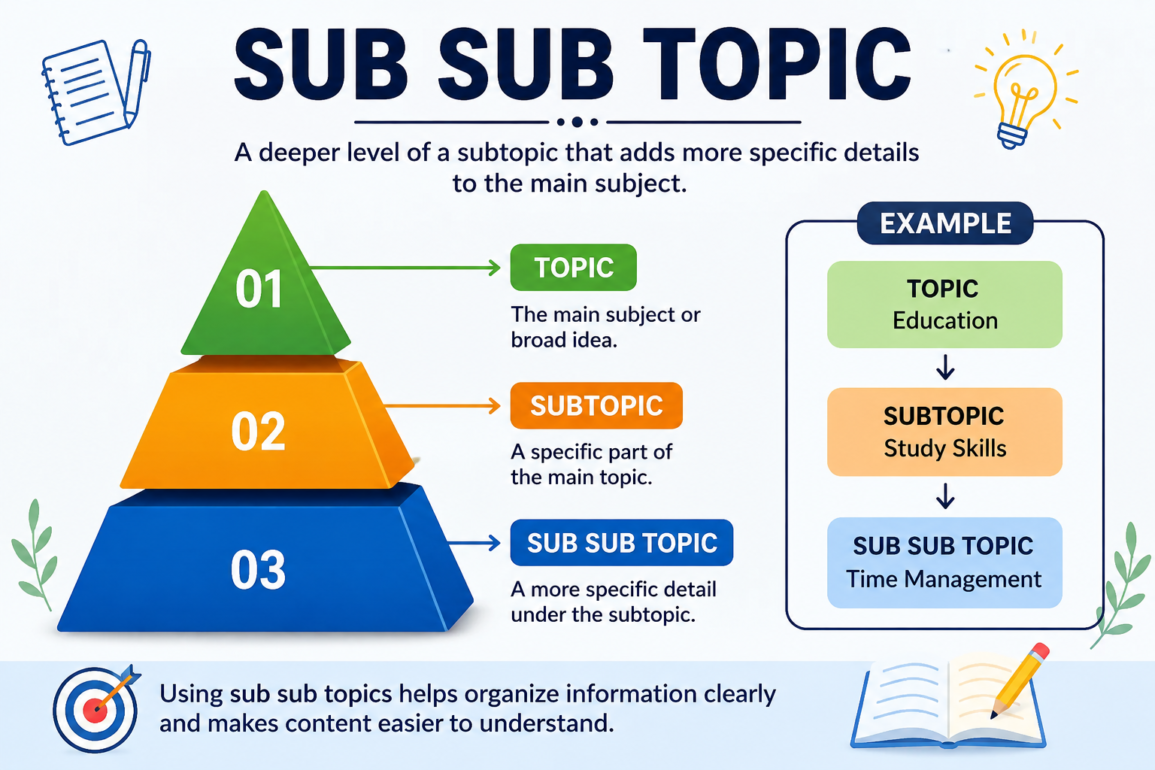
A sub sub topic is a more specific idea that belongs under a subtopic, which itself belongs to a broader main topic. In simple terms, it represents a third level of organization.
For example, consider the main topic Healthy Eating. A writer may divide it into several subtopics, such as nutrition, meal planning, and healthy habits. The nutrition section can then contain smaller ideas such as vitamins, minerals, and protein. These smaller ideas can function as sub sub topics.
This structure creates a clear relationship between broad and narrow information. The reader can understand where each detail belongs because every level connects to the idea above it.
A Simple Structure
The basic structure can look like this:
Main Topic → Subtopic → Sub Sub Topic
For example:
Education → Study Skills → Time Management
Here, Education is the main subject, Study Skills is the subtopic, and Time Management is the more specific subject.
This approach prevents information from becoming disorganized. It also gives writers a practical framework for developing detailed content.
Why Is This Structure Important?
A well-organized structure makes information easier to understand. Readers usually process information more effectively when related ideas appear together.
A sub sub topic can help create this organization by placing specific details under the correct category. Instead of presenting ten separate points at the same level, you can group them according to their relationship.
This method is especially useful for long-form content. A detailed article may discuss a broad subject from several perspectives. Without clear organization, readers may struggle to follow the discussion. Smaller sections provide natural stopping points and improve navigation.
For students, this structure can also make revision easier. Study materials become more manageable when large chapters are divided into smaller concepts.
Difference Between a Topic, Subtopic and Sub Sub Topic
The three terms describe different levels of detail.
A topic is the broad subject being discussed. It usually represents the overall purpose of the content..
A subtopic focuses on one important part of that subject. Examples might include online courses, learning platforms, or virtual classrooms.
A sub sub topic goes one step further and explores a specific aspect of a subtopic. Under online courses, for example, you could discuss course assessment methods, video lessons, or interactive assignments.
The hierarchy can therefore be represented as:
Topic: Digital Learning
Subtopic: Online Courses
Sub Sub Topic: Online Assessment
Each level becomes narrower while remaining connected to the original subject.
How to Create an Effective Sub Sub Topic
Creating useful sections requires more than simply adding extra headings. Every smaller section should have a clear purpose and meaningful connection to the larger subject.
Start With the Main Idea
First, identify the central subject. Ask yourself what the entire article, chapter, or project is about.
If your subject is “Environmental Education,” do not immediately create dozens of small sections. Start by identifying the major areas that deserve attention.
Divide the Subject Into Subtopics
Next, identify the major components of the subject. These should be broad enough to contain several related details.
For environmental education, possible subtopics could include climate awareness, recycling, conservation, and sustainable living.
Break Each Subtopic Into Smaller Ideas
After creating the main sections, examine each one carefully. Ask which specific concepts need further explanation.
For example, recycling could include paper recycling, plastic recycling, electronic waste, and household recycling practices. These specific areas can become a sub sub topic depending on the structure of the content.
Keep Each Section Relevant
Every heading should support the main subject. Avoid creating a smaller section simply because you have additional information.
A useful test is to ask, “Does this idea help explain the section above it?” If the answer is no, the information may belong somewhere else.
Examples of a Sub Sub Topic
Examples make the concept easier to understand. Consider an educational article about Online Education.
The structure could include:
Main Topic: Online Education
Subtopic: Benefits of Online Learning
Sub Sub Topic: Flexible Study Schedules
Another example could be:
Main Topic: Computer Science
Subtopic: Programming Languages
Sub Sub Topic: Python for Beginners
A business-related structure might look like:
Main Topic: Digital Marketing
Subtopic: Search Engine Optimization
Sub Sub Topic: Keyword Research
These examples show how a broad subject can gradually become more specific while maintaining a logical connection.
Uses in Academic Writing
Academic writing often requires detailed organization. Essays, research papers, dissertations, and reports can contain large amounts of information. A clear hierarchy helps readers understand how different arguments and supporting points relate to one another.
Students can use smaller sections to separate theories, evidence, examples, methods, and findings. However, the number of levels should remain reasonable. Excessive headings may make an academic paper appear fragmented.
A well-planned sub sub topic should introduce a meaningful point rather than divide a paragraph unnecessarily. The goal is clarity, not simply creating more headings.
Uses in Educational Content
Teachers and educational writers can use hierarchical structures to explain complicated subjects. A large lesson can be divided into chapters, sections, and smaller concepts.
For example, a science lesson about the human body may contain a section about the circulatory system. That section can then discuss blood vessels, the heart, and blood circulation.
This organization helps students focus on one concept at a time. It can also support digital learning platforms where learners move through lessons in a structured sequence.
Uses in SEO and Online Publishing
Website owners also benefit from logical content organization. Search engines need to understand relationships between different parts of a page, while readers want to locate useful information quickly.
Using descriptive headings can improve readability and create a clear content hierarchy. A page about education, for example, might cover learning methods as a major section and then discuss specific techniques underneath it.
However, headings should never be created solely to insert keywords. Search-focused writing should prioritize usefulness, accuracy, and natural language.
A strong structure allows related terms to appear naturally without excessive repetition. This can make an article more useful for readers and easier to navigate.
Common Mistakes to Avoid
One common mistake is creating too many levels. If every few sentences receive a new heading, the article may become difficult to read.
Another problem is using vague headings. A heading should tell readers what they will learn in the following section. “More Information” is usually less useful than a descriptive heading such as “Benefits of Online Assessment.”
Writers should also avoid placing unrelated ideas together. A smaller section should have a clear connection to its parent section.
Finally, do not force every article into the same structure. Short content may only need a main topic and a few subtopics. More detailed projects may require additional levels.
How Students Can Use This Method
Students can apply hierarchical organization when preparing notes, assignments, presentations, and revision materials.
Start by writing the main subject at the top of the page. Then identify major categories beneath it. Finally, add specific concepts under each category.
For example, a student studying history might organize notes like this:
World War II
Major Causes
Economic Conditions
Political Tensions
This method turns a large subject into smaller study units. It can also make revision sessions more focused because students can review individual concepts instead of attempting to memorize an entire chapter at once.
How Writers Can Improve Their Content Structure
Good organization begins before writing the first paragraph. Create a simple outline and decide which information belongs under each heading.
Make the most important ideas broader and the supporting details more specific. Use consistent heading levels throughout the article.
You should also check the structure after completing the first draft. Look for sections that repeat information or contain ideas that belong elsewhere. Combining similar sections can make the final piece more concise.
Remember that structure should serve the reader. If a heading does not improve understanding or navigation, consider removing it.
Frequently Asked Questions
What does sub sub topic mean?
It means a specific idea placed under a subtopic within a larger subject. It represents a deeper level of organization.
Is a sub sub topic the same as a heading?
Not always. A sub sub topic is an idea or subject level, while a heading is the formatting element used to introduce that idea.
Why are smaller topics useful?
They make complicated information easier to organize, read, study, and understand. They also help readers locate specific information quickly.
Can students use this structure for notes?
Yes. Students can use it for class notes, research, revision guides, presentations, and assignments.
How many levels should an article have?
There is no universal number. Use only as many levels as necessary to make the content clear. Most articles should avoid unnecessary complexity.
Conclusion
A clear information hierarchy makes complex subjects easier to understand. The concept of a sub sub topic provides a practical way to divide detailed information into smaller, connected sections. Students can use it for notes and academic work, while writers can use it for articles, reports, and educational resources. The most effective structure remains simple, relevant, and reader-focused. By starting with a broad subject and gradually narrowing the discussion, you can create content that feels organized rather than overwhelming. Good structure does not merely make information look professional; it helps readers understand and remember the ideas being presented.