


Understanding the skeleton of rabbit anatomy helps explain how this small mammal moves, eats, protects its organs, and survives in different environments. Rabbits have a lightweight but strong skeletal structure designed for rapid movement and powerful jumping. Their bones support the body while giving muscles firm attachment points. Although a rabbit may appear delicate, its skeleton contains many specialized features that allow it to run, leap, dig, and change direction quickly. Learning about the skeleton of rabbit anatomy is useful for students, pet owners, animal lovers, and anyone interested in mammalian biology.
What Is the Skeleton of Rabbit?
The skeleton of rabbit is the internal framework made mainly of bones, cartilage, and joints. It provides structural support and gives the body its recognizable shape. Like other mammals, rabbits have an endoskeleton, meaning their skeletal framework exists inside the body.
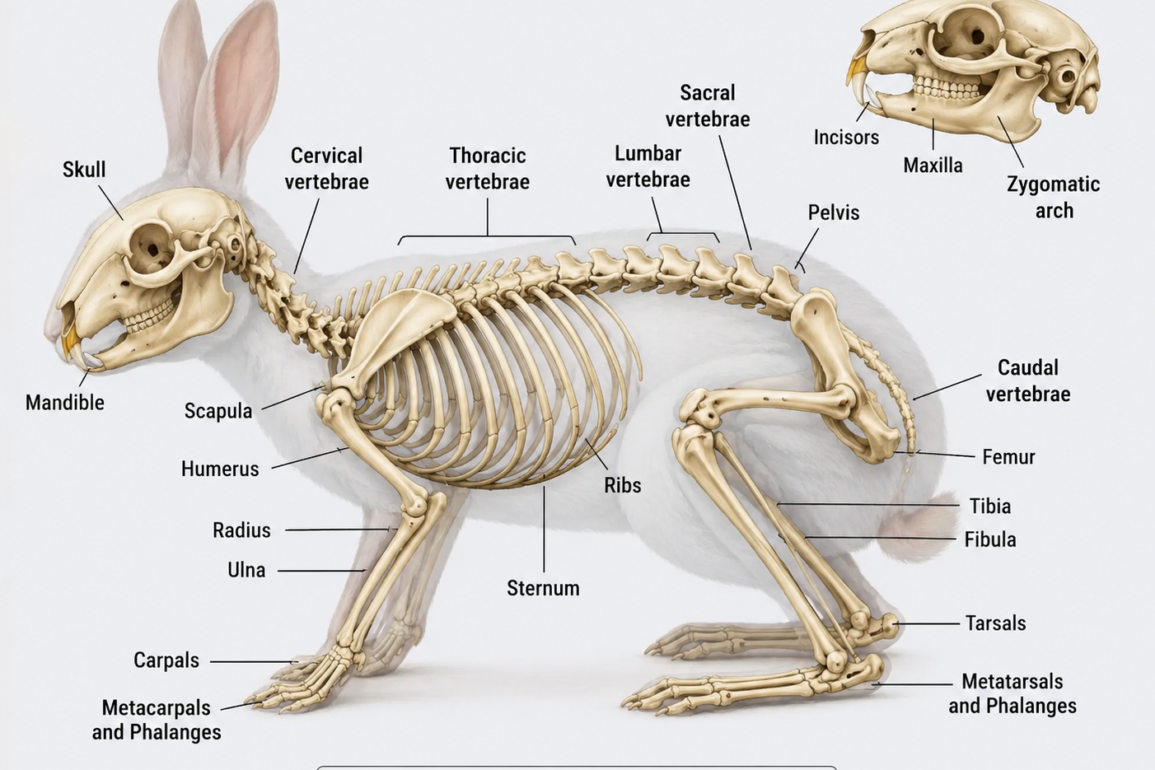
An adult rabbit has a skeleton divided into two major sections: the axial skeleton and the appendicular skeleton. The axial skeleton includes the skull, vertebral column, ribs, and sternum. The appendicular skeleton contains the bones of the limbs and the structures that connect the limbs to the main body.
The skeleton of rabbit is relatively light compared with its overall body structure. This lightweight design benefits an animal that depends on quick movement and jumping for escape and exploration.
Main Parts of the Rabbit Skeleton
The skeleton of rabbit contains several important regions. Each region performs a different role while working with muscles, ligaments, and other tissues.
The Skull
The skull protects the brain and forms the framework of the rabbit’s face. It also contains the jawbones and supports the teeth. Rabbit teeth continue growing throughout life, so their skull and jaw structure is strongly adapted for constant chewing.
The skull includes the cranium, which surrounds the brain, and facial bones that shape the nose, cheeks, and mouth. Openings in the skull allow nerves and blood vessels to pass through different regions.
The Vertebral Column
The backbone is one of the most important components of the skeleton of rabbit. It supports the body and protects the spinal cord.
The vertebral column consists of several regions, including cervical, thoracic, lumbar, sacral, and caudal vertebrae. The neck contains cervical vertebrae, while the thoracic region connects with the ribs.
Rabbit vertebrae also contribute to the animal’s flexible movement. Their spine allows the body to bend during running and jumping while providing essential support.
The Ribs and Sternum
Ribs form a protective cage around vital organs in the chest. They help shield the heart and lungs from injury. The ribs connect with the thoracic vertebrae and, either directly or indirectly, with the sternum.
The sternum lies along the underside of the chest. Together, the ribs and sternum create a flexible protective structure that also participates in breathing movements.
Rabbit Forelimb Bones
The front limbs of the skeleton of rabbit are shorter and less powerful than the hind limbs. However, they remain essential for balance, landing, digging, and controlled movement.
The forelimb includes the scapula, humerus, radius, ulna, wrist bones, and bones of the digits. The scapula connects the front limb to the trunk through muscles and connective tissues.
The humerus forms the upper portion of the forelimb. Below it are the radius and ulna, which extend toward the wrist. Smaller bones form the wrist and paw.
This arrangement gives rabbits useful control over their front limbs. During a jump, the forelimbs help absorb impact when the animal lands.
Powerful Hind Limbs
The hind limbs are one of the most distinctive features of the skeleton of rabbit. Rabbits depend heavily on their long and muscular hind legs for jumping and rapid acceleration.
The hind limb includes the pelvis, femur, tibia, fibula, ankle bones, and foot bones. The femur is the major bone of the thigh, while the lower leg contains the tibia and fibula.
The pelvis connects the hind limbs with the vertebral column. Strong muscles attach around these bones, creating the power required for jumping.
When a rabbit jumps, the hind limbs push forcefully against the ground. The skeletal structure provides the rigid framework needed to transfer muscular force into movement.
The Rabbit’s Pelvis
The pelvis plays a major role in supporting the rear part of the body. It also connects the hind limbs with the axial skeleton.
A strong pelvis is important because the hind legs generate substantial force during jumping. The pelvic bones provide attachment areas for several muscles involved in movement.
The shape of the pelvis also contributes to balance. This is an important characteristic of the skeleton of rabbit, because rabbits frequently change direction while running.
How the Rabbit Skeleton Supports Movement
The skeleton of rabbit works closely with muscles and joints to create efficient movement. Bones provide leverage, while muscles produce force. Joints allow controlled movement between connected bones.
Rabbit hind limbs are particularly adapted for powerful propulsion. Their long bones and strong muscles allow the animal to make rapid jumps.
The spine also contributes to movement. During running, the back can flex and extend, helping the rabbit increase stride length. The tail and pelvis contribute to balance during sudden changes in direction.
This combination of bones, muscles, and joints makes the rabbit an efficient runner despite its relatively small size.
Bone Structure and Lightweight Design
Another interesting feature of the skeleton of rabbit is its balance between strength and weight. Rabbits need bones strong enough to withstand jumping but light enough to support quick movement.
Bones are living tissues. They contain mineral components that provide hardness and protein-based materials that contribute to flexibility and resilience.
The skeletal system also stores minerals and provides locations where muscles attach. Bone marrow inside certain bones contributes to blood-cell production.
Therefore, the skeleton of rabbit is not simply a rigid framework. It is an active biological system that supports several essential functions.
Joints in the Rabbit Skeleton
Joints connect bones and allow different types of movement. The skeleton of rabbit contains joints that vary in structure and function.
For example, joints in the limbs allow bending and extension. The hip and knee are especially important for running and jumping. The joints between vertebrae provide controlled flexibility along the spine.
Cartilage covers many joint surfaces and helps reduce friction. Ligaments help stabilize joints by connecting bones to one another.
Healthy joints are essential for normal movement. Problems affecting joints can make running, jumping, or climbing difficult for a rabbit.
Teeth and the Rabbit Skull
The relationship between teeth and the skeleton of rabbit is particularly interesting. Rabbits have specialized teeth suited to their herbivorous diet.
Their incisors are adapted for cutting plant material. Rabbits also possess cheek teeth that help grind food. Because rabbit teeth grow continuously, regular chewing helps maintain appropriate tooth length.
The jaw and skull provide the foundation for these teeth. Strong jaw muscles attach to the bones around the skull and help produce the repeated movements required for chewing.
This specialization shows how the skeletal system can reflect an animal’s feeding behavior.
Skeleton of Rabbit Compared With Other Mammals
The skeleton of rabbit shares many basic characteristics with other mammals. It contains a skull, vertebral column, ribs, limbs, and pelvis.
However, rabbits have notable adaptations for their lifestyle. Their hind limbs are particularly developed for jumping, while their flexible spine supports fast movement.
Their skeletal design differs from that of animals adapted mainly for swimming, climbing, or slow walking. Every animal’s bones reflect a combination of evolutionary history and environmental demands.
Studying these differences helps students understand comparative anatomy and animal adaptation.
Why Rabbit Bones Need Proper Care
The skeleton of rabbit requires adequate nutrition and normal physical activity to remain healthy. Minerals such as calcium and phosphorus are important components of normal bone tissue.
A balanced diet supports overall skeletal health. Rabbits also benefit from safe opportunities to move because regular activity helps maintain muscle strength and normal coordination.
Owners should provide a safe environment that reduces the risk of falls and traumatic injuries. Rabbits have relatively delicate bodies, and accidents can cause serious skeletal injuries.
If a rabbit suddenly stops using a limb, shows unusual movement, or appears to experience pain, veterinary attention is important.
Common Skeletal Problems in Rabbits
Several conditions can affect the skeleton of rabbit. Injuries may occur from falls, improper handling, accidents, or forceful struggling.
Fractures are particularly important because rabbits have strong hind limbs that can generate significant force. If a rabbit struggles while being restrained incorrectly, injury can occur.
Joint problems may also affect movement. Dental disorders can indirectly involve the skull and jaw because abnormal tooth growth can interfere with normal feeding.
Good nutrition, safe housing, proper handling, and regular veterinary care can help reduce preventable problems.
Interesting Facts About Rabbit Bones
The skeleton of rabbit contains several fascinating adaptations. The most obvious is the powerful hind-limb system that supports jumping.
Another interesting feature is the rabbit’s flexible spine. This flexibility helps the animal move efficiently and maintain balance during rapid motion.
The skull is also highly specialized because it supports continuously growing teeth and the muscles required for chewing.
Rabbit bones additionally serve as mineral storage sites and provide attachment points for muscles. These functions demonstrate why the skeletal system is essential for much more than body support.
Conclusion
The skeleton of rabbit is a remarkable biological structure that combines strength, flexibility, protection, and efficient movement. Its skull protects the brain and supports specialized teeth, while the vertebral column provides stability and flexibility. The ribs protect vital organs, and the pelvis connects the powerful hind limbs to the body. Together, these structures allow rabbits to run, jump, land, and change direction effectively. Understanding rabbit anatomy also highlights the close relationship between bones, muscles, nutrition, and behavior. A healthy skeletal system is essential for a rabbit’s mobility, safety, and overall quality of life.
Frequently Asked Questions
1. What is the main function of the rabbit skeleton?
The main functions include supporting the body, protecting internal organs, enabling movement, storing minerals, and providing attachment points for muscles.
2. Why are rabbit hind legs so powerful?
Rabbit hind legs contain strong muscles and specialized bones that help generate the force needed for jumping, running, and rapid acceleration.
3. What protects a rabbit’s heart and lungs?
The ribs and sternum form a protective chest structure around the heart and lungs.
4. Does the rabbit skeleton have a backbone?
Yes. Rabbits have a vertebral column consisting of cervical, thoracic, lumbar, sacral, and caudal regions.
5. Why is rabbit skeletal health important?
Healthy bones and joints allow rabbits to move normally, maintain balance, jump effectively, and perform everyday activities without unnecessary discomfort.