



Pilates has become a popular approach to improving strength, mobility, balance, and body awareness without relying on high-impact movements. Among the many Pilates methods available, pilates chair exercises offer a particularly versatile way to train the body. The chair creates resistance and support while encouraging controlled movement, making it useful for beginners as well as people with more experience.
Unlike traditional mat routines, chair-based exercises can challenge the arms, legs, core, and posture through carefully controlled movements. They can also be adapted to different fitness levels. Whether your goal is to improve stability, strengthen your core, or add variety to your routine, understanding how these exercises work can help you practice them more effectively.
What Are Pilates Chair Exercises?
Pilates chair exercises are movements performed with a specialized Pilates chair, commonly called a Wunda Chair. The equipment usually has a padded seat and a pedal connected to springs. Depending on the movement, you may press the pedal with your hands, feet, or body while maintaining controlled alignment.
The resistance from the springs makes the exercises different from ordinary chair workouts. Instead of simply moving through a large range of motion, you must control the equipment throughout each phase of the exercise. This encourages concentration, stability, and coordination.
Some exercises are performed while sitting, while others involve standing beside the chair, kneeling, or supporting the body with the hands. This variety allows instructors to develop routines that target different muscle groups.
Why People Practice Chair-Based Pilates
One of the main advantages of pilates chair exercises is their ability to combine resistance training with controlled movement. The chair can make relatively small movements surprisingly challenging because your muscles must stabilize the body while working against spring resistance.
Improved Core Strength
Many chair movements require you to maintain a stable torso while the arms or legs move. This creates a strong demand on the abdominal and back muscles. Consistent practice may help improve core control and posture.
A stronger core can also make everyday activities such as bending, lifting, walking, and climbing stairs feel more controlled.
Better Balance and Stability
Balance is another important part of pilates chair exercises. Standing variations often require you to coordinate your legs, pelvis, and upper body while controlling the pedal.
This type of training can improve body awareness and teach you how to distribute your weight more effectively. Beginners should start with supported movements before progressing to more demanding balance exercises.
Greater Mobility
Controlled Pilates movements encourage you to work through comfortable ranges of motion. Depending on the exercise, you may focus on the hips, shoulders, spine, or ankles.
The objective is not to force flexibility. Instead, pilates chair exercises emphasize controlled movement and proper alignment.
Essential Pilates Chair Exercises for Beginners
If you are new to chair Pilates, begin with simple movements that help you understand resistance and body positioning.
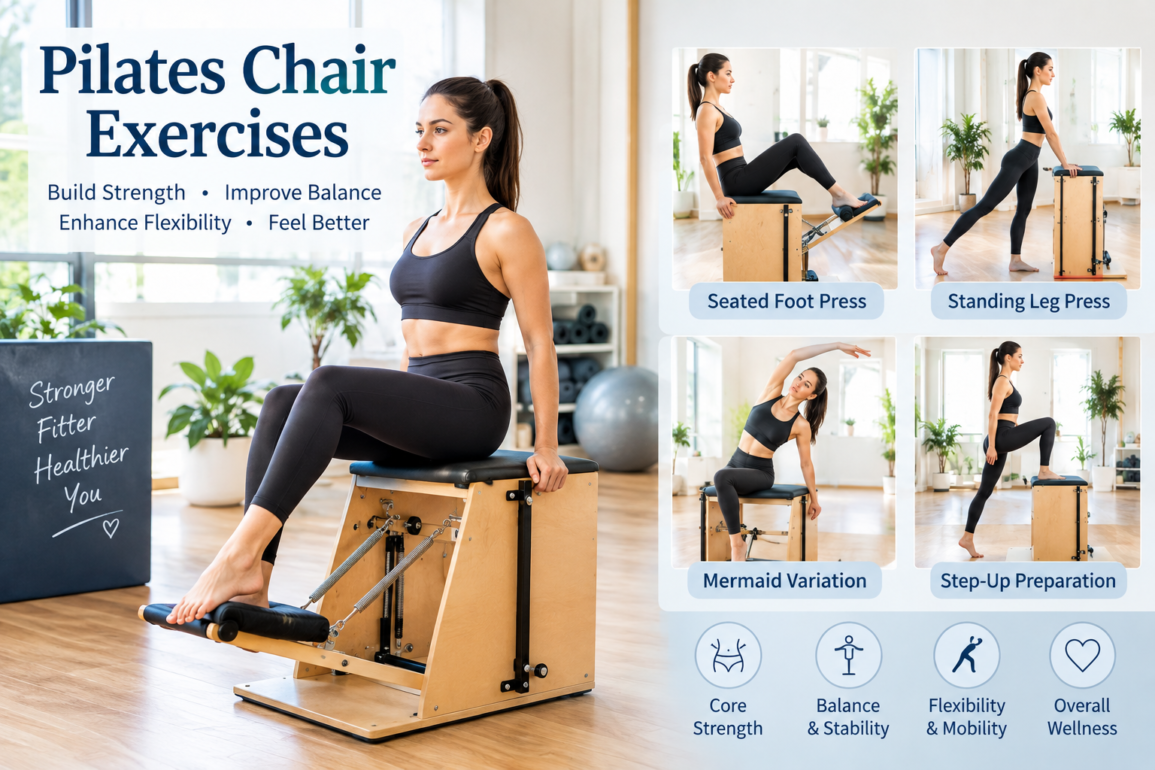
Seated Foot Press
Sit upright on the chair and place one foot on the pedal. Keep your spine lengthened and gently press the pedal downward. Slowly allow it to return while maintaining control.
This exercise can engage the legs while teaching you how to work against spring resistance. Start with a small range of motion and gradually increase it as your control improves.
Standing Leg Press
Stand beside the chair while keeping one hand on a stable surface if necessary. Place one foot on the pedal and press it downward using controlled movement.
The standing leg must stabilize your body while the working leg moves. This makes the exercise useful for developing coordination and lower-body control.
Mermaid Variation
The mermaid is a popular Pilates movement that focuses on lateral body movement and spinal mobility. Sit sideways on the chair and position yourself comfortably before moving through a controlled side bend.
This movement should feel smooth rather than forced. Proper positioning is more important than achieving a deep stretch.
Step-Up Preparation
Step-up variations can challenge the legs and balance. Beginners should learn the movement with an instructor or stable support before attempting more advanced versions.
The goal is to maintain control rather than move quickly. This is one reason pilates chair exercises can be demanding even when the movements look simple.
How Chair Pilates Works Different Muscle Groups
A well-designed routine can involve nearly the entire body. The legs may work against spring resistance while the core stabilizes the pelvis and spine. The shoulders and arms may also become involved when supporting body weight.
Lower Body
Squats, presses, step variations, and pedal movements can engage the quadriceps, hamstrings, glutes, and calves. The exact muscles involved depend on your position and technique.
Core
The abdominal muscles often work isometrically to stabilize the torso. Rather than performing repeated crunches, you may need to maintain a stable position while another part of the body moves.
Upper Body
Certain pilates chair exercises require the arms and shoulders to support or move the body. These exercises can develop upper-body strength while also demanding good shoulder alignment.
How to Perform Pilates Chair Exercises Safely
Technique should always come before intensity. Pilates relies on controlled movement, and rushing through an exercise can reduce its effectiveness and increase the chance of poor form.
Start with an appropriate spring setting and learn the basic movement before increasing resistance. Keep your breathing steady and avoid holding your breath during challenging repetitions.
Your spine should remain in the position required by the exercise rather than being forced into an exaggerated posture. Pay attention to your knees, shoulders, hips, and feet, especially during standing movements.
If you experience sharp pain, dizziness, numbness, or unusual discomfort, stop the exercise. People recovering from an injury or managing a medical condition should seek appropriate professional advice before starting a new exercise program.
Common Mistakes to Avoid
Even simple pilates chair exercises can become ineffective when performed without proper control.
One common mistake is using momentum. Moving the pedal quickly may make an exercise feel easier, but it reduces the amount of controlled muscular work required.
Another mistake is choosing excessive spring resistance. More resistance does not automatically mean a better workout. The appropriate level allows you to maintain alignment throughout the entire movement.
Poor breathing is another issue. Pilates generally encourages coordinated breathing because it helps maintain concentration and control.
Finally, beginners sometimes focus too much on the number of repetitions. Quality matters more than quantity. Ten controlled repetitions can be more useful than many rushed ones.
Creating a Simple Chair Pilates Routine
A beginner routine can start with a short warm-up followed by several basic movements. For example, you might begin with seated foot presses, continue with controlled leg work, and then add a gentle mobility exercise.
As your technique improves, you can gradually introduce more challenging pilates chair exercises. A balanced routine should include movements for the legs, core, upper body, balance, and mobility rather than repeatedly targeting one area.
Rest between difficult exercises when needed. Pilates does not require you to work at maximum intensity during every session. Consistency and technique are more valuable for long-term progress.
How Often Should You Practice?
The ideal frequency depends on your experience, fitness level, and overall exercise routine. Beginners may benefit from two or three sessions per week, allowing time for recovery between more demanding workouts.
More experienced practitioners may practice more frequently when their technique and recovery allow it. However, increasing frequency should not come at the expense of good form.
If you are learning pilates chair exercises for the first time, working with a qualified Pilates instructor can be especially useful. An instructor can adjust spring resistance, demonstrate positioning, and identify technique problems that may be difficult to notice on your own.
Pilates Chair Exercises vs. Mat Pilates
Both chair and mat Pilates use principles such as concentration, controlled movement, breathing, alignment, and core engagement. However, the equipment changes the training experience.
Mat Pilates primarily uses body weight and gravity as resistance. Chair Pilates adds spring resistance and provides different ways to position the body.
Neither approach is automatically better. Your choice should depend on your goals, experience, equipment, and personal preferences. Some people enjoy combining both methods for greater variety.
How to Progress Without Overtraining
Progress does not always mean adding more resistance. You can make pilates chair exercises more challenging by improving your control, increasing your range of motion when appropriate, changing your body position, or performing a more advanced variation.
A useful progression is to master the basic movement first. Once you can perform it consistently without losing alignment, gradually introduce another challenge.
This approach reduces the temptation to advance too quickly and helps build a stronger technical foundation.
Frequently Asked Questions
Are Pilates chair exercises suitable for beginners?
Yes. Many chair exercises can be modified for beginners. However, because the equipment uses springs and some movements challenge balance, beginners should learn proper technique before attempting advanced exercises.
Can chair Pilates strengthen the core?
Yes. Many movements require the abdominal and back muscles to stabilize the torso. The amount of core involvement depends on the specific exercise and how it is performed.
Do I need a special Pilates chair?
Traditional chair Pilates uses specialized equipment designed for Pilates training. A regular household chair should not automatically be treated as a substitute, particularly for exercises involving significant body weight or unstable positioning.
How long should a chair Pilates workout last?
The duration can vary considerably. Beginners may start with a short session and gradually increase workout length as their technique and endurance improve. Quality of movement should remain the priority.
Can chair Pilates improve balance?
Many pilates chair exercises challenge balance because they require controlled weight shifting and stabilization. Regular practice may help develop coordination and body awareness, although results vary between individuals.
Conclusion
Pilates chair exercises provide a versatile approach to strength, mobility, balance, coordination, and body control. The spring resistance and unique positions of the chair create opportunities to challenge muscles in ways that differ from traditional mat routines. From simple seated presses to more advanced standing movements, exercises can be adapted as your skills develop.
The most effective practice is not about moving quickly or using the heaviest resistance. It is about maintaining control, breathing consistently, respecting your body’s limits, and gradually progressing when your technique is ready. With thoughtful practice and appropriate instruction, chair Pilates can become a valuable part of a balanced fitness routine.