




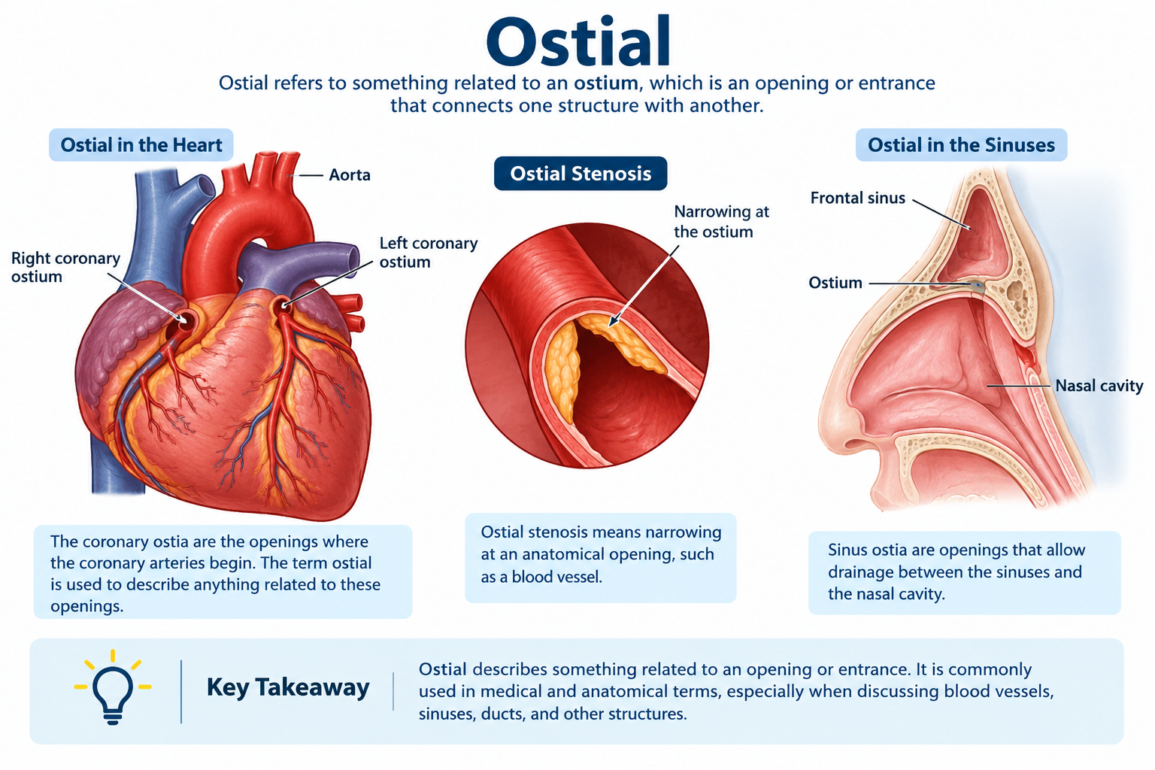
The word it may appear unfamiliar outside medical, anatomical, and scientific writing. However, it describes an important concept involving an opening, entrance, or outlet in the body. Medical professionals often use this term when discussing blood vessels, organs, ducts, and other anatomical structures. Understanding the meaning of ostial can make complex medical terminology easier to follow.
In simple terms, ostial refers to something related to an ostium, which means an opening or entrance. Depending on the context, an ostium can connect one anatomical structure with another. For example, blood vessels have openings where they connect to the heart, while certain sinuses and ducts have openings that allow fluids or air to move.
This article explains the meaning of this, its medical applications, common examples, related terminology, and why these openings matter for normal body function.
What Does Ostial Mean?
This is an adjective derived from the anatomical term ostium. An ostium is an opening that provides communication between two structures. Therefore, ostial describes anything associated with that opening.
Doctors may use the word when describing the location, condition, narrowing, blockage, or structure of an opening. For instance, ostial stenosis means narrowing that occurs at the opening of a vessel or other anatomical structure.
The exact meaning depends on the surrounding medical terminology. Its lesion in a coronary artery has a different clinical context from this opening in a sinus. However, both involve an anatomical entrance or opening.
Understanding this basic definition helps readers interpret many medical reports more confidently.
Ostium and Ostial: Understanding the Difference
Although these terms look similar, they have different grammatical roles.
An ostium is the actual opening or entrance. The word describes a physical anatomical structure. The term ostial, on the other hand, describes something associated with that opening.
For example, a coronary ostium is an opening where a coronary artery begins. A problem located at that opening may be described as it is abnormality.
This distinction is useful because medical reports often use both terms together. Recognizing the relationship between them makes technical descriptions easier to understand.
What Is an Ostium?
An ostium can be a natural opening in an organ, blood vessel, duct, or body cavity. These openings allow communication between different anatomical areas.
Some ostia permit blood to enter vessels. Others allow mucus, air, or other substances to move between connected structures. Their size, shape, and location vary according to their function.
What Does Ostial Describe?
The adjective this identifies something connected to an ostium. It can describe a disease, narrowing, lesion, blockage, measurement, or anatomical location.
For example, physicians may describe a narrowing as an ostial narrowing when it affects the beginning or opening of a vessel.
Ostial in Cardiovascular Medicine
One of the most important uses of ostial occurs in cardiovascular medicine. The heart contains openings where major blood vessels connect with the heart chambers.
The coronary arteries originate near the beginning of the aorta. Their openings are known as the coronary ostia. These openings play a vital role because they provide access for blood to enter the coronary arteries and supply the heart muscle.
An abnormality affecting a coronary ostium can potentially interfere with blood flow. Medical specialists therefore pay close attention to the anatomy and condition of these openings during diagnostic examinations.
Ostial Coronary Artery Disease
Coronary artery disease can sometimes involve the opening of a coronary artery. When significant narrowing develops near this location, doctors may describe it as ostial coronary artery disease.
The narrowing can reduce blood flow into the affected artery. The clinical significance depends on factors such as the degree of narrowing, symptoms, other coronary disease, and overall cardiovascular health.
Doctors may use imaging tests to evaluate these areas and determine an appropriate treatment approach.
Ostial Stenosis Explained
Ostial stenosis refers to narrowing at an anatomical opening. The term stenosis generally means an abnormal narrowing of a passageway.
When the affected structure is a blood vessel, stenosis may restrict circulation. The impact depends on the vessel involved and the severity of the narrowing.
This is stenosis can sometimes be more challenging to evaluate because it occurs at the beginning of a vessel. Specialized imaging may help physicians understand the anatomy and determine how much the narrowing affects normal blood flow.
Treatment depends entirely on the underlying condition and the structure involved.
Ostial Lesions and Blockages
An ostial lesion is an abnormal area located at or near an anatomical opening. Lesions may develop because of several different processes, depending on the body system involved.
In blood vessels, plaque buildup can contribute to narrowing. In other structures, inflammation, infection, structural abnormalities, or other conditions may affect an opening.
A blockage near an ostium can be important because it may interfere with the movement of blood, air, mucus, or other substances. Physicians therefore consider both the location and severity of this problem when evaluating a patient.
Ostial Anatomy in the Respiratory System
The concept of it opening also applies to the respiratory system. Several anatomical spaces and passages contain openings that allow air and secretions to move between connected areas.
The paranasal sinuses, for example, communicate with the nasal cavity through specific openings. These openings are important for ventilation and drainage.
If an ostium becomes narrowed or blocked, normal drainage may become difficult. This situation can contribute to sinus-related symptoms in some individuals.
Sinus Ostial Blockage
A sinus ostium provides a pathway between a sinus and the nasal cavity. When the opening becomes swollen or obstructed, mucus may not drain normally.
Inflammation associated with sinus problems can affect the surrounding tissues and reduce the openness of these pathways.
Doctors may examine the anatomy of the sinus ostia when assessing persistent or complicated sinus conditions.
Ostial Terminology in Medical Reports
Medical reports often contain specialized terminology that can appear confusing. Understanding common combinations can make these reports easier to interpret.
Some frequently encountered terms include ostial stenosis, ostial lesion, ostial narrowing, and ostial obstruction.
Each phrase describes a problem or feature associated with an anatomical opening. However, the seriousness of the finding depends on the body part involved.
For example, this is narrowing in a major blood vessel may have very different implications from a minor anatomical variation in another structure.
Patients should therefore avoid interpreting an ostial finding in isolation. The complete report, symptoms, medical history, and diagnostic results provide the necessary context.
Why Ostial Openings Matter
An anatomical opening may look like a small structure, but it can have an important physiological role. Many openings serve as gateways between different parts of the body.
In the cardiovascular system, an ostium can provide an entrance for blood into a vessel. In the respiratory system, an opening can support ventilation and drainage. Other ostia may help fluids move between organs or cavities.
Because these pathways regulate movement between connected structures, changes in their size or shape can affect normal function.
This explains why physicians may pay particular attention to an ostial region during imaging or examination.
How Doctors Evaluate Ostial Problems
Doctors use different diagnostic methods depending on the location of the suspected abnormality. Physical examination may provide initial information, but imaging often gives a clearer view of internal anatomy.
For cardiovascular concerns, techniques such as CT angiography, coronary angiography, echocardiography, or other specialized tests may be considered when clinically appropriate.
For sinus-related concerns, nasal examination and imaging can help evaluate the relevant openings.
The choice of test depends on the patient’s symptoms and the anatomical structure being investigated. A medical professional must interpret the findings within the appropriate clinical context.
Common Questions About Ostial
Is ostial a medical word?
Yes. Ostial is commonly used in medical and anatomical terminology. It describes something associated with an ostium, which is an opening or entrance.
What is an ostial opening?
An ostial opening is an anatomical entrance that connects one structure with another. Such openings can occur in blood vessels, organs, ducts, and body cavities.
What does ostial stenosis mean?
This stenosis means narrowing located at an anatomical opening. The clinical importance depends on the affected structure and severity of the narrowing.
What is an ostial lesion?
This lesion is an abnormal area found at or near an anatomical opening. The cause and significance depend on the organ or vessel involved.
Is an ostial blockage always serious?
Not necessarily. The importance of this blockage depends on its location, severity, cause, and effect on normal function. A healthcare professional should interpret such findings.
Conclusion
The term ostial describes something associated with an anatomical opening known as an ostium. Although the word may initially seem complicated, its basic meaning is straightforward. It identifies a location or condition involving an entrance, outlet, or communication between anatomical structures.
The term appears frequently in cardiovascular and respiratory medicine, particularly when discussing vessel openings, sinus pathways, narrowing, lesions, and blockages. Understanding ostial terminology can help readers make better sense of medical information without confusing the adjective with the physical opening itself.
Because medical terminology requires context, its finding should always be interpreted alongside the complete diagnostic report and professional medical assessment. Learning these basic concepts can make medical language easier to understand while encouraging informed communication with healthcare professionals.