



Understanding algebra becomes easier when you learn how to solve problems one step at a time. Multi step inequalities are an important part of mathematics because they help students compare quantities, find possible values, and solve real-world problems. Unlike simple inequalities, which often require only one operation, these problems involve several mathematical steps before you reach the final answer.
Learning this topic can improve your algebra skills, strengthen logical thinking, and prepare you for more advanced mathematical concepts. Whether you are studying for an examination, completing homework, or reviewing basic algebra, understanding the rules and methods will help you approach each problem with confidence.
This guide explains how multi step inequalities work, how to solve them correctly, which mistakes to avoid, and how to apply them to practical situations.
What Are Multi Step Inequalities?
An inequality is a mathematical statement that compares two expressions using symbols such as less than, greater than, less than or equal to, and greater than or equal to. Unlike an equation, which states that two expressions have the same value, an inequality describes a relationship that can hold for multiple values.
For example, x+3>7 is a simple inequality because you can solve it by subtracting three from both sides. The result is x>4, meaning that any number greater than four satisfies the statement.
Multi step inequalities require more than one mathematical operation to isolate the variable. These operations may include addition, subtraction, multiplication, division, and the distribution of expressions inside parentheses. Some problems also contain variables on both sides of the inequality sign.
Consider the following example:
3x+5>17
First, subtract five from both sides:
3x>12
Next, divide both sides by three:
x>4
The solution tells us that every number greater than four makes the original inequality true. The number four itself is not included because the symbol represents a strict inequality.
Understanding the Four Inequality Symbols
Before solving more complicated problems, you should understand what each inequality symbol means.
The less-than symbol (<) indicates that the expression on the left has a smaller value than the expression on the right. For example, x<8 means that x can be any number below eight.
The greater-than symbol (>) indicates that the left expression has a larger value. For instance, x>2 includes all numbers greater than two.
The less-than-or-equal-to symbol () includes the boundary value as well as every smaller number. Therefore, x6 includes six and all numbers below it.
Similarly, the greater-than-or-equal-to symbol () includes the boundary value and every larger number. The statement x9 includes nine and all numbers above it.
Recognizing these differences helps you interpret solutions accurately. When working with multi step inequalities, always preserve the original meaning of the inequality symbol unless you multiply or divide both sides by a negative number.
How to Solve Multi Step Inequalities
Solving these problems becomes manageable when you follow a consistent process. Your main objective is to isolate the variable while maintaining a true mathematical relationship.
Step 1: Simplify Both Sides
Start by removing parentheses, combining like terms, and simplifying any expressions that can be reduced.
For example:
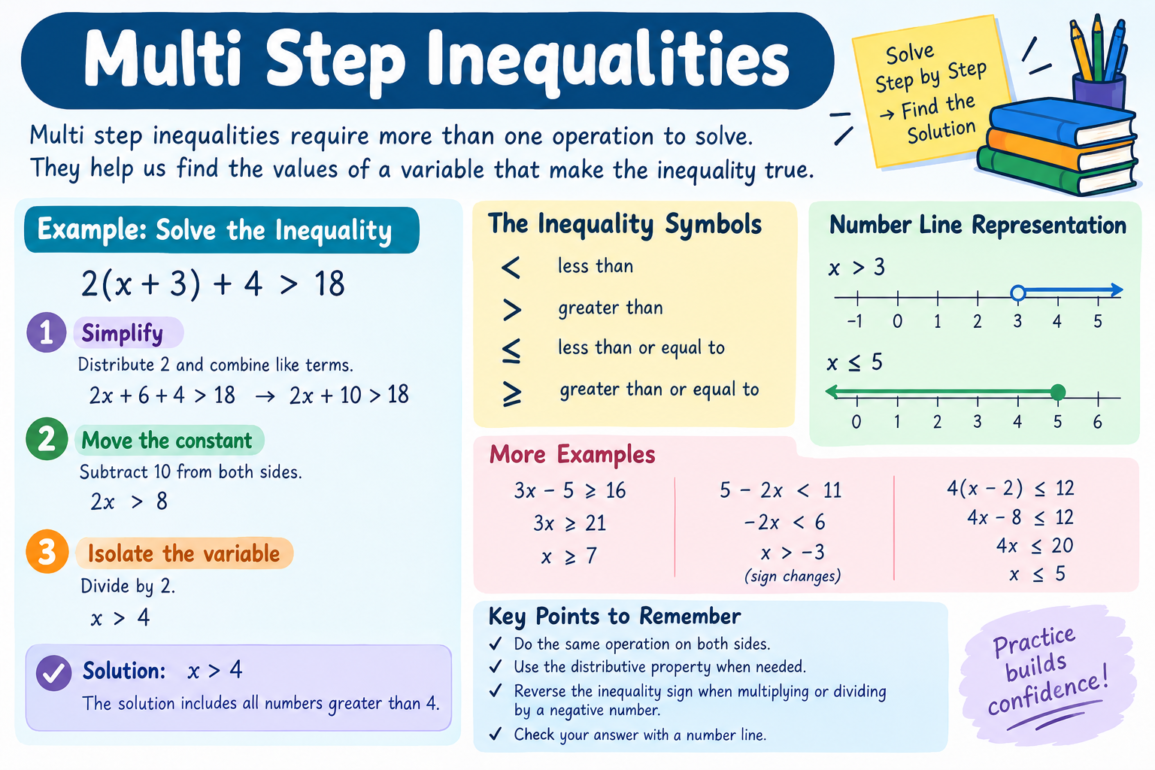
2(x+3)+4>18
Distribute the two across the parentheses:
2x+6+4>18
Combine the constant terms:
2x+10>18
Simplifying the expression first makes the remaining calculations easier to follow.
Step 2: Move Constant Terms
The next step is to move numbers that do not contain the variable to the opposite side of the inequality.
Using the previous example:
2x+10>18
Subtract ten from both sides:
2x>8
Remember that whatever operation you perform on one side must also be performed on the other side. This principle maintains the relationship between the two expressions.
Step 3: Isolate the Variable
After removing the constant term, divide or multiply as necessary to leave the variable by itself.
From the previous step:
2x>8
Divide both sides by two:
x>4
The final answer includes every real number greater than four.
These steps form a reliable method for solving many multi step inequalities, particularly those involving one variable and basic arithmetic operations.
Solving Inequalities With Variables on Both Sides
Some algebra problems place the variable on both sides of the inequality sign. These questions require an additional step because you must collect the variable terms together before isolating the unknown.
Consider this example:
5x-4>2x+8
Subtract 2x from both sides:
3x-4>8
Add four to both sides:
3x>12
Divide by three:
x>4
The solution includes every number greater than four.
When solving multi step inequalities with variables on both sides, choose the operations that make the variable terms easier to combine. You can move either variable term first, provided you apply the same operation to both sides.
Sometimes, the result may contain no solution or all real numbers. For example, 2x+3>2x+7 becomes 3>7, which is false for every value of x. Therefore, the inequality has no solution.
In contrast, 2x+7>2x+3 simplifies to 7>3, which is always true. In that case, every real number is a solution.
The Most Important Rule: Negative Numbers
One of the most important concepts in inequality problems is understanding what happens when you multiply or divide both sides by a negative number.
You must reverse the inequality symbol whenever you multiply or divide both sides by a negative number.
For example:
-3x>12
Divide both sides by negative three. Because the divisor is negative, reverse the greater-than symbol:
x<-4
The correct answer is x<-4, not x>-4.
Why does this happen? Multiplying or dividing by a negative number reverses the order of numbers on the number line. For example, negative eight is less than negative two, but multiplying both numbers by negative one gives eight and two, respectively. Eight is greater than two.
Students frequently forget this rule when solving multi step inequalities. A useful habit is to check the sign of the number used in the final multiplication or division step before writing the answer.
Using the Distributive Property
The distributive property is essential when an inequality contains parentheses. It allows you to multiply a number by every term inside a set of parentheses.
For example:
4(2x-3)20
Distribute four:
8x-1220
Add twelve to both sides:
8×32
Divide by eight:
x4
The answer includes four and every number below it.
Pay attention to negative signs when distributing. Consider another example:
-2(x+5)<-14
Distribute negative two:
-2x-10<-14
Add ten to both sides:
-2x<-4
Divide by negative two and reverse the symbol:
x>2
This example demonstrates why careful distribution and correct sign handling are necessary for accurate results.
Representing Solutions on a Number Line
A number line provides a visual way to understand the solutions of multi step inequalities. It helps you identify which values satisfy an inequality and whether the boundary value belongs to the solution set.
Use an open circle when the inequality uses < or >. An open circle means the boundary value is excluded. Use a closed circle when the inequality uses or , because the boundary value is included.
For example, x>3 uses an open circle at three, with the line extending to the right. The solution includes all numbers greater than three.
For x5, place a closed circle at five and shade the line to the left. This representation includes five and every smaller number.
Number lines are especially useful when checking your answers or comparing different solution sets. They also make it easier to understand why a solution can contain infinitely many possible values rather than just one number.
Common Mistakes to Avoid
Even when students understand the basic procedure, small errors can lead to incorrect answers. Recognizing these mistakes helps improve accuracy.
Forgetting to Reverse the Inequality Sign
The most common error occurs when dividing or multiplying both sides by a negative number. Always reverse the symbol in this situation.
Applying Operations to Only One Side
An inequality remains balanced only when you apply the same addition, subtraction, multiplication, or division operation to both sides. Changing just one side can produce an incorrect result.
Distributing Incorrectly
When expanding parentheses, multiply the outside number by every term inside. For example, 3(x+4) becomes 3x+12, not 3x+4.
Combining Unlike Terms
You can combine 4x and 2x to obtain 6x, but you cannot combine 4x and five into a single like term. Keep variable terms and constants separate.
Confusing Strict and Inclusive Inequalities
The symbols < and > exclude the boundary value. The symbols and include it. Preserve this distinction when writing your final answer.
Checking each operation can prevent these mistakes and make multi step inequalities easier to solve consistently.
Real-Life Applications of Inequalities
Inequalities are not limited to classroom exercises. They help people make decisions whenever a situation involves limits, minimum requirements, or maximum amounts.
Budgeting and Shopping
Suppose you have $50 to spend on notebooks that cost $5 each. If n represents the number of notebooks you can purchase, your budget creates the inequality:
5n50
Dividing by five gives n10. You can purchase up to ten notebooks without exceeding your budget.
Travel and Distance
Imagine a driver wants to travel no more than 300 miles in one day. If the driver has already covered 80 miles and plans to travel another x miles, the condition is:
80+x300
Subtracting 80 gives x220. The driver can travel up to 220 additional miles.
Academic Requirements
A student needs at least 70 points to pass a test. If the student has already earned 45 points and can earn another x points, the requirement becomes:
45+x70
Subtracting 45 gives x25. The student needs at least 25 additional points.
These examples demonstrate how inequalities help translate everyday requirements into mathematical statements. More complex situations may involve several conditions, making multi step inequalities a useful problem-solving tool.
Practice Problems for Students
The best way to improve your skills is to practice different types of questions. Try solving the following examples before checking the answers.
Problem 1
3x+7>22
Subtract seven to obtain 3x>15. Divide by three. The answer is x>5.
Problem 2
4x-915
Add nine to both sides to obtain 4×24. Divide by four. The answer is x6.
Problem 3
2x+5x+12
Subtract x from both sides, giving x+512. Subtract five. The answer is x7.
Problem 4
-4x+6<18
Subtract six to obtain -4x<12. Divide by negative four and reverse the inequality symbol. The answer is x>-3.
Problem 5
3(x-2)+416
Distribute three to obtain 3x-6+416. Combine the constants to get 3x-216. Add two and divide by three. The answer is x6.
Practice these examples until you can identify the correct operations without hesitation. For additional practice, create similar problems with parentheses, negative coefficients, and variables on both sides.
Frequently Asked Questions
What are multi step inequalities?
Multi step inequalities are mathematical statements that require several operations to solve for an unknown variable. These operations may include distribution, combining like terms, addition, subtraction, multiplication, and division.
How do you solve multi step inequalities?
Simplify both sides, distribute where necessary, combine like terms, move variable terms to one side, and isolate the variable. Apply the same operations to both sides, and reverse the inequality symbol whenever you multiply or divide by a negative number.
Why does the inequality sign change?
The inequality sign reverses when both sides are multiplied or divided by a negative number because this operation reverses the order of the numbers being compared.
Can an inequality have more than one answer?
Yes. Most inequalities have a range of solutions rather than a single answer. For example, x>2 includes every real number greater than two.
How can students improve at solving inequalities?
Students can improve by practicing regularly, showing every step, reviewing negative-number rules, and substituting test values into their final answers to confirm that the original statement is true.
Conclusion
Mastering multi step inequalities is an important step toward building strong algebra skills. By learning how to simplify expressions, distribute correctly, combine like terms, isolate variables, and reverse inequality signs when necessary, you can solve a wide variety of mathematical problems with greater confidence.
Consistent practice is the key to success. Start with basic questions, gradually move toward problems involving parentheses and variables on both sides, and check each solution carefully. Use number lines to visualize answers and real-life examples to understand why inequalities matter beyond the classroom.
With patience and a clear method, multi step inequalities become easier to understand and solve. These skills will support your future studies in algebra, geometry, statistics, and other areas of mathematics.