


Motorization has changed the way people travel, work, manufacture products, and operate machines. From cars and buses to agricultural equipment and industrial systems, powered movement has become an essential part of modern life. It reduces manual effort, improves productivity, and allows machines to perform tasks with greater speed and consistency. As technology continues to advance, motorization is also becoming smarter, cleaner, and more efficient.
Understanding it helps students, professionals, business owners, and everyday users recognize how powered systems influence different industries. It also provides useful insight into transportation, engineering, agriculture, manufacturing, and energy management. This guide explains the meaning of this, its major types, benefits, applications, challenges, and future developments in clear and practical terms.
What Is Motorization?
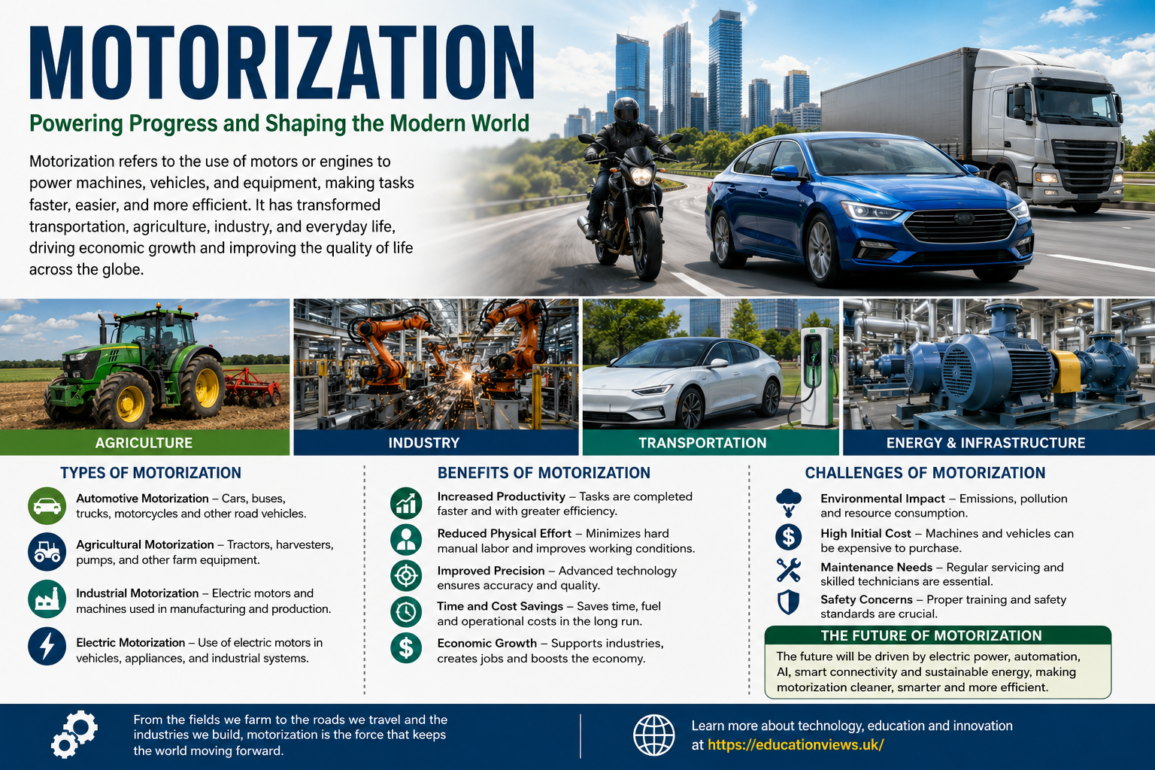
Motorization refers to the process of using motors or engines to provide mechanical power for movement or operation. Instead of depending entirely on human or animal effort, a motorized system uses an energy source to generate controlled motion. That motion can operate a vehicle, machine, tool, pump, conveyor, or other mechanical equipment.
The concept applies to many technologies. A passenger car uses an engine or electric motor to move its wheels. A factory may use electric motors to operate production equipment. Farmers can use motorized tractors and harvesters to complete demanding agricultural tasks. In each example, powered machinery performs work that would otherwise require significant physical effort.
Motorization does not describe only one specific technology. It represents a broad transition from manual operation toward mechanical and powered systems.
How Motorization Works
A motorized system generally requires an energy source, a power-conversion mechanism, and a method of transferring motion. The energy source may include electricity, gasoline, diesel, natural gas, hydrogen, or another suitable fuel.
In an internal combustion engine, fuel combines with air and produces energy through combustion. The engine converts that energy into mechanical motion. A transmission and other components then transfer the power to the wheels or working mechanism.
Electric systems operate differently. An electric motor converts electrical energy into mechanical energy through electromagnetic forces. Modern electric vehicles demonstrate this principle by using battery-stored electricity to power motors that turn the wheels.
Although technologies differ, the basic purpose remains similar: convert available energy into useful mechanical work.
Major Types of Motorization
Automotive Motorization
Automotive motorization covers powered vehicles used for personal and commercial transportation. Cars, buses, trucks, motorcycles, and other road vehicles depend on motorized systems.
Traditional vehicles commonly use gasoline or diesel engines. However, electric and hybrid vehicles have expanded the range of available technologies. These alternatives aim to improve energy efficiency and reduce dependence on conventional fossil fuels.
Agricultural Motorization
Agriculture has benefited greatly from powered machinery. Tractors, combine harvesters, irrigation pumps, seeders, and other machines allow farmers to complete large tasks efficiently.
Agricultural motorization can reduce the time required for planting, cultivation, harvesting, and transportation. It also helps farmers manage larger areas with fewer manual resources. Modern equipment increasingly includes GPS guidance, sensors, automation, and digital monitoring.
Industrial Motorization
Factories rely heavily on motorized equipment. Electric motors can power conveyor belts, pumps, compressors, fans, robotic systems, cutting machines, and manufacturing equipment.
Industrial motorization supports consistent production and allows businesses to operate machinery for extended periods. Automated systems can also improve precision while reducing repetitive manual work.
Electric Motorization
Electric motorization uses electric motors instead of conventional combustion engines for mechanical movement. It appears in electric vehicles, elevators, industrial equipment, household appliances, and automated systems.
Electric motors can provide efficient operation and precise control. As battery technology and charging infrastructure improve, electric motorization is becoming increasingly important in transportation and other sectors.
Benefits of Motorization
Motorization provides several important advantages across different areas of life and industry.
Increased Productivity
Powered machines can complete many tasks faster than manual labor. A tractor can prepare large areas of farmland in much less time than traditional hand methods. Similarly, automated industrial equipment can maintain consistent production rates.
This higher productivity allows organizations to complete more work within available time and resources.
Reduced Physical Effort
Heavy mechanical tasks can place significant demands on workers. Motorized equipment reduces the physical burden associated with lifting, transportation, digging, cutting, and repetitive operations.
Instead, it changes their role toward operating, monitoring, maintaining, and managing machines.
Improved Precision
Modern motorized systems often include electronic controls and sensors. These technologies allow equipment to perform operations with greater consistency.
For example, precision agricultural machines can help farmers apply seeds, water, or fertilizer more accurately. Industrial systems can also maintain specific speeds and operating conditions.
Faster Transportation
Motorization has dramatically improved personal and commercial mobility. Motor vehicles allow people and goods to travel considerable distances within relatively short periods.
Efficient transportation supports education, employment, trade, tourism, healthcare access, and economic development.
Economic Development
Powered machinery can support businesses by increasing production capacity and reducing the time required for certain operations. Transportation systems also help connect suppliers, manufacturers, retailers, and customers.
For developing economies, appropriate motorization can contribute to improved agricultural output, infrastructure development, and access to markets.
Motorization in Education and Technical Learning
Motorization is also an important topic for students studying engineering, automotive technology, mechanical systems, agriculture, and industrial technology. Understanding motors and power systems provides a foundation for learning about machines and modern transportation.
Students can study subjects such as engine operation, electric motors, power transmission, energy conversion, vehicle systems, automation, and maintenance. Practical training helps learners understand how theoretical principles work in real equipment.
Technical education plays an important role because modern motorized systems require trained professionals. Mechanics, electrical technicians, engineers, machine operators, and maintenance specialists all contribute to the safe and efficient use of powered equipment.
Motorization and Environmental Concerns
Despite its benefits, motorization can create environmental challenges. Conventional combustion engines release gases and particles that can contribute to air pollution and greenhouse gas emissions.
Fuel extraction, transportation, and consumption can also affect natural resources. Traffic congestion and increasing vehicle ownership may create additional environmental and infrastructure pressures in large cities.
These concerns have encouraged governments, researchers, and manufacturers to develop cleaner technologies. Electric vehicles, hybrid systems, efficient engines, renewable electricity, and alternative fuels are among the approaches being explored.
The goal is not simply to increase the number of motorized machines. Modern development increasingly focuses on making powered systems more efficient and environmentally responsible.
Challenges of Modern Motorization
Motorization requires careful planning and investment. Vehicles and machines can be expensive to purchase, operate, and maintain. Fuel or electricity costs also affect long-term expenses.
Infrastructure presents another challenge. Electric vehicles require suitable charging networks, while industrial equipment needs reliable power supplies and trained maintenance personnel.
Safety is equally important. Machines can cause serious injuries when operators ignore instructions or maintenance requirements. Proper training, protective equipment, inspections, and safety standards help reduce these risks.
Another concern involves unequal access. Advanced machinery may be difficult for small businesses or low-income communities to afford. Responsible development should therefore consider affordability and accessibility alongside technological progress.
The Future of Motorization
The future is likely to combine motorization with automation, artificial intelligence, connectivity, and cleaner energy. Electric motors will continue to play an important role in transportation and industrial applications.
Autonomous vehicles may also change how people and goods move. Smart agricultural equipment could analyze field conditions and adjust operations automatically. In factories, connected machines can share information and help managers identify maintenance requirements before equipment fails.
Energy efficiency will remain another major focus. Manufacturers are developing lighter materials, improved batteries, efficient motors, regenerative braking systems, and advanced control technologies.
These developments suggest that future powered systems will not simply become more powerful. They will become more intelligent, efficient, connected, and responsive to environmental needs.
Motorization vs. Automation
Motorization and automation are related but different concepts. Motorization provides mechanical power, while automation focuses on reducing the need for continuous human control.
A conveyor belt powered by an electric motor is motorized. If sensors and software automatically control its speed and operation, the system also becomes automated.
Modern industries often combine both technologies. Motorization provides the physical movement, while automation manages when, where, and how that movement occurs.
How Motorization Has Changed Everyday Life
Many everyday activities depend on powered systems. People use motorized transportation to commute, electric pumps to move water, washing machines to clean clothes, and powered tools to complete household repairs.
Businesses also depend on motorized delivery vehicles, refrigeration systems, manufacturing equipment, and warehouse machinery. These technologies have become so common that their importance can sometimes go unnoticed.
The broader impact is clear: powered machinery has changed how society uses time, labor, energy, and resources.
Conclusion
Motorization represents one of the most important developments in modern mechanical and transportation technology. By converting energy into useful movement, it has reduced physical effort, increased productivity, improved transportation, and supported economic development. Its applications extend from classrooms and farms to factories, roads, warehouses, and homes.
At the same time, responsible development remains essential. Environmental impact, safety, affordability, energy consumption, and maintenance must receive proper attention. As electric power, automation, artificial intelligence, and smart technologies continue to advance, motorized systems will become increasingly efficient and capable. Understanding these developments can help students and professionals prepare for a future where intelligent powered machines play an even greater role.
Frequently Asked Questions
What does motorization mean?
Motorization means using a motor or engine to provide mechanical power for movement or to operate machinery. It replaces or reduces the need for direct manual effort.
What are common examples of motorization?
Common examples include cars, buses, tractors, motorcycles, industrial machines, electric pumps, elevators, and powered manufacturing equipment.
Why is motorization important?
It improves productivity, reduces physical effort, supports transportation, increases operational efficiency, and helps industries perform demanding tasks more quickly.
Is electric motorization environmentally friendly?
Electric motorization can reduce direct emissions during operation compared with combustion engines. Its overall environmental impact also depends on electricity generation, battery production, and energy sources.
What is the future of motorization?
The future will likely involve greater use of electric motors, automation, connected systems, artificial intelligence, advanced batteries, and energy-efficient technologies.