



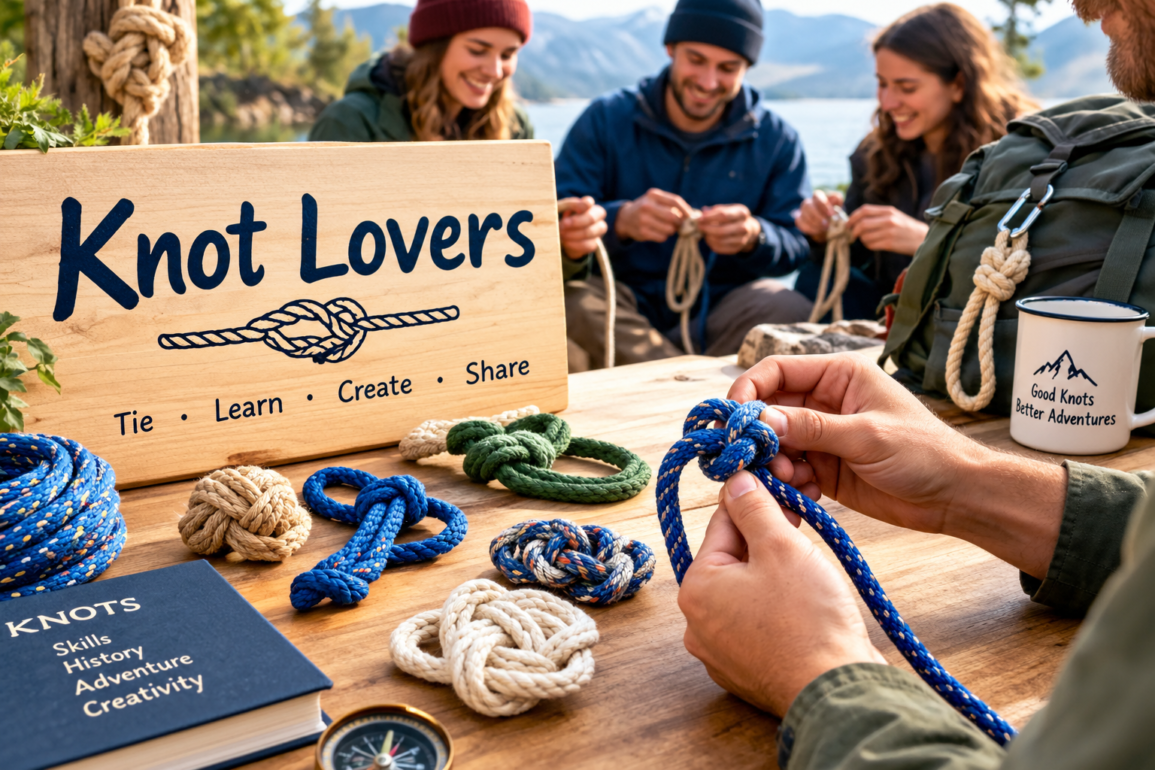
Knot lovers are people who appreciate knots not merely as practical tools but as fascinating examples of skill, creativity, tradition, and problem-solving. Knots have played an important role in human life for thousands of years, appearing in sailing, fishing, climbing, crafts, decoration, construction, and everyday tasks. What begins as a simple crossing of rope can become an intricate structure with a specific purpose and character.
For many knot lovers, learning about knots becomes a rewarding hobby. Each knot has its own method, appearance, strength, and ideal application. Some are easy enough for beginners, while others require patience and repeated practice. The subject also connects practical knowledge with history and artistic expression. Understanding this world can help anyone develop better hand skills while discovering an activity that encourages concentration and creativity.
What Does Knot Lovers Mean?
The phrase knot lovers generally describes people who have a strong interest in tying, learning, collecting, studying, or creating knots. The expression can cover a wide range of interests because knots serve many different purposes.
Some knot lovers focus on traditional ropework and want to understand knots used by sailors and explorers. Others enjoy decorative knotting, where rope becomes an artistic material. There are also people interested in climbing knots, rescue systems, fishing knots, camping techniques, and practical household applications.
The common connection is curiosity about how rope can be manipulated into useful or attractive forms. For knot lovers, learning one knot often leads naturally to discovering several related techniques.
Why People Become Interested in Knots
Knots Combine Skill and Logic
One reason knots attract so many people is that they combine physical movement with logical thinking. A person needs to understand how the rope travels through loops, around standing parts, and across different sections.
This makes knot tying more than simple repetition. A small change in direction can produce an entirely different result. Experienced knot lovers often learn to recognize a knot from its structure rather than simply memorizing every movement.
Knots Encourage Patience
Learning complicated ropework requires practice. Beginners may struggle to remember the sequence, especially when a knot involves several turns or crossings. Repeating the process gradually builds familiarity.
For knot lovers, this repetition can become part of the enjoyment. The satisfaction of completing a difficult knot correctly can encourage people to continue learning more advanced techniques.
Knots Have Practical Value
Unlike many hobbies, knot tying can immediately provide useful skills. A well-chosen knot can help secure equipment, organize ropes, attach objects, or create temporary connections.
This practical value has helped maintain interest in knots across generations. Knot lovers can enjoy the hobby while also developing knowledge that may be useful during camping, boating, fishing, or outdoor activities.
The Historical Importance of Knots
Knots have existed alongside rope technology for a very long time. Ancient societies used cords and fibers for transportation, hunting, construction, fishing, and domestic activities. As maritime exploration developed, sailors created and refined numerous rope techniques.
Traditional sailors needed reliable ways to secure sails, join ropes, create loops, and control lines. Their experience contributed to a large body of practical knot knowledge that remains interesting today.
Modern knot lovers often study these traditional techniques because they reveal how people solved practical problems before modern materials and equipment became widely available.
Popular Types of Knots
There are countless knots, but each category has different characteristics and applications.
Knots for Creating Loops
Loop knots create a fixed or adjustable loop in rope. Depending on the design, the loop may remain stable under load or change size when the rope is manipulated.
These knots can be useful in outdoor activities, boating, and other situations where a dependable loop is required. Knot lovers often practice loop knots because they demonstrate how small structural differences affect performance.
Knots for Joining Ropes
Joining knots connect two pieces of rope. The best choice depends on factors such as rope size, material, and intended use.
Some joining methods work especially well with ropes of similar thickness, while others can handle differences in diameter. Understanding these distinctions helps beginners move beyond simply memorizing knot names.
Decorative Knots
Decorative knotting transforms rope into visual patterns. It can be used for ornaments, bracelets, wall decorations, keychains, and other handmade objects.
For knot lovers interested in creativity, decorative work offers a different experience from purely functional ropework. The goal may be symmetry, texture, beauty, or complexity rather than maximum utility.
Knot Lovers and Outdoor Activities
Outdoor recreation has helped keep knot knowledge relevant. Campers may need to secure tarps, organize gear, or create temporary structures. Boaters regularly work with ropes and lines, while climbers use specialized systems where correct technique is essential.
However, people should distinguish between casual knot practice and safety-critical applications. A decorative or basic knot should never be assumed to be appropriate for climbing, rescue work, lifting, or other situations where failure could cause serious injury.
For knot lovers who want to explore technical applications, learning from qualified instructors and authoritative training materials is particularly important.
The Artistic Side of Knotting
The appeal of knots extends beyond function. Intricate patterns can create impressive visual designs from a surprisingly small amount of material.
Decorative ropework can involve repeated patterns, symmetrical arrangements, and carefully controlled tension. The process encourages attention to detail and can produce handmade objects with a distinctive appearance.
For many knot lovers, this artistic dimension makes the hobby more personal. Instead of simply learning a technique, they can experiment with materials, patterns, colors, and forms.
Materials Used by Knot Lovers
Rope choice can significantly influence the experience of tying knots. Natural fibers such as cotton, hemp, and manila have different textures from synthetic materials such as nylon and polyester.
Cotton can be pleasant for decorative projects because it is soft and easy to handle. Synthetic ropes may offer different levels of durability and resistance to environmental conditions.
Beginners should choose material appropriate to the activity. A rope suitable for crafts is not automatically suitable for climbing, rescue, towing, or load-bearing work.
How Beginners Can Start Learning
Anyone interested in becoming one of the many knot lovers can begin with a small collection of basic techniques. Learning a few foundational knots is generally more useful than trying to memorize dozens immediately.
Start by identifying the rope’s working end and standing part. Then practice slowly while paying attention to each turn and crossing. Watching the structure develop can make the process easier to understand.
After learning a knot, practice tying it without looking at instructions. This helps convert a sequence of movements into muscle memory.
Keeping a small practice rope nearby can also make regular practice convenient. Short sessions performed consistently can be more effective than attempting a large number of knots in one sitting.
Common Mistakes Beginners Make
One common mistake is pulling the rope too tightly before the structure has been formed. This can make a knot difficult to inspect or untie.
Another mistake is learning a knot without understanding its purpose. Knowing where a particular knot works best makes it easier to remember and apply correctly.
Beginners may also overlook rope condition. Damaged, excessively worn, or unsuitable rope can create unnecessary risks. Knot lovers should develop the habit of checking their materials before using them.
Why Knot Lovers Enjoy the Community
Knotting can also be a social hobby. Enthusiasts share diagrams, demonstrations, projects, historical information, and personal discoveries. Learning from others can introduce techniques that might otherwise take considerable time to discover.
Community participation can also make practice more enjoyable. Someone who struggles with a particular knot may find that another enthusiast explains the movement from a completely different perspective.
Online communities, books, workshops, clubs, and practical demonstrations can all contribute to the learning process. The best educational resources should explain not only how to tie a knot but also when and why it should be used.
The Educational Benefits of Knot Practice
Knot tying can support several useful learning skills. It requires concentration, sequencing, spatial awareness, coordination, and patience.
Children can explore simple knotting activities under appropriate supervision, while adults can use the hobby as a practical skill-building activity. More advanced learners can explore the mathematical and structural properties of knots.
This connection between practical craft and abstract thinking makes knotwork especially interesting. A simple piece of rope can become an introduction to geometry, mechanics, history, and design.
How the Hobby Is Changing Today
Modern technology has made knot education more accessible. Instead of relying only on printed diagrams, learners can watch detailed demonstrations and slow-motion tutorials.
Digital communities also allow enthusiasts from different countries to exchange techniques and traditions. This has expanded access to knowledge that was once passed primarily through personal instruction.
At the same time, traditional books and hands-on teaching remain valuable because knot tying depends heavily on physical understanding. Seeing a knot is helpful, but actually forming it with rope provides a deeper understanding of tension and structure.
Frequently Asked Questions
What are knot lovers interested in?
Knot lovers may be interested in practical ropework, sailing, camping, climbing, fishing, decorative knotting, history, crafts, or the structural properties of knots.
Is knot tying difficult to learn?
Basic knots can be learned relatively quickly, while advanced techniques may require considerable practice. Progress usually depends on consistent hands-on repetition.
What is the best rope for beginners?
A soft, manageable practice rope is often easier for beginners than a very stiff or slippery material. The appropriate rope depends on whether the goal is craft, practice, or a specific technical application.
Can knot tying become a creative hobby?
Yes. Decorative knotting can produce artwork, accessories, ornaments, and household decorations. Many knot lovers combine traditional techniques with their own designs.
Are all knots safe for heavy loads?
No. A knot’s suitability depends on its design, rope, loading conditions, and application. Safety-critical tasks require appropriate training and equipment rather than relying on a knot’s appearance alone.
Conclusion
The world of knot lovers demonstrates how a simple length of rope can become a source of practical knowledge, creativity, history, and personal achievement. From traditional maritime techniques to decorative crafts, knots offer countless opportunities for exploration. The hobby encourages patience and precision while teaching people to think carefully about structure, movement, and purpose.
For beginners, the best approach is to start with a few foundational techniques, practice them carefully, and gradually explore new categories. For experienced knot lovers, there is always another pattern, historical method, or practical application to discover. Whether approached as a craft, a technical skill, or an intellectual curiosity, knotting remains a fascinating activity that connects hands-on learning with human ingenuity.