




Introduction
Many everyday products use lightweight packaging materials that look simple but have interesting chemical properties. Styrofoam is one of the most familiar examples. People see it in takeaway containers, protective packaging, disposable cups, insulation boards, and shipping materials. This often leads to a common question: is styrofoam plastic?
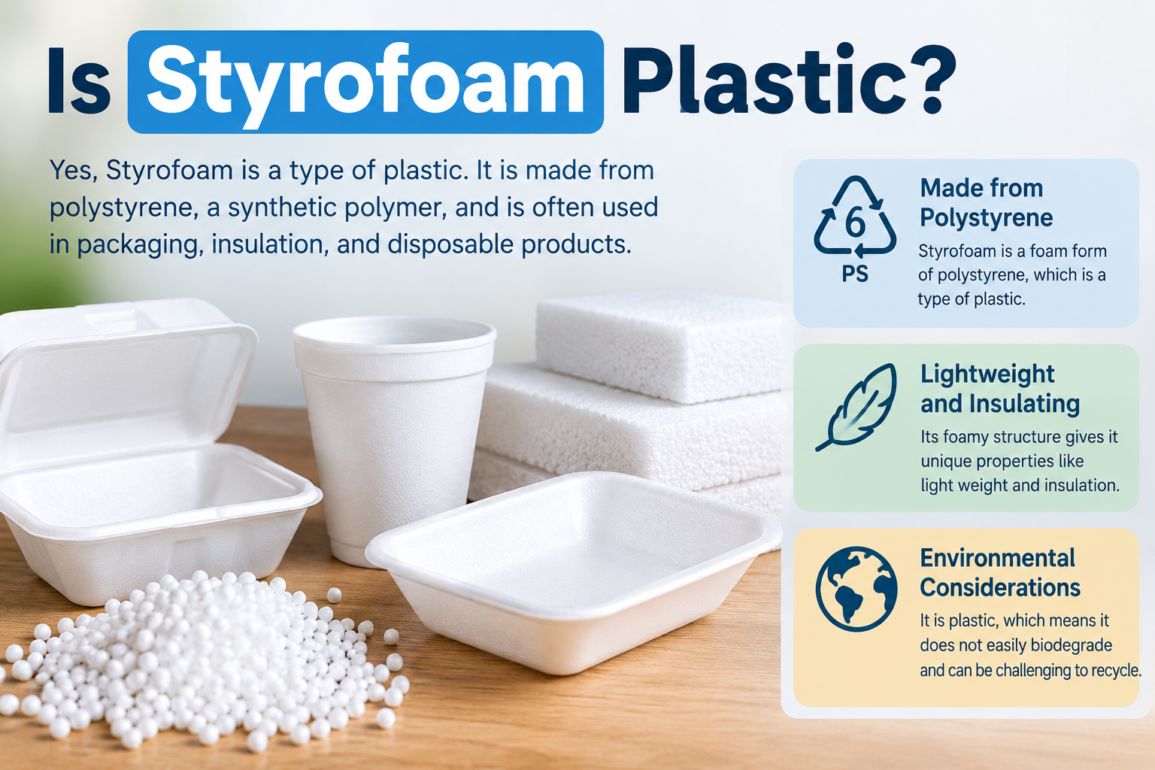
The short answer is yes. Styrofoam is a type of plastic material, although the word “Styrofoam” is often used casually to describe several different foam products. Understanding what this material actually is can help consumers make better choices about packaging, insulation, waste disposal, and environmental impact.
When people ask is styrofoam plastic, they are usually asking whether foam packaging belongs to the same broad material family as other plastics. It does. The material commonly called Styrofoam is based on polystyrene, a synthetic polymer made from petroleum-derived chemicals. However, its foamy structure gives it properties that differ significantly from solid plastic products.
What Is Styrofoam?
The term Styrofoam technically refers to a particular type of extruded polystyrene foam associated with insulation applications. In everyday conversation, however, people often use the word to describe expanded polystyrene, commonly abbreviated as EPS. Disposable food containers, cups, trays, and protective packaging are frequently made from EPS rather than true branded Styrofoam.
This distinction matters when considering the question is styrofoam plastic. Both expanded and extruded polystyrene are plastic-based materials. They contain a polymer called polystyrene, which belongs to the thermoplastic family.
Polystyrene begins as a solid polymer. Manufacturers can process it into many forms, including rigid products and lightweight foam. During foam production, tiny air pockets become trapped inside the material. Those air spaces make the finished product much lighter than solid polystyrene.
Why Does Styrofoam Look Different From Plastic?
A major reason people wonder is styrofoam plastic is its unusual appearance. Traditional plastic items such as bottles and containers often have smooth, solid surfaces. Foam products, by comparison, appear soft, porous, or bead-like.
The difference comes from the manufacturing process rather than from the basic material category. Foam polystyrene is still plastic, but manufacturers expand it with air or gas to create a cellular structure. As a result, the product has a very low density while retaining many characteristics associated with plastics.
What Type of Plastic Is Styrofoam?
Polystyrene is classified as a thermoplastic. Thermoplastics can soften when heated and harden again when cooled under appropriate processing conditions. This characteristic allows manufacturers to shape them into different products.
When answering is styrofoam plastic, it is therefore useful to distinguish between the polymer and the finished foam. Polystyrene is the plastic polymer, while Styrofoam and EPS are foam forms or products based on that polymer.
Solid polystyrene can appear clear, rigid, or brittle depending on how manufacturers formulate and process it. Foamed polystyrene has a much lower density because it contains a large amount of trapped air.
This structure explains why foam packaging can protect fragile goods without adding much weight. It also explains why foam cups and containers can provide insulation against temperature changes.
How Is Styrofoam Made?
The manufacturing process depends on whether the product is expanded or extruded. EPS typically begins with small polystyrene beads. Manufacturers expose these beads to heat and a blowing agent, causing them to expand. The expanded beads can then be molded into packaging products.
Extruded polystyrene foam follows a different manufacturing process. Polystyrene is melted, mixed with a blowing agent, and forced through an extrusion system. The material expands as it leaves the equipment and cools into a continuous foam structure.
These processes reinforce the answer to is styrofoam plastic because the underlying material remains polystyrene throughout manufacturing. What changes is its physical structure.
Common Uses of Styrofoam and Polystyrene Foam
One reason this material remains popular is its combination of low weight, low cost, and useful insulation properties.
Food and Beverage Packaging
Foam cups, trays, containers, and protective packaging have traditionally been used for food service. Their lightweight construction makes them convenient for transporting meals and drinks.
However, local regulations increasingly restrict certain foam food-service products because of waste-management and environmental concerns.
Protective Packaging
Polystyrene foam can absorb some impacts, making it is styrofoam plastic useful for protecting electronics, appliances, furniture, and other fragile goods during transportation. Its low weight also helps keep shipping packages relatively lightweight.
Building Insulation
Foam polystyrene products are also used in construction. Their ability to resist heat transfer makes them useful in walls, roofs, foundations, and other parts of buildings.
In this context, the material is valued less for convenience and more for its insulation performance and structural characteristics.
Is Styrofoam Plastic or Rubber?
Another common source of confusion is whether foam should be classified as rubber because it can feel soft or slightly flexible.
The answer is no. Styrofoam and polystyrene foam are plastics, not rubber. Their softness or lightness comes from their cellular structure. Rubber belongs to a different group of polymers and has different chemical and physical characteristics.
So, when someone asks is styrofoam plastic, the correct classification is plastic, specifically a foam form of polystyrene.
Can Styrofoam Be Recycled?
The recyclability of polystyrene foam depends heavily on location and the type of recycling system available. Although polystyrene is technically recyclable, foam products can be difficult and expensive to collect, transport, clean, and process.
Foam takes up a large amount of space relative to its weight. This creates transportation and handling challenges for recycling facilities. Food contamination can create additional problems.
For this reason, many ordinary curbside recycling programs do not accept foam packaging. Consumers should check their local waste-management instructions rather than assuming that a foam product belongs in the recycling bin.
The question is styrofoam plastic does not automatically mean that every foam item can be recycled through a household recycling program. Material classification and local recycling acceptance are two different issues.
Why Is Styrofoam a Concern for the Environment?
The environmental discussion surrounding polystyrene foam involves several factors. One important issue it is styrofoam plasticpersistence. Unlike organic materials such as paper or food waste, conventional polystyrene does not readily biodegrade under normal environmental conditions.
Foam can also break into smaller pieces when exposed to weather, physical forces, or other environmental conditions. These pieces can spread through urban areas, waterways, and other environments.
Another concern involves litter. Because foam products are extremely lightweight, wind and water can move them easily. Disposable packaging can therefore become widespread when it is not properly contained or discarded.
Understanding is styrofoam plastic helps explain why these products are considered part of the larger plastic-waste problem.
Is Styrofoam Safe to Use?
Safety depends on the particular product, its intended purpose, and how it is used. Food-contact products are manufactured under applicable safety requirements in the markets where they are sold. Consumers should follow the manufacturer’s instructions and avoid using packaging for purposes for which it was not designed.
Heat is another important consideration. Some foam products are not designed for very high temperatures or direct exposure to cooking heat. Using a product outside its intended application can change its performance.
Therefore, knowing is styrofoam plastic is useful, but material identification alone does not answer every safety question. Product labeling and manufacturer guidance remain important.
How Should You Dispose of Styrofoam?
Proper disposal depends on local rules. Some communities provide dedicated collection programs for certain types of polystyrene foam, while others direct residents to place it in general waste.
Before throwing foam away, check your municipality’s waste guidelines. If a local recycling center accepts clean EPS or other polystyrene products, following its preparation requirements can help improve the chance that the material will be processed correctly.
Do not assume that putting foam into a recycling container is always environmentally responsible. Contaminated or unacceptable materials can interfere with recycling operations.
The fact that is styrofoam plastic has a simple answer does not mean disposal is equally simple everywhere.
Styrofoam vs. Other Plastics
Polystyrene foam differs from many familiar plastics mainly because of its structure. A plastic bottle may consist of a relatively dense polymer wall, whereas foam contains a large volume of air.
This makes foam exceptionally lightweight. It can also provide useful cushioning and thermal insulation. On the other hand, its low density creates challenges for collection and transportation.
From a recycling perspective, a plastic’s recyclability depends on more than whether it technically belongs to the plastic family. Local infrastructure, contamination, market demand, product design, and processing technology all influence what can actually be recovered.
Frequently Asked Questions
Is styrofoam plastic?
Yes. Styrofoam is a foam material based on polystyrene, which is a type of plastic. The term is also commonly used for expanded polystyrene products.
Is Styrofoam biodegradable?
Conventional polystyrene foam does not readily biodegrade under normal environmental conditions. It can persist for a long time and may break into smaller pieces.
Can Styrofoam go in recycling?
Not necessarily. Acceptance varies by location. Check your local recycling or waste-management program before placing foam in a recycling bin.
Why is Styrofoam so lightweight?
Foam polystyrene contains many tiny air-filled spaces. These spaces significantly reduce its density compared with solid polystyrene.
Is Styrofoam the same as polystyrene?
They are closely related, but the terms are not always interchangeable. Styrofoam is a specific branded type of extruded polystyrene foam, while polystyrene is the broader plastic polymer. Everyday speech often uses “Styrofoam” for various polystyrene foam products.
Conclusion
So, is styrofoam plastic? Yes. Styrofoam and the many foam products commonly given that name are based on polystyrene, a synthetic thermoplastic polymer. Their lightweight, insulating, and cushioning qualities come from the way the plastic is expanded into a cellular foam structure.
Understanding is styrofoam plastic also helps explain why its disposal and environmental impact receive so much attention. Being plastic does not automatically determine whether a particular item is recyclable, and recycling availability varies considerably between communities.
The most responsible approach is to identify the exact product, follow local disposal guidance, reduce unnecessary single-use packaging where practical, and reuse suitable materials when possible. With a clearer understanding of what this material actually is, consumers can make more informed decisions about how they use and dispose of it.