




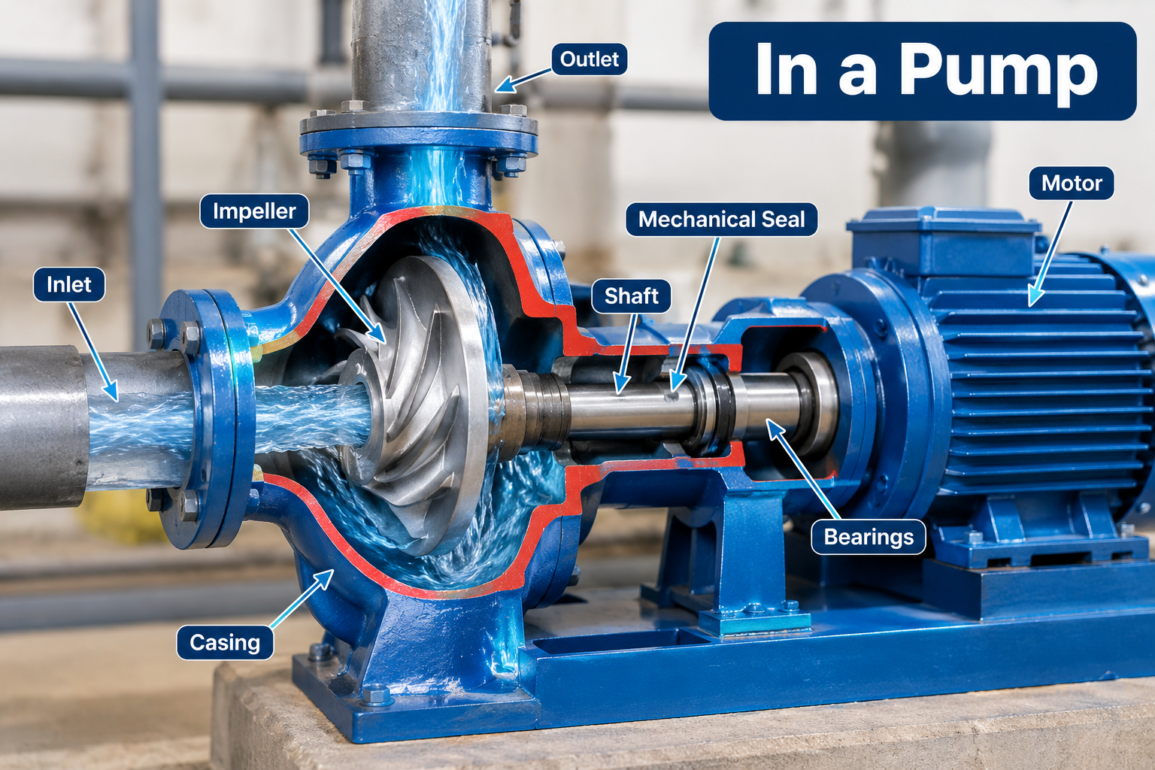
Pumps play an essential role in moving liquids, gases, and other materials from one location to another. They operate in homes, farms, factories, water treatment facilities, vehicles, and countless industrial systems. Although pumps often work quietly in the background, they support many processes people rely on every day. Understanding what happens in a pump can make it easier to recognize how these machines create pressure, control flow, and transport fluids efficiently.
The basic purpose of a pump is straightforward: it transfers energy to a fluid so the fluid can move through a system. Different designs achieve this goal in different ways. Some pumps use rotating components, while others rely on reciprocating motion. The choice depends on the type of fluid, required pressure, flow rate, operating environment, and application. By learning how components interact in a pump, you can better understand its performance and maintenance requirements.
What Happens in a Pump?
At its most basic level, a pump receives fluid through an inlet and moves it toward an outlet. Energy enters the machine through a motor, engine, or another power source. Internal components then transfer that energy to the fluid.
The exact process in a pump depends on its design. A centrifugal pump, for example, uses a rotating impeller to accelerate liquid. The casing then helps convert some of that velocity into pressure. A positive displacement pump works differently by trapping a specific amount of fluid and moving it mechanically from the inlet toward the discharge side.
Regardless of the design, the objective remains similar. The pump creates conditions that allow fluid to overcome resistance and travel where it is needed.
Main Components Found in a Pump
Several important components work together in a pump to produce reliable fluid movement. Their arrangement varies according to the pump type, but many systems contain similar functional elements.
Impeller
An impeller is a rotating component commonly found in centrifugal pumps. As it spins, it transfers energy to the liquid and increases its velocity. The shape and size of the impeller influence flow, pressure, efficiency, and operating characteristics.
Casing
The casing surrounds important internal components and directs fluid toward the discharge outlet. In many centrifugal designs, the casing also helps transform fluid velocity into useful pressure.
Shaft
The shaft transfers mechanical energy from the motor or engine to the rotating component. Proper alignment is essential because excessive vibration or misalignment can damage parts in a pump.
Seals and Bearings
Seals help prevent unwanted leakage around moving components, while bearings support rotating parts and reduce friction. Both require appropriate maintenance because failure can affect the overall reliability of the system.
How Different Pumps Work
Not every pump operates according to the same principle. Understanding these differences helps users select the appropriate equipment for a specific application.
Centrifugal Pumps
Centrifugal pumps are widely used for water circulation, irrigation, cooling systems, and industrial processes. Fluid enters near the center of the rotating impeller and moves outward because of the impeller’s motion. This movement increases fluid velocity before the casing converts part of that velocity into pressure.
The performance in a pump of this type depends on factors such as impeller diameter, rotational speed, fluid properties, and system resistance.
Positive Displacement Pumps
Positive displacement pumps move fluid by repeatedly trapping and displacing a defined volume. Gear pumps, piston pumps, diaphragm pumps, and screw pumps fall into this broad category.
These designs can be useful when an application requires accurate flow or relatively high pressure. However, the operating conditions must match the pump’s specifications to avoid excessive wear.
Submersible Pumps
A submersible pump operates while surrounded by the fluid it is designed to move. This configuration is common in drainage systems, wells, wastewater applications, and some dewatering operations.
Because the motor and other components may operate underwater, proper sealing is particularly important in a pump designed for submerged operation.
Why Pressure Matters in a Pump
Pressure is one of the most important concepts when evaluating pump performance. A pump does not simply create pressure without purpose. It adds energy to a fluid, enabling that fluid to overcome resistance caused by elevation changes, pipe friction, valves, fittings, and other system components.
If the pressure generated in a pump is insufficient, the required flow may not reach its destination. If the pressure is unnecessarily high, the system may experience energy waste, leakage, excessive stress, or premature component wear.
For this reason, engineers normally evaluate the complete system rather than looking at the pump alone.
Understanding Flow Rate
Flow rate describes how much fluid moves through a system over a given period. It is usually expressed in units such as liters per minute, gallons per minute, or cubic meters per hour.
The desired flow rate influences pump selection. A small domestic circulation system has very different requirements from a large industrial water-transfer installation. Selecting equipment based only on motor size can therefore lead to poor performance.
The relationship between flow and pressure in a pump is especially important. Many pumps perform differently as system resistance changes, so operators should consult the manufacturer’s performance curve before making a selection.
Common Problems in a Pump
Even well-designed equipment can develop problems when it operates under unsuitable conditions. Recognizing warning signs early can prevent costly repairs.
One common issue is cavitation. It can occur when pressure at the pump inlet becomes too low, allowing vapor bubbles to form and collapse. This can produce unusual noise, vibration, and damage to internal surfaces.
Leaks can also indicate seal deterioration, excessive pressure, poor installation, or component wear. Unusual vibration may point to imbalance, misalignment, damaged bearings, or other mechanical problems.
Overheating is another concern. Insufficient lubrication, restricted flow, excessive load, or motor problems can increase operating temperatures in a pump and shorten component life.
How to Improve Pump Efficiency
Efficiency matters because pumps can operate for long periods and consume significant amounts of energy. A properly selected and maintained system can reduce unnecessary operating costs.
The first step is selecting the correct pump for the application. The equipment should match the required flow, pressure, fluid properties, temperature, and operating schedule.
Regular maintenance also helps. Inspecting seals, checking alignment, monitoring vibration, and keeping relevant components properly lubricated can reduce unexpected failures.
Operators should also avoid running equipment far outside its intended operating range. A pump that is too large may repeatedly operate inefficiently, while an undersized unit may work excessively hard to meet demand.
Monitoring conditions in a pump can provide useful information about developing problems before they become major failures.
Safety Considerations
Safety should always remain a priority when working with pumping equipment. Before inspection or maintenance, appropriate shutdown and isolation procedures should be followed. Electrical systems should be handled by qualified personnel when required.
Operators should also consider the properties of the fluid being moved. Hot, corrosive, toxic, or pressurized fluids may require specialized equipment and protective procedures.
Never assume that a pump is safe to open simply because it has stopped running. Pressure, heat, stored mechanical energy, or electrical hazards may still exist in a pump or connected system.
Choosing the Right Pump
Choosing the correct equipment requires more than knowing the desired flow rate. Important factors include fluid type, viscosity, temperature, pressure requirements, suction conditions, pipe arrangement, operating hours, and environmental conditions.
For example, a pump designed for clean water may not be appropriate for thick liquids containing solids. Similarly, equipment intended for occasional domestic use may not withstand continuous industrial operation.
The best approach is to evaluate the entire application and compare manufacturer specifications. Paying attention to information in a pump manufacturer’s technical documentation can help users identify appropriate operating limits, maintenance requirements, and installation procedures.
Maintenance Tips for Long-Term Performance
Preventive maintenance can significantly improve equipment reliability. A maintenance schedule should be based on the manufacturer’s recommendations and the actual operating environment.
Inspect the system regularly for leaks, unusual sounds, vibration, overheating, and changes in flow. Keep connections secure and make sure relevant components remain properly aligned.
Filters and strainers should also be checked where applicable because restrictions can affect suction conditions and reduce performance. Contamination can cause serious wear in a pump, particularly when internal clearances are small.
Keeping accurate maintenance records is another useful practice. Recording inspections, repairs, operating conditions, and replacement dates makes it easier to identify recurring problems.
The Role of Pumps in Everyday Life
Many people rarely think about pumps even though they encounter them constantly. Water reaches buildings through pumping systems, agricultural equipment depends on pumps for irrigation, and industrial facilities use them to move process fluids.
Heating and cooling systems also depend on fluid circulation. Wastewater facilities use specialized pumps to transport and process contaminated water. Vehicles contain multiple pumping systems that move fuel, oil, coolant, and other fluids.
This wide range of applications demonstrates why understanding what happens in a pump is useful for students, technicians, engineers, homeowners, and anyone interested in mechanical systems.
Conclusion
Pumps are fundamental machines that make modern fluid-handling systems possible. Their designs may vary considerably, but each one transfers energy to a fluid and enables controlled movement through a system. Understanding the components, pressure requirements, flow characteristics, maintenance needs, and common problems associated with pumps can help users make better decisions.
Whether the equipment serves a home, farm, workshop, or industrial facility, proper selection and maintenance remain essential. Paying attention to conditions in a pump can reveal early signs of wear and help prevent unexpected downtime. With appropriate installation, monitoring, and care, pumping equipment can deliver dependable performance for many years.
Frequently Asked Questions
What is the basic function of a pump?
A pump transfers energy to a fluid so it can move through a piping or process system. Different designs use different mechanical principles to achieve this goal.
What is an impeller used for?
An impeller is commonly used in centrifugal pumps to accelerate fluid and transfer mechanical energy into the liquid.
Why does cavitation happen?
Cavitation can occur when pressure at the pump inlet falls too low, causing vapor bubbles to form and collapse. It can result in noise, vibration, and internal damage.
How can pump efficiency be improved?
Correct sizing, proper installation, regular maintenance, suitable operating conditions, and monitoring can improve overall pump efficiency.
How often should a pump be maintained?
Maintenance frequency depends on the pump design, operating conditions, fluid, workload, and manufacturer’s recommendations. Regular inspection is generally important for reliable operation.