



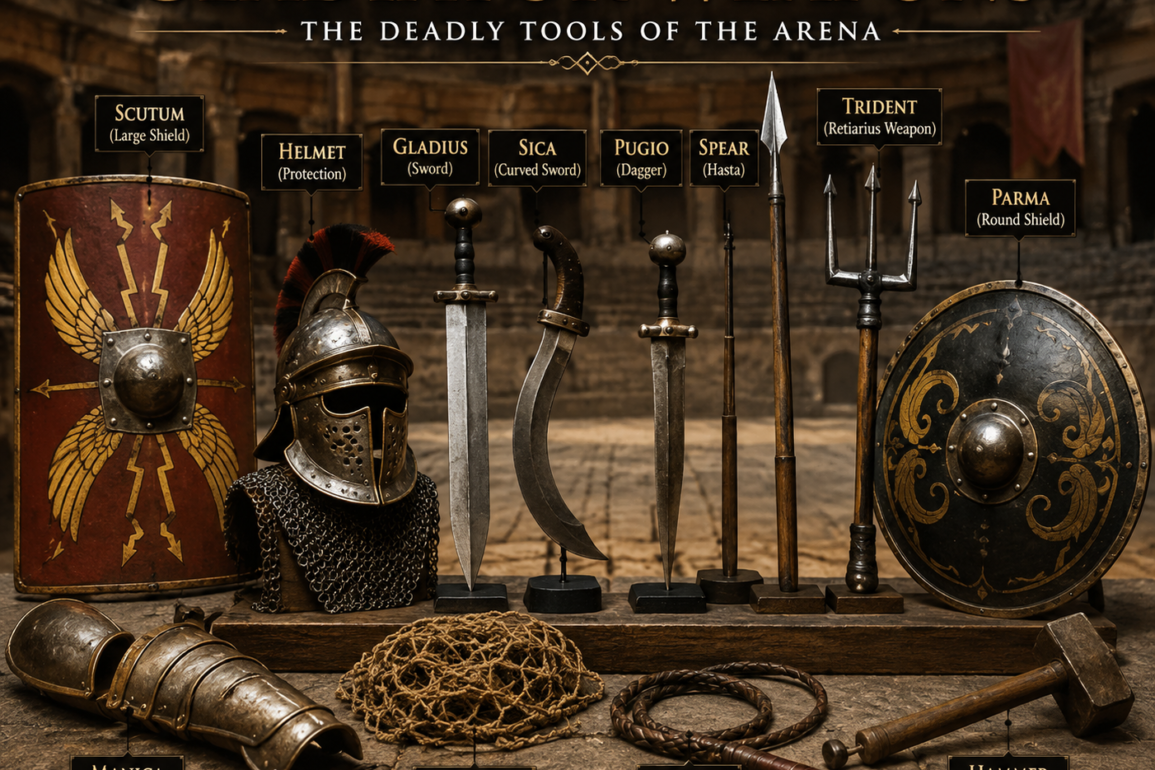
Gladiators were among the most recognizable fighters of the ancient Roman world. They entered massive arenas, faced dangerous opponents, and entertained crowds with displays of strength, skill, and courage. One of the most fascinating aspects of these warriors was the variety of gladiator weapons they carried. Each weapon influenced a fighter’s style, movement, defense, and chances of survival.
The world of Roman combat was not based on one standard fighting method. Different gladiator types used specialized equipment designed to create exciting and balanced contests. Some carried swords and shields, while others relied on tridents, nets, daggers, or heavy protective gear. Understanding gladiator weapons offers valuable insight into Roman military culture, entertainment, and craftsmanship.
The Importance of Gladiator Weapons
Weapons played a central role in determining how a gladiator fought. A heavily armored fighter needed different equipment from a fast and lightly protected opponent. Roman organizers often paired contrasting combat styles together to make battles more dramatic.
The design of gladiator weapons reflected both practical fighting needs and theatrical presentation. Equipment had to be effective enough for combat while also making each gladiator visually distinctive to the audience.
Weapons were usually combined with helmets, shields, greaves, arm guards, and other protective items. This combination created recognizable fighting classes within the Roman arena.
The Gladius: The Famous Roman Sword
The gladius was one of the most important gladiator weapons used in ancient Rome. This short sword became strongly associated with Roman soldiers and arena fighters.
A gladiator could use the gladius for quick thrusting attacks and close-range combat. Its relatively short length allowed a fighter to maintain control in crowded and intense encounters.
Many heavily armed gladiators carried a sword alongside a shield. The shield provided protection, while the blade allowed the fighter to strike when an opening appeared.
Why the Gladius Was Effective
The gladius worked especially well in close combat because it was easy to control. Fighters could attack quickly without requiring large swinging movements. This made the weapon practical inside an arena where opponents remained close.
Among all gladiator weapons, the gladius remains one of the best-known symbols of Roman combat.
The Trident
The trident was a three-pronged weapon famously used by the retiarius, a lightly armored gladiator. Unlike sword-based fighters, the retiarius depended on reach and movement.
The long handle allowed the gladiator to keep opponents at a distance. A skilled fighter could thrust toward an enemy while avoiding close-range attacks.
The trident created a unique visual style in the arena. Its unusual shape also made it one of the most recognizable gladiator weapons in Roman history.
The Fighting Style of the Retiarius
A retiarius usually avoided heavy armor because speed was essential. Instead of standing directly against an opponent, he often moved around the arena and looked for opportunities to attack.
The combination of a trident and net created an unpredictable combat style that fascinated Roman audiences.
The Net
The net was another famous piece of equipment used by the retiarius. Although it may seem unusual compared with swords and spears, it could become highly effective in skilled hands.
The fighter attempted to trap or distract an opponent by throwing the net. Even a brief moment of confusion could create an opportunity for attack.
The net demonstrates that gladiator weapons were not limited to traditional blades. Roman arena combat included specialized equipment that encouraged different strategies.
The Sica
The sica was a curved sword associated with certain gladiators, particularly the Thraex or Thracian type. Its curved blade gave it a distinctive appearance.
The weapon could potentially strike around an opponent’s shield or defensive position. This made the sica different from the straight gladius.
The unusual shape of the blade helped create a recognizable identity for the gladiator carrying it. Roman spectators could often identify a fighter’s class simply by observing his equipment.
The Spear
Spears appeared in different forms throughout ancient combat. Some gladiators used long weapons to control distance and prevent opponents from approaching easily.
A spear provided reach, allowing a fighter to attack before a sword-wielding opponent came close. However, losing control of a long weapon could create a serious disadvantage.
Among the many gladiator weapons, spears represented a balance between offensive reach and the need for careful positioning.
The Hasta
The hasta was a type of thrusting spear. It became associated with the hoplomachus, a gladiator whose equipment reflected Greek military traditions.
The hoplomachus typically carried a spear and a smaller shield. This combination required precise movement and strong defensive awareness.
The hasta allowed the gladiator to attack from a greater distance than a sword. If the spear became unusable, the fighter could rely on a secondary weapon.
The Pugio
The pugio was a Roman dagger that could serve as a backup weapon. Small blades became important when fighters lost their primary equipment or entered extremely close combat.
A dagger required the user to move close to an opponent, making timing especially important. Despite its small size, it could become dangerous in experienced hands.
Smaller gladiator weapons like the pugio remind us that arena combat often involved more than one piece of equipment.
The Scutum and Offensive Combat
The scutum was primarily a shield rather than a weapon, but it played an important role in gladiatorial fighting. A large shield could protect much of a fighter’s body.
Gladiators could also use shields aggressively by pushing, blocking, or disrupting an opponent’s balance. Therefore, defensive equipment could influence offensive tactics.
A sword-and-shield combination gave many fighters a strong balance between protection and attack.
The Parma Shield
The parma was a smaller round shield used by certain gladiator types. It provided less coverage than a large shield but allowed greater mobility.
A fighter using a smaller shield needed to rely more heavily on speed and careful positioning. The reduced weight made quick movements easier.
When studying gladiator weapons, it is important to remember that shields often shaped the entire fighting style of a gladiator.
The Manica
The manica was an armored arm guard rather than a traditional weapon. However, it played an essential role in protecting the arm used for fighting.
Some gladiators wore metal or leather protection on one arm. This allowed them to defend against attacks while keeping other areas more mobile.
Protective equipment often worked together with weapons to create specialized fighting styles.
The Scissor Weapon
One of the more unusual gladiator weapons was associated with the scissor gladiator. This fighter used specialized equipment attached around the arm.
The exact design remains a subject of historical discussion, but the weapon likely included a protective structure combined with a blade. This created a distinctive and dangerous fighting style.
The scissor demonstrates how Roman arena combat encouraged experimentation with different forms of equipment.
The Whip
Whips appeared in various forms of Roman entertainment and combat-related settings. While they were not the primary weapon of most famous gladiator classes, they represent another example of the variety of tools known in the ancient world.
A whip required distance and control. Its effectiveness depended heavily on the user’s skill and the situation.
Compared with swords or tridents, it was less commonly associated with formal gladiatorial combat, but it remains relevant when discussing the wider range of Roman fighting equipment.
The Hammer and Heavy Weapons
Heavy striking weapons could produce powerful blows but required significant strength. Weapons such as hammers and clubs were more difficult to control than lightweight swords.
A heavy weapon could create intimidation before the fight even began. However, repeated swinging could quickly exhaust the fighter.
These examples show that gladiator weapons varied greatly in weight, shape, and purpose.
How Weapons Defined Gladiator Classes
Roman gladiators were divided into different categories based on their armor and equipment. A murmillo, for example, often carried a large shield and sword. A retiarius used a net and trident. A Thraex carried a curved sword and smaller shield.
These combinations were carefully designed to create contrasts. A heavily protected fighter might face a faster opponent with lighter equipment.
The variety of gladiator weapons helped ensure that arena combat involved different strategies rather than identical fighting styles.
Murmillo Equipment
The murmillo was usually heavily equipped compared with lighter gladiators. His fighting style emphasized protection and close-range attacks.
A helmet, shield, and sword created a powerful appearance. The large shield allowed defensive positioning while the sword provided offensive capability.
Retiarius Equipment
The retiarius had one of the most distinctive fighting styles. His trident and net required mobility and careful timing.
Because he carried less heavy armor, speed became one of his greatest advantages. The contrast between the retiarius and heavily armed opponents created dramatic contests.
Thraex Equipment
The Thraex carried the curved sica and a smaller shield. His equipment was inspired by weapons associated with Thracian traditions.
This combination allowed him to use quick movements and unusual attack angles.
How Gladiator Weapons Were Made
Ancient weapons required skilled metalworkers and craftsmen. Iron and steel were shaped into blades, while wood and leather were used for handles and protective equipment.
Quality mattered greatly. A poorly made sword could bend or break during combat. A weak shield could fail to protect its owner.
The construction of gladiator weapons therefore involved practical knowledge, craftsmanship, and access to valuable materials.
Training With Arena Weapons
Gladiators did not simply receive weapons and enter the arena. They trained extensively in specialized schools known as ludi.
Training helped fighters develop balance, endurance, timing, and weapon control. Wooden practice weapons were sometimes used to reduce injuries during preparation.
Each gladiator needed to understand his own equipment and the equipment of his opponent. Knowing the strengths and weaknesses of different gladiator weapons could make a major difference during combat.
Why These Weapons Still Fascinate People
Modern interest in Roman gladiators remains strong because their world combines history, combat, engineering, and entertainment. Movies, books, games, and documentaries continue to explore the ancient arena.
The variety of equipment is especially fascinating because every weapon tells a different story. A short sword represents close combat, while a trident represents reach and movement. A net shows the importance of strategy rather than brute force.
Studying gladiator weapons also helps us understand how the Romans transformed combat into a highly organized public spectacle.
Conclusion
The history of gladiator weapons reveals much more than ancient methods of fighting. These weapons shaped identities, determined combat styles, and created the dramatic contrasts that made Roman arena contests memorable. From the gladius and sica to the trident and net, every piece of equipment required skill and strategy. The diversity of gladiator weapons continues to capture modern imagination because it reflects the complexity, craftsmanship, and spectacle of ancient Roman culture.