

Learning English vocabulary becomes easier when you understand common spelling patterns. One useful pattern involves words that end with the letters “sh.” From everyday words such as fish and wish to longer terms such as finish and publish, these words appear frequently in conversations, books, school assignments, and word games. Exploring final SH words can help students improve spelling, pronunciation, reading fluency, and vocabulary.
Whether you are a student, teacher, parent, or word-game enthusiast, understanding this spelling pattern can make language learning more enjoyable. This final sh words guide explains what these words are, provides useful examples, explores their meanings, and shares practical activities for remembering them.
What Are Final SH Words?
Final SH words are words that end with the letters “sh.” In English, this letter combination usually represents a single consonant sound, often written in phonetic notation as /ʃ/. You can hear this sound when saying words such as ship, brush, and fresh.
The sound is produced by directing air through a narrow space between the tongue and the roof of the mouth. Unlike the sounds in sip or chip, the “sh” sound has a soft, continuous quality.
Examples include cash, dish, rush, crash, and finish. Although these words differ in meaning and length, they share the same ending. Recognizing this pattern helps learners identify familiar words and spell unfamiliar ones more confidently.
Common Examples of Words Ending in SH
Many short English words end with “sh.” These examples are particularly useful for beginners because they are easy to pronounce and appear in everyday communication.
Short Final SH Words
Words with three or four letters provide an excellent starting point for vocabulary practice.
Three-letter words: Ash, bash, bushel is longer, but ash, ish, and shy do not all end in the same spelling pattern. Common examples that genuinely end in “sh” include ash and ish, although “ish” is often informal.
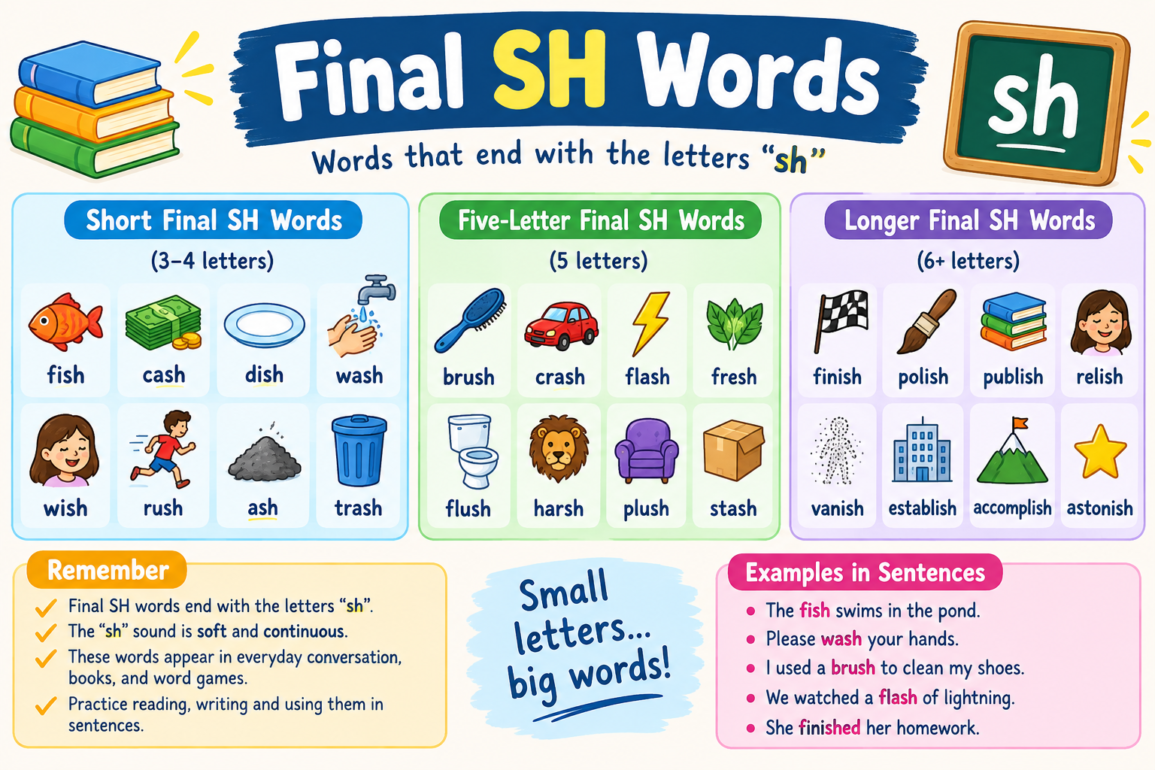
Four-letter words: Cash, dash, dish, fish, gush, hash, hush, lush, mash, mesh, mush, rash, rush, sash, wash, wish, and bash.
These words cover different meanings. Cash refers to money in physical form, while dish can mean a container for food or a prepared meal. Rush describes moving quickly, and wish expresses a desire for something.
Five-Letter Final SH Words
Five-letter words are especially useful for spelling exercises and word puzzles. Examples include brush, crash, flash, fresh, flush, harsh, plush, smash, stash, and trash.
Each word has a distinct meaning. A brush can be a tool for cleaning or painting. A flash may describe a brief burst of light, while fresh can refer to something new, recently prepared, or not spoiled. Harsh describes something severe or unpleasant.
Practicing these examples helps learners recognize final SH words without memorizing every word separately.
Longer Words That End in SH
The “sh” ending also appears in longer words. These examples are valuable for intermediate learners who want to expand their vocabulary and understand how spelling patterns work across different word lengths.
Common examples include finish, polish, publish, relish, vanish, establish, accomplish, astonish, and distinguish.
The meanings of these words vary considerably. To final sh words means to complete something. To publish means to make written or other creative material available to the public. Vanish means to disappear, while accomplish means to achieve a goal or complete a task successfully.
Studying longer examples demonstrates that the final “sh” pattern is not limited to simple vocabulary. It remains common in verbs and other words used in formal writing.
Understanding the SH Sound
English spelling can sometimes confuse learners because the same sound may appear in different positions within a word. The “sh” sound appears at the beginning of shoe, in the middle of washing, and at the end of fish.
When practicing final SH words, focus on the last sound rather than simply looking at the spelling. Say each word slowly and listen for the soft, continuous sound at the end.
For example, compare cash with cat. The first word ends with the “sh” sound, whereas the second ends with a “t” sound. Similarly, wish ends with “sh,” while wit ends with “t.”
These comparisons help learners distinguish similar-sounding words and develop stronger pronunciation skills.
Final SH Words for Children
Children often learn spelling patterns more effectively when they connect words with familiar objects, actions, and experiences. Teachers and parents can introduce these words through pictures, short sentences, and simple games.
Start with familiar words such as fish, dish, wash, wish, and brush. Ask children to identify a fish in a picture, describe a dish on the table, or explain when they wash their hands.
Once children recognize the pattern, introduce slightly more challenging examples such as crash, fresh, and flash. Encourage them to say each word aloud, identify its ending, and use it in a complete sentence.
For example, “The fish swims in the pond” and “Please wash your hands before dinner” demonstrate how the words work naturally in everyday English.
These activities make final SH words easier to remember while improving reading comprehension and sentence construction.
How to Teach and Learn These Words
Effective vocabulary practice combines reading, writing, listening, and speaking. Rather than memorizing a long list in one sitting, learners should practice a few words at a time and review them regularly.
1. Group Words by Length
Begin with short examples such as ash, cash, fish, and wish. Then move to five-letter words such as brush, fresh, and smash. Finish with longer examples such as finish and publish.
Grouping words by length gives learners a manageable starting point and helps them recognize spelling patterns.
2. Write Sentences
Writing sentences makes vocabulary meaningful. Instead of copying a word repeatedly, use it in a context that explains its meaning.
For example, write “I use a brush to clean my shoes” or “We watched a flash of lightning during the storm.” These final sh words sentences connect spelling with practical communication.
3. Read Aloud
Reading aloud helps learners connect written letters with spoken sounds. Choose a short paragraph containing several words with the target ending and pronounce each example clearly.
Ask learners to identify the words that end in “sh.” This simple exercise combines reading comprehension with spelling recognition.
4. Practice Through Word Games
Word games can make vocabulary practice more engaging. Crossword puzzles, word searches, spelling challenges, and word-building activities encourage learners to recognize patterns while having fun.
For example, provide the letters needed to form fish, dish, cash, and wish. Ask learners to change the first letter to create a different word while keeping the ending unchanged.
Such exercises develop spelling awareness and encourage independent learning.
Common Spelling Mistakes to Avoid
Although the “sh” ending is relatively straightforward, learners sometimes confuse it with other letter combinations or select a word that sounds similar but has a different ending.
For example, ship begins with “sh,” but it does not end with those letters. Similarly, wish ends in “sh,” while white does not. Recognizing the position of the letters is therefore essential.
Another common mistake involves pronunciation. Learners may pronounce the final sound too sharply or replace it with a different consonant. Listening to accurate examples and repeating them slowly can help correct this problem.
It is also important to understand word meanings. Memorizing spelling without learning how a word is used may limit vocabulary development. Combining definitions, examples, and sentence practice produces better results.
Using Final SH Words in Word Games
Many word puzzles challenge players to identify words according to their length, starting letters, or ending patterns. Final SH words can be useful in these activities because the shared ending narrows the range of possible answers.
For example, if a puzzle requires a five-letter word ending in “sh,” possible answers include brush, crash, flash, fresh, flush, harsh, plush, smash, stash, and trash.
However, the correct answer depends on the puzzle’s other clues. A word game may also restrict certain letters or require a particular meaning. Players should therefore combine spelling patterns with the available information rather than guessing randomly.
Regular practice builds pattern recognition, expands vocabulary, and helps players approach unfamiliar words more strategically.
Frequently Asked Questions
What are final SH words?
Final SH words are English words that end with the letters “sh,” such as fish, cash, brush, fresh, and finish.
What are some common four-letter words ending in SH?
Examples include cash, dash, dish, fish, gush, hush, mash, mesh, rash, rush, wash, and wish.
Can longer words end in SH?
Yes. Longer examples include finish, publish, vanish, accomplish, astonish, and distinguish.
How can children learn these spelling patterns?
Children can practice through picture cards, reading aloud, sentence writing, word searches, and spelling games. Starting with short, familiar words usually makes learning easier.
Why are ending patterns useful in word games?
Recognizing common endings helps players narrow down possible answers, identify spelling relationships, and solve vocabulary puzzles more efficiently.
Conclusion
Learning English spelling patterns is a practical way to strengthen vocabulary and improve communication. Words that end in “sh” appear in everyday speech, classroom activities, books, and popular word games. From simple examples such as fish, dish, and wish to longer words such as finish, publish, and accomplish, this group offers plenty of opportunities for meaningful practice.
By reading examples, understanding definitions, writing sentences, and playing word games, learners can develop a stronger understanding of the pattern. Consistent practice is more effective than memorizing long lists without context. With time and repetition, recognizing and using these words becomes a natural part of reading, writing, and speaking English.