




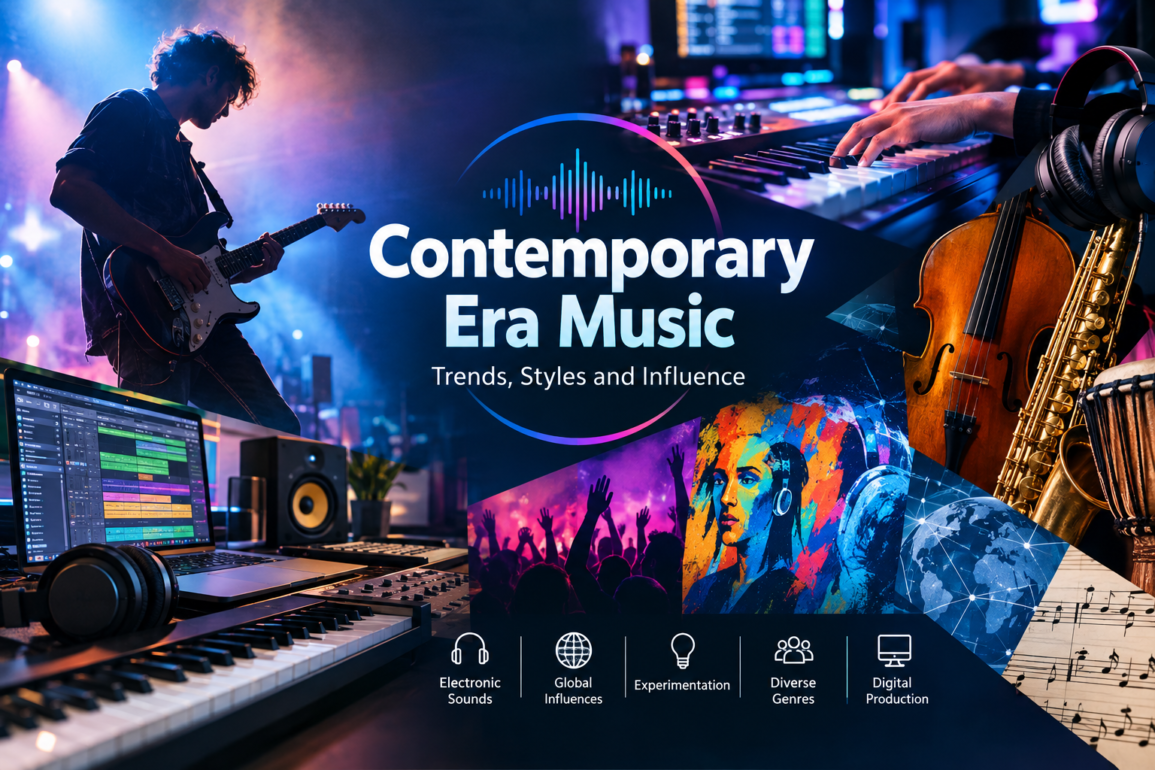
Music has always reflected the society that creates it, but the contemporary era has transformed that relationship in remarkable ways. Advances in technology, changing cultural identities, global communication, and new approaches to artistic expression have created a musical landscape that is broader than ever before. Contemporary era music includes a wide range of styles, techniques, and creative ideas that developed particularly from the late twentieth century into the twenty-first century.
Unlike earlier periods that often followed recognizable musical traditions, contemporary composers and artists frequently experiment with structure, sound, technology, rhythm, and performance. Contemporary era music can combine classical instruments with electronic sounds, traditional cultural elements with modern production, and carefully written compositions with improvisation. This diversity makes the subject important for anyone interested in understanding how music responds to a changing world.
Understanding Contemporary Era Music
The term contemporary era music generally refers to music created during the modern period, particularly music associated with the twentieth and twenty-first centuries. In classical music, the contemporary period is often connected with developments that followed the Romantic era and the emergence of modernism. However, the term can also describe broader popular and experimental musical developments.
One important characteristic of contemporary era music is its willingness to challenge established conventions. Composers may move away from traditional harmony, predictable rhythms, or familiar forms. Instead, they may explore unusual combinations of sounds, silence, texture, repetition, or electronic effects.
The meaning of contemporary era music can therefore vary depending on the musical tradition being discussed. A contemporary classical composition may sound completely different from a modern electronic track, yet both can demonstrate the experimentation and technological influence associated with the contemporary period.
Major Characteristics of Contemporary Era Music
Several characteristics help explain why contemporary era music sounds different from music associated with earlier historical periods.
Experimentation and Innovation
Experimentation stands at the center of much contemporary era music. Composers have explored new scales, harmonies, rhythmic patterns, instrumental techniques, and methods of composition. Some works deliberately avoid conventional tonal structures, while others reinterpret traditional musical forms.
This willingness to experiment has expanded the possibilities available to musicians. Sounds that were once considered unusual can now become important elements of a composition.
Use of Technology
Technology has had an enormous impact on contemporary era music. Electronic instruments, digital audio workstations, synthesizers, samplers, and recording technology allow artists to create sounds that were difficult or impossible to produce in earlier periods.
Digital technology has also changed how music is recorded, edited, distributed, and performed. A modern musician can create a complex production using software and a computer without needing a large recording studio.
Global Musical Influences
Another defining feature of contemporary era music is its global character. Musicians can access recordings, instruments, traditions, and artistic ideas from different parts of the world. This has encouraged collaborations and musical combinations that cross geographical and cultural boundaries.
Traditional rhythms can appear alongside electronic production, while instruments from different cultures can be incorporated into contemporary compositions. Such combinations demonstrate how interconnected modern musical culture has become.
The Development of Contemporary Classical Music
The history of contemporary era music is closely connected with major changes in classical composition. During the twentieth century, composers questioned many of the principles that had dominated Western classical music for generations.
Modernist composers experimented with dissonance, unusual scales, new rhythmic systems, and alternative approaches to musical structure. Later developments introduced chance procedures, electronic composition, minimalism, and other techniques.
Some composers focused on controlling every detail of a composition, while others allowed performers or environmental factors to influence the final result. This variety demonstrates that contemporary era music does not follow a single formula.
Electronic Music and Digital Production
Electronic music has become one of the most influential areas within contemporary era music. Early electronic experiments required specialized equipment, but technological advances eventually made electronic production more accessible.
Synthesizers can generate a wide range of tones, while samplers allow musicians to manipulate recorded sounds. Digital production software provides tools for sequencing, mixing, editing, and sound design.
As a result, contemporary era music can exist entirely within a digital environment. Artists can construct compositions from synthesized sounds, recorded samples, vocals, and digitally created effects. This development has influenced classical music, film scores, pop, hip-hop, dance music, and many other genres.
Contemporary Music and Popular Culture
The influence of contemporary era music extends far beyond concert halls. Popular music has adopted technologies and creative approaches that were once associated with experimental composition.
Modern pop productions may use layered vocals, electronic textures, unusual rhythmic patterns, and extensive digital editing. Hip-hop has transformed sampling and beat production into major creative practices. Electronic dance music has developed sophisticated approaches to rhythm, sound design, and live performance.
Streaming platforms have also changed how audiences discover music. Listeners can move between genres, countries, and historical periods within seconds. This accessibility has helped create a musical environment in which contemporary era music can spread rapidly across international audiences.
The Role of Contemporary Composers
Contemporary composers play an important role in expanding musical possibilities. Rather than simply repeating established forms, many composers investigate questions about sound, identity, technology, environment, and society.
Some create works for traditional orchestras, while others write for electronic instruments, multimedia performances, small ensembles, or unconventional sound sources. Their work demonstrates how contemporary era music can remain connected to musical history while exploring unfamiliar territory.
Composers may also collaborate with filmmakers, dancers, visual artists, game designers, and theater producers. These collaborations show that music increasingly functions as part of larger creative experiences.
Performance in the Contemporary Era
Performance practices have changed alongside composition. Contemporary era music may involve traditional concerts, digital performances, multimedia events, interactive installations, or online presentations.
Modern performers often need to understand technology as well as musical technique. They may work with microphones, electronic processors, computers, projection systems, and other digital equipment.
Improvisation can also play an important role. Some contemporary works provide performers with flexible instructions rather than prescribing every musical detail. This approach gives performers a greater role in shaping the final performance.
Cultural Diversity and Musical Identity
Cultural identity has become an important theme in contemporary era music. Musicians increasingly draw from their personal backgrounds, local traditions, languages, and cultural experiences.
This approach can preserve traditional musical ideas while placing them in new contexts. A traditional melody might be reinterpreted through modern harmony or electronic production. Similarly, an indigenous instrument may appear alongside a contemporary ensemble.
Such practices demonstrate that modern music does not have to abandon tradition. Instead, contemporary era music can provide a space where historical and modern ideas interact.
How Technology Changed Music Consumption
The way people listen to music has changed dramatically. Physical records, tapes, and compact discs once dominated music distribution, but digital platforms have become central to modern listening.
Streaming services provide access to enormous catalogs and allow listeners to explore artists from around the world. Social media has also created new opportunities for musicians to share performances and build audiences.
These changes have influenced contemporary era music because artists can reach listeners without relying exclusively on traditional publishing and distribution systems. Independent musicians can produce, promote, and distribute their work using digital tools.
Challenges and Criticism
Despite its innovations, contemporary era music can sometimes be challenging for audiences. Experimental compositions may avoid familiar melodies or traditional harmonic patterns, making them less immediately accessible.
Some listeners prefer music with predictable structures, while others enjoy discovering unfamiliar sounds. Neither response is unusual. Contemporary music encompasses such a broad range of styles that audiences can encounter both highly accessible compositions and extremely experimental works.
Another challenge involves the rapid pace of technological change. New tools constantly influence music production, forcing artists to adapt their skills and approaches.
The Future of Contemporary Era Music
The future of contemporary era music will likely continue to be shaped by technology, cultural exchange, and experimentation. Artificial intelligence, immersive audio, virtual environments, and increasingly sophisticated digital instruments may provide musicians with new creative possibilities.
At the same time, traditional instruments and historical musical forms will continue to influence modern creators. The relationship between old and new ideas is likely to remain an important part of musical development.
Young musicians now have access to resources that previous generations could hardly imagine. They can study performances from different countries, experiment with inexpensive software, collaborate remotely, and share their work with international audiences.
Why Contemporary Era Music Matters
Studying contemporary era music provides more than an understanding of modern sound. It offers insight into changes in technology, culture, communication, and artistic thinking.
Music often reflects the concerns and possibilities of its time. By examining contemporary compositions and productions, listeners can understand how musicians respond to new technologies, cultural connections, and changing expectations.
The diversity of contemporary era music also encourages listeners to approach music with curiosity. Instead of expecting every composition to follow familiar rules, audiences can explore different approaches to rhythm, melody, harmony, texture, and performance.
Conclusion
Contemporary era music represents one of the most diverse and experimental stages in musical history. Its development has been shaped by technological innovation, global communication, cultural exchange, and the desire to explore new forms of expression. From experimental classical compositions and electronic soundscapes to modern popular genres, its influence can be heard across the musical world.
The continuing development of contemporary era music shows that music is never completely fixed. Artists continue to reinterpret traditions, develop new technologies, and discover different ways to communicate ideas through sound. For listeners, this creates an opportunity to explore a musical world where creativity, experimentation, and cultural diversity remain at the heart of artistic expression.