




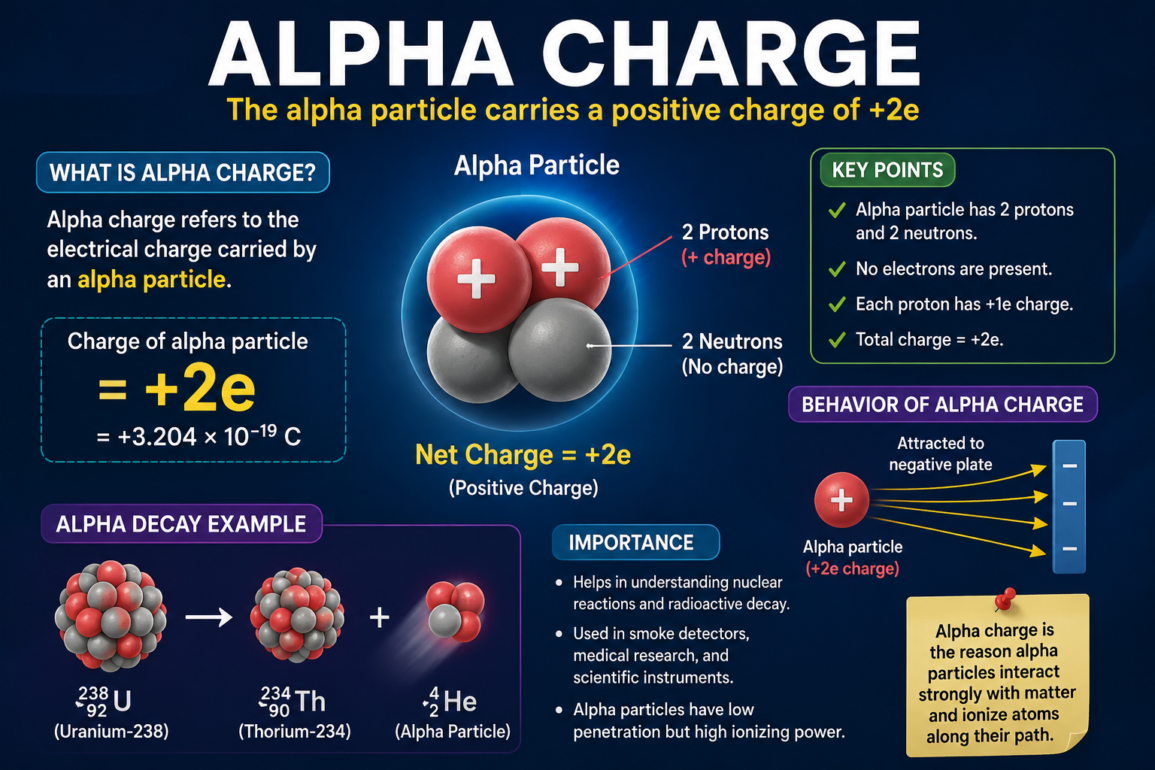
Alpha charge is an important concept in nuclear physics and radiation science. It describes the positive electrical charge associated with an alpha particle. Although alpha particles travel only short distances through matter, they can strongly interact with atoms because of their relatively large mass and positive charge. Understanding this concept helps explain radioactive decay, nuclear reactions, radiation detection, and several scientific applications.
The idea becomes easier when you understand what an alpha particle contains. It consists of two protons and two neutrons, which makes it essentially the nucleus of a helium-4 atom. Because it contains two positively charged protons and no electrons, it carries a net charge of +2 elementary charges. This positive characteristic is the foundation of alpha charge.
What Is Alpha Charge?
Alpha charge refers to the electrical charge carried by an alpha particle. An alpha particle contains two protons, and each proton has a charge of +1 elementary charge. Its two neutrons have no electrical charge.
Therefore, the total charge of an alpha particle is +2e, where e represents the elementary charge. In coulombs, this is approximately +3.204 × 10⁻¹⁹ C.
The alpha charge is important because it affects how alpha particles interact with matter. Since the particle is positively charged, it can attract electrons and repel other positively charged particles.
What Is an Alpha Particle?
An alpha particle is a relatively heavy form of nuclear radiation. It consists of two protons and two neutrons bound together inside a compact nucleus.
When certain unstable heavy atoms undergo alpha decay, they release an alpha particle. The original atom loses two protons and two neutrons, changing into a different element.
For example, uranium and radium isotopes can undergo alpha decay. During this process, the alpha charge remains positive because the emitted particle contains two protons and no electrons.
Basic Composition of an Alpha Particle
The structure can be summarized simply:
| Property | Alpha Particle |
| Protons | 2 |
| Neutrons | 2 |
| Electrons | 0 |
| Mass | About 4 atomic mass units |
| Electrical charge | +2e |
| Radiation type | Nuclear particle radiation |
| Penetration | Relatively low |
These characteristics explain why the alpha charge is described as a double positive charge.
How Alpha Charge Is Created
An alpha particle begins as the nucleus of a helium-4 atom. A normal helium atom contains two protons, two neutrons, and two electrons.
However, an alpha particle does not contain those two electrons. Without the negative electron charges, the two positive proton charges remain unbalanced.
As a result, the particle has a net charge of +2e. This is why alpha charge is positive rather than neutral.
The particle can later capture electrons while moving through matter. When it gains two electrons, it effectively becomes a neutral helium atom.
Alpha Charge and Radioactive Decay
Alpha decay occurs when an unstable atomic nucleus emits an alpha particle. This process helps the nucleus reach a more stable configuration.
During alpha decay, the atomic number decreases by two, while the mass number decreases by four. The emitted particle carries the alpha charge away from the original nucleus.
For example, when a heavy radioactive nucleus releases an alpha particle, the resulting daughter nucleus has two fewer protons. This means it belongs to a different chemical element.
The positive alpha charge also influences the way the emitted particle loses energy as it passes through surrounding material.
Why Alpha Particles Ionize Matter
One major feature of alpha charge is its ability to cause strong ionization. As an alpha particle travels through matter, its positive charge interacts with electrons in nearby atoms.
These interactions can remove electrons from atoms and create ions. Alpha particles therefore produce dense ionization along relatively short paths.
Their large mass also contributes to their behavior. Unlike very light radiation particles, alpha particles generally travel in fairly direct paths and lose energy quickly.
This strong ionization is useful in some scientific applications but also explains why alpha-emitting materials can be dangerous when they enter the body.
Alpha Charge Compared With Beta Charge
Alpha and beta radiation behave differently because their particles have different masses and charges.
An alpha particle carries a positive charge of +2e. A beta-minus particle is an electron and carries a negative charge of -1e. Beta-plus radiation involves positrons, which carry a positive charge of +1e.
The difference in charge changes how these particles interact with electric and magnetic fields.
Alpha particles are also much heavier than beta particles. Consequently, their movement through matter and their deflection in fields differ significantly.
Alpha Charge and Penetration Power
The alpha charge contributes to strong interactions with matter. Alpha particles quickly transfer energy to nearby atoms, which limits how far they normally travel.
A sheet of paper or the outer dead layer of human skin can stop alpha particles under typical conditions. However, this does not mean alpha radiation is always harmless.
The primary concern occurs when an alpha-emitting substance is inhaled, swallowed, or otherwise introduced inside the body. Internal exposure can place the radiation directly near sensitive tissues.
How Alpha Charge Behaves in Electric Fields
Because the alpha charge is positive, an alpha particle responds to electric fields in a predictable direction.
It is attracted toward negatively charged regions and repelled from positively charged regions. This behavior provides a useful way to distinguish alpha radiation from negatively charged beta radiation.
Scientists can also use magnetic fields to study charged particles. The amount and direction of deflection depend on factors such as charge, mass, velocity, and field strength.
Alpha Charge in Nuclear Physics
Nuclear physicists study the alpha charge when examining radioactive nuclei and nuclear reactions. Alpha particles provide information about the structure and stability of heavy atomic nuclei.
Their emission is also connected to the balance between nuclear forces and electrostatic repulsion inside large nuclei. In heavy atoms, many positively charged protons repel one another. Nuclear forces help hold the nucleus together, but some combinations become unstable.
Alpha decay provides one pathway through which these nuclei can release energy and become more stable.
Alpha Decay Equation
A general alpha-decay process can be represented as:
Parent nucleus → Daughter nucleus + alpha particle
The daughter nucleus has an atomic number two units lower and a mass number four units lower.
The alpha charge belongs to the emitted helium nucleus, while the daughter nucleus receives the corresponding change in proton number.
Practical Uses of Alpha Radiation
Although alpha radiation requires careful handling, it has useful applications.
Some smoke detectors use radioactive materials that produce alpha radiation. The radiation helps ionize air inside the detector, allowing the device to monitor changes caused by smoke.
Alpha emitters can also be studied in scientific research, nuclear physics, and certain specialized medical applications. Researchers investigate alpha-emitting radionuclides because their strong ionization can be useful when radiation needs to deliver energy over a short distance.
In every application, scientists must consider the behavior of alpha charge and the limited penetration of alpha particles.
Health and Safety Considerations
The alpha charge itself is not the main reason alpha radiation is dangerous. The greater concern is the intense ionization produced when alpha particles deposit their energy.
External alpha radiation generally presents a lower hazard because the particles have limited penetration. However, internal contamination can be considerably more serious.
Appropriate radiation-safety procedures therefore focus on preventing radioactive material from entering the body. Laboratories and industrial facilities use containment, monitoring, protective procedures, and specialized equipment when working with radioactive substances.
Alpha Charge vs. Other Radiation
Different types of nuclear radiation have different electrical characteristics.
| Radiation | Particle | Typical Charge | Penetration |
| Alpha | Helium nucleus | +2e | Low |
| Beta-minus | Electron | -1e | Moderate |
| Beta-plus | Positron | +1e | Moderate |
| Gamma | Photon | 0 | High |
This comparison shows why alpha charge is distinctive. Alpha particles have a relatively large positive charge compared with beta particles, while gamma radiation has no electrical charge.
Why Understanding Alpha Charge Matters
Learning about alpha charge provides a foundation for understanding several areas of physics. It connects atomic structure with radiation behavior and helps explain why charged particles interact with electric fields, magnetic fields, and matter.
Students can also use the concept to understand alpha decay equations. If they know that an alpha particle contains two protons and two neutrons, they can quickly determine how a parent nucleus changes after decay.
The concept is therefore useful beyond memorizing a single number. It demonstrates how the structure of a particle determines its physical behavior.
Frequently Asked Questions
What is the charge of an alpha particle?
An alpha particle has a net charge of +2e because it contains two positively charged protons and no electrons.
Why does an alpha particle have a positive charge?
The alpha charge is positive because the particle contains two protons and no electrons. The two neutrons do not contribute electrical charge.
Is alpha radiation highly penetrating?
No. Alpha particles generally have low penetrating power because they interact strongly with matter and lose energy quickly.
Can alpha particles be harmful?
Yes. External exposure is usually limited by their low penetration, but radioactive alpha emitters can pose a significant internal hazard if they enter the body.
What is the difference between alpha and beta charge?
An alpha particle carries +2e, while a beta-minus particle is an electron with -1e. Their different charges and masses cause them to behave differently in matter and electromagnetic fields.
Conclusion
Alpha charge describes the positive electrical charge carried by an alpha particle, which consists of two protons and two neutrons. Its +2e charge strongly influences how the particle interacts with matter, electric fields, magnetic fields, and electrons. Understanding this property makes radioactive decay and nuclear radiation easier to study. From nuclear research to radiation detection, the behavior of alpha particles demonstrates how tiny changes in atomic structure can produce important physical effects.