



Understanding unfamiliar English words can improve your vocabulary, reading comprehension, and communication skills. Some words appear frequently in literature, formal writing, and everyday conversations but may seem confusing because people rarely use them in casual speech. One such word is beget. If you are searching for beget define, you may want to understand its meaning, grammatical role, pronunciation, and practical use in sentences.
The word beget define has an interesting history and carries more than one related meaning. It beget define commonly refers to producing, creating, or bringing something into existence. Depending on the context, it can describe biological parenthood, the origin of an idea, or the development of a particular situation. Learning how to use this word correctly can help you understand older texts and express yourself more precisely.
This article explains the meaning of beget, its origins, synonyms, grammatical forms, and examples to help you use it confidently.
What Does Beget Mean?
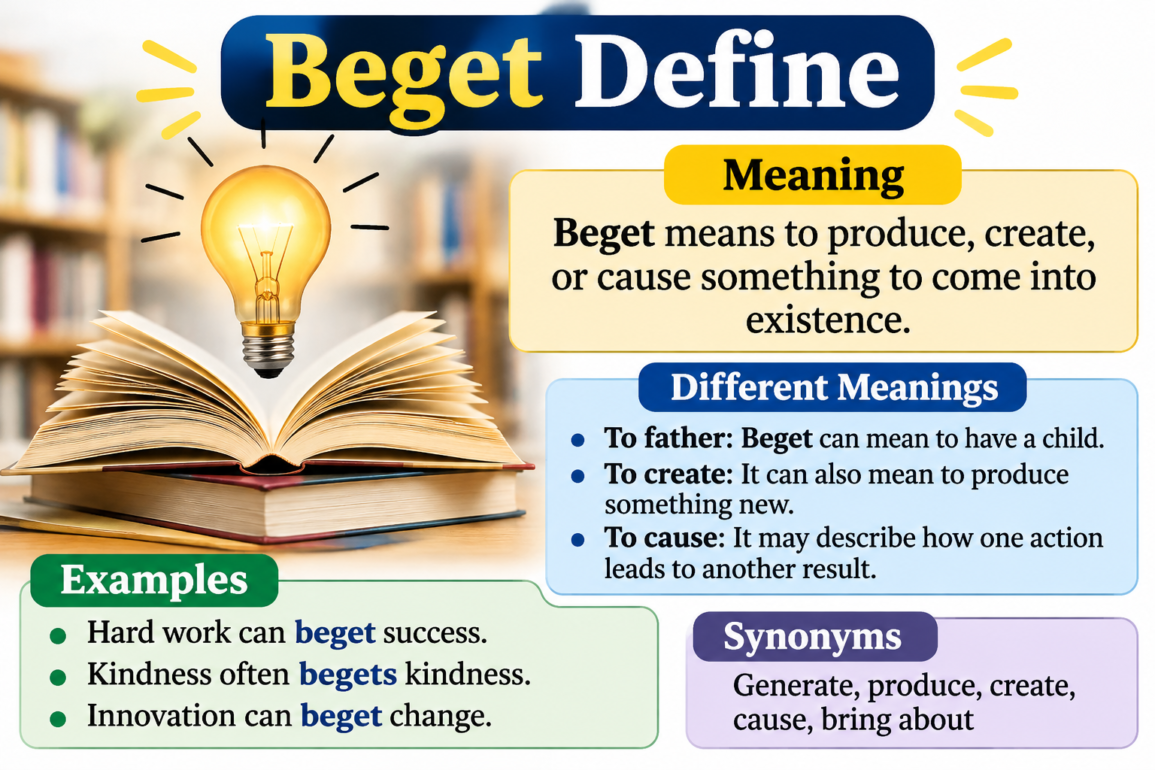
To beget means to produce, generate, cause, or bring something into existence. Traditionally, the word refers to fathering a child or becoming the biological parent of offspring. However, modern English also uses it figuratively to describe how one action, event, or condition produces another.
When someone asks you to beget define, the simplest explanation is that beget means to cause something to happen or produce something new.
For example, the sentence “Hard work can beget success” means that consistent effort can produce positive results. Similarly, “Fear can beget define uncertainty” explains how one emotional condition may create another.
The word is generally associated with formal writing, literature, historical documents, and philosophical discussions. Although it is not especially common in everyday conversations, it remains useful because it expresses the relationship between a cause and its result.
Origin and History of the Word Beget
The word beget define has Old English roots. It developed from an earlier English expression meaning to obtain, acquire, or bring forth. Over time, its meaning became strongly associated with producing offspring and creating something.
Historically, writers used the term when discussing family relationships, ancestry, and generations. It also appeared in religious texts and traditional literature, where it described the relationship between parents and children.
One famous example appears in biblical genealogies, where the word is repeatedly used to describe generations of descendants. This historical association explains why many readers encounter the term in older religious and literary writing.
As English developed, the meaning expanded beyond biological reproduction. Today, beget can describe the creation of ideas, emotions, opportunities, problems, and social conditions.
Different Meanings of Beget
Understanding the different meanings of this word makes it easier to recognize its purpose in various sentences.
1. To Father or Produce Offspring
The traditional meaning of beget is to father a child or produce biological offspring. It usually appears in historical, religious, or literary contexts.
For example, “The king was said to beget define several children during his lifetime.” This sentence describes the king as the biological father of those children.
This meaning is less common in everyday communication because people generally prefer simpler expressions such as father, have children, or produce offspring.
2. To Create or Generate Something
Another important meaning involves creating something new. The word can describe the production of an idea, opportunity, invention, or result.
For example, “Creative thinking can beget define innovative solutions.”
Here, the word explains how one activity produces something valuable. It does not refer to biological reproduction.
3. To Cause a Particular Situation
Beget can also describe how one action or condition leads to another. This meaning is especially useful when discussing social issues, emotions, relationships, and consequences.
For instance, “Dishonesty can beget distrust.” The sentence means that dishonest behaviour can create a lack of confidence between people.
This figurative meaning is particularly common in formal discussions because it communicates the connection between cause and effect.
Beget Define in Different Contexts
The meaning of beget can become clearer when you examine how writers use it in different situations.
In Everyday English
Although people do not frequently use beget in casual conversation, they can understand its meaning through familiar examples.
For example, “One good decision can beget define another.” This means that making a positive choice may encourage additional positive decisions.
Another example is “Kindness often begets kindness.” This suggests that treating people well can encourage them to respond with similar behaviour.
In Literature and Religious Writing
The word frequently appears in traditional literature and religious texts. In these settings, it may describe family relationships, ancestry, or the creation of something.
Older English translations of religious writings often use beget define when presenting genealogical records. Readers may encounter the expression while studying historical family lines or traditional narratives.
In Academic and Formal Writing
Writers sometimes use beget to explain relationships between causes and outcomes.
For example, “Economic instability can beget social uncertainty.”
This sentence describes how one condition may contribute to another. The word makes the relationship between the two ideas clear without requiring a longer explanation.
Grammatical Forms of Beget
Learning the grammatical forms of beget is important if you want to use it correctly in writing and conversation.
The word is an irregular verb, meaning that its past forms do not follow the regular pattern of adding -ed.
| Verb form | Word |
| Base form | Beget |
| Third-person singular | Begets |
| Present participle | Begetting |
| Simple past | Begot |
| Past participle | Begotten |
Both begot and begotten appear in English, although their use depends on the grammatical construction and context.
How to Use Beget in Different Tenses
Present tense: One careless decision begets several problems.
Past tense: The disagreement begot further confusion.
Present continuous: The situation is begetting unnecessary tension.
Present perfect: The new policy has begotten several opportunities.
These examples demonstrate how the verb changes according to tense while maintaining its central meaning of producing or causing something.
Synonyms of Beget
Synonyms can help you understand unfamiliar vocabulary and choose more suitable words when writing. Several English words have meanings similar to beget, although their exact use depends on the sentence.
Some common synonyms include:
- Generate: To produce or create something.
- Produce: To make or bring something into existence.
- Create: To develop something new.
- Cause: To make something happen.
- Give rise to: To lead to a particular result.
- Bring about: To make an event or situation occur.
- Father: To become the biological parent of a child.
- Spawn: To produce or generate something, sometimes in large quantities.
For example, the sentence “Poor communication can beget define misunderstandings” can also be written as “Poor communication can cause misunderstandings.”
However, beget often sounds more formal and emphasizes the process through which one thing produces another.
Antonyms of Beget
Antonyms are words that express opposite meanings. Since beget define generally means creating, producing, or causing something, its opposite depends on the context.
Some possible antonyms include:
Destroy: To damage something completely or make it cease to exist.
Prevent: To stop something from happening.
Eliminate: To remove something entirely.
Suppress: To prevent something from developing or becoming noticeable.
Terminate: To bring something to an end.
For example, if a particular action begets conflict, another action may prevent or reduce that conflict.
Understanding antonyms helps readers recognize the difference between producing an outcome and stopping it from occurring.
Examples of Beget in Sentences
The best way to understand a new vocabulary word is to examine it in complete sentences. The following examples demonstrate how the word works in different contexts.
- Consistent effort can beget remarkable achievements over time.
- Dishonest behaviour often begets serious problems in relationships.
- The invention begot several improvements in modern technology.
- His curiosity begets new questions every day.
- Economic difficulties can beget define social challenges.
- Kind actions frequently beget positive responses.
- The disagreement begot a lengthy discussion.
- Unfair treatment can beget resentment among employees.
- Innovation often begets further innovation.
- The decision has begotten unexpected consequences.
These examples show that beget define is not limited to describing biological relationships. It can also explain how actions, ideas, and circumstances produce particular results.
Common Mistakes to Avoid When Using Beget
Although beget has a straightforward meaning, learners sometimes make grammatical mistakes when using it.
One common mistake involves treating it as a regular verb. Its past forms are begot and begotten, not simply begetted. Remembering its irregular structure will help you avoid incorrect sentences.
Another mistake involves using the word in situations where a simpler alternative would sound more natural. For example, saying “The company begot a new product” may sound unnecessarily formal. In ordinary business communication, “The company created a new product” is usually more natural.
Writers should also avoid confusing beget define with unrelated words that describe possession or ownership. Beget focuses on producing or causing something rather than simply having or holding it.
Finally, always consider the surrounding sentence. Its beget define traditional meaning relates to parenthood, while its figurative meaning describes the creation of an outcome.
Why Is Learning the Word Beget Important?
Expanding your vocabulary helps you understand different writing styles and communicate more effectively. Learning words such as beget can be particularly useful when reading classic literature, historical documents, religious texts, and academic material.
It also improves your ability to recognize relationships between actions and consequences. Instead of repeatedly using general words such as make or cause, you can choose a more precise expression when the context supports it.
Students preparing for vocabulary examinations, English language assessments, and reading comprehension exercises may also benefit from learning less frequently used verbs.
Furthermore, understanding the word’s historical background provides insight into how English vocabulary changes over time. A word that originally described biological relationships can develop broader meanings through repeated literary and figurative use.
Conclusion
Understanding the meaning of unfamiliar vocabulary is an important part of improving English language skills. The word beget define means to produce, generate, father, or cause something to come into existence. Its traditional meaning relates to biological parenthood, while its modern figurative meaning describes how one event, action, or condition produces another.
If you are learning the beget define meaning, remember its main idea: one thing brings another thing into existence. Knowing its grammatical forms, synonyms, antonyms, and sentence examples will help you recognize and use it correctly. Although it is more common in formal and literary writing than everyday conversation, beget remains a valuable word for developing a stronger and more expressive vocabulary.
Frequently Asked Questions (FAQs)
1. What does beget mean in simple English?
Beget means to produce, create, or cause something. Traditionally, it also means to father a child or produce offspring.
2. Is beget a noun or a verb?
Beget is a verb. It describes an action involving the production or creation of something.
3. What is the past tense of beget?
The simple past tense is begot. Its past participle is begotten, although begot is also used as a past participle in some contexts.
4. What are the synonyms of beget?
Common synonyms include generate, produce, create, cause, father, and bring about. The best choice depends on the sentence.
5. Can beget be used in modern English?
Yes. Beget remains part of modern English, particularly in formal writing, literature, academic discussions, and expressions describing cause-and-effect relationships.