




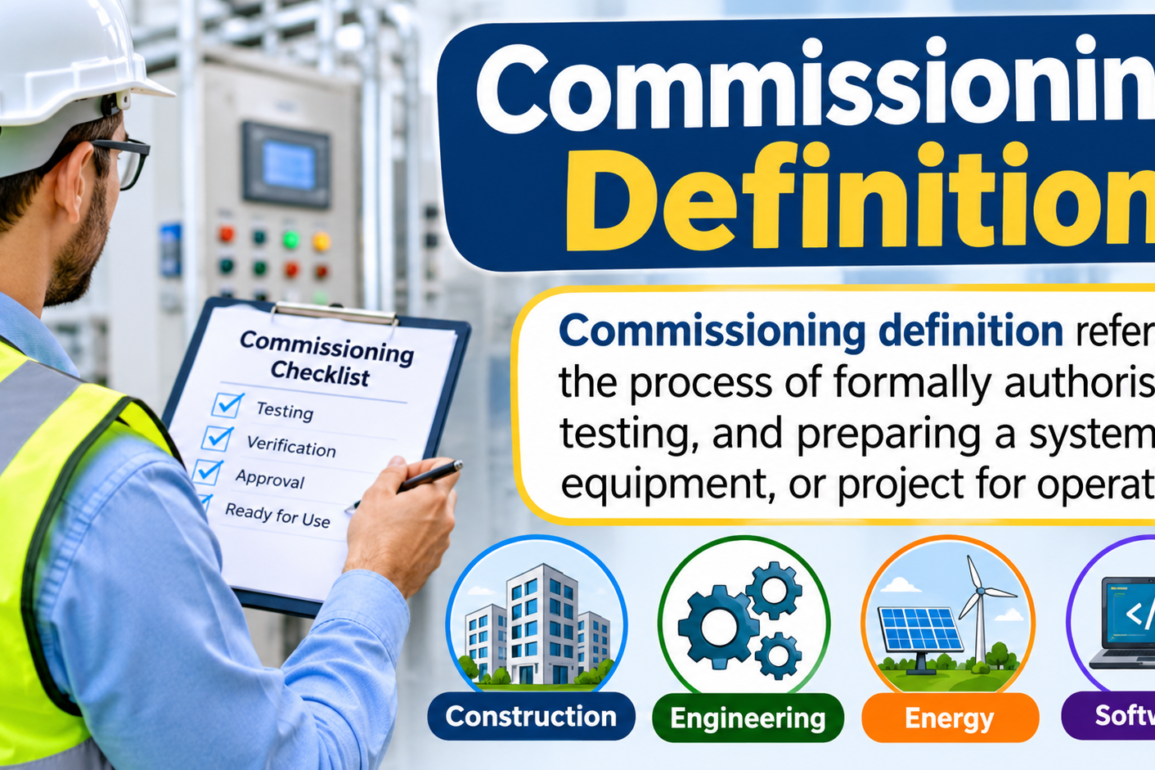
Understanding professional and technical terminology helps people communicate clearly in workplaces, businesses, engineering projects, and everyday situations. One important term is commissioning, which appears in industries such as construction, manufacturing, healthcare, energy, and project management. Although the word may sound complicated, its meaning becomes easier to understand when you explore how people use it in different situations.
The commissioning definition generally refers to the formal process of assigning responsibility, authorising work, or putting a system, building, machine, or service into operation. Its exact meaning depends on the context in which someone uses it. For example, a company might commission an artist to create a painting, while an engineering team might commission new equipment before allowing employees to use it.
Understanding the commissioning definition helps readers recognise the difference between requesting work, completing a project, and making something officially operational. This guide explains its meaning, different applications, examples, and related terminology.
What Is the Commissioning Definition?
The commissioning definition describes the act of formally ordering, authorising, or arranging something to be created, completed, tested, or placed into service. It can refer to hiring someone for a particular task or preparing equipment and systems for practical operation.
The word comes from the verb commission, which means to give someone authority or responsibility to perform a specific activity. A person or organisation that commissions something usually establishes the purpose, requirements, and expectations before the work begins.
For example, when a business hires an architect to design a new office building, it commissions the architect to complete a particular project. Similarly, when a factory installs new machinery, technicians may perform commissioning activities to ensure that the equipment operates correctly.
Therefore, the commissioning definition has two important dimensions: formally assigning work and preparing something for successful operation.
Understanding the Meaning of Commissioning
Commissioning can describe several activities depending on the industry. In general communication, it often means requesting or authorising professional work. In technical environments, it usually involves checking, testing, and verifying that equipment or systems meet their intended requirements.
For instance, a hospital may commission a new medical imaging system after installation. Before using it for patients, specialists check its performance, safety features, and operating conditions.
The commissioning definition also appears in creative industries. A publisher may commission a writer to produce an article, while a gallery might commission an artist to create an original sculpture.
These examples demonstrate that commissioning is not limited to machinery or construction. It applies whenever someone formally authorises a task or arranges for a service, product, or system to become available.
Different Types of Commissioning
1. Construction Commissioning
Construction commissioning involves checking whether a newly constructed building and its systems operate according to the owner’s requirements. It usually includes inspecting heating, ventilation, air conditioning, lighting, electrical systems, plumbing, and safety equipment.
The commissioning definition in construction focuses on ensuring that the building performs as intended before occupants begin using it.
Commissioning professionals may review design documents, inspect installations, conduct functional tests, and prepare reports. These activities help identify problems before they become expensive operational issues.
2. Engineering Commissioning
Engineering commissioning refers to the process of testing and verifying machinery, equipment, and technical systems before regular operation.
For example, engineers commissioning an industrial production line may check electrical connections, control systems, safety mechanisms, and machine performance.
The commissioning definition in engineering is closely connected to reliability, efficiency, and operational safety. Proper testing helps organisations reduce unexpected breakdowns and confirm that equipment meets technical specifications.
3. Energy System Commissioning
Energy companies use commissioning procedures when introducing power plants, solar installations, wind turbines, and electrical distribution systems.
Technicians examine connections, test protective equipment, and verify that systems produce or distribute energy safely.
For renewable energy projects, commissioning confirms that solar panels, inverters, batteries, and monitoring systems work together correctly.
4. Software Commissioning
In software and information technology, commissioning may describe formally introducing a new system or service into an organisation.
Before deployment, teams can check software functionality, security, compatibility, and performance. They commissioning definition may also train employees and confirm that the system supports business requirements.
Although software professionals more commonly use terms such as deployment, implementation, and acceptance testing, commissioning can still describe the broader process of authorising and preparing a system for operational use.
How Does the Commissioning Process Work?
The commissioning process usually follows several stages. The exact procedure depends on the project, industry, and equipment involved.
Planning and Preparation
The first stage involves defining project requirements and establishing performance expectations. Project owners identify what the system must accomplish and determine the standards it should meet.
Planning also includes assigning responsibilities, preparing schedules, and identifying the resources required for testing.
Installation and Inspection
After planning, the equipment or system is installed according to approved specifications. Professionals inspect the installation to identify visible problems, incorrect connections, or missing components.
This stage ensures that the system is ready for more detailed testing.
Testing and Verification
Testing is one of the most important parts of commissioning. Specialists operate equipment under controlled conditions and compare its commissioning definition performance with established requirements.
They may examine efficiency, safety, reliability, and overall functionality. If testing identifies problems, the responsible team corrects them before proceeding.
Documentation and Handover
Once the system passes the necessary checks, professionals prepare documentation containing test results, operating instructions, maintenance information, and relevant approvals.
The completed system can then be handed over to its owner or operational team.
This structured approach demonstrates how the commissioning definition connects formal approval with practical readiness.
Real-Life Examples of Commissioning
Practical examples make the commissioning definition easier to understand.
Example 1: Construction project
A property developer hires specialists to test the electrical, heating, and ventilation systems in a newly constructed office. This activity represents building commissioning.
Example 2: Creative project
A magazine publisher pays a photographer to produce original images for an upcoming issue. The publisher commissions the photographer to complete the assignment.
Example 3: Manufacturing equipment
A factory installs a new production machine. Engineers test its controls, safety features, and production capacity before employees begin using it.
Example 4: Renewable energy
A company installs solar panels on a commercial building. Technicians inspect the installation and verify that the panels and electrical equipment operate correctly.
Example 5: Public infrastructure
A local authority introduces a new water treatment facility. Specialists test the equipment and confirm that the facility meets its operational and safety requirements.
Each situation reflects a different application of the commissioning definition.
Commissioning vs. Installation: What Is the Difference?
People sometimes confuse commissioning with installation because both activities occur during the introduction of new equipment or systems.
However, they describe different stages of a project.
Installation means physically setting up equipment, machinery, or systems in their intended locations. Commissioning goes further by testing, checking, and confirming that the installed equipment performs according to its requirements.
For example, connecting an air conditioning unit to a building represents installation. Testing its temperature controls, airflow, electrical performance, and safety features forms part of commissioning.
A project may have completed installation without being ready for operation. Commissioning helps establish that readiness.
Why Is Commissioning Important?
Commissioning provides several practical benefits for businesses, organisations, and project owners.
Improves safety: Testing helps identify faults and potential hazards before equipment enters regular operation.
Supports reliability: Proper verification reduces the likelihood of unexpected failures and operational interruptions.
Improves performance: Specialists confirm that systems operate according to their intended specifications.
Reduces additional costs: Identifying problems during commissioning can prevent expensive repairs and modifications later.
Provides clear documentation: Commissioning records give owners useful information about equipment performance, maintenance, and operating requirements.
Supports better project handovers: A properly commissioned system gives operational teams greater confidence when taking responsibility for new facilities or equipment.
These advantages explain why commissioning plays an important role in modern project management and technical operations.
Common Terms Related to Commissioning
Learning related vocabulary makes it easier to understand professional documents and conversations.
Commission: A formal instruction, assignment, or authorisation given to someone to complete specific work.
Commissioner: A person or organisation that authorises or requests a particular project or service.
Commissioned: An adjective describing something formally assigned, authorised, or placed into service.
Commissioning agent: A professional or specialist responsible for coordinating or carrying out commissioning activities.
Operational readiness: The condition in which equipment, systems, or facilities are prepared for their intended use.
Decommissioning: The process of permanently or temporarily removing equipment, facilities, or systems from active service.
Although these expressions are connected, they do not always have identical meanings. Understanding their differences helps prevent confusion in professional communication.
Frequently Asked Questions (FAQs)
1. What is the simple commissioning definition?
The commissioning definition in simple terms means formally requesting or authorising work, or testing and preparing a system or piece of equipment before it begins operating.
2. What does commissioning mean in construction?
In construction, commissioning involves checking and testing building systems to confirm that they operate according to the owner’s requirements and approved specifications.
3. Is commissioning the same as installation?
No. Installation involves setting up equipment, while commissioning involves testing and verifying that the installed equipment works correctly and is ready for use.
4. What is an example of commissioning?
A company may hire an architect to design a new building. Alternatively, engineers may test a newly installed industrial machine before allowing employees to operate it. Both situations involve commissioning.
5. What is the opposite of commissioning?
The closest opposite in technical and operational contexts is decommissioning. It describes removing equipment, machinery, or facilities from active service.
Conclusion
Understanding the commissioning definition is important because the term appears in many professional, creative, and technical environments. It generally describes formally assigning work, authorising a project, or preparing a system for practical operation.
In construction and engineering, commissioning involves inspection, testing, verification, and documentation. In creative industries, it often means hiring someone to produce specific work. Although the activities differ, they share the idea of formally arranging something for a defined purpose.
By understanding the commissioning definition, its applications, and its relationship with installation and decommissioning, readers can use the term more accurately. Whether you encounter it in a business agreement, construction report, engineering document, or everyday conversation, its meaning becomes much clearer when you consider the surrounding context.