


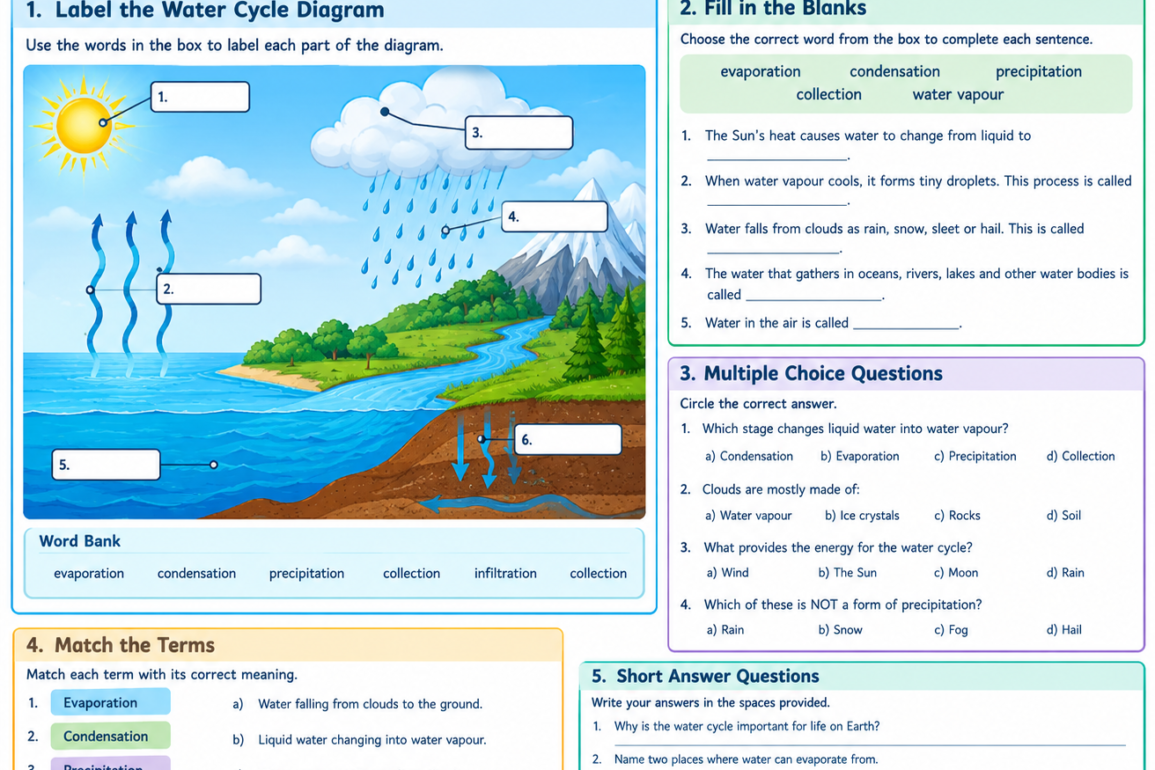
The natural world is full of fascinating processes, but few are as important to life on Earth as the water cycle. Every drop of rain, every flowing river, and every cloud in the sky plays a role in this continuous process. Understanding how water moves between the Earth’s surface and the atmosphere helps students develop a stronger knowledge of science and the environment. A water cycle worksheet makes this topic easier to understand by turning scientific information into practical learning activities.
Teachers and parents can use these worksheets to introduce important scientific concepts, reinforce classroom lessons, and encourage children to explore how nature works. Through labeling diagrams, answering questions, completing sentences, and matching scientific terms, students can learn about evaporation, condensation, precipitation, and collection. These activities also improve observation, reading comprehension, and critical-thinking skills.
What Is the Water Cycle?
The water cycle is the continuous movement of water between the Earth’s surface and the atmosphere. It is also called the hydrological cycle. Water changes its physical state as it moves through different stages, but the total amount of water on Earth remains relatively constant.
The Sun provides the energy that drives much of this process. Its heat causes water from oceans, lakes, rivers, and other surfaces to evaporate. Water vapour rises into the atmosphere, cools, and forms clouds. Eventually, water returns to the ground as rain, snow, sleet, or hail.
A water cycle worksheet introduces these stages in a structured way. Instead of simply memorizing scientific definitions, students can see how each stage connects to the next.
Why Is a Water Cycle Worksheet Important for Students?
Science becomes more interesting when students actively participate in learning. Reading a textbook provides useful information, but practical exercises help children remember what they have learned.
A water cycle worksheet gives students an opportunity to explore the subject through different activities. They can identify stages, complete diagrams, answer questions, and explain how water travels through the environment.
Develops Scientific Understanding
Young learners sometimes find scientific processes difficult because they cannot observe every stage directly. Worksheets make abstract ideas easier to understand through illustrations and simple explanations.
For example, students can study a diagram showing how sunlight heats ocean water, how vapour rises, and how clouds eventually produce rainfall.
Improves Vocabulary
The water cycle includes several scientific terms that students need to understand. These include evaporation, condensation, precipitation, transpiration, and collection.
Regular practice helps children recognize these words, understand their meanings, and use them correctly in science lessons.
Encourages Independent Learning
Worksheets allow students to complete activities independently or with limited assistance. They can read instructions, study diagrams, and answer questions using their existing knowledge.
This approach builds confidence and encourages children to take responsibility for their learning.
The Four Main Stages of the Water Cycle
Before completing a water cycle worksheet, students should understand the four main stages of this natural process.
1. Evaporation
Evaporation occurs when heat changes liquid water into water vapour. The Sun provides most of the energy responsible for this process in nature.
Water evaporates from oceans, lakes, rivers, ponds, and wet surfaces. The resulting water vapour rises into the atmosphere.
Students can understand evaporation through a simple classroom observation. When a small amount of water remains in an open container, it gradually disappears as it changes into vapour.
2. Condensation
Condensation happens when water vapour cools and changes into tiny liquid water droplets. These droplets gather around small particles in the atmosphere and contribute to cloud formation.
This stage explains why clouds appear in different shapes and sizes. It also helps students understand how invisible water vapour becomes visible droplets.
A water cycle worksheet may ask students to identify condensation in a labelled picture or complete a sentence explaining how clouds form.
3. Precipitation
Precipitation occurs when water falls from clouds to the Earth’s surface. It can take several forms, including rain, snow, sleet, and hail.
When water droplets or ice particles become large and heavy enough, they fall because of gravity.
Students should understand that precipitation does not always mean rainfall. Weather conditions determine whether water reaches the ground as liquid or frozen particles.
4. Collection
After precipitation reaches the ground, water collects in oceans, lakes, rivers, ponds, and other water bodies. Some water flows across the land, while some enters the soil and becomes groundwater.
Eventually, collected water can evaporate again, continuing the cycle.
A water cycle worksheet often uses arrows to demonstrate how collection connects with evaporation and keeps the entire process moving.
Different Types of Water Cycle Worksheets
Not every student learns in the same way. Some children understand concepts through pictures, while others prefer reading, writing, or solving questions. Different worksheet formats can support these learning preferences.
Water Cycle Diagram Worksheet
Diagram-based activities are especially useful for visual learners. Students receive an illustration of the water cycle and identify its different stages.
Some worksheets provide labels that students must place in the correct positions. Others include an empty diagram where children write the scientific terms themselves.
Water Cycle Labeling Worksheet
Labeling exercises help students connect scientific vocabulary with visual information. They may need to identify clouds, sunlight, rivers, oceans, water vapour, and rainfall.
These activities are suitable for elementary and middle school students because they combine observation with vocabulary development.
Fill-in-the-Blank Activities
Fill-in-the-blank questions test whether students understand important scientific definitions.
For example, a question might say, “The process through which liquid water changes into water vapour is called ______.”
Students must remember the correct term and complete the sentence.
Multiple-Choice Questions
Multiple-choice activities provide several possible answers to each question. Students select the option that correctly explains a particular stage or process.
These exercises are useful for revision, classroom assessments, and independent practice.
Water Cycle Worksheet with Answers
Worksheets with answer keys help students check their understanding after completing an activity. Teachers can also use them to evaluate classroom progress and identify topics that need further explanation.
However, students should attempt the questions before looking at the answers to gain the greatest educational benefit.
How to Use Water Cycle Worksheets at Home and School
Worksheets become more effective when students understand the subject before attempting the activities. Teachers and parents can introduce the topic through simple explanations and everyday examples.
Start by explaining how sunlight heats water and causes evaporation. Next, discuss cloud formation and explain why precipitation occurs. Once children understand the sequence, provide a water cycle worksheet containing a simple diagram.
Encourage students to describe each stage in their own words. This helps them demonstrate understanding rather than simply memorizing definitions.
Parents can also connect lessons with daily observations. For example, they can ask children why wet clothes dry outside, why clouds form, or where rainwater goes after a storm.
These small discussions make science more meaningful and help children connect classroom knowledge with everyday experiences.
Benefits of Interactive Water Cycle Activities
Traditional written exercises are useful, but combining them with interactive activities can make science lessons more engaging.
Students can create their own water cycle diagrams using coloured pencils, paper, and simple labels. They can draw arrows to show the movement of water and use different colours to distinguish each stage.
Another useful activity involves placing warm water in a transparent container and covering it with a clear lid. As the warm water evaporates and cools against the lid, small droplets may form. This demonstrates aspects of evaporation and condensation.
A water cycle worksheet can accompany this experiment by asking students to record their observations and explain what happened.
Teachers may also organize group activities in which children arrange stage cards in the correct order. Working together encourages discussion, cooperation, and scientific reasoning.
Common Mistakes Students Should Avoid
Although the water cycle is relatively straightforward, students sometimes misunderstand particular stages.
One common mistake is assuming that evaporation happens only in oceans. In reality, water evaporates from many surfaces, including lakes, rivers, wet soil, and other exposed areas.
Another misunderstanding is thinking that clouds are made of water vapour. Clouds mainly consist of tiny liquid water droplets or ice crystals suspended in the atmosphere.
Students may also confuse condensation with precipitation. Condensation helps form clouds, whereas precipitation describes water falling from clouds to the ground.
A well-designed water cycle worksheet helps address these misunderstandings through diagrams, definitions, and practical questions.
How Teachers Can Choose the Right Worksheet
Selecting an appropriate activity depends on students’ ages, reading abilities, and existing scientific knowledge.
For younger children, teachers should choose worksheets with large illustrations, simple labels, and short instructions. These activities introduce basic vocabulary without overwhelming learners.
Older students can benefit from more detailed exercises covering groundwater, transpiration, infiltration, and surface runoff. They may also explore how temperature, sunlight, and weather conditions influence the movement of water.
Teachers should also consider whether an activity supports their lesson objectives. A worksheet designed for revision may include questions and answer spaces, while an introductory activity may focus more on pictures and definitions.
The best water cycle worksheet provides an appropriate level of challenge while keeping instructions clear and understandable.
Frequently Asked Questions
1. What is a water cycle worksheet?
A water cycle worksheet is an educational resource that helps students understand how water moves between the Earth’s surface and atmosphere. It usually includes diagrams, labeling exercises, questions, and vocabulary activities.
2. What are the four main stages of the water cycle?
The four commonly taught stages are evaporation, condensation, precipitation, and collection. Together, they explain the continuous movement of water through the environment.
3. At what grade level can students use these worksheets?
Students can begin using simple water cycle activities in elementary school. More advanced worksheets can introduce additional scientific concepts to middle school and higher-grade learners.
4. Why is evaporation important in the water cycle?
Evaporation changes liquid water into water vapour, allowing it to enter the atmosphere. Solar energy provides the heat that drives most natural evaporation.
5. How can parents teach the water cycle at home?
Parents can explain the four main stages using pictures, simple experiments, and everyday observations. A printable worksheet can help children practise the scientific terms and review what they have learned.
Conclusion
The water cycle is an essential natural process that supports life, influences weather, and maintains the movement of water throughout the environment. Understanding its stages helps students develop important scientific knowledge and appreciate the relationship between nature and everyday life.
A water cycle worksheet makes this learning process more accessible by combining explanations with practical exercises, diagrams, and questions. Whether used in a classroom or at home, these educational resources encourage curiosity, strengthen vocabulary, and improve scientific understanding. With regular practice and real-world examples, students can develop a lasting understanding of how water moves through the natural world and why this continuous cycle matters to every living thing.