

Introduction
Children begin learning about the world long before they enter a classroom. They observe their families, interact with friends, recognise familiar places, and gradually understand how people live and work together. Kindergarten is an important stage for developing these early social skills and building an understanding of the world around them. This is where kindergarten social studies becomes an essential part of early childhood education.
Through engaging lessons, classroom discussions, stories, games, and practical activities, young learners discover their identities, families, communities, traditions, and responsibilities. These experiences help children understand that everyone has a role in society and that people can have different backgrounds, experiences, and perspectives.
Kindergarten social studies also encourages curiosity, communication, cooperation, and respect. Rather than memorising complicated historical or geographical facts, children explore familiar concepts through activities that connect learning with everyday life. Teachers can make these lessons meaningful by using examples that children recognise and understand.
What Is Kindergarten Social Studies?
Kindergarten social studies introduces young children to the basic ideas of society, community, culture, geography, history, and citizenship. It helps them understand how people interact, why communities exist, and how individuals contribute to the world around them.
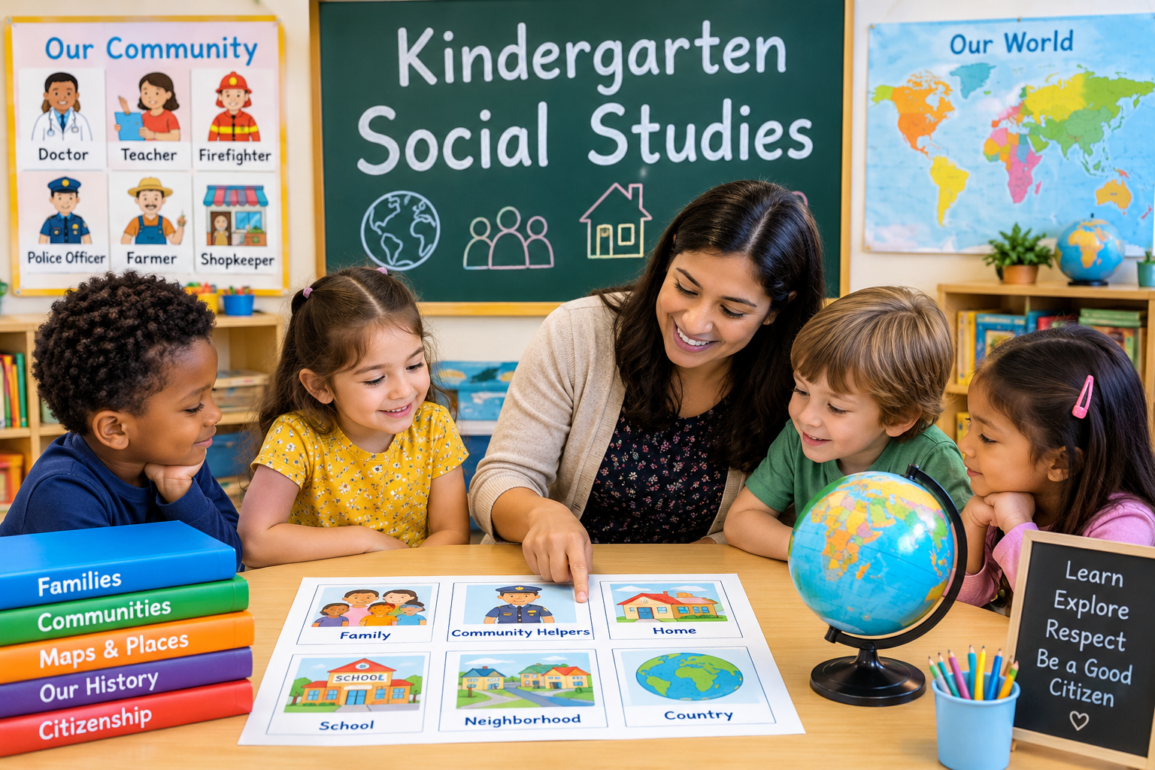
At this age, children learn best through experiences rather than lengthy explanations. For example, a discussion about family members can introduce relationships and responsibilities. A classroom activity about community helpers can explain why teachers, doctors, firefighters, and police officers are important.
The purpose of kindergarten social studies is to develop awareness and understanding through simple, age-appropriate lessons. Children begin recognising similarities and differences between people while learning that cooperation and kindness make communities stronger.
These early experiences also prepare students for more advanced social studies topics in primary school.
Why Is Social Studies Important in Kindergarten?
Social studies plays an important role in helping children develop beyond basic academic skills. It connects classroom learning with real-life experiences and teaches students how to become thoughtful members of their communities.
1. Develops Social Awareness
Children gradually learn that they are part of different groups, including families, classrooms, neighbourhoods, and communities. Kindergarten social studies helps them understand how these groups work and why people depend on one another.
For example, students can discuss how family members support each other or how classmates cooperate during group activities. These conversations introduce the importance of relationships and shared responsibilities.
2. Encourages Respect for Differences
Every child comes from a unique background. Families may speak different languages, celebrate different traditions, and follow different daily routines.
Through kindergarten social studies, teachers can introduce cultural diversity in a positive and welcoming way. Children learn that differences are normal and that everyone deserves kindness and respect.
3. Builds Communication Skills
Classroom conversations encourage children to express their thoughts, describe personal experiences, and listen to others. These activities improve vocabulary and help students communicate more confidently.
When children discuss their families, favourite places, or community activities, they practise speaking while learning to understand different viewpoints.
4. Introduces Responsibility
Young learners need opportunities to understand that their actions affect other people. Lessons about classroom rules, sharing, cleanliness, and helping others introduce the meaning of responsibility.
These simple ideas form the foundation of responsible behaviour and positive citizenship.
Main Topics Covered in Kindergarten Social Studies
A well-planned kindergarten curriculum introduces several important subjects through familiar examples and interactive learning experiences.
Families and Relationships
Family is one of the first social groups children experience. Lessons about families help students understand relationships, responsibilities, and the different ways people care for one another.
Teachers can invite students to describe family activities, discuss household responsibilities, or draw pictures of people who support them. It is important to recognise that families come in different forms and that every child’s family experience may be unique.
Kindergarten social studies uses these discussions to develop belonging, appreciation, and emotional awareness.
Community Helpers
Communities depend on people who perform different jobs and provide essential services. Children can learn about doctors, nurses, teachers, farmers, firefighters, shopkeepers, and other workers.
Teachers can explain what these professionals do and how their work helps others. Pretend-play activities are particularly useful because children can act as doctors, teachers, or shopkeepers.
This approach makes kindergarten social studies more practical while introducing the connection between occupations and community needs.
Geography and Places
Geography helps children recognise the places where they live, learn, and play. At the kindergarten level, lessons should focus on simple concepts such as homes, schools, parks, roads, and neighbourhoods.
Children can identify familiar locations through pictures, drawings, maps, and classroom discussions. Teachers may also introduce basic directional words such as near, far, left, and right.
These activities develop spatial awareness and help children understand their surroundings.
History and Past Experiences
Young children can begin understanding history by comparing past and present experiences. Teachers might discuss how toys, clothing, transportation, or communication methods have changed over time.
Family photographs and old household objects can provide useful examples. Children may also share memories of birthdays, holidays, or their first day at school.
Kindergarten social studies introduces the idea that people and communities change over time.
Rules and Citizenship
Every community has rules that help people live and work together safely. Children can learn why classroom rules matter and how following them creates a positive learning environment.
Teachers can introduce concepts such as taking turns, respecting personal space, listening carefully, and keeping shared areas clean.
These lessons help students understand that citizenship begins with everyday actions.
Engaging Kindergarten Social Studies Activities
Practical activities make social studies easier to understand because children can connect new information with something they already know.
Create a Community Helpers Corner
Set up a classroom area with toy medical equipment, uniforms, books, and other pretend-play materials. Allow children to take turns acting as different community workers.
During the activity, ask questions about each occupation and its importance. This helps students understand how different people contribute to society.
Draw a Family Picture
Ask children to draw the people who care for them or are important in their lives. They can explain their pictures and describe activities they enjoy doing together.
This kindergarten social studies activity encourages self-expression and introduces family relationships in a comfortable way.
Make a Simple Classroom Map
Give students paper and crayons to draw their classroom, including desks, doors, windows, and reading areas.
Discuss where different objects are located and introduce basic direction words. This activity connects geography with a familiar environment.
Explore Cultural Traditions
Invite children to learn about different celebrations, foods, clothing, music, and customs. Teachers can use picture books and classroom materials to introduce traditions from different communities.
The goal is to develop curiosity and appreciation rather than expecting children to memorise cultural information.
Practise Classroom Citizenship
Create small responsibilities such as distributing books, organising supplies, watering classroom plants, or helping clean shared spaces.
These tasks demonstrate how individual contributions support a group. They also make kindergarten social studies relevant to children’s everyday experiences.
How Teachers Can Make Social Studies More Effective
Teaching young children requires creativity, patience, and an understanding of their developmental needs. Lessons should be interactive, visually engaging, and connected to real-life situations.
Use Stories and Picture Books
Stories help children understand unfamiliar ideas through relatable characters and situations. Teachers can select books about friendship, families, communities, cultural traditions, and helping others.
After reading, they can ask simple questions about the characters’ decisions and actions.
Include Group Discussions
Short conversations allow children to share experiences and learn from classmates. Questions such as “Who helps keep our neighbourhood safe?” or “Why should we share?” encourage participation.
Teachers should give every child an opportunity to contribute without making anyone feel uncomfortable.
Connect Lessons With Everyday Life
Children understand concepts more easily when they see them in familiar situations. A walk around the school, a discussion about local shops, or an observation of school workers can turn ordinary experiences into valuable learning opportunities.
This is one of the most effective ways to teach kindergarten social studies because it connects classroom concepts with the real world.
Encourage Questions
Young children naturally ask questions about people, places, and events. Teachers should encourage this curiosity by providing clear explanations and allowing students to explore simple answers.
Open-ended questions also help develop independent thinking.
Skills Children Develop Through Social Studies
Social studies supports several important areas of early childhood development. These skills contribute to children’s academic progress and their ability to interact positively with others.
Critical thinking: Children begin comparing information, recognising patterns, and understanding simple cause-and-effect relationships.
Cooperation: Group projects and shared activities teach students how to work with others, take turns, and achieve common goals.
Cultural awareness: Children develop an appreciation for different traditions, languages, experiences, and family backgrounds.
Communication: Discussions, storytelling, and presentations improve listening, speaking, and vocabulary skills.
Problem-solving: Everyday classroom situations help children consider possible solutions and understand the consequences of their actions.
Kindergarten social studies brings these skills together through meaningful learning experiences that support children’s overall development.
How Parents Can Support Social Studies at Home
Learning about society does not need to stop when children leave school. Parents and caregivers can introduce social studies through simple activities at home and in the neighbourhood.
Conversations about family traditions, household responsibilities, and community activities help children understand their surroundings. Parents can also discuss different occupations when visiting shops, parks, hospitals, or other public places.
Reading picture books about communities and different cultures provides another useful learning opportunity. Children can ask questions, describe what they notice, and connect stories with their own experiences.
Parents can also encourage children to participate in age-appropriate household tasks, such as organising toys, helping prepare simple meals, or keeping personal spaces tidy.
These experiences reinforce kindergarten social studies lessons and demonstrate how cooperation and responsibility work in everyday life.
Common Challenges in Teaching Kindergarten Social Studies
Although social studies offers many learning benefits, teachers may face challenges when introducing these topics to young children.
One common challenge is maintaining attention. Kindergarten students often find lengthy explanations difficult to follow. Teachers can address this issue by dividing lessons into shorter activities and using stories, pictures, games, and demonstrations.
Another challenge involves differences in children’s backgrounds and experiences. Some students may have limited knowledge of particular community roles, traditions, or places. Teachers should introduce concepts gradually and avoid assuming that every child shares the same experiences.
Limited classroom resources can also affect lesson planning. However, teachers can use drawings, recycled materials, storytelling, classroom objects, and role-playing to create effective learning experiences.
A thoughtful approach makes kindergarten social studies accessible to children with different learning needs and backgrounds.
How to Assess Children’s Social Studies Learning
Assessment helps teachers understand whether students are developing the knowledge and skills introduced during lessons. At the kindergarten level, evaluation should focus more on participation, understanding, and practical application than formal examinations.
Teachers can observe how children interact during group activities, identify community helpers, recognise familiar places, and explain basic classroom rules.
Drawing assignments, storytelling, simple matching games, and classroom conversations can also provide useful information about children’s progress.
For example, students might draw a community and explain what different people do. Their responses can show whether they understand how individuals contribute to a shared environment.
Regular observation allows teachers to identify areas where children may need additional support while recognising their individual achievements.
Conclusion
Early childhood education provides an important opportunity to help children understand themselves, their relationships, and the communities around them. Kindergarten social studies introduces these ideas through familiar experiences, interactive activities, stories, and meaningful classroom discussions. It teaches children about families, community helpers, geography, history, cultural diversity, and responsible citizenship.
By including engaging lessons and practical experiences, teachers can develop communication, cooperation, critical thinking, and social awareness. Parents can strengthen this learning through everyday conversations and activities at home.
Most importantly, kindergarten social studies helps young learners recognise that everyone has a place in society and that kindness, respect, and responsibility make communities better. These early lessons create a strong foundation for becoming informed, considerate, and confident members of the wider world.
Frequently Asked Questions (FAQs)
1. What is kindergarten social studies?
Kindergarten social studies is an early learning subject that introduces children to families, communities, culture, geography, history, and citizenship through simple and interactive lessons.
2. Why do kindergarten students need social studies?
It helps children understand their surroundings, respect differences, develop social skills, practise responsibility, and learn how people work together in communities.
3. What are some kindergarten social studies topics?
Common topics include family relationships, community helpers, neighbourhoods, maps, cultural traditions, historical changes, classroom rules, and citizenship.
4. How can teachers make social studies fun?
Teachers can use storytelling, role-playing, drawing, classroom maps, group discussions, pretend-play activities, and community exploration to make lessons interesting.
5. How can parents teach social studies at home?
Parents can discuss family traditions, introduce different occupations, visit community places, read educational books, and encourage children to participate in simple household responsibilities.