
Introduction
Learning numbers is one of the first steps in a child’s mathematical journey. Before children can solve addition problems, compare quantities, or understand basic calculations, they need to recognize numbers and connect them with real objects. A knowing numbers sheet provides a simple and engaging way to develop these essential skills. It allows children to identify numerals, count objects, trace numbers, and practice writing them independently.
Parents and teachers can use a knowing numbers sheet to introduce mathematical concepts in a structured and enjoyable manner. These learning resources are suitable for preschoolers, kindergarten students, and children who need extra practice with early numeracy. With colorful illustrations, clear instructions, and age-appropriate activities, children can gradually build confidence in mathematics.
What Is a Knowing Numbers Sheet?
A knowing numbers sheet is an educational worksheet designed to help children understand, recognize, and use numbers. Depending on the child’s age and learning level, it may include number identification, counting exercises, tracing activities, matching games, and simple number sequences.
For example, a worksheet may ask children to identify the number 4, count four stars, trace the numeral, and connect it with a group containing four objects. These activities help children understand that numbers represent specific quantities rather than simply being symbols on a page.
A knowing numbers sheet can also introduce the relationship between spoken number names, written numerals, and physical objects. When children practice these connections repeatedly, they develop a stronger foundation for more advanced mathematical learning.
Why Learning Numbers Early Matters
Building Number Recognition
Number recognition helps children identify numerals quickly and accurately. When children see numbers regularly in books, worksheets, toys, and everyday situations, they become more familiar with their shapes and meanings.
A knowing numbers sheet provides repeated opportunities to recognize numbers from zero to ten and eventually expand to larger numbers. Children can point to a requested numeral, circle matching numbers, or select the correct answer from several choices.
This practice also helps children distinguish between numerals that look similar, such as 6 and 9. Consistent exposure and gentle correction can improve their accuracy over time.
Developing Counting Skills
Counting involves more than saying numbers in order. Children must learn to assign one number to each object and understand that the final number represents the total quantity.
A knowing numbers sheet can support this process through pictures of fruits, animals, toys, shapes, and other familiar objects. Children count each item and choose the corresponding numeral.
For instance, a worksheet showing five apples encourages children to count the objects individually before identifying the number five. Such exercises strengthen counting accuracy and help children connect abstract mathematical symbols with visible quantities.
Improving Writing and Fine Motor Skills
Writing numbers requires children to coordinate their hands, fingers, and visual attention. Tracing activities help them become familiar with the correct direction and shape of each numeral.
A knowing numbers sheet with dotted numbers gives children a guide to follow as they practice writing. Once they feel comfortable tracing, they can try copying numbers independently.
These activities also strengthen pencil control, hand coordination, and concentration. However, children should receive enough time to practice without feeling pressured to produce perfect handwriting immediately.
Essential Activities to Include in a Knowing Numbers Sheet
Number Tracing and Writing
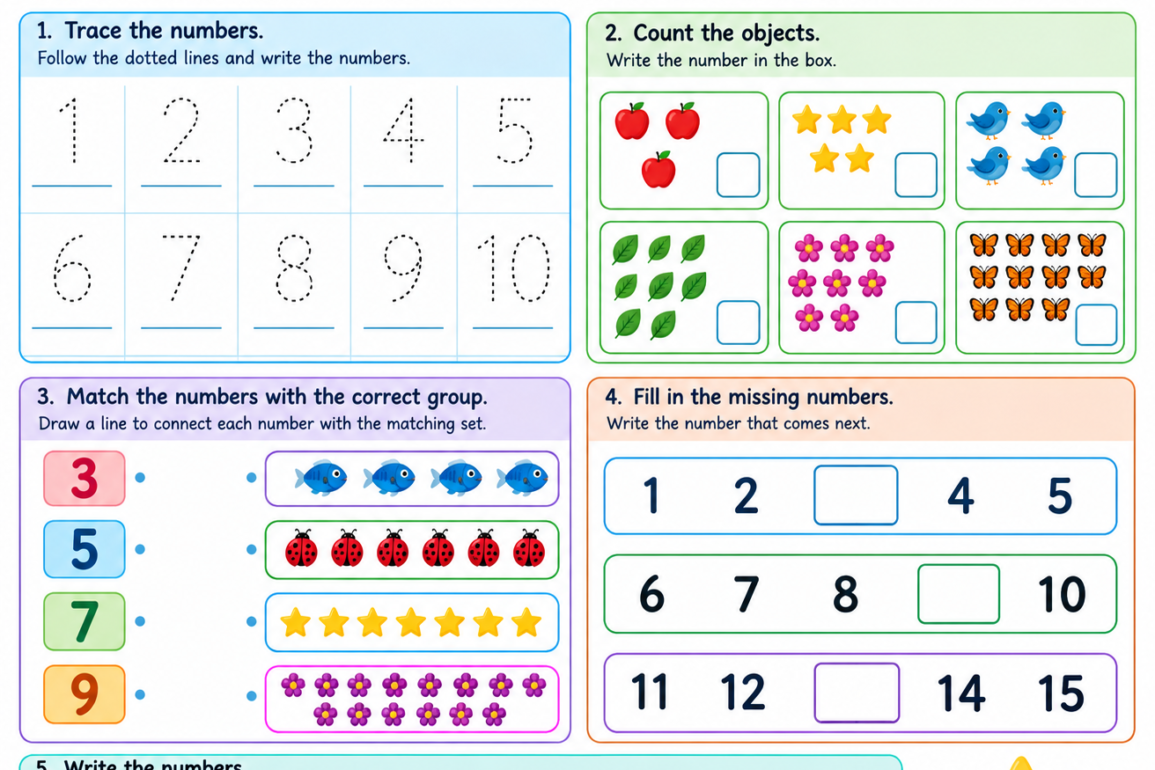
Number tracing is a useful starting point for young learners who are developing early writing skills. Worksheets can display large numerals with dotted outlines that children follow using a pencil or crayon.
After tracing each number, children can write it independently in an empty box. A knowing numbers sheet that combines tracing and independent writing allows children to move gradually from guided practice to greater independence.
Teachers should demonstrate how to form each numeral before asking children to complete the activity. Short practice sessions can help children remain interested and avoid unnecessary frustration.
Counting Objects
Counting activities make mathematics more concrete and understandable. Worksheets can include pictures of balls, flowers, birds, or building blocks that children count before selecting a matching number.
A knowing numbers sheet with visual counting exercises can accommodate different learning levels. Beginners might count one to five objects, while more experienced learners can count ten or twenty.
Parents can extend these activities by asking children to count real objects around the house. Counting spoons, books, or toy cars reinforces the same concepts beyond the worksheet.
Matching Numbers With Quantities
Matching exercises teach children that a written numeral corresponds to a particular quantity. A worksheet might show the number 3 on one side and several groups of objects on the other.
Children draw lines between the numeral and the correct group. A knowing numbers sheet with matching activities encourages visual comparison, careful counting, and independent decision-making.
Teachers can make the exercise more challenging by including groups with similar quantities. For example, children may need to distinguish between four and five objects rather than selecting between groups that look very different.
Missing Number Sequences
Number sequences introduce children to mathematical order. A simple worksheet might display 1, 2, __, 4, 5, asking children to identify the missing numeral.
A knowing numbers sheet featuring missing numbers helps learners understand what comes before and after a given number. Once children master short sequences, teachers can introduce longer patterns and backward counting.
These exercises prepare students for addition, subtraction, and other concepts that depend on understanding numerical order.
How to Use a Knowing Numbers Sheet at Home
Parents do not need specialized teaching equipment to help children learn numbers. A quiet space, a pencil, and an appropriate worksheet can provide a useful starting point.
Begin by selecting a knowing numbers sheet that matches your child’s current ability. If the child is learning numbers for the first time, start with zero to five before introducing larger quantities. Explain the activity in simple language and demonstrate one example.
Allow the child to complete the remaining questions independently while offering assistance when necessary. Instead of immediately giving the correct answer, ask guiding questions such as, “How many objects can you count?” or “Which number comes after two?”
Keep practice sessions short enough to maintain interest. Some children may benefit from five to ten minutes of focused practice, while others may prefer slightly longer sessions. Adapt the duration to the child’s attention and comfort level.
Praise effort, persistence, and improvement rather than focusing exclusively on correct answers. Positive encouragement helps children view mathematics as a skill they can develop through practice.
How Teachers Can Use Number Worksheets in Classrooms
Teachers can incorporate number worksheets into classroom routines, mathematics centers, small-group activities, and individual learning sessions. A knowing numbers sheet can serve as an introduction to a lesson, a guided practice resource, or a short review activity.
For example, a teacher may begin by displaying the number seven and asking students to identify it. The class can then count seven classroom objects before completing a worksheet that reinforces the same concept.
Group activities can make number learning more interactive. Students might work together to match numerals with picture cards, compare quantities, or identify missing numbers on a classroom chart.
Teachers should also observe how children approach the exercises. Some learners may recognize numerals but struggle to count accurately, while others may count confidently but have difficulty writing numbers. Identifying these differences allows educators to provide more targeted support.
A knowing numbers sheet can also help teachers monitor progress over time. Comparing completed worksheets can reveal improvements in number recognition, counting accuracy, and writing control.
Choosing the Right Knowing Numbers Sheet
Not every worksheet suits every child. The most useful resource matches the learner’s developmental stage, provides clear instructions, and introduces concepts at a manageable pace.
For preschool children, choose worksheets with large numerals, simple pictures, and a limited number of questions. Kindergarten students may benefit from activities involving number sequences, matching, tracing, and counting quantities up to twenty.
Children who already recognize basic numerals may need more challenging exercises, such as comparing numbers, identifying missing values, or counting larger groups.
A good knowing numbers sheet should have enough space for children to write comfortably. Its pictures should support learning rather than distract from the task. Clear layouts and uncluttered pages make it easier for young learners to concentrate.
Printable worksheets can be particularly convenient because parents and teachers can reuse them for revision. Digital activities may also be helpful when they provide clear feedback and encourage children to participate actively.
Common Mistakes to Avoid
One common mistake is introducing too many numbers at once. Children need time to recognize each numeral and connect it with a quantity. Teaching a smaller group of numbers thoroughly is often more effective than rushing through a large sequence.
Another mistake is relying entirely on written worksheets. Although a knowing numbers sheet offers valuable practice, children should also count physical objects, play number games, and identify numbers in their surroundings.
Parents should avoid comparing one child’s progress with another’s. Children develop early mathematical skills at different rates, and some need additional repetition before mastering a concept.
It is also important to correct errors patiently. If a child confuses two numerals, demonstrate their differences and provide another opportunity to practice. Mistakes are a normal part of learning and can help adults identify which skills require further attention.
Finally, avoid turning every activity into a test. A relaxed learning environment encourages curiosity and allows children to build confidence without unnecessary pressure.
Ways to Make Number Learning More Enjoyable
Children often learn effectively when activities connect with play and everyday experiences. Parents can combine a knowing numbers sheet with simple games to reinforce classroom learning.
For example, ask children to find three red objects in a room or bring four building blocks to the table. These practical tasks demonstrate how numbers describe quantities in daily life.
Number songs, counting rhymes, puzzles, and picture books can provide additional opportunities for repetition. Children can also practice forming numerals using playdough, drawing them in sand, or arranging small objects into number shapes.
Reward systems may encourage participation, but rewards do not need to involve prizes. Verbal encouragement, displaying completed work, or allowing children to choose the next activity can be equally motivating.
The goal is to make number practice meaningful, varied, and appropriate for the child’s abilities.
Conclusion
Early number learning creates the foundation for future mathematical success. Children who understand number recognition, counting, and numerical order are better prepared to explore addition, subtraction, measurement, and problem-solving.
A knowing numbers sheet provides a practical way to introduce these concepts through tracing, matching, counting, and sequencing activities. When parents and teachers combine worksheets with hands-on experiences, patient guidance, and regular practice, children can develop stronger numeracy skills and greater confidence.
The most effective approach focuses on steady progress rather than perfection. Choose suitable activities, celebrate small achievements, and give children opportunities to use numbers in everyday situations. With consistent encouragement, a knowing numbers sheet can become a valuable part of an enjoyable and effective early mathematics routine.
Frequently Asked Questions
1. What is a knowing numbers sheet used for?
A knowing numbers sheet helps children recognize numerals, count objects, trace numbers, match quantities, and understand numerical order. It supports early mathematics learning at home and in school.
2. What age is suitable for number worksheets?
Many children can begin simple number activities around ages three to four, depending on their development and interest. More advanced worksheets are suitable for kindergarten and early primary school students.
3. How often should children practice numbers?
Short, regular practice sessions are generally useful. Parents can introduce number activities several times a week and adjust the frequency according to the child’s interest, attention, and learning needs.
4. Can number worksheets improve counting skills?
Yes. Worksheets that connect numerals with pictures and quantities can reinforce counting skills. Combining them with real objects and interactive games provides additional practice.
5. Where can parents find printable number worksheets?
Parents can explore educational websites, preschool learning platforms, teacher resource libraries, and printable activity collections. Choose age-appropriate worksheets with clear instructions and activities that match the child’s current abilities.