


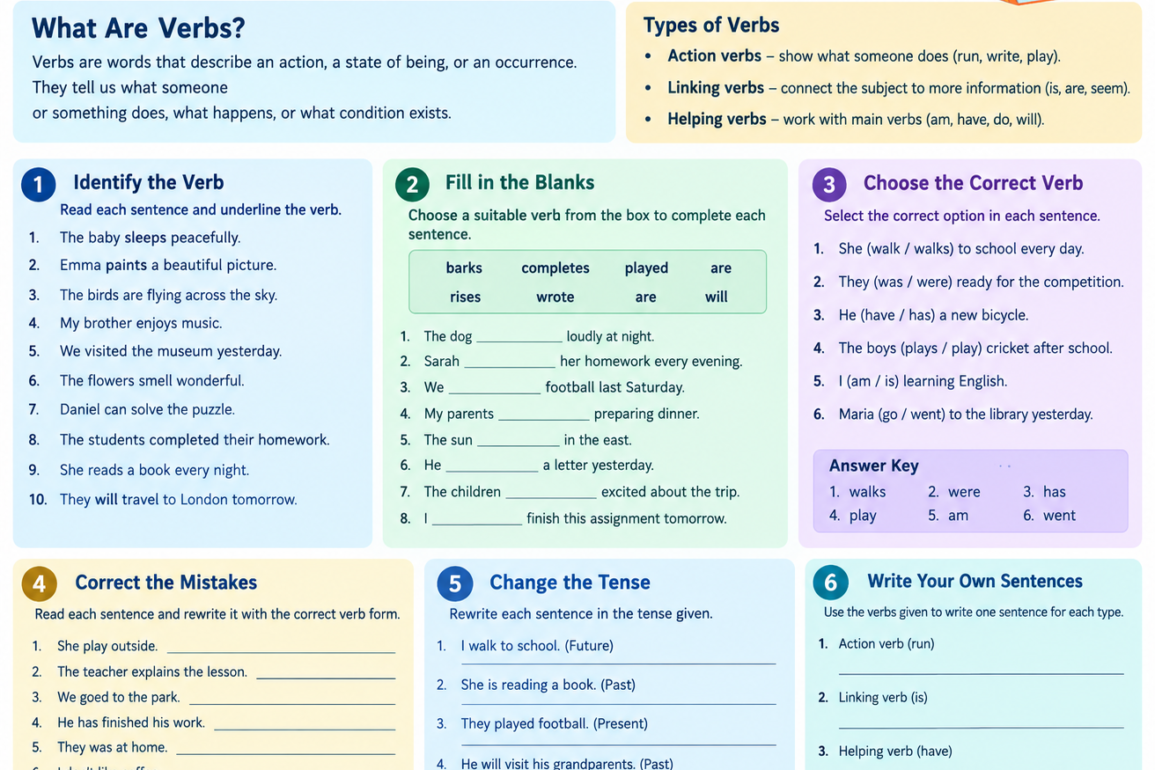
Understanding verbs is an essential part of learning English grammar. Verbs help us describe actions, express feelings, explain situations, and communicate ideas clearly. Whether a student is learning to write simple sentences or improving advanced grammar skills, regular practice can make a significant difference. A verbs worksheet provides a practical way to recognize verbs, understand their functions, and use them correctly in different sentences.
Students often find grammar easier when they can apply rules to real examples instead of memorizing definitions. Worksheets offer opportunities to identify action words, distinguish helping verbs from main verbs, practise verb tenses, and correct common mistakes. Teachers can use these activities in classrooms, while parents can introduce them during home learning sessions. With suitable exercises and clear explanations, learners can develop stronger writing skills and greater confidence in English.
What Is a Verb in English Grammar?
A verb is a word that describes an action, a state of being, or an occurrence. It tells readers what someone or something does, what happens, or what condition exists. Without verbs, most complete sentences would lack essential information.
Consider the sentence, “The children play outside.” The word “play” is the verb because it describes what the children do. In “She feels happy,” the word “feels” describes a state. Similarly, “The weather became colder” uses “became” to describe a change.
A verbs worksheet introduces these basic concepts through short sentences and practical questions. Students learn to locate verbs, understand their meanings, and recognize how they contribute to sentence structure.
Why Are Verbs Important?
Verbs allow people to explain events, describe experiences, and communicate information accurately. They also help establish when an action happens. For example, “I walk to school,” “I walked to school,” and “I will walk to school” communicate present, past, and future time.
Learning verbs also improves reading comprehension. When students identify the main verb in a sentence, they can understand the action or condition being described. Regular exercises help them apply these skills in conversations, school assignments, and creative writing.
Different Types of Verbs Students Should Learn
English contains several categories of verbs. Understanding their differences helps learners construct meaningful sentences and avoid common grammatical errors.
Action Verbs
Action verbs describe physical or mental activities. Examples include run, jump, write, think, imagine, and remember. Some actions are visible, while others occur in the mind.
In the sentence “Ali writes a letter,” the verb “writes” identifies the action. In “Maya remembers the answer,” the verb “remembers” expresses a mental activity.
A verbs worksheet can ask students to underline action verbs in sentences or select suitable verbs to complete short paragraphs. These activities help learners recognize actions in different contexts.
Linking Verbs
Linking verbs connect a subject with information that describes or identifies it. Common examples include am, is, are, was, were, seem, become, and feel.
For instance, “The soup smells delicious” uses “smells” to connect the soup with its description. The sentence does not describe the soup performing an action; instead, it explains one of its characteristics.
Students should learn that some verbs can function differently depending on context. The word “feel” can describe a condition in “I feel tired” or a physical action in “I feel the fabric.”
Helping Verbs
Helping verbs work with main verbs to express tense, possibility, ability, or other grammatical meanings. Common helping verbs include am, is, are, was, were, have, has, had, do, does, did, will, can, and should.
In “She is reading a book,” the word “is” helps the main verb “reading.” In “They have completed the task,” the word “have” helps express the present perfect tense.
Practice exercises can ask learners to identify both the helping verb and the main verb in each sentence. This distinction becomes particularly useful when students begin studying more complex grammar.
How a Verbs Worksheet Supports Learning
A well-designed worksheet turns grammar lessons into active learning experiences. Rather than simply reading explanations, students answer questions, correct errors, and apply rules independently.
One important benefit is improved identification. Students learn to distinguish verbs from nouns, adjectives, and other parts of speech. Another benefit is better sentence construction because learners practise choosing verbs that match their subjects and intended meanings.
A verbs worksheet also supports independent study. Students can complete exercises at their own pace, review mistakes, and repeat activities until they understand the concepts. Teachers can use the results to identify areas that require additional instruction.
Worksheets become more effective when they progress from simple identification tasks to more challenging activities. Beginners might underline action words, while advanced learners might correct tense errors or rewrite complete paragraphs.
Common Verb Exercises for Students
Different exercise formats allow students to practise individual skills without becoming overwhelmed. Teachers can combine several activities to create balanced grammar lessons.
Exercise 1: Identify the Verb
Read each sentence and identify the verb.
- The baby sleeps peacefully.
- Emma paints a beautiful picture.
- The birds are flying across the sky.
- My brother enjoys music.
- We visited the museum yesterday.
- The flowers smell wonderful.
- Daniel can solve the puzzle.
- The students completed their homework.
These questions encourage students to examine each sentence carefully. Some sentences contain helping verbs as well as main verbs, so learners should identify both where appropriate.
Exercise 2: Fill in the Blanks
Choose a suitable verb to complete each sentence.
- The dog _____ loudly at night.
- Sarah _____ her homework every evening.
- We _____ football last Saturday.
- My parents _____ preparing dinner.
- The sun _____ in the east.
- He _____ a letter yesterday.
- The children _____ excited about the trip.
- I _____ finish this assignment tomorrow.
Possible answers include barks, completes, played, are, rises, wrote, are, and will. Some sentences may accept different answers depending on the intended meaning and context.
A verbs worksheet using fill-in-the-blank questions helps students select appropriate verbs and recognize grammatical patterns. Teachers can make these exercises more challenging by providing a word bank with similar-looking or easily confused options.
Exercise 3: Choose the Correct Verb
Select the correct option in each sentence.
- She (walk/walks) to school every day.
- They (was/were) ready for the competition.
- He (have/has) a new bicycle.
- The boys (plays/play) cricket after school.
- I (am/is) learning English.
- Maria (go/went) to the library yesterday.
Answer key: 1. walks, 2. were, 3. has, 4. play, 5. am, 6. went.
These questions teach students to match verbs with subjects and recognize past-tense forms. They also reinforce the importance of reading an entire sentence before choosing an answer.
Understanding Verb Tenses
Verb tenses indicate when an action or situation occurs. The three basic time references are present, past, and future. Each category includes different forms that express whether an action is habitual, completed, ongoing, or connected to another event.
Present Tense
The simple present tense describes habits, general truths, and repeated activities. Examples include “Birds fly,” “She reads every night,” and “Water boils at high temperatures.”
Students should remember that third-person singular subjects usually require an -s or -es ending in the simple present. For example, “He watches television” is correct, while “He watch television” is incorrect in standard English.
Past Tense
The simple past tense describes completed actions. Regular verbs often form the past tense by adding -ed, as in “walked,” “cleaned,” and “helped.” However, irregular verbs follow different patterns. For example, go becomes went, eat becomes ate, and write becomes wrote.
A verbs worksheet can help students practise both regular and irregular forms through sentence completion, matching activities, and short writing tasks.
Future Tense
The simple future commonly uses “will” followed by the base form of a verb. For example, “We will visit our grandparents tomorrow.”
Learners can practise changing present-tense sentences into future-tense statements. This activity helps them understand how small changes in verb structure communicate different time references.
Common Verb Mistakes and How to Avoid Them
Students sometimes use incorrect verb forms because English grammar includes several rules and exceptions. Understanding these mistakes makes practice more productive.
One common error involves subject-verb agreement. A singular subject generally takes a singular verb form in the simple present, while a plural subject usually takes the base form. For example, “The teacher explains the lesson” and “The teachers explain the lesson” are correct.
Another frequent mistake involves irregular past-tense verbs. Students may write “goed” instead of “went” or “eated” instead of “ate.” Reading examples and practising these forms regularly can improve accuracy.
Learners also sometimes confuse helping verbs with main verbs. In “She has finished her work,” “has” is the helping verb, while “finished” is the main verb. Recognizing both parts helps students understand sentence structure.
Teachers can include error-correction questions in a verbs worksheet to address these problems directly. Students should explain why an answer is incorrect rather than simply replacing it with the right form.
Tips for Teachers and Parents
Effective grammar practice should match the learner’s age, reading level, and current understanding. Young children benefit from familiar examples involving family members, animals, toys, and daily routines. Older students can work with longer sentences, irregular verbs, and more advanced tense structures.
Begin with a short explanation and demonstrate two or three examples before asking students to work independently. This approach gives learners a clear model to follow without completing every question for them.
Use feedback to explain mistakes in a supportive way. If a student writes “She play outside,” explain that the simple present tense usually requires “plays” with a third-person singular subject. Then provide another example for independent practice.
A verbs worksheet can also become more engaging when paired with reading passages, classroom games, storytelling, or sentence-building activities. Encourage students to create their own examples after finishing the questions. This additional step helps them transfer grammar knowledge into everyday communication.
How to Check Progress After Completing a Worksheet
Checking answers is an important part of learning. Students should compare their responses with an answer key, identify incorrect answers, and review the rules behind their mistakes.
Teachers can evaluate progress by observing whether learners identify verbs accurately, choose appropriate tense forms, and maintain subject-verb agreement. Repeating a similar exercise after a few days can show whether students have retained the information.
A useful strategy is to maintain a small list of difficult verbs. Students can record the base form, past form, and past participle of irregular verbs, such as begin, began, begun. Reviewing this list regularly makes it easier to remember challenging forms.
For meaningful improvement, practice should be consistent rather than rushed. Short sessions with clear objectives often help students develop stronger grammar habits over time.
Conclusion
Verbs form the foundation of clear and meaningful English sentences. By learning action, linking, and helping verbs, students can express ideas more accurately and understand how sentences communicate actions, conditions, and time. Regular exercises also improve subject-verb agreement, tense recognition, reading comprehension, and writing confidence.
A carefully prepared verbs worksheet gives learners practical opportunities to apply grammatical rules and recognize areas that need improvement. Teachers and parents can strengthen these benefits by combining written activities with examples, discussion, and independent sentence writing. With consistent practice and helpful feedback, students can build lasting grammar skills that support their academic progress and everyday communication.
Frequently Asked Questions
1. What is a verbs worksheet?
A verbs worksheet is a learning resource that helps students identify verbs, understand their functions, practise verb tenses, and improve sentence construction through grammar exercises.
2. At what age can students start learning verbs?
Children can begin learning basic action verbs during their early school years. Teachers should introduce more complex verb types and tense rules as students develop their reading and writing abilities.
3. What are the three main types of verbs?
Action verbs describe activities, linking verbs connect subjects with descriptions or identities, and helping verbs work with main verbs to express grammatical information.
4. How can students improve their verb skills?
Students can improve by completing grammar exercises, reading regularly, practising sentence writing, reviewing irregular verbs, and correcting mistakes with an answer key.
5. Why are verb tenses important?
Verb tenses show when actions or situations occur. Using them correctly helps readers understand whether an event happens in the present, occurred in the past, or will happen in the future.