


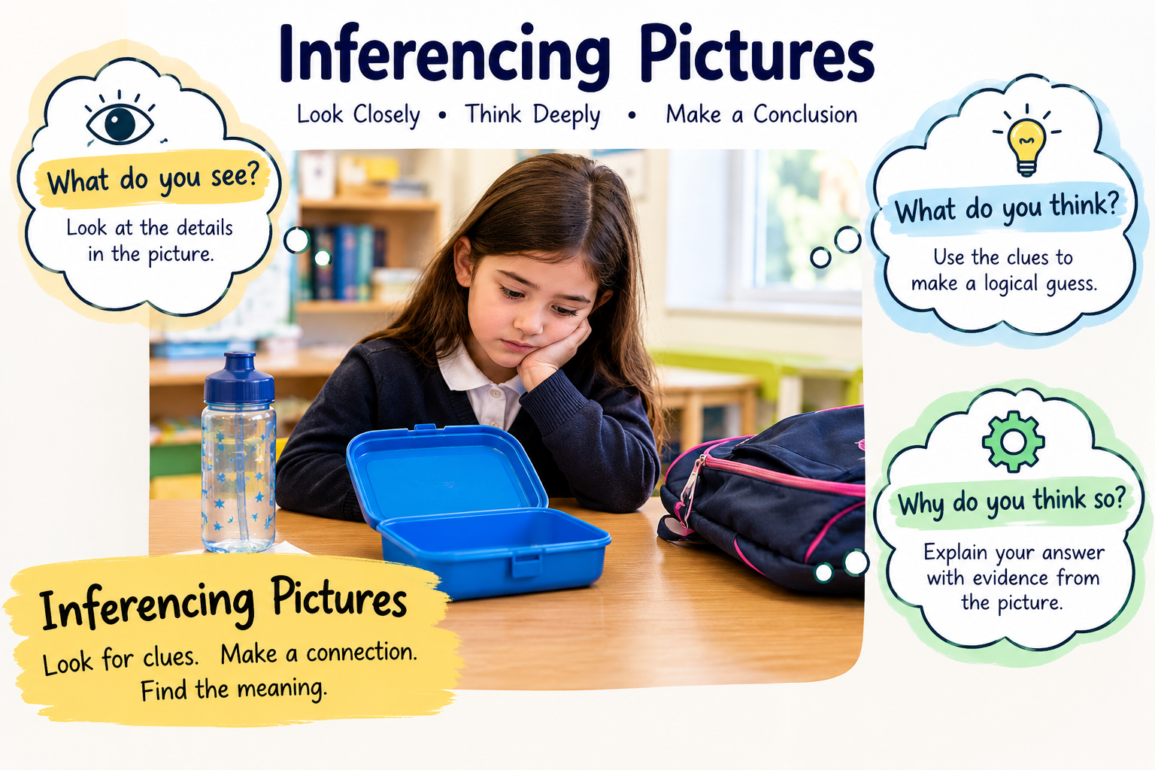
Reading is more than recognizing words on a page. It also involves understanding hidden meanings, interpreting visual clues, and connecting information to what we already know. Inferencing pictures help learners develop these skills by encouraging them to look carefully at an image, identify important details, and make logical conclusions about what might be happening. This approach makes learning more interactive and helps students become thoughtful readers.
Teachers and parents can use inferencing pictures to support reading comprehension, critical thinking, vocabulary development, and communication. From simple classroom illustrations to detailed photographs, these visual resources encourage children to ask questions, examine evidence, and explain their ideas. With regular practice, learners can become more confident when interpreting stories, pictures, and real-life situations.
What Are Inferencing Pictures?
Inferencing pictures are images that encourage viewers to draw conclusions from visual evidence rather than relying on information that an image directly provides. A picture might show a child holding a wet umbrella beside a doorway, for example. The image does not necessarily state that it is raining outside, but viewers can use the umbrella and other visual clues to make that reasonable inference.
The purpose of inferencing pictures is to help learners distinguish between what they can directly observe and what they can reasonably conclude. This distinction is important because a good inference requires evidence. Students should not simply guess what an image means; they should explain which details support their interpretation.
These activities work well for young children, elementary school students, English language learners, and older students who want to improve their analytical reading skills. Educators can adjust the difficulty by choosing images with straightforward clues or more complex situations.
Why Inferencing Pictures Matter in Education
Improving Reading Comprehension
Strong readers often look beyond the literal meaning of a sentence. They use context, background knowledge, and clues to understand what an author implies. Inferencing pictures introduce this process in a visual format before students apply the same thinking to written passages.
For example, a picture of a student looking at an empty lunchbox while classmates eat may suggest that the student forgot lunch or finished it earlier. Students must examine the available evidence and consider possible explanations. This process prepares them to recognize implied meanings when reading stories.
Developing Critical Thinking
Critical thinking involves evaluating information, considering alternatives, and making decisions based on evidence. Inferencing pictures provide an accessible way to practise these skills because learners can examine a scene without needing to understand a complicated written passage.
Students may initially suggest several explanations for the same image. A teacher can encourage them to compare their ideas and identify which explanation has the strongest supporting evidence. This discussion helps students understand that some interpretations are more reasonable than others.
Encouraging Language Development
Visual activities give learners opportunities to describe objects, explain actions, and express opinions. When students discuss inferencing pictures, they practise using complete sentences, descriptive vocabulary, and reasoning phrases such as “I think this because…” or “The picture suggests that…”
These sentence structures are particularly useful for children who are learning English. They can begin with familiar objects and gradually move toward more detailed explanations.
How to Use Inferencing Pictures Effectively
Teachers can make inferencing activities more productive by following a clear process. Students should first observe the image, then identify evidence, connect that evidence to their existing knowledge, and finally explain their conclusions. This sequence helps them develop a repeatable strategy they can use in different learning situations.
Step 1: Observe the Image Carefully
Begin by showing students an image without providing its title or explanation. Give them a few moments to examine the people, objects, expressions, surroundings, and actions. Ask them to describe only what they can see.
For example, they might notice dark clouds, puddles, people carrying umbrellas, and wet roads. At this stage, encourage students to avoid making assumptions. Careful observation gives them a reliable foundation for their reasoning.
Step 2: Identify Visual Clues
Next, ask students to identify the details that might explain the situation. In inferencing pictures, even small details can provide useful information. A broken glass beside a startled child, for instance, may suggest that something has fallen, although the image alone cannot establish exactly how it happened.
Encourage learners to identify two or three clues before sharing their conclusions. This habit helps them avoid unsupported guesses and pay attention to the evidence available.
Step 3: Connect Clues to Background Knowledge
Students use their experiences and existing knowledge to interpret what they see. A person wearing a thick coat and gloves in a snowy landscape may suggest cold weather because learners understand the purpose of warm clothing.
When working with inferencing pictures, remind students that background knowledge should support their conclusions rather than replace visual evidence. Different people may interpret an image differently because their experiences vary.
Step 4: Explain the Inference
Ask students to complete a sentence explaining their reasoning. For example, “I think the family is preparing for a trip because their suitcases are packed and they are standing near the front door.”
This final step turns observation into a clear explanation. It also allows teachers to assess whether students can connect their conclusions to specific details.
Types of Inferencing Pictures for Students
1. Everyday Situations
Everyday scenes show familiar activities, such as getting ready for school, preparing food, or walking through a park. These inferencing pictures are suitable for beginners because students can use familiar experiences to interpret the clues. Teachers can ask what happened before the scene or what might happen next.
2. Facial Expressions and Emotions
Images showing people smiling, frowning, looking worried, or appearing surprised help students infer emotions. They can examine facial expressions, body language, and surrounding events to explain how a character might feel. Remind students that expressions provide clues but do not always reveal a person’s exact feelings.
3. Mystery and Problem-Solving Scenes
Mystery images contain clues that invite learners to investigate an uncertain situation. Muddy footprints, an open window, or an overturned plant pot can encourage students to suggest possible explanations. These inferencing pictures develop logical reasoning because students must evaluate which explanation best fits the evidence.
4. Nature and Environmental Scenes
Natural environments provide clues about weather, seasons, animal behaviour, and changes in surroundings. Students might infer that winter is approaching when they see bare trees, falling leaves, and people wearing warmer clothes. These images connect classroom learning with observation of the world.
Inferencing Pictures Activities for the Classroom
Teachers can turn visual reasoning into an enjoyable classroom activity without requiring expensive materials. A collection of photographs, illustrations, or textbook images is often enough to get started.
What Happened Before and After?
Display an image showing a moment in the middle of an event. Ask students to imagine what might have happened immediately before the scene and what could happen next. For example, a picture of a child standing beside a fallen stack of books may lead students to suggest that the books slipped from a desk.
Students should support their explanations with visible evidence. This activity strengthens sequencing, prediction, and storytelling skills.
Guess the Situation
Show students a picture without revealing its context. Ask them to describe the setting, identify the people involved, and explain what might be happening. Once everyone has shared an idea, invite students to compare their interpretations.
This activity works especially well with inferencing pictures that contain several clues but do not have one obvious explanation. It encourages discussion while helping learners understand that a conclusion should remain open to revision when new evidence appears.
Find the Evidence
Give students an image and a statement, such as “The person is in a hurry.” Ask them to identify details that support or challenge the statement. They might notice someone running, looking at a watch, or carrying an open bag.
This activity teaches students to evaluate claims rather than accept them automatically. Teachers can also introduce statements with insufficient evidence to help students recognize the difference between a reasonable inference and an unsupported assumption.
Write a Short Story
After analysing an image, ask students to write a short paragraph explaining the situation. They can describe what they observe, explain what they believe is happening, and predict the next event.
Using inferencing pictures in writing lessons helps learners organize ideas, develop descriptive language, and connect visual details with written explanations. Teachers can adapt the task to suit different reading and writing abilities.
Examples of Inferencing Pictures Questions
The following questions can help parents and educators guide visual reasoning without immediately revealing an answer.
| Picture situation | Question to ask | Possible inference |
| A child enters with wet shoes and a dripping umbrella. | What might the weather be like outside? | It may be raining. |
| A birthday cake sits on a table surrounded by wrapped presents. | What event might the family be celebrating? | A birthday celebration. |
| A student looks at a clock while putting books into a bag. | What might the student be preparing to do? | Leave for school or another activity. |
| A dog stands beside an empty food bowl. | What might the dog need? | It may be hungry. |
| Several people wear sunglasses on a bright beach. | What can you infer about the conditions? | The weather may be sunny. |
These examples demonstrate how inferencing pictures connect observable details with reasonable conclusions. However, the suggested answers are possibilities rather than guaranteed facts. A student may offer another explanation if they can support it with relevant evidence.
How Parents Can Practise Inferencing at Home
Parents do not need special teaching equipment to help children develop inference skills. Everyday photographs, picture books, magazines, and illustrations provide opportunities to discuss clues and possible explanations.
During shared reading, pause before explaining what happens next. Ask the child what they think a character might be feeling or why the character made a particular decision. Encourage them to point to details in the illustration that support their ideas.
Parents can also use inferencing pictures during ordinary conversations. A photograph of a crowded playground might prompt questions about the time of day, the activity taking place, or why people gathered there. These short discussions make reasoning a natural part of daily learning.
The most important principle is to encourage explanations rather than simply judge answers as right or wrong. If a child makes an unlikely inference, ask which clues led to that conclusion. This approach builds confidence and helps children improve their reasoning without feeling discouraged.
Common Mistakes to Avoid
One common mistake is treating an inference as a proven fact. An image might suggest that a person is upset, but the viewer cannot know the person’s exact feelings without additional information. Teachers should help students use phrases such as “might be,” “probably,” and “the clues suggest.”
Another mistake is giving students too much information before they examine the image. Providing the answer in advance removes the opportunity to practise independent reasoning. Instead, begin with open-ended questions and allow students enough time to observe.
Educators should also select age-appropriate images. Younger learners benefit from clear, familiar scenes, while advanced students can explore ambiguous situations with multiple possible interpretations. Effective inferencing pictures should challenge students without making the task unnecessarily confusing.
Finally, avoid rewarding only one interpretation when the image genuinely supports several possibilities. Assess the quality of the reasoning, the relevance of the evidence, and the student’s ability to explain the connection between them.
Frequently Asked Questions
What are inferencing pictures used for?
Inferencing pictures help students interpret visual clues, draw logical conclusions, improve reading comprehension, and develop critical-thinking skills. Teachers can use them in reading, writing, vocabulary, and speaking lessons.
At what age can children start learning inference skills?
Children can begin with simple visual observations in preschool and kindergarten. As they grow, educators can introduce more complex situations that require several clues and deeper reasoning.
How are inferencing pictures different from prediction activities?
Inference involves using available clues and background knowledge to explain something that may not be directly stated. Prediction focuses on what might happen in the future. Both skills overlap, and the same image can support either activity.
Can inferencing pictures help English language learners?
Yes. Images provide context that helps learners understand situations and practise descriptive language. They can also explain their reasoning using sentence starters and familiar vocabulary before progressing to more complex responses.
How can teachers assess students’ inference skills?
Teachers can assess whether students identify relevant visual clues, make reasonable conclusions, explain their thinking, and consider alternative interpretations. Short written responses and classroom discussions provide useful evidence of progress.
Conclusion
Inferencing pictures provide a practical and engaging way to help students move beyond simple observation toward deeper understanding. By examining visual clues, connecting details to background knowledge, and explaining their conclusions, learners develop skills that support reading comprehension, communication, and critical thinking.
Teachers and parents can make these activities part of everyday learning through classroom illustrations, picture books, photographs, and familiar situations. Start with straightforward images, ask open-ended questions, and gradually introduce more challenging scenes. Most importantly, encourage students to explain the evidence behind their ideas. With consistent practice, inferencing pictures can help learners become more independent, observant, and confident thinkers.