

Introduction
Education involves more than memorizing facts. Students must understand relationships between concepts, recognize important information, and apply their knowledge to different situations. Teachers use various assessment methods to measure these abilities, and matching activities remain a popular choice because they test understanding in a clear and organized format. Matching test questions help learners connect related words, definitions, concepts, dates, names, and explanations.
These questions appear in school examinations, college assessments, online quizzes, professional training programs, and practice worksheets. They can cover subjects such as science, mathematics, history, geography, language, and computer studies. When teachers design them carefully, matching test questions provide an efficient way to assess knowledge while helping students identify areas that need improvement.
Understanding how these assessments work can make preparation easier for both students and teachers. By learning common formats, practicing examples, and using effective answering strategies, learners can improve their accuracy and develop stronger connections between related ideas.
What Are Matching Test Questions?
Matching test questions are assessment items that ask students to connect information in one column with the correct information in another. One column usually contains prompts, while the second contains possible answers. Students must identify which options belong together according to the instructions.
For example, a science teacher might list animal names in one column and their habitats in another. Students then match each animal with the appropriate environment. A history assessment could ask learners to connect historical figures with their achievements, while a vocabulary exercise might pair words with their definitions.
The primary purpose of matching test questions is to determine whether students understand relationships between pieces of information. Unlike questions that require long written explanations, this format allows students to demonstrate knowledge through short, direct responses.
A well-designed matching exercise uses clear instructions, relevant options, and one consistent topic. These features make the assessment easier to understand and help teachers evaluate learning efficiently.
Common Types of Matching Test Questions
Teachers can adapt matching exercises to suit different subjects, learning objectives, and academic levels. The format remains similar, but the information students connect can vary considerably.
Vocabulary and Definition Matching
Vocabulary matching is especially useful in language learning. Students connect words with their meanings, synonyms, antonyms, or appropriate examples. This method helps learners expand their vocabulary and distinguish between similar terms.
For instance, an English teacher might ask students to match “generous” with “willing to give or share.” Such exercises encourage students to remember meanings and recognize how words function in context.
Concept and Explanation Matching
This format tests whether students understand academic concepts. One column presents terms, while the other provides explanations. Science teachers might include concepts such as evaporation, condensation, and precipitation, asking students to connect each term with the correct process.
Matching test questions of this type encourage conceptual understanding rather than simple memorization when the options require students to distinguish between closely related ideas.
Question and Answer Matching
Students receive several short questions and a separate list of possible answers. They must identify the correct response for each question. This approach works well for revision exercises, general knowledge quizzes, and introductory lessons.
Person and Achievement Matching
History, literature, and social studies teachers often connect individuals with their contributions, discoveries, books, or historical roles. This format helps students organize facts and understand the relationships between important people and events.
Image and Label Matching
Visual matching exercises ask learners to connect pictures with names, descriptions, or functions. Teachers may use diagrams of the human body, geographical maps, plant structures, or mathematical shapes. These assessments are particularly useful when visual recognition forms an important part of the learning objective.
Benefits of Matching Test Questions for Students
Matching exercises offer several advantages when teachers use them alongside other assessment methods. Their value extends beyond making examinations shorter or easier to mark.
They Strengthen Memory
Students often remember information more effectively when they actively connect related ideas. Matching a term with its definition requires learners to retrieve information from memory and compare it with available options. Repeated practice can reinforce these connections and make future recall easier.
For example, a student preparing for a biology examination might connect organ names with their functions. Reviewing these relationships regularly can make it easier to remember them during a written test.
They Improve Recognition Skills
Students must distinguish between correct and incorrect associations when completing matching activities. This process helps them recognize similarities, identify differences, and pay attention to details.
Matching test questions can be particularly useful when learners need to differentiate between related concepts, such as weather and climate or mass and weight.
They Save Time During Assessment
Most matching exercises require brief responses rather than lengthy written explanations. Teachers can include several related learning objectives in a relatively short assessment, while students can demonstrate their knowledge without writing complete paragraphs for every item.
However, time efficiency should not replace meaningful assessment. Teachers still need to ensure that the questions measure the intended learning outcomes.
They Help Teachers Identify Learning Gaps
Incorrect matches can reveal misunderstandings that might otherwise remain unnoticed. If several students confuse two scientific processes, for example, the teacher can revisit those concepts before moving to more advanced material.
This feedback makes matching test questions useful for both formal examinations and everyday classroom practice.
How to Answer Matching Test Questions Correctly
A systematic approach can help students complete matching exercises more accurately. Instead of choosing answers randomly, learners should read the instructions, evaluate each option, and verify their final responses.
Read the Instructions Carefully
Start by understanding what each column contains and how many times an answer may be used. Some exercises allow each option only once, while others permit repeated answers. Missing this detail can lead to avoidable mistakes.
Students should also check whether the task involves matching words with meanings, events with dates, or concepts with examples.
Read Both Columns Before Answering
Review the entire list before selecting any matches. This overview helps students identify familiar information and notice relationships between the options.
When students read only the first prompt and immediately choose an answer, they may overlook a better option later in the list. Reading both columns provides a clearer understanding of the available choices.
Begin With the Easiest Matches
Identify the pairs you know with confidence first. Completing familiar matches reduces the number of remaining options and makes difficult items easier to evaluate.
For example, if a vocabulary exercise includes ten words and you recognize six definitions immediately, match those six before examining the remaining four. This process helps organize the task and prevents unnecessary confusion.
Eliminate Incorrect Options
When two or more answers seem possible, remove the options that clearly do not fit. Compare the remaining choices with the meaning of the prompt and look for specific clues.
In matching test questions about geography, a description mentioning a desert climate can help eliminate countries or regions that do not fit the given information. Elimination is especially effective when students understand the subject rather than relying entirely on guessing.
Review Every Pair
After completing the exercise, check each connection again. Confirm that the selected answer fits the prompt and that you have followed the instructions about using options.
If time permits, read each completed pair together. A word and definition should make sense as a combination, just as a historical figure and achievement should form a meaningful relationship.
Examples of Matching Test Questions
The following examples show how matching exercises work across different subjects. Students can use them for revision, while teachers can adapt them for classroom quizzes.
Example 1: English Vocabulary
Match each word with its correct meaning.
| Column A: Word | Column B: Meaning |
| 1. Ancient | A. To make something clear |
| 2. Explain | B. Very old |
| 3. Rapid | C. Moving quickly |
| 4. Honest | D. Truthful |
Answers: 1–B, 2–A, 3–C, 4–D.
This activity tests vocabulary knowledge and the ability to connect words with their definitions.
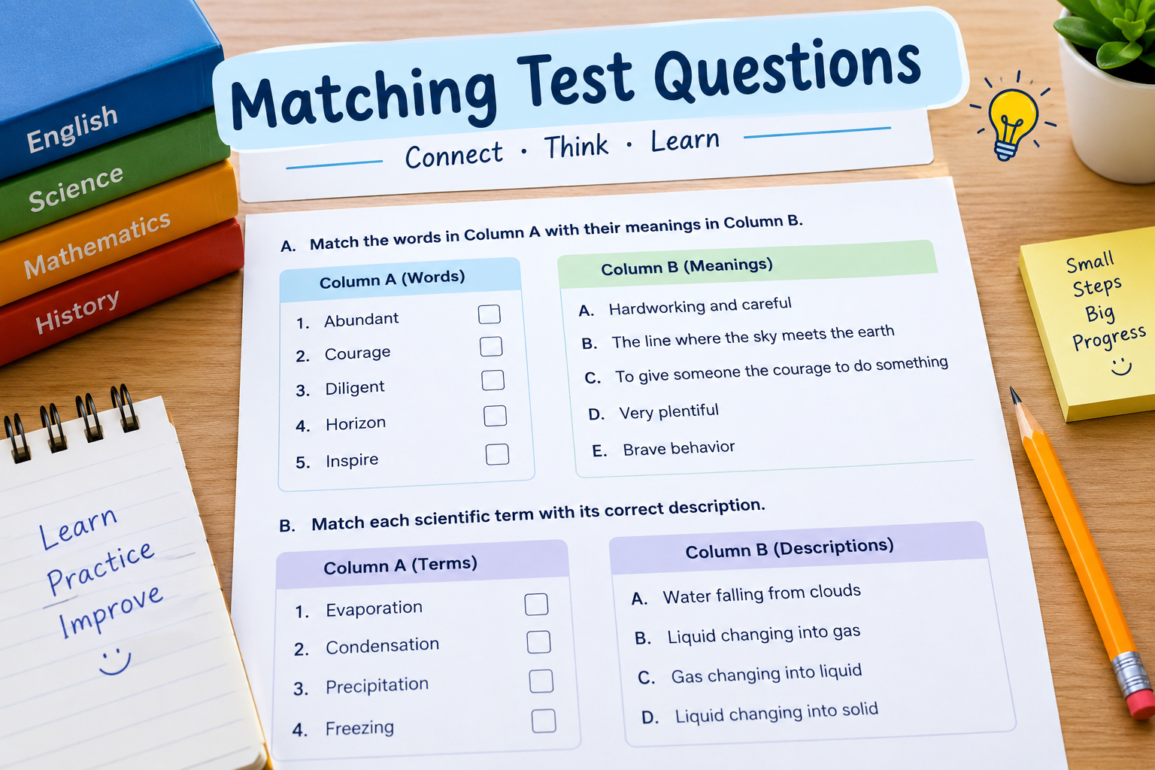
Example 2: Basic Science
Match each scientific term with its correct description.
| Column A: Term | Column B: Description |
| 1. Evaporation | A. Water falling from clouds |
| 2. Condensation | B. Liquid changing into gas |
| 3. Precipitation | C. Gas changing into liquid |
| 4. Freezing | D. Liquid changing into solid |
Answers: 1–B, 2–C, 3–A, 4–D.
These matching test questions help students review the stages and processes associated with changes in water.
Example 3: Mathematics
Connect each mathematical term with the correct description.
| Column A: Term | Column B: Description |
| 1. Triangle | A. A number multiplied by itself |
| 2. Square | B. A shape with three sides |
| 3. Perimeter | C. The distance around a shape |
| 4. Square number | D. A quadrilateral with four equal sides and four right angles |
Answers: 1–B, 2–D, 3–C, 4–A.
This exercise combines mathematical vocabulary with basic geometric knowledge.
How Teachers Can Create Effective Matching Test Questions
Teachers should design assessments around specific learning objectives instead of simply creating lists of facts. A good matching exercise measures knowledge that students have had a reasonable opportunity to learn.
Keep Each Exercise Focused
Use one main topic per exercise whenever possible. Mixing unrelated subjects, such as historical dates, grammar rules, and scientific terms, can make the assessment confusing and reduce its educational value.
Focused matching test questions allow students to concentrate on the relationships the teacher wants to assess.
Use Clear and Consistent Language
Write prompts and answers in straightforward language. Avoid unnecessary details, vague descriptions, and grammatical clues that reveal the correct answer without testing knowledge.
Each item should have a clearly defensible answer. If two options could reasonably match the same prompt, revise the wording to remove the ambiguity.
Include More Answers Than Prompts
Teachers can sometimes include extra answer choices to discourage guessing through elimination alone. For example, a worksheet with five prompts might contain seven possible answers.
Extra options should remain relevant to the subject and should not confuse students through misleading wording. The goal is to assess understanding fairly, not to trick learners.
Match Difficulty to Learning Objectives
Basic exercises may connect familiar words with simple definitions. More advanced assessments can require students to distinguish between similar concepts or apply knowledge to specific examples.
Effective matching test questions should challenge students appropriately while remaining aligned with the course material and expected learning level.
Review the Answer Key
Before distributing an assessment, verify every correct pairing and check that the instructions agree with the answer key. Teachers should also consider whether any distractors could create unintended ambiguity.
A short review can prevent errors that might otherwise confuse students or affect grading.
Common Mistakes to Avoid
Students sometimes lose marks on matching activities even when they understand most of the material. Recognizing common mistakes can help them improve their results.
One frequent mistake is rushing through the instructions. Students may assume that every answer can be used only once, even when the exercise permits repetition. Reading the directions first prevents this problem.
Another mistake is matching options based on familiar words rather than meaning. A term might appear related to a definition without actually describing it. Students should evaluate the complete meaning of each item instead of relying on a single word.
Guessing too early can also cause difficulties. When students select answers before reviewing the entire list, they may use an option that fits another prompt more accurately. Completing the easiest matches first and revisiting uncertain items can reduce these errors.
Finally, students should avoid leaving answers unchecked. Reviewing matching test questions before submitting an examination gives them an opportunity to correct misplaced responses, identify unanswered items, and confirm that each pairing makes sense.
How to Practice Matching Exercises at Home
Regular practice helps students become familiar with different assessment formats. They do not need expensive resources or complicated study materials to get started.
Begin by turning class notes into two columns. Write important terms on one side and definitions or explanations on the other. Cover one column and try to recall the corresponding information. Then reverse the process to test whether you can recognize the term from its definition.
Flashcards provide another useful option. Write a concept on one side and its meaning on the other. Shuffle the cards and find the correct pairs. Students can also ask classmates or family members to prepare short quizzes using information from their textbooks.
Online educational platforms offer additional practice opportunities, including interactive exercises that provide immediate feedback. When choosing digital resources, students should prioritize accuracy, clear explanations, and alignment with their curriculum.
For the best results, practice matching test questions alongside multiple-choice questions, short-answer exercises, and written explanations. This combination develops both recognition and deeper understanding.
The Role of Matching Questions in Online Learning
Digital education has made matching exercises easier to create, distribute, and complete. Online quizzes can automatically check responses and display results immediately, allowing students to identify mistakes without waiting for a teacher to mark their work.
Interactive activities may also use drag-and-drop features, clickable answer choices, and visual prompts. These features can make practice more engaging, especially for younger learners and students who benefit from visual learning materials.
Teachers can use digital results to identify common misunderstandings and adjust lessons accordingly. Students can repeat exercises at their own pace, concentrate on difficult topics, and monitor their progress over time.
Nevertheless, technology does not automatically make an assessment effective. Matching test questions still need accurate answers, clear instructions, and an appropriate level of difficulty. Teachers should also combine automated exercises with activities that require students to explain ideas in their own words.
Frequently Asked Questions
1. What are matching test questions used for?
Matching test questions assess whether students can connect related information, such as terms and definitions, people and achievements, or scientific concepts and descriptions. Teachers use them for classroom quizzes, examinations, revision activities, and online assessments.
2. Are matching questions easier than multiple-choice questions?
Not necessarily. Matching questions may save time because they often require short responses, but their difficulty depends on the subject, the available options, and the student’s knowledge. Closely related concepts can make a matching exercise challenging.
3. How can students improve their matching test scores?
Students can improve by reading instructions carefully, reviewing both columns, answering familiar items first, eliminating incorrect choices, and checking their completed pairs. Consistent practice and a strong understanding of the material are also important.
4. Can teachers use matching questions for every subject?
Teachers can use matching exercises in many subjects, including English, science, mathematics, history, geography, and computer studies. However, these questions are less suitable when the main objective is to assess extended reasoning, original writing, or complex problem-solving.
5. How many options should a matching exercise include?
The appropriate number depends on the students’ age, the topic, and the assessment’s purpose. A short exercise with four or five pairs may suit beginners, while older students may handle larger sets. Teachers can include extra answer choices when they want to reduce simple guessing.
Conclusion
Matching exercises provide a practical way to assess knowledge, reinforce memory, and help students recognize relationships between important concepts. Their simple structure makes them useful across a wide range of subjects, from vocabulary and mathematics to science and history.
Students can achieve better results by reading instructions carefully, reviewing every option, completing familiar pairs first, and checking their answers before submission. Teachers can improve assessment quality by writing clear prompts, selecting appropriate material, and aligning each exercise with specific learning objectives.
Ultimately, matching test questions are most valuable when they support meaningful learning rather than memorization alone. When combined with regular revision, thoughtful teaching, and other assessment methods, they can help learners build confidence, identify knowledge gaps, and develop a stronger understanding of the subjects they study.