



Introduction
The world is full of differences in wealth, living standards, education, healthcare, and access to essential resources. While some countries enjoy advanced infrastructure and strong economies, others continue to face poverty, limited opportunities, and development challenges. Understanding these differences helps explain how the global economy works and why development remains an important international issue. One concept that helps illustrate these differences is the Brandt Line.
The Brandt Line is a geographical and economic concept used to describe the historical divide between relatively wealthy, industrialised countries and comparatively poorer, developing countries. It became widely recognised during the early 1980s and offered a simple way to visualise global economic inequality. Although the world has changed considerably since then, the Brandt Line remains an important topic in geography, economics, international relations, and development studies.
Learning about the Brandt Line provides insight into historical inequalities, the relationship between developed and developing nations, and the limitations of dividing the world into two broad economic groups.
What Is the Brandt Line?
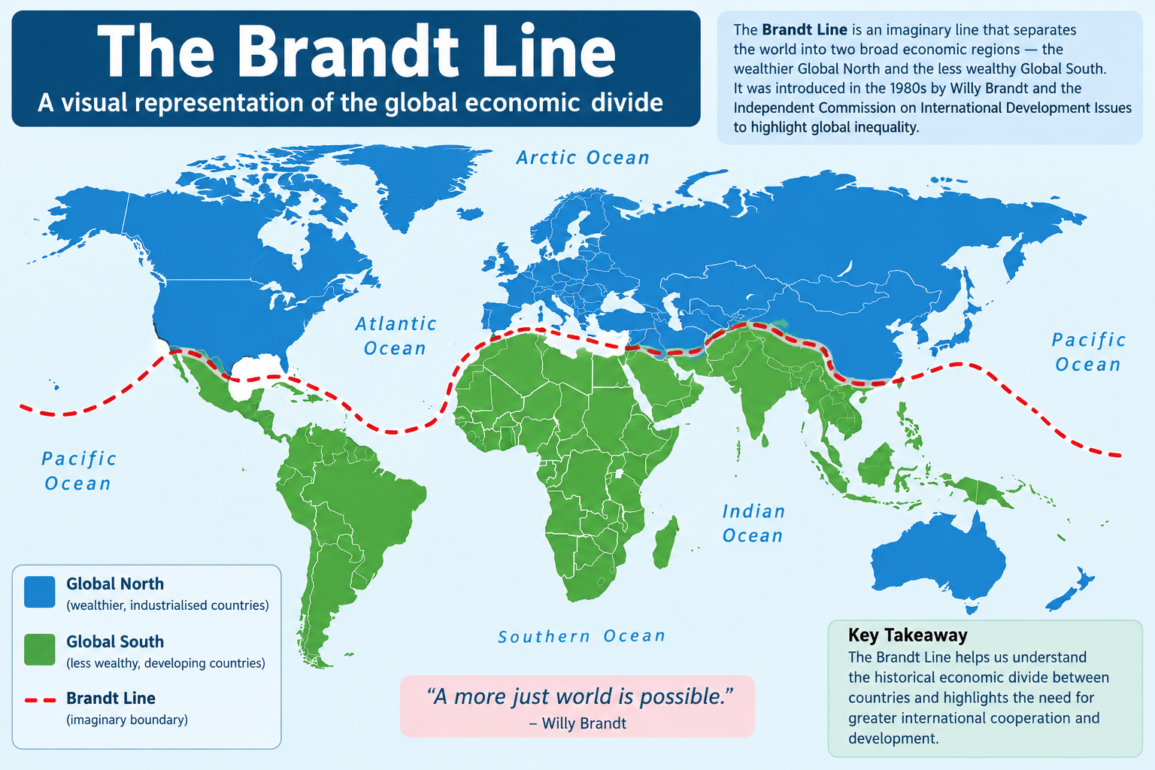
The Brandt Line is an imaginary line that historically divided the world into two broad economic regions: the relatively wealthy Global North and the less wealthy Global South. It was designed to highlight differences in income, industrial development, living standards, and access to resources between countries.
The concept is associated with Willy Brandt, a former West German chancellor who chaired the Independent Commission on International Development Issues. The commission published its influential report, North–South: A Programme for Survival, in 1980. The report examined the economic relationship between richer and poorer nations and called for greater international cooperation.
The Brandt Line became a popular visual representation of the inequalities discussed in this report. It roughly separated wealthier countries in North America, Western Europe, Japan, and Australia from many countries in Africa, Asia, and Latin America.
However, the Brandt Line was never a precise political border or an official international boundary. Instead, it served as a simplified model for understanding the uneven distribution of economic prosperity across the world.
Who Created the Brandt Line?
Willy Brandt and International Development
Willy Brandt was a German political leader who served as chancellor of West Germany from 1969 to 1974. He became internationally recognised for his diplomatic efforts and his work to improve relations between countries during the Cold War.
After his time as chancellor, Brandt continued working on international issues, particularly the economic challenges affecting developing countries. He chaired the Independent Commission on International Development Issues, which brought together experts and public figures to examine the relationship between industrialised and developing nations.
The commission’s 1980 report argued that global economic problems could not be solved effectively if wealthy and poorer countries ignored their shared interests. It encouraged cooperation on trade, development assistance, energy, food security, and international finance.
The Brandt Line emerged from this broader discussion about global inequality and became a useful educational tool for explaining the economic divisions of that period.
Why Was the Concept Important?
During the second half of the twentieth century, many countries experienced rapid industrial growth, while others struggled with colonial legacies, weak infrastructure, limited access to technology, and unstable economic conditions.
The Brandt Line helped make these differences easier to understand. Rather than examining dozens of individual economic indicators, students and policymakers could use a world map to visualise the broad divide between wealthier and poorer regions.
Nevertheless, the concept was intended to encourage discussion about development, not to suggest that every country within either region had identical economic conditions.
Where Does the Brandt Line Run?
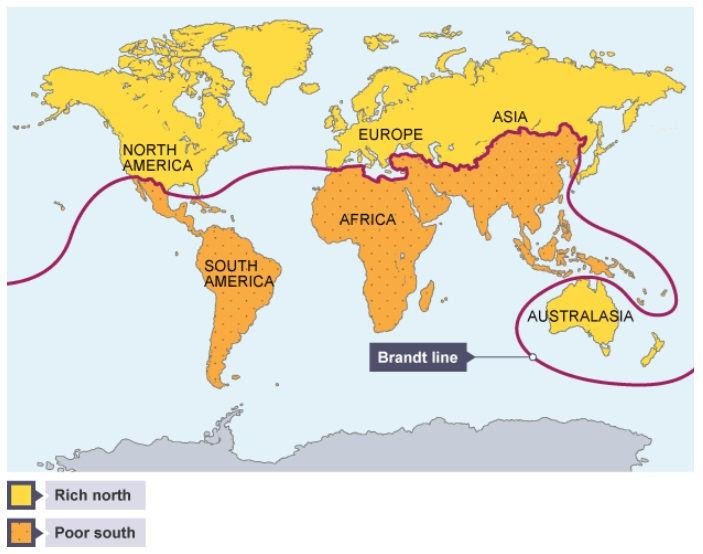
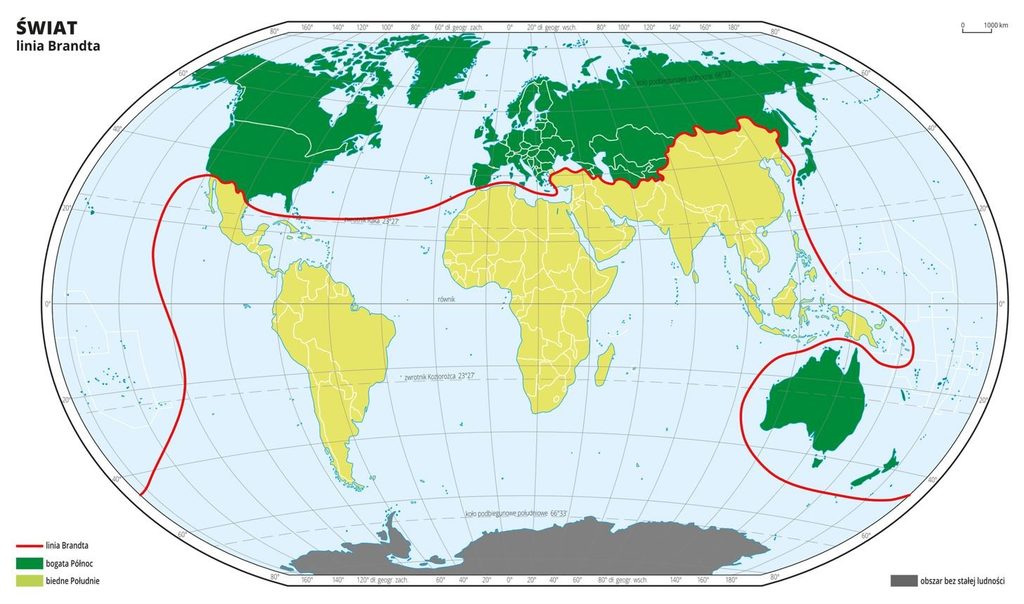
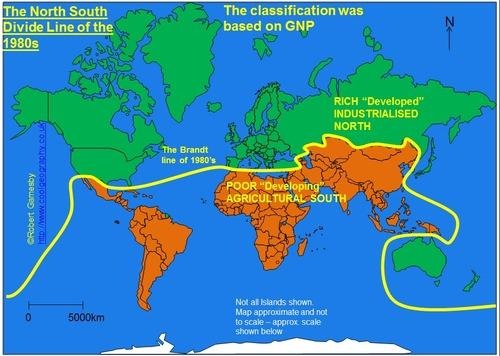
The traditional Brandt Line is often illustrated as a curved boundary that runs around the world, separating much of the wealthier Northern Hemisphere from many developing countries located farther south.
6
The line roughly places the following regions into two broad groups.
Countries Traditionally Associated With the Global North
The northern group generally includes the United States, Canada, much of Western Europe, Japan, Australia, and New Zealand. These countries developed relatively high average incomes and advanced industrial, technological, financial, and service sectors.
Many also established extensive transport networks, developed education systems, and invested in healthcare and public services. However, wealth and living standards still vary within these countries, and economic inequality remains a concern.
Countries Traditionally Associated With the Global South
The southern group includes many countries in Africa, Latin America, the Caribbean, South Asia, and parts of Southeast Asia. Historically, numerous countries in these regions experienced lower average incomes, limited industrialisation, and reduced access to certain public services.
Colonial exploitation, unequal trading relationships, political instability, debt, and limited infrastructure contributed to development challenges in some countries. However, these factors do not affect every nation equally.
It is also important to recognise that the Brandt Line does not follow the equator. Several countries geographically located in the Northern Hemisphere have historically been associated with the Global South, while Australia and New Zealand are geographically located in the Southern Hemisphere but are generally associated with the Global North.
This distinction demonstrates that the Brandt Line is primarily an economic and developmental model rather than a geographical rule based on latitude.
Why Was the Brandt Line Developed?
The Brandt Line was developed to communicate the scale of international economic inequality and encourage governments to consider the relationship between wealthier and poorer countries.
Highlighting Global Economic Inequality
One of the principal purposes of the Brandt Line was to illustrate how unevenly economic resources and opportunities were distributed around the world. Some nations possessed advanced industries, strong financial institutions, and extensive infrastructure, while others faced major barriers to economic growth.
The model helped explain why a country’s location in the global economy could influence its access to investment, technology, and international markets.
Encouraging International Cooperation
The Brandt Commission believed that wealthy and developing nations had interconnected interests. Economic instability, food shortages, energy crises, and political conflict could affect countries across national boundaries.
The commission encouraged governments to work together on international development, improve economic relationships, and address the conditions that contributed to persistent poverty.
Drawing Attention to Development Challenges
The Brandt Line also helped bring attention to issues such as inadequate healthcare, limited educational opportunities, unemployment, and insufficient access to clean water and reliable energy.
By presenting these challenges on a global scale, the concept encouraged people to consider development as an international responsibility rather than a problem restricted to individual countries.
Brandt Line and the Global North–South Divide
The Brandt Line is closely connected with the terms Global North and Global South. These expressions describe broad economic and political groupings, although they do not perfectly correspond to the world’s physical geography.
The Global North generally refers to wealthier, industrialised economies, while the Global South commonly refers to countries that have historically experienced disadvantages in the international economic system.
However, the terms are not strict classifications. They can reflect political relationships, historical experiences, and patterns of international trade as well as income.
Economic Differences
Countries differ in productivity, wages, industrial capacity, infrastructure, and access to financial resources. Economies with advanced technology and diversified industries may generate higher incomes and provide more employment opportunities.
Countries that depend heavily on a narrow range of exports can face greater risks when global prices change. These differences help explain some of the economic patterns associated with the Brandt Line.
Education and Healthcare
Access to education and healthcare is another important dimension of development. Countries with well-funded institutions may provide broader access to schools, universities, hospitals, and preventive healthcare.
In other countries, limited funding, shortages of trained professionals, or unequal access to services can restrict opportunities. However, these conditions vary significantly within both the Global North and the Global South.
Technology and Infrastructure
Reliable electricity, internet access, transport systems, and modern communication networks can support business growth and improve daily life.
The Brandt Line draws attention to historical differences in access to such resources. Today, digital connectivity and infrastructure investment continue to influence how countries participate in the global economy.
Is the Brandt Line Still Relevant Today?
The Brandt Line remains useful as a historical and educational concept, but its ability to explain the modern world has become more limited.
Since the 1980s, international trade, technological innovation, global investment, and economic development have transformed many countries. Some economies that were once classified among developing nations have experienced substantial industrial expansion and rising incomes.
China, India, South Korea, Singapore, and other Asian economies illustrate different paths of economic transformation. Their experiences show why a simple division between rich northern countries and poor southern countries cannot fully describe contemporary development.
At the same time, poverty and inequality have not disappeared. Many countries continue to experience limited access to public services, high debt burdens, climate-related risks, and difficulties creating stable employment.
The Rise of Emerging Economies
Several economies in Asia and other regions have become increasingly important in global manufacturing, technology, finance, and trade. This growth challenges the idea that economic power is concentrated entirely in traditional industrialised countries.
However, economic growth does not automatically eliminate inequality. A country can become more prosperous overall while significant differences in income and opportunity remain among its population.
Inequality Within Countries
The Brandt Line focuses on differences between countries and regions, but it does not show how wealth is distributed within individual nations.
High-income countries may contain communities experiencing poverty, while lower-income countries may have wealthy business owners and prosperous urban centres. This makes national averages insufficient for understanding everyone’s living conditions.
Modern development analysis therefore considers income distribution, access to services, employment, and other indicators alongside national wealth.
Advantages of the Brandt Line
The Brandt Line has several educational advantages. First, it offers a straightforward way to introduce students to global economic inequality. A world map makes broad patterns easier to recognise than a long list of statistics.
Second, it connects geography with economics and history. Students can explore how industrialisation, colonialism, trade, and political decisions contributed to differences in development.
Third, the Brandt Line encourages discussion about international cooperation. It highlights the fact that economic relationships between countries can influence employment, investment, food supplies, and access to technology.
Finally, the concept provides historical context for modern discussions about the Global North and Global South. Even when its original categories are too broad, it remains a useful starting point for examining global development.
Limitations of the Brandt Line
Despite its usefulness, the Brandt Line has important limitations.
Its main weakness is oversimplification. Countries grouped together may have very different levels of income, infrastructure, education, and industrial development. Treating them as a single category can hide these differences.
The model also reflects economic conditions that existed around the late 1970s and early 1980s. Since then, many economies have changed significantly, making the original division less representative of contemporary realities.
Another limitation is that the Brandt Line can create the impression that geography determines prosperity. In reality, economic development depends on a complex combination of institutions, education, investment, technology, resources, historical experiences, and public policy.
Furthermore, the line does not directly measure inequality, poverty, or quality of life. Researchers now use a wider range of indicators, including gross national income, the Human Development Index, poverty rates, and measures of income distribution, to compare development outcomes.
For these reasons, the Brandt Line is best understood as a simplified historical framework rather than a complete explanation of global economic conditions.
Brandt Line Compared With Modern Development Measures
Modern development studies use several methods to understand economic and social differences between countries.
Gross domestic product per capita estimates economic output per person, while gross national income per capita measures income associated with a country’s residents. Neither indicator alone provides a complete picture of living standards.
The Human Development Index considers life expectancy, education, and income to provide a broader assessment of human development. Poverty indicators examine the proportion of people living below defined income or consumption thresholds, while inequality measures assess how resources are distributed across a population.
These measures complement the historical perspective provided by the Brandt Line. Together, they offer a more detailed understanding of economic progress and the challenges that remain.
Conclusion
The Brandt Line is an influential concept that illustrates the historical economic divide between wealthier industrialised countries and many developing nations. Associated with Willy Brandt and the 1980 report North–South: A Programme for Survival, it helped draw international attention to differences in income, infrastructure, healthcare, education, and economic opportunity.
Although the Brandt Line remains valuable for understanding the history of global development, it cannot fully explain today’s interconnected economy. Emerging markets, changing trade relationships, technological progress, and inequalities within countries have made the global picture more complex.
Understanding the Brandt Line allows students and readers to explore the historical roots of economic inequality while recognising the importance of modern development indicators. Its greatest value lies in encouraging informed discussion about international cooperation, fair opportunities, and the continuing effort to improve living standards around the world.