



A praying mantis is one of nature’s most fascinating predators. With its long body, powerful front legs, excellent eyesight, and quick movements, this insect is specially adapted to capture other creatures. Understanding praying mantis feeding can help beginners, gardeners, students, and insect enthusiasts provide suitable food while appreciating how these predators behave in the wild.
A mantis does not eat plants like many other insects. Instead, it relies primarily on live prey, using its folded front legs to seize and hold food. Its diet can change as it grows, and younger mantises generally need smaller prey than adults. Learning about praying mantis feeding also reveals important facts about their hunting behavior, nutrition, feeding frequency, and natural environment.
Understanding Praying Mantis Feeding
Praying mantis feeding is based mainly on predation. Mantises are carnivorous insects that hunt animals they can capture and consume. Their diet commonly includes flies, moths, crickets, grasshoppers, beetles, and other appropriately sized insects.
A mantis usually waits for prey rather than chasing it over long distances. Its body coloration can provide camouflage, allowing it to remain still among leaves, stems, flowers, and branches. When prey comes within reach, the mantis can react extremely quickly.
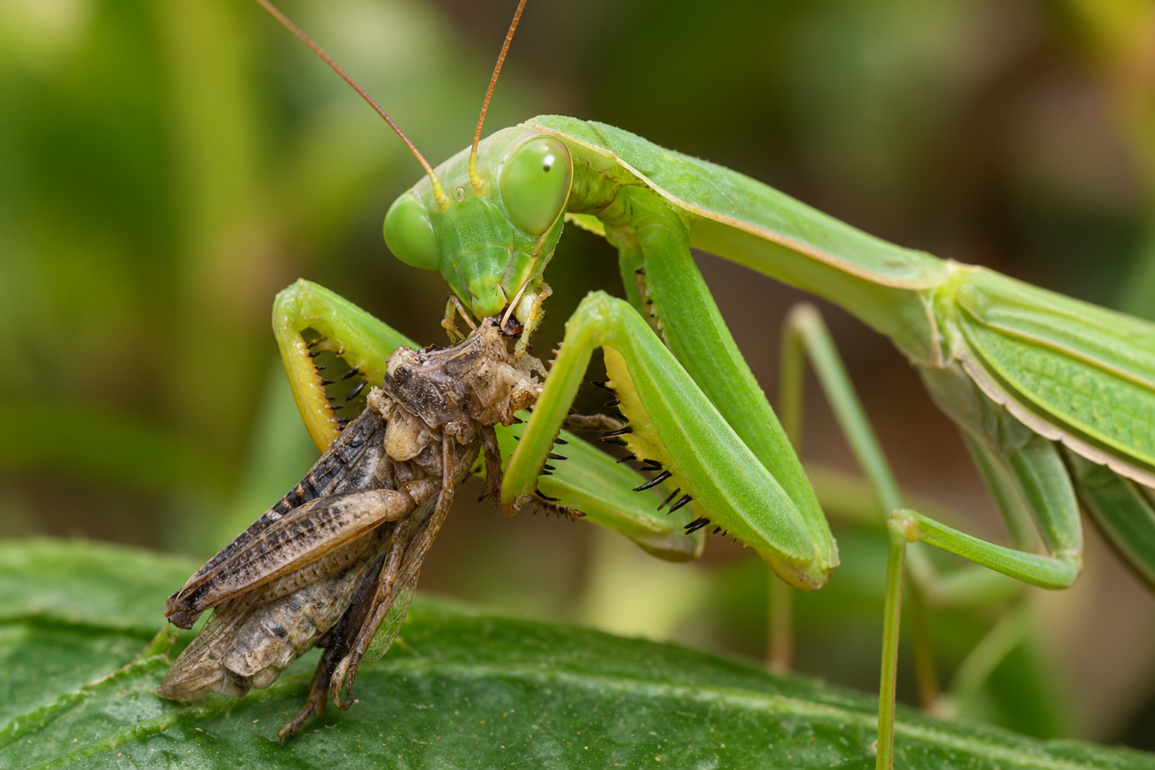
The front legs play the most important role during praying mantis feeding. These specialized legs have spines that help the insect grip prey securely. After catching its meal, the mantis uses its strong mouthparts to consume the food.
What Do Praying Mantises Eat?
The natural diet of a mantis depends on its species, age, size, and surroundings. Small nymphs often begin with tiny prey such as fruit flies and other small insects. As they mature, their food options become larger.
Common foods associated with praying mantis feeding include small flies, moths, crickets, grasshoppers, roaches, beetles, and other insects. Larger mantises may sometimes capture prey considerably larger than themselves.
In the wild, a mantis is an opportunistic predator. It does not necessarily choose one particular insect every time. Instead, it generally responds to suitable prey that approaches within striking distance.
How Does a Mantis Catch Its Food?
The hunting process makes praying mantis feeding especially interesting. A mantis often remains motionless while watching its surroundings. Its head can rotate significantly, helping it monitor movement from different directions.
When a potential meal gets close enough, the mantis rapidly extends its front legs. The spines on those legs help prevent the prey from escaping. The mantis then brings the captured insect toward its mouth and begins eating.
This behavior demonstrates how specialized the insect’s anatomy is. Its large eyes support visual hunting, while its grasping forelegs provide an efficient method for capturing prey.
Feeding Young Praying Mantises
Young mantises, called nymphs, have different nutritional requirements from adults. Because they are small, their prey must also be appropriately sized.
During early praying mantis feeding, tiny insects such as fruit flies can be useful prey for many commonly kept species. The food should be small enough for the nymph to handle safely.
As the mantis grows through successive molts, its food requirements generally increase. Owners should avoid offering prey that is excessively large because the mantis may struggle to capture or consume it.
Why Prey Size Matters
Prey size is one of the most important considerations in praying mantis feeding. Food should generally be manageable for the mantis. An oversized insect can potentially injure a young mantis or create unnecessary stress.
Smaller prey also makes it easier to observe whether the mantis is successfully hunting. As the insect matures, larger prey can gradually become appropriate depending on the species and individual size.
How Often Should a Praying Mantis Eat?
There is no single feeding schedule that applies to every mantis. Feeding frequency can depend on age, species, body size, temperature, activity level, and the amount of food available.
Young mantises may need food more frequently because they are growing rapidly. Adults may eat less often, particularly when they have recently consumed a substantial meal.
Good praying mantis feeding practices involve observing the insect rather than forcing a rigid schedule. A mantis that is actively hunting may be ready for another meal, while one with a noticeably full abdomen may not need additional food immediately.
Feeding Before and After Molting
Molting is an important stage in a mantis’s development. During this period, its body changes significantly as it grows into a larger stage.
Praying mantis feeding should be handled carefully around molting. A mantis preparing to molt may become less interested in food. This change is normal and should not automatically be interpreted as illness.
Providing an appropriate enclosure with enough space for the mantis to hang safely is particularly important during molting. Live prey should also be managed carefully because active insects could potentially disturb a vulnerable mantis.
After a successful molt, the insect may require time before returning to normal feeding behavior. Patience is important during this stage.
Water and Hydration
Although food provides some moisture, hydration is also relevant to praying mantis feeding and general care. Many mantises obtain water by drinking droplets from surfaces.
Instead of placing a deep water container inside an enclosure, keepers often provide moisture through carefully controlled misting or droplets on suitable surfaces. A mantis can drink from these droplets when needed.
The exact humidity and hydration requirements vary by species. Excessive moisture can create problems in some enclosures, while insufficient humidity may also be unsuitable. Species-specific care information is therefore valuable.
Can Praying Mantises Eat Dead Insects?
Many mantises respond more readily to moving prey because movement triggers their hunting response. As a result, live insects are commonly used in captive praying mantis feeding.
Some individual mantises may accept food that is freshly dead or presented in a way that stimulates movement, but this behavior is not universal. A mantis that refuses stationary food is not necessarily experiencing a problem.
For captive care, prey should come from a safe and appropriate source. Wild-caught insects can carry pesticides, parasites, or other contaminants, making them a less predictable food option.
Foods to Avoid
Responsible praying mantis feeding means considering both what a mantis can eat and what it should eat. Avoid offering prey that may have been exposed to pesticides or other chemicals.
It is also sensible to avoid insects that could defend themselves effectively against a small mantis. Some prey species have powerful bites, stings, or other defenses.
Food should always be proportional to the mantis. Giving an insect something excessively large simply because the mantis appears capable of hunting can introduce unnecessary risks.
Feeding Behavior in the Wild
Wild mantises have access to a much broader range of prey than captive insects. Their diet can change according to habitat and season.
Natural praying mantis feeding can include insects living among vegetation, such as flies, moths, grasshoppers, and other arthropods. Larger species may sometimes capture unusual prey when an opportunity presents itself.
Their hunting strategy is particularly effective in environments where vegetation provides camouflage. Remaining still helps a mantis avoid detection while allowing it to wait for suitable prey.
Why a Praying Mantis May Stop Eating
A temporary reduction in feeding does not always indicate a problem. Several natural factors can affect appetite.
A mantis may eat less when preparing to molt, after consuming a large meal, or when environmental conditions change. Adult mantises may also show different feeding patterns compared with rapidly growing nymphs.
During praying mantis feeding, observation is more useful than assuming that every missed meal represents an emergency. Look at the insect’s overall behavior, posture, appearance, and enclosure conditions.
If a mantis consistently refuses food and also shows unusual physical symptoms, examining temperature, humidity, prey suitability, and general husbandry can help identify potential problems.
Safe Feeding Practices for Captive Mantises
Good praying mantis feeding requires more than simply placing insects into an enclosure. The enclosure should provide enough room for hunting, resting, and molting.
Prey should be appropriately sized and introduced carefully. Remove uneaten insects when necessary, especially if they could disturb a mantis during molting.
Keeping the enclosure clean is equally important. Leftover prey, waste, and excessive moisture can contribute to poor enclosure conditions.
Observe Before Offering More Food
One of the easiest ways to improve praying mantis feeding is to observe the abdomen and behavior of the insect. A well-fed mantis generally does not need food immediately after a substantial meal.
Instead of repeatedly adding prey, allow the mantis time to digest its meal. This approach reduces unnecessary food buildup and makes enclosure management easier.
The Role of Temperature and Environment
Environmental conditions can influence digestion and activity. Mantises are ectothermic, meaning their body temperature is strongly affected by their surroundings.
Appropriate conditions can support normal praying mantis feeding, while unsuitable environmental conditions may affect activity and appetite. Because different species come from different climates, care requirements should always be matched to the particular species.
Lighting, ventilation, humidity, temperature, and enclosure size can all contribute to successful captive care.
Common Mistakes in Praying Mantis Feeding
One common mistake is offering prey that is too large. Another is feeding too frequently without considering whether the mantis has already eaten enough.
Some beginners also assume that a mantis needs food every day. In reality, feeding needs vary considerably according to age and individual circumstances.
Poor prey quality is another concern. Insects collected from areas treated with pesticides can expose a mantis to harmful chemicals.
Finally, disturbing a mantis while it is preparing to molt can create unnecessary risk. Careful observation is therefore an important part of successful praying mantis feeding.
Frequently Asked Questions
What is the main food of a praying mantis?
Praying mantises primarily eat insects and other small animals they can capture. Common prey includes flies, moths, crickets, grasshoppers, and beetles.
Can praying mantises eat fruit?
Fruit is not a normal part of a mantis’s diet. Mantises are predators and generally require animal-based prey rather than plant foods.
How often should a mantis be fed?
Feeding frequency varies according to species, age, size, and environmental conditions. Young mantises generally need appropriately sized prey more frequently than adults.
Do praying mantises drink water?
Yes. Mantises can drink water droplets from surfaces. Their hydration needs can often be supported through appropriate misting and enclosure management.
Should I feed a mantis during molting?
A mantis preparing to molt may stop eating naturally. Avoid disturbing it and ensure that the enclosure provides enough space and suitable conditions for a safe molt.
Conclusion
Understanding praying mantis feeding is essential for anyone interested in these remarkable predators. Their diet is based primarily on live animal prey, and their specialized hunting equipment allows them to capture insects with impressive speed and precision. From tiny nymphs eating small flies to adults handling larger prey, feeding behavior changes as the mantis develops.
Successful praying mantis feeding depends on appropriate prey size, reasonable feeding frequency, clean enclosure conditions, hydration, and careful observation. Rather than following one rigid routine, responsible keepers should consider the mantis’s age, species, behavior, and stage of development. With suitable care and attention, observing a mantis feed can provide a fascinating look at one of nature’s most efficient small predators.