



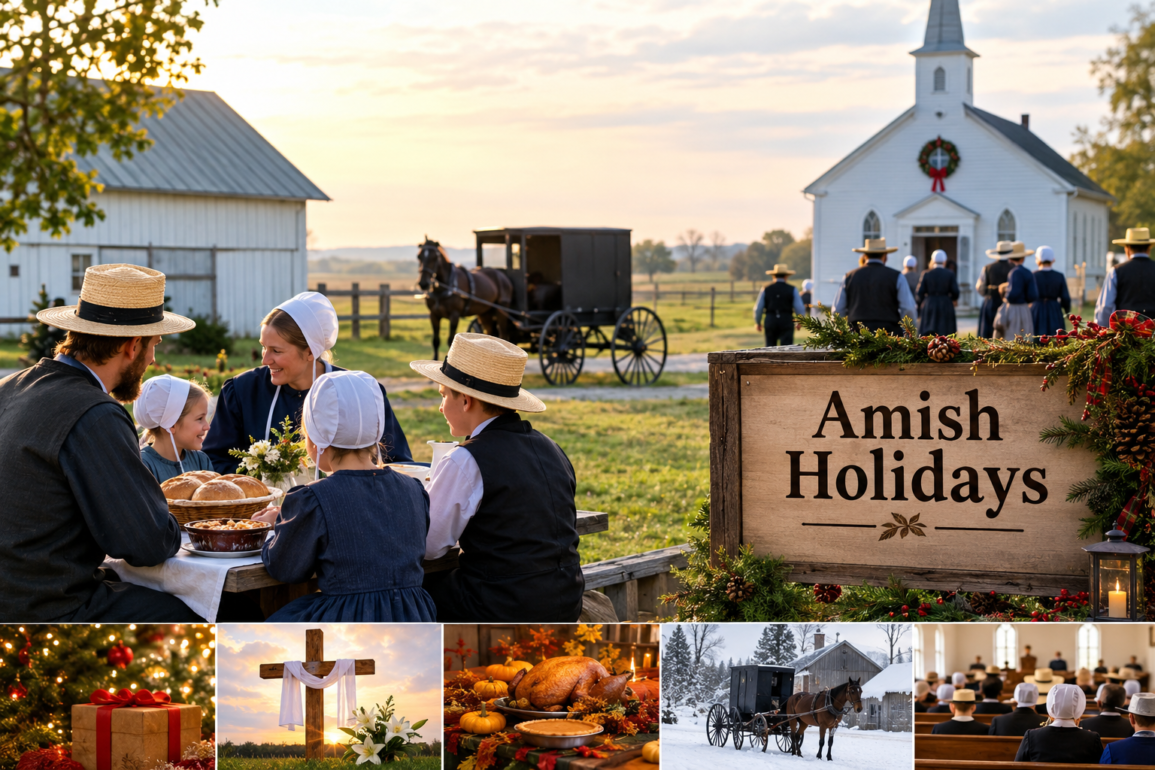
The Amish are known for their simple lifestyle, strong community values, and deep Christian faith. Their approach to celebrations differs from the modern American calendar. Instead of focusing heavily on commercial events, Amish communities generally observe religious occasions, family gatherings, and traditional days that emphasize faith, gratitude, and community. Understanding amish holidays provides an interesting look into how religious beliefs can shape everyday life and annual traditions.
The Amish do not follow one universal calendar for every celebration. Practices can vary between communities because Amish groups have different local customs and church rules. However, several important religious and traditional occasions appear across many Amish communities. Christmas, Easter, Good Friday, Ascension Day, and Thanksgiving are among the better-known observances. Some communities also recognize special church days and local traditions.
What Are Amish Holidays?
Amish holidays are religious or traditional observances followed by Amish communities throughout the year. Their celebrations usually focus on worship, family, fellowship, and gratitude rather than entertainment or commercial activity. The Amish generally avoid excessive displays and activities that could conflict with their values of humility and simplicity.
Religion plays a central role in the Amish calendar. Since the Amish belong to an Anabaptist Christian tradition, many important celebrations are connected to the life, death, and resurrection of Jesus Christ. At the same time, ordinary community life remains important, so certain holidays involve shared meals, visiting relatives, and spending time with neighbors.
The way people observe these occasions can differ significantly from one settlement to another. There is no single set of rules that applies equally to every Amish person.
Why Are Holidays Important to the Amish?
For Amish families, religious observances provide opportunities to strengthen faith and relationships. A holiday can create time for prayer, reflection, worship, and family interaction. These activities fit naturally into the Amish emphasis on community and mutual support.
Many amish holidays are deliberately simple. People may gather for meals, attend church services, visit relatives, or spend quiet time together. Decorations and elaborate commercial traditions generally receive less attention than they do in mainstream American culture.
Faith Comes Before Entertainment
Amish celebrations typically emphasize spiritual meaning. Religious teachings influence how families approach major occasions, and church leaders may guide the community regarding acceptable practices.
This does not mean that Amish people never enjoy themselves. Social gatherings can be warm and cheerful. However, entertainment generally remains secondary to family, faith, and community responsibilities.
Christmas in Amish Communities
Christmas is one of the most important Christian celebrations for many Amish communities. It commemorates the birth of Jesus Christ and provides an opportunity for families to gather and reflect on their faith.
Christmas traditions vary considerably. Some Amish families exchange modest gifts, while others place greater emphasis on visiting relatives and sharing meals. Certain communities may observe Christmas Day and another Christmas-related day separately.
Commercialism is generally less prominent than in mainstream Christmas celebrations. You may not see elaborate electronic decorations, large displays, or extensive holiday shopping in an Amish settlement.
For many families, the meaning of Christmas centers on Christ, family relationships, generosity, and gratitude.
Easter and Good Friday
Easter holds special religious importance because it celebrates the resurrection of Jesus. Good Friday is also significant because it commemorates the crucifixion.
Among amish holidays, Easter is particularly connected with Christian worship and reflection. Families may attend church services and spend time discussing the religious meaning of the occasion.
The Amish generally do not treat Easter primarily as a commercial event. Popular traditions such as large Easter-themed displays may be less common. Instead, the religious message remains central.
Good Friday can also be observed with a serious and reflective attitude. The day provides an opportunity to remember the suffering and sacrifice associated with the Christian story.
Ascension Day
Ascension Day is another Christian observance recognized in many Amish communities. It commemorates the ascension of Jesus into heaven following his resurrection.
The day has an important place within the traditional Christian calendar. In communities that observe it, Amish people may attend worship services and devote time to religious reflection.
Because Amish traditions differ by settlement, the exact way Ascension Day is observed can vary. Some communities may give the day greater importance than others.
Thanksgiving Among the Amish
Thanksgiving is widely observed by Amish families, although its meaning may extend beyond a single historical event. Gratitude is strongly connected to Amish religious and community values.
Families often gather for a substantial meal and spend time together. Food can play an important role because Amish communities place considerable value on hospitality and sharing.
Unlike highly commercialized celebrations, Thanksgiving among Amish families often focuses on gratitude, family, work, and God’s provision.
The holiday can also provide an opportunity for relatives to reconnect. Extended families may travel between homes, share traditional foods, and enjoy conversation.
New Year’s Day
New Year’s Day is observed differently across Amish communities. Some Amish families may recognize it as a normal day rather than treating it as a major celebration.
Large parties and late-night festivities are generally not central to Amish culture. Their approach reflects the broader preference for modest social activities.
For some Amish families, the beginning of a new year can still provide an opportunity for reflection and appreciation. However, the emphasis is usually quieter than the celebrations commonly associated with New Year’s Eve in wider American society.
Amish Church Days
One important part of the Amish calendar involves church services and special religious gatherings. Amish churches typically meet every other Sunday rather than every Sunday, with the schedule allowing families and communities to organize their religious and social lives differently.
Some special church occasions may involve additional worship or community activities. These gatherings can bring together large numbers of Amish people from nearby families or settlements.
Church life is central to understanding amish holidays because religious observances cannot easily be separated from the community’s broader spiritual practices.
Do Amish Celebrate Halloween?
Halloween is not generally treated as an important religious holiday by the Amish. Practices can vary, but many Amish communities do not participate in the mainstream Halloween culture of costumes, trick-or-treating, and elaborate decorations.
This approach reflects the Amish preference for avoiding traditions they consider inconsistent with their religious values.
Individual Amish families and communities can differ, so it would be inaccurate to assume that every Amish person follows exactly the same practice.
Do Amish Celebrate Valentine’s Day?
Valentine’s Day is not typically one of the major religious amish holidays. However, individual families may recognize it in modest ways.
Amish culture places significant value on family relationships and affection, so the absence of a large commercial celebration does not mean families ignore one another. Simple gestures, family meals, or thoughtful gifts may occur depending on local customs.
The important distinction is that commercial traditions do not generally define Amish celebrations.
Weddings and Other Community Celebrations
Although weddings are not technically holidays, they are major events in Amish community life. Amish weddings often involve extended family, church members, food preparation, and considerable cooperation.
These events demonstrate why understanding amish holidays requires looking beyond dates on a calendar. Amish culture emphasizes community participation throughout the year.
Funerals, church gatherings, and other important occasions can also bring families together. Community members commonly contribute practical assistance, reflecting the Amish principle of mutual support.
How Amish Holidays Differ From Modern Celebrations
The biggest difference between mainstream American celebrations and amish holidays is often the level of commercial influence.
Modern holidays may involve shopping, television, digital entertainment, travel, and large public events. Amish celebrations generally place greater emphasis on relationships, religion, food, hospitality, and community.
Technology also plays a different role. Many Amish communities restrict or avoid technologies that they believe could negatively affect family or community life. The exact rules vary between groups.
This means an Amish holiday may appear quiet from an outside perspective while remaining deeply meaningful to the people participating in it.
Food and Family During Amish Holidays
Food is an important part of many Amish gatherings. Families may prepare homemade breads, meats, vegetables, desserts, preserves, and other traditional dishes.
Large meals can require significant preparation. Relatives and neighbors may work together to cook, serve, and clean afterward.
During amish holidays, the meal is often more than a source of nourishment. Sharing food creates an opportunity for conversation, hospitality, and fellowship.
Traditional cooking also helps preserve cultural knowledge. Recipes can pass from parents and grandparents to younger generations, keeping familiar foods connected to family history.
Are All Amish Holidays the Same?
No. One of the most important facts about amish holidays is that Amish communities are not completely uniform.
Different settlements can have different church rules, traditions, and levels of interaction with modern society. One community may observe a particular occasion more strongly than another.
The Amish follow local church districts and Ordnung, a set of community expectations governing many aspects of life. Because these expectations can vary, holiday customs should not be treated as identical everywhere.
Visitors should therefore avoid assuming that one Amish settlement represents every Amish community.
The Meaning Behind Amish Celebrations
At their core, amish holidays reflect several recurring values: faith, humility, family, community, gratitude, and simplicity.
The Amish approach to celebrations demonstrates that meaningful holidays do not necessarily require expensive decorations, large purchases, or elaborate entertainment. A shared meal, religious service, family conversation, or act of generosity can hold significant value.
Their traditions also show how religious communities can preserve distinctive cultural practices while living within a modern society.
Frequently Asked Questions
What are the main Amish holidays?
Major observances commonly include Christmas, Easter, Good Friday, Ascension Day, and Thanksgiving. Practices vary between Amish communities.
Do Amish people celebrate Christmas?
Yes. Christmas is an important Christian observance for many Amish people. Celebrations commonly emphasize faith, family, worship, meals, and modest gift-giving.
Do Amish celebrate Easter?
Yes. Easter has major religious significance because it commemorates the resurrection of Jesus Christ. Good Friday is also important in many communities.
Do Amish celebrate Halloween?
Halloween is generally not a major Amish celebration. Many communities do not participate in mainstream Halloween activities, although practices can vary.
Do Amish celebrate Thanksgiving?
Yes. Many Amish families observe Thanksgiving with family gatherings, shared meals, and expressions of gratitude.
Conclusion
Amish holidays offer a fascinating example of how faith and community traditions can shape the way people celebrate important occasions. Rather than emphasizing commercial entertainment, Amish celebrations generally focus on worship, family, hospitality, gratitude, and community relationships. Christmas, Easter, Good Friday, Ascension Day, and Thanksgiving are important examples, although customs differ from one Amish settlement to another.
Understanding these traditions also requires recognizing the diversity within Amish society. There is no single holiday rulebook that applies perfectly to every community. Local church practices and cultural traditions influence how each occasion is observed. Ultimately, the Amish approach to holidays reflects a broader commitment to simplicity, faith, family, and community—values that remain central to their distinctive way of life.